
 Worksheets
Chemical Kinetics Quiz
Total questions: 14
Worksheet time: 1hrs 11mins
What is the study of the rate at which chemical reactions occur called?
Chemical Kinetics
Chemical Equilibrium
Thermodynamics
Stoichiometry
What is the term used to describe the speed at which chemical reactions take place?
Reaction rate
Reaction time
Reaction speed
Reaction velocity
Which of the following is NOT a topic covered in the chapter on Chemical Kinetics?
Factors that affect reaction rate
Rate laws (zero, first, second order)
Activation energy
Chemical bonding
Which of the following is a factor that affects the reaction rate?
Temperature
Color
Volume
Density
What is the reaction rate in chemistry?
The speed at which a chemical reaction occurs
The amount of reactants used in a reaction
The temperature at which a reaction occurs
The volume of products formed in a reaction
Which of the following factors does NOT influence the reaction rate?
Physical state of the reactants
Reactant concentrations
Reaction temperature
Color of the reactants
What is the unit of measurement for reaction rate?
Which of the following is a factor that influences the reaction rate?
Volume of the container
Presence of a catalyst
Pressure of the system
Color of the products
What factor influences the physical state of the reactants?
Temperature
Collision frequency and phase
Pressure
Concentration
What happens when reactants collide more readily?
They react more slowly
They react more rapidly
They do not react
They form a precipitate
Which type of reaction is often faster?
Heterogeneous reactions
Reactions involving solids
Homogeneous reactions
Reactions involving liquids and solids
Which type of reaction is slower?
Homogeneous reactions
Reactions involving gases
Reactions involving liquids
Heterogeneous reactions that involve solids
What happens to the rate of most reactions if the reactant concentration is increased?
The reaction rate decreases.
The reaction rate remains the same.
The reaction rate increases.
The reaction stops.
Why do reactions proceed faster when the reactant concentration is increased?
There are fewer molecules, so fewer collisions are possible.
There are more molecules, so more collisions are possible.
The temperature decreases.
The pressure decreases.
How does increasing the surface area of a reactant affect the reaction rate?
The reaction rate decreases.
The reaction rate remains the same.
The reaction rate increases.
The reaction stops.
Which form of a reactant reacts faster, according to the text?
A pellet or tablet
A fine powder (thin fibers)
A solid block
A liquid solution
What generally happens to the reaction rate when the temperature is increased?
It decreases.
It remains the same.
It increases.
It fluctuates.
How is the kinetic energy of molecules related to temperature?
It is inversely related.
It is directly related.
It is not related.
It is exponentially related.
What happens to molecules at higher temperatures?
They move more slowly.
They move more quickly.
They stop moving.
They move at a constant speed.
What is the effect of higher temperatures on the number of collisions between molecules?
The number of collisions decreases.
The number of collisions remains the same.
The number of collisions increases.
The number of collisions fluctuates.
What is the term used to describe the energy barrier that molecules must cross to react?
Potential energy.
Kinetic energy.
Activation energy.
Thermal energy.
What is the role of a catalyst in a chemical reaction?
It increases the rate of reaction without being consumed.
It decreases the rate of reaction and is consumed.
It appears in the overall balanced equation.
It does not affect the kinds of collisions.
Do catalysts appear in the overall balanced equation of a reaction?
Yes, they always appear.
No, they do not appear.
Sometimes they appear.
Only in biological reactions.
How do catalysts affect the kinds of collisions in a reaction?
They do not affect the collisions.
They decrease the number of collisions.
They change the mechanism of the reaction.
They increase the energy of collisions.
In which types of reactions are catalysts critical?
Only in industrial reactions.
Only in biological reactions.
In both biological (enzyme) and industrial reactions.
In neither biological nor industrial reactions.
What does the symbol Δ represent in the context of reaction rates?
Time
Molar concentration
Change in
Temperature
In the formula for reaction rate, what does [ ] represent?
Time
Molar concentration
Change in
Temperature
What does the symbol t represent in the context of reaction rates?
Time
Molar concentration
Change in
Temperature
How are reaction rates conventionally expressed?
As negative quantities
As positive quantities
As zero
As variable quantities
What types of rates are measured to understand a reaction?
Average and instantaneous rates
Initial and final rates
Maximum and minimum rates
Constant and variable rates
What can the rate of a reaction measure with time?
The increase in [reactant]
The decrease in [product]
The increase in [product]
The decrease in [catalyst]
What is another aspect that the rate of a reaction can measure with time?
The increase in [catalyst]
The decrease in [reactant]
The increase in [product]
The decrease in [product]
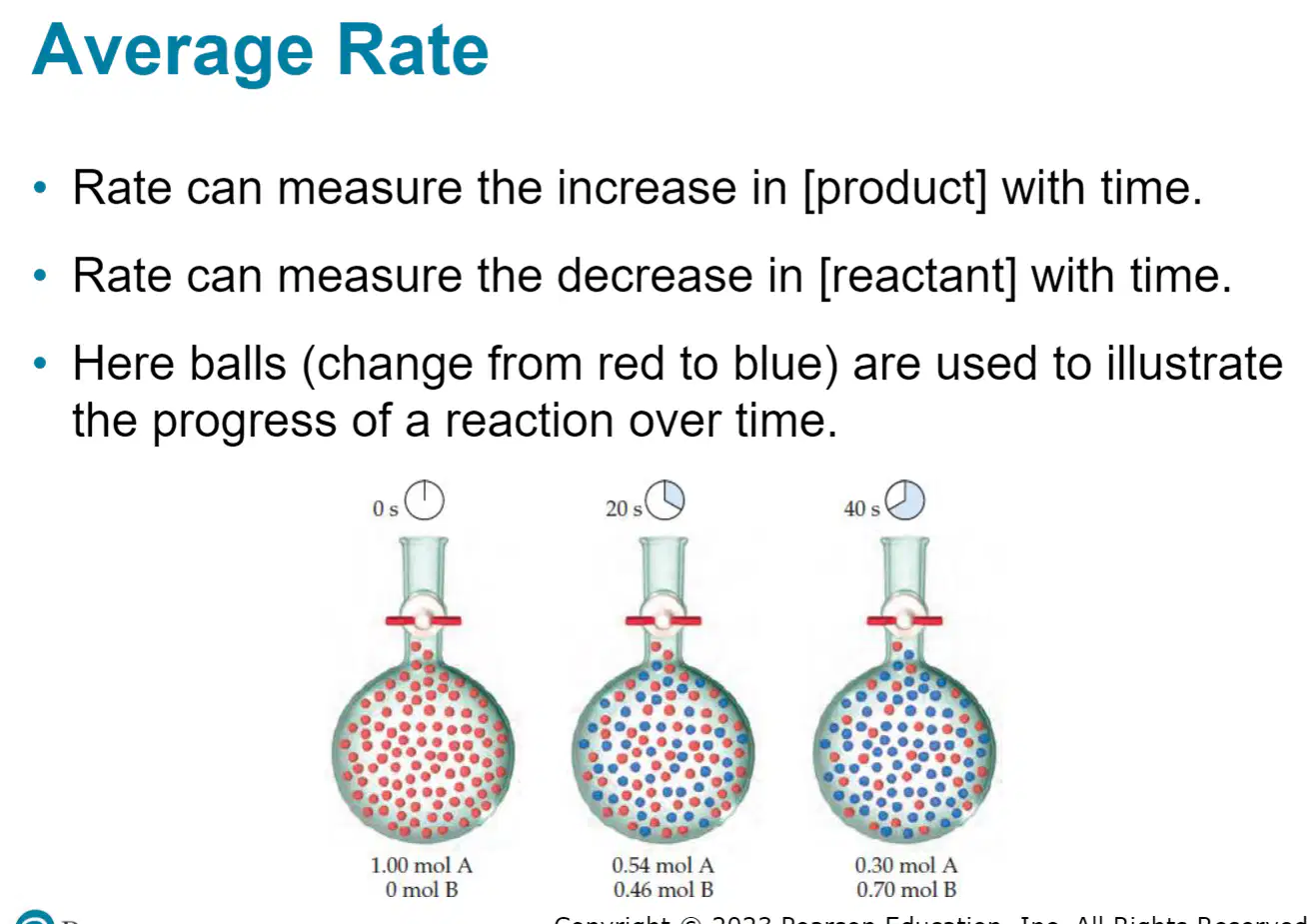
What do the balls changing from red to blue illustrate in the context of the reaction?
The temperature change over time
The pressure change over time
The progress of a reaction over time
The volume change over time
What is the chemical equation for the reaction described in the document?
C₄H₉Cl(aq) + H₂O(l) → C₄H₉OH(aq) + HCl(aq)
C₄H₉Cl(aq) + H₂O(l) → C₄H₉OH(aq) + H₂(aq)
C₄H₉Cl(aq) + H₂O(l) → C₄H₉OH(aq) + Cl₂(aq)
C₄H₉Cl(aq) + H₂O(l) → C₄H₉OH(aq) + O₂(aq)
In the given example, which concentration is measured to find the average rate?
[C₄H₉OH]
[H₂O]
[C₄H₉Cl]
[HCl]
What is the formula used to calculate the rate in the given example?
Rate = Δ[C₄H₉Cl] / Δt
Rate = -Δ[C₄H₉Cl] / Δt
Rate = Δ[C₄H₉OH] / Δt
Rate = -Δ[C₄H₉OH] / Δt

What is the average rate (M/s) when the time (t) is 0 seconds according to Table 14.2?
1.9 × 10⁻⁴
1.7 × 10⁻⁴
1.6 × 10⁻⁴
1.4 × 10⁻⁴
What is the rate at time zero called?
Instantaneous rate
Average rate
Final rate
Initial rate
Why is it difficult to measure concentration at time zero?
Because the reaction has not started
Because the concentration is too high
Because a time (t) is chosen during the course of reaction to assess the reaction
Because the concentration is too low
What does the slope of the curve at one point in time give?
Average rate
Final rate
Instantaneous rate
Initial rate
How is the rate calculated?
Using the slope of the tangent to the line at time t
Using the average concentration over time
Using the final concentration
Using the initial concentration
Can reaction rates be measured using either reactant or product?
Only reactant
Only product
Both reactant and product
Neither reactant nor product
Will measuring the rate of disappearance of a reactant give the same rate as the appearance of a product?
No
Yes
Sometimes
Only under certain conditions
If we measured the disappearance of C4H9Cl and compared it to the appearance of C4H9OH, what would be true about their magnitudes?
The magnitudes would be different
The magnitudes would be the same
The magnitudes would be zero
The magnitudes would be infinite
What would be the sign of the rate of disappearance of a reactant?
Positive
Negative
Zero
Undefined
What would be the sign of the rate of appearance of a product?
Positive
Negative
Zero
Undefined

What is the formula for the rate of reaction given in the document?
Rate = -(Δ[C4H9Cl]/Δt) = (Δ[C4H9OH]/Δt)
Rate = (Δ[C4H9Cl]/Δt) = -(Δ[C4H9OH]/Δt)
Rate = (Δ[C4H9Cl]/Δt) = (Δ[C4H9OH]/Δt)
Rate = -(Δ[C4H9Cl]/Δt) = -(Δ[C4H9OH]/Δt)
What should the stoichiometric coefficient of 2 be converted to when setting up the rate equality?
1/2
2
1/3
3
In the reaction 2 O₃ (g) → 3 O₂ (g), what is the relative rate expression for O₃?
-1/2 Δ[O₃]/Δt
1/2 Δ[O₃]/Δt
-1/3 Δ[O₃]/Δt
1/3 Δ[O₃]/Δt
In the reaction 2 O₃ (g) → 3 O₂ (g), what is the relative rate expression for O₂?
1/3 Δ[O₂]/Δt
-1/3 Δ[O₂]/Δt
1/2 Δ[O₂]/Δt
-1/2 Δ[O₂]/Δt
What does the variable 'k' represent in the rate law equation Rate = k[A]x[B]y?
Reactant concentration
Specific rate constant
Reaction order
Product concentration
In the rate law equation Rate = k[A]x[B]y, what do the variables 'x' and 'y' refer to?
Reactant concentration
Specific rate constant
Reactant order
Product concentration
If the rate law for a reaction is Rate = k[NH4+][NO2-], what is the order of the reaction with respect to NH4+?
Zero order
First order
Second order
Third order
For the reaction with the rate law Rate = k[NH4+][NO2-], what is the overall reaction order?
Zero order
First order
Second order
Third order
Which of the following statements is true regarding the order of a reaction?
The order of a reaction is always equal to the stoichiometric coefficients in the balanced equation.
The order of a reaction must be determined experimentally.
The order of a reaction is always zero.
The order of a reaction is always one.
For an elementary reaction: 2 N2O5(g) → 4 NO2(g) + O2(g), what is the rate law?
Rate = k[N2O5]2
Rate = k[NO2]4
Rate = k[N2O5]
Rate = k[O2]
For the reaction (H2(g) + I2(g) -> 2 HI(g)), what is the rate law?
Rate = k[H2][I2]
Rate = k[HI]^2
Rate = k[H2]^2
Rate = k[I2]^2
For the reaction (CHCl3(g) + Cl2(g) -> CCl4(g) + HCl(g)), what is the rate law?
Rate = k[CHCl3][Cl2]
Rate = k[CCl4][HCl]
Rate = k[CHCl3][Cl2]^(1/2)
Rate = k[CHCl3]^2[Cl2]
For reactions with k ~ 10^9 or higher, how is the reaction considered?
A) Slow
B) Moderate
C) Fast
D) Unpredictable
For reactions with k less than 10 or lower, how is the reaction considered?
A) Slow
B) Moderate
C) Fast
D) Unpredictable
If the rate is in M/s, what are the units of k for a zero-order reaction?
A) s^-1
B) M^-1s^-1
C) Ms^-1
D) M^-2s^-1
If the rate is in M/s, what are the units of k for a first-order reaction?
A) s-1
B) M-1s-1
C) Ms-1
D) M-2s-1
If the rate is in M/s, what are the units of k for a second-order reaction?
A) s-1
B) M-1s-1
C) Ms-1
D) M-2s-1
To determine the rate law, what should you choose from the data set?
Two experiments where both reactants vary
Two experiments where one reactant is constant and the other reactant varies
Two experiments where both reactants are constant
Two experiments where neither reactant varies
What should be set up to determine the rate law?
A ratio of rates versus time
A ratio of rates versus temperature
A ratio of rates versus reactant concentration
A ratio of rates versus pressure
In the equation conc ratio^exponent = rate ratio, what is useful to place on top?
The smaller rate
The larger rate
The average rate
The initial rate
In the given example, which reactants are used?
NO and NH3
NO2 and NH4+
NO3 and NH2
NO2 and NH3+
What needs to be determined for the rate law equation Rate = k[NO2]^x[NH4+]^y?
Which experiments show how the concentration of [NH₄⁺] affects the rate?
Experiments 1-3
Experiments 4-6
Experiments 1-6
Experiments 2-5
Which experiments show how the concentration of [NO₂⁻] affects the rate?
Experiments 1-3
Experiments 4-6
Experiments 1-6
Experiments 2-5
What is the observed initial rate for Experiment 1?
5.4 × 10⁻⁷
10.8 × 10⁻⁷
21.5 × 10⁻⁷
43.3 × 10⁻⁷
What is the initial concentration of [NH₄⁺] in Experiment 4?
0.0100 M
0.0200 M
0.0400 M
0.2000 M
What is the initial concentration of [NO₂⁻] in Experiment 6?
0.200 M
0.0202 M
0.0404 M
0.0808 M
Which experiment has the highest observed initial rate?
Experiment 1
Experiment 3
Experiment 5
Experiment 6
What is the temperature at which the reaction of ammonium and nitrite ions in water was conducted?
20°C
25°C
30°C
35°C
In the given example, what is the order with respect to [NH_4^+]?
1
2
0
3
If the concentration of [NH_4^+] doubles, what happens to the rate?
The rate doubles.
The rate triples.
The rate remains the same.
The rate halves.
In the experiments mentioned, which concentration is kept constant?
[NO_2^-]
[NH_4^+]
[H_2O]
[O_2]
What is the value of y found in the example?
1
2
0
3

What is the ratio of the rates in Experiment 2 to Experiment 1?
2
0.5
1
4
In the given example, what is the order with respect to [NO2^-]?
1
2
0
3
If the concentration of [NO2^-] doubles, what happens to the rate?
The rate doubles.
The rate triples.
The rate remains the same.
The rate halves.
In the experiments mentioned, which concentration is kept constant?
[NH4^+]
[NO2^-]
[H2O]
[O2]
What is the value of x in the given example?
1
2
0
3

What is the ratio of the rates in Experiment 5 to Experiment 4?
2
1
0.5
3
During the reaction P4 + 5O2 → P4O10, 0.800 mole of product was made in 15.0 seconds. What is the rate of reaction?
56.8 g/min
908 g/min
If the initial concentration of a reactant is 1.0 M and it changes to 0.5 M in 3 hours, what is the rate of reaction?
-0.167 M/hr
0.167 M/hr
-0.5 M/hr
0.5 M/hr
When [B] is decreasing at 0.5 molL-1s-1, how fast is [A] decreasing for A +2B → C ?
0.5
0.25
1.0
1.25
What are the units of k for the rate law: Rate = k[A][B]2, when the concentration unit is mol/L?
s-1
s
L mol-1 s-1 or M-1s-1
L2 mol-2 s-1 or M-2s-1
L2 s2 mol-2 or M2s2
A student is doing an experiment in science class with baking soda and vinegar. Their teacher is happy with the results of their experiment; however, they want to make sure that the students can get the rest of their trials done before the end of class. What is one way that the student can speed up the reaction without affecting the results?
The student can add more baking soda.
There is no way for the student to speed up the reaction.
The student can add ice to the vinegar to decrease its temperature.
The student can do the experiment on a hot plate to increase the temperature.
Match the following Reaction Rate affect with the definition of why it speeds up reactions.
The higher of this, the smaller of the volume, causing more particle collisions
Pressure
This substance speeds the reaction rate by lowering the activation energy needed to start the reactions
Catalyst
The more of this causes there to be more room for the particles to collide and react with one another
Surface Area
Higher amounts of this of this leads to more frequent collisions between reactant particles
Concentration
The higher the ______, the faster the reaction because more particles are moving and colliding, thus contacting with each other to react.
Temperature

What is the activation energy (in kJ) of the reaction shown in the diagram?
For a reaction 2A + B ⟶ 2C, with the rate equation:
Rate = k [A]2 [B]
The order with respect to A is 1 and the order overall is 1
The order with respect to A is 2 and the order overall is 2
The order with respect to A is 2 and the order overall is 3
The order with respect to B is 2 and the order overall is 3
The order with respect to B is 2 and the order overall is 2
If we double the concentration of a reactant and the rate quadruples, what reaction order is this?
first order
second order
third order
eighth order
A reaction has the rate law: Rate = k [A][B].Thee order of reaction with respect to A is (a) order.
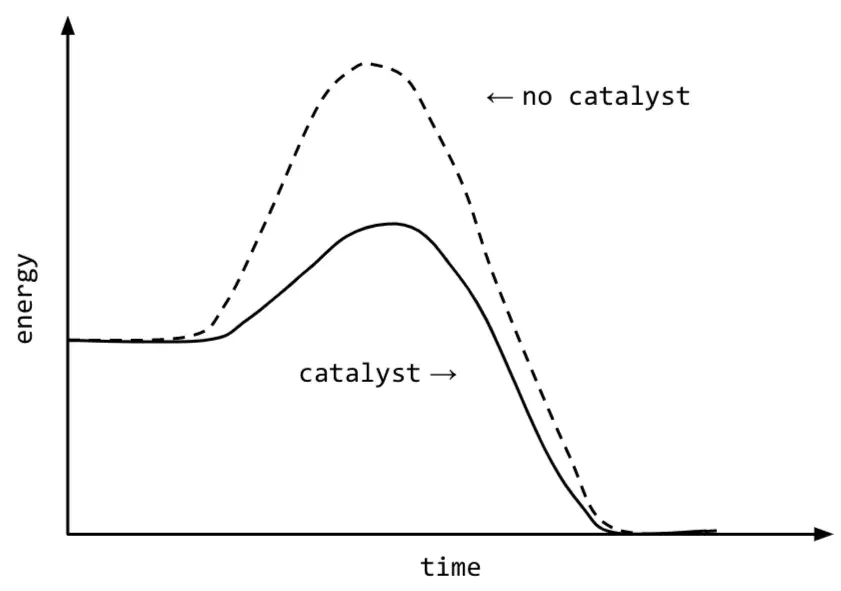
A catalyst increases the rate of a chemical reaction by:
Increasing the temperature of the reaction mixture
Providing an alternative reaction pathway with a lower activation energy
Increasing the concentration of reactants
Decreasing the concentration of products
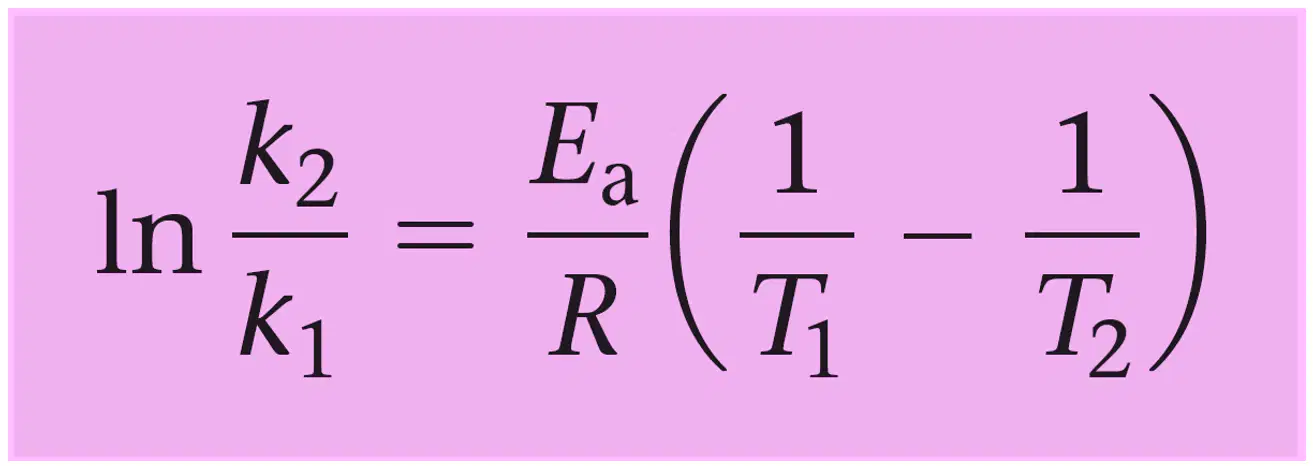
A reaction is found to have an activation energy of 108 kJ/mol. If the rate constant for this reaction is 4.60×10⁻⁶ s−1 at 275 K, what is the rate constant at 366 K?
R = 8.314 J/mol.K
1 kJ = 1000 J
5.80 s-1
0.580 s-1
850 s-1
8.50 s-1

