
 Worksheets
Chem two exam one
Total questions: 104
Worksheet time: 57mins
Indicate the strongest intermolecular force in each molecule
1.HCL
2.F2
3.CO
4.HF
1. dispersion
2. hydrogen bonding
3. dipole-dipole
4. hydrogen bonding
1. dipole-dipole
2. dipole-dipole
3. dispersion
4. dipole-dipole
1. dipole-dipole
2. dispersion
3. dipole-dipole
4. hydrogen bonding
1. dispersion
2. dipole-dipole
3. dispersion
4. dipole-dipole
Choose the pair of substances most likely to form a
homogeneous mixture.
KCl and Hg
NaI and C6H14
C3H8 and C2H5OH
F2 and PF3
NH3 and CH3OH
How much energy in joules does it take to heat 50.0g of water
at 100 ºC to 120 ºC? Cs(liquid) = 4.18 j/g·ºC Cs(gas) = 2.01 j/g
ºC ∆Hvap = 40.7 kJ/mol
115 kJ
1150kJ
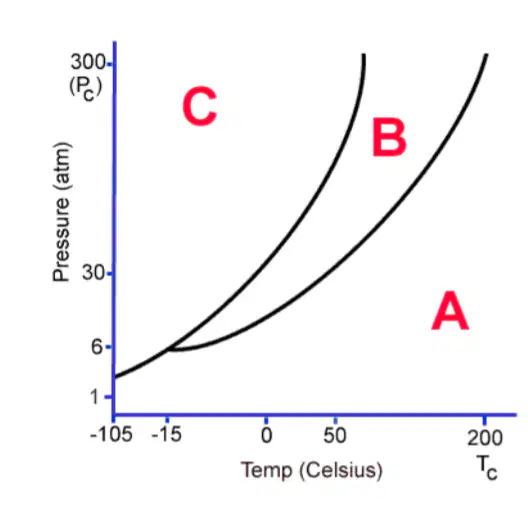
What phase changes, if any, would occur in
Order if this substance was at 0 ºC and 300 atm
and then keeping the temperature constant
the pressure was dropped down to 2 atm?
Evaporation
Melting
Evaporation followed by Melting
Melting followed by Evaporation
What is the edge length of a basic cubic lattice cell in relation to
the atomic radius?
(a)
Identify the network covalent solid
Cl2(s)
Rn(s)
CH4(s)
SiO2(s,quartz)
Identify the metallic solid
Xe(s)
KBr(s)
Zr(s)
CO2(s)
Which substance would have the lowest melting point?
• Cl2(s), Kr(s), C3H8(s), SiO2(s,quartz)
Cl2(s)
Kr(s)
C3H8(s)
SiO2(s,quartz)
Place the following compounds in order of decreasing strength of intermolecular forces.
CH3CH2CH2CH2CH2CH3 II. (CH3)3CCH2CH3 III. (CH3)2CHCH2CH2CH3
I > III > II
II > III > I
III > II > I
I > II > III
Identify the term used to describe the resistance of liquid to flow.
density
viscosity
surface tension
capillary action
How much energy is required to vaporize 45.4 g of ethanol (C2H5OH) at its boiling point, if its ΔHvap is 40.5 kJ/mol?
27.8 kJ
51.1 kJ
39.9 kJ
18.9 kJ
What is the strongest intermolecular force present in CH3CH2CH2OH?
hydrogen bonding
dipole-dipole
ion-dipole
dispersion forces
How much energy is required to heat 36.0 g H2O from a liquid at 65°C to a gas at 115°C? The following physical data may be useful.
ΔHvap = 40.7 kJ/mol
Cliq = 4.18 J/g∘C
Cgas = 2.01 J/g∘C
Csol = 2.09 J/g∘C
Tmelting = 0∘C
Tboiling = 100∘C
91.7 kJ
87.7 kJ
63.5 kJ
52.7 kJ

According to the phase diagram of CO2 below. If we started at 4 atm and 190 K and kept the pressure constant but increased the temperature to 217K what process would occur?
melting
evaporation
freezing
sublimation

Triple Point
Vapor Pressure Curve
Sublimation Point
Critical Point
What type of cubic lattice cell has a coordination number of 8?
face centered cubic
basic cubic
cubed cubic cube
body centered cubic
What is the volume of a single lattice cell in cubic centimeters for an atom with a radius of 151 pm that forms a face centered cubic cell.
Because webcourses wont' let you put an exponent into the numerical answer put just the value for the blank portion (a) x 10-23
What type of solid is palladium?
ionic solid
metallic atomic solid
network covalent solid
nonbonding atomic solid
Which of these forms hydrogen bonds?
HF
CH3CO2H
Br
CH3OH
CH3OCH3
Ethanol, CH3CHOH, has a vapor pressure of 59mmHg at 25 degrees C. What quantity of energy as heat is required to evaporate 125mL of the alcohol heat at 25 degrees C? The enthalpy of vaporization of the alcohol at 25 degrees C is 42.32kJ/mol. The density of the liquid is 0.7849g/mL
Answer in kJ
(a)
Higher boiling point?
O2 or N2
O2
N2
Higher boiling point?
SO2 or CO2
SO2
CO2
Higher boiling point?
HF or HI
HF
HI
Higher boiling point?
SiH4 or GeH4
SiH4
GeH4
Rank in order of increasing enthalpy of vaporization
a. CH3OH
b. C2H6
c. HCl
C2H6 < HCl < CH3OH
HCl<CH3OH<C2H6
CH3OH<C2H6<HCL
Rank the following in order of increasing boiling point:
a. CH3CH2CH2CH2CH3
b. CH3F
c. CH3Cl
CH3CI<CH3F<CH3CH2CH2CH2CH3
CH3CH2CH2CH2CH3 < CH3Cl < CH3F
Calcium metal crystallizes in a face-centered cubic unit cell. The density of the solid is 1.54 g/cm3. What is the radius of the calcium atom?
(a)
Which statement is true?
Ideal gases mix because mixing decreases their potential energy
Ideal gases mix because mixing increases their potential energy
Ideal gases mix because mixing decreases their entropy
Ideal gases mix because mixing increases their entropy
If the solvent-solute interactions in a mixture are comparable in strength to the solvent-solvent interactions and the solute solute interactions, what can you conclude about solution formation in this mixture?
A homogeneous solution forms.
A homogeneous solution does not form.
The formation of a homogeneous solution is uncertain.
The forces between ionic compounds and polar compounds are known as __________ forces.
dispersion
dipole-dipole
hydrogen bonding
ion-dipole
ionic
In a liquid the tendence of liquids to minimize their surface area is calle
Viscosity
Surface Tension
Vapor Pressure
Capillary Action
Hydrogen Bonding
Which of the following has the smallest dipole-dipole forces (having none would also be considered
the smallest)?
HI
CH3CH2Cl
F2
CO
all are the same
Identify the compound that does NOT have hydrogen bonding
NH3
HF
H2O
CH3(CH2)3NH2
CH3CH2F
Ammonia (NH3) has a higher normal boiling point than its heavier congener PH3. Which is the best
explanation for this difference
NH3 is trigonal pyramidal and polar while PH3 is trigonal planar and nonpolar
NH3 is more acidic than PH3
NH3 experiences stronger dispersion forces than PH3
NH3 has extensive hydrogen bonding while PH3 does not.
Choose the substance with the HIGHEST vapor pressure at a given temperature
AsH3
CH3OCH2CH3
RbBr
SiO2
BH3
Determine the vapor pressure (in mm Hg) of a substance at 29°C, whose normal boiling point is 76°C
and has a ΔHvap of 38.7 kJ/mol.
48 mm Hg
21 mm Hg
13 mm Hg
96 mm Hg
80 mm Hg
A student collected multiple data points relating the temperature and pressure of a substance. She then
plotted 1/T vs. ln P and obtained a straight-line plot with a slope of -3101. What is the ∆Hvap of the
substance?
4.78 kJ
3000 kJ
8.314 kJ
25.78 kJ
not enough information
I only
II only
both I and II
neither I or II
Calculate the total quantity of heat required to convert 25.0 g of liquid CCl4 from 35.0°C to gaseous
CCl4 at 76.8°C (the normal boiling point for CCl4). The specific heat of CCl4(l) is 0.857 J/(g ∙ °C) its heat
of fusion is 3.27 kJ/mol and its heat of vaporization is 29.82 kJ/mol.
0.896 kJ
5.74 kJ
6.28 kJ
1.43 kJ
7.45 kJ
Identify the characteristics of a body-centered cubic cell
1 atom inside, coordination # of 6
1 atom inside, coordination # of 8
2 atom inside, coordination # of 6
4 atom inside, coordination # of 12
2 atom inside, coordination # of 8
A metal crystallizes in a face centered cubic structure and has a density of 8.90 g/cm3. If the radius
of the metal atom is 125 pm, what is the identity of the metal?
At
Fe
Pd
Cr
Co
Which of the following forms a molecular solid?
C10H22
Silver
NH4NO3
C, diamond
all of the above






-650 kJ/mol
+650 kJ/mol
+690 kJ/mol
-690 kJ/mol
-710 kJ/mol
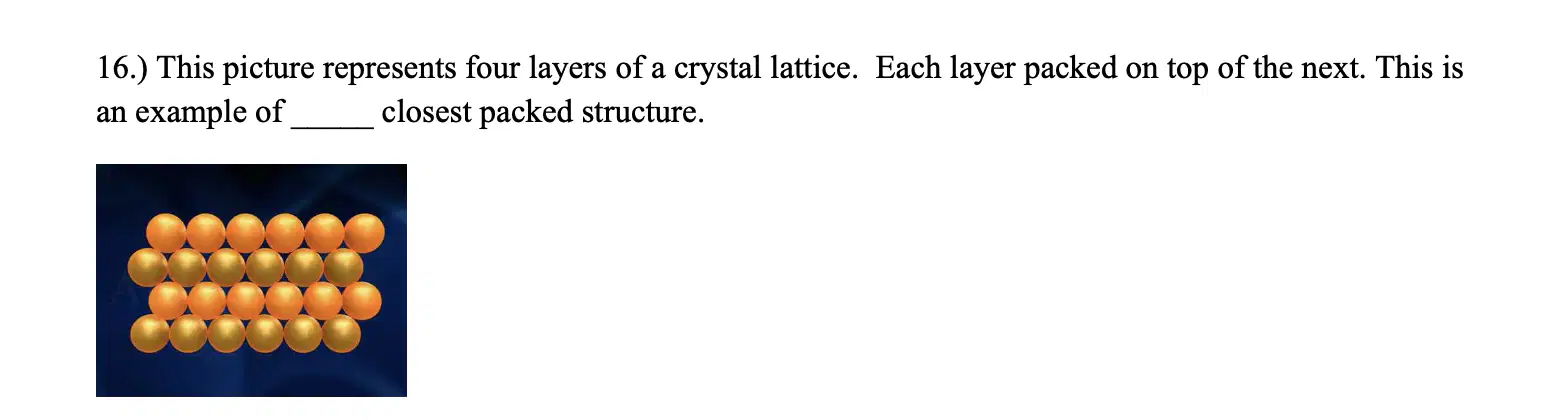
AA
AB
ABC
all of the above
none of the above
Which of the following compounds will be MOST soluble in nonane (C9H20)?
CH3CH2OH
CH3(CH2)3CH2OH
CH3COCH2CH3
CH3COOH
C6H6
Which of the following elements would you add to germanium to make an n-type semiconductor?
phosphorous
silicon
gallium
arsenic
both A and D
Choose the correct order of increasing band gaps
Conductor < Insulator < Semiconductor
Insulator < Conductor < Semiconductor
Semiconductor < Conductor < Insulator
Conductor < Semiconductor < Insulator
Dynamic equilibrium can be defined as ___________
rate of dissolution > rate of recrystallization
rate of concensing > rate of bubbling
rate of dissolution < rate of recrystallization
rate of dissolution = rate of recrystallization
rate of bubbling > rate of dissolving
Determine the IMF in this element or compound
Xe
dispersion
dipole-dipole
H-bonding
ion-dipole
dispersion
dipole-dipole
dispersion
dispersion
dipole-dipole
H-bonding
what IMF does HF have increasing strength
(all lowercase)
(a)
what IMF does NF3 have increasing strength
(all lowercase)
(a)
what IMF does SiBr4 have increasing strength
(all lowercase)
(a)
what IMF does Cl2 have increasing strength
(all lowercase)
(a)
what IMF does PCl3 have increasing strength
(all lowercase)
(a)
what IMF does HI have increasing strength
(all lowercase)
(a)
Arrange these compounds in order of increasing boiling point.
a.CH4
b.CH3CH3
c.CH3CH2Cl
d.CH3CH2OH
b,d,a,c
a,b,c,d
d,c,b,a
d,a,c,b
Which one has the higher boiling point?
NH3
CH4
Which one has the higher boiling point?
CH3OCH3
CH3CH2OH
Which one has the higher boiling point?
CO2
NO2
At the same temperature, which has the higher vapor pressure?
Br2
I2
At the same temperature, which has the higher vapor pressure?
H2S
H2O
At the same temperature, which has the higher vapor pressure?
NH3
PH3
Does this pair of compounds form a homogeneous solution when combined?
CCl4 and H20
homogeneous
not homogeneous
Does this pair of compounds form a homogeneous solution when combined?
KCl and H20
not homogenous
homogenous
Does this pair of compounds form a homogeneous solution when combined?
Br2 and CCl4
homogenous
not homogenous
Does this pair of compounds form a homogeneous solution when combined?
CH3CH2OH and H2O
homogenous
not homogenous
Which compound would you expect to have greater surface tension?
acetone
(CH3)2CO
Water
H20
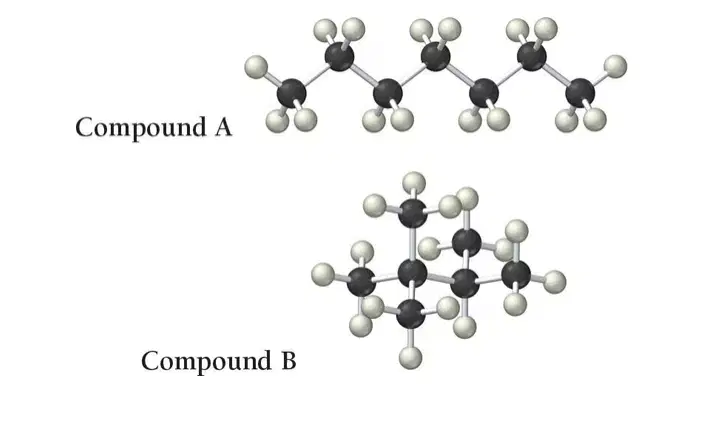
Which compound would be expected to have the greater viscosity?
Compound A
Compound B
Identify each solid as molecular, ionic, or atomic
Br2 (s), CO2 (s), Cu (s), CaBr2 (s)
ionic, covalent, molecular, atomic
molecular, molecular, atomic, ionic
atomic, ionic, molecular molecular
molecular, atomic, molecular, covalent
Which solid has the highest melting point?
Ar (s)
CCl4 (s)
LiCl (S)
CH3OH (s)
Which solid has a higher melting point?
TiO2 (s)
HOOH (s)
Which solid has a higher melting point?
CCl4 (s)
SiCL4 (s)
Which solid has a higher melting point?
Kr (s)
Xe (s)
Which solid has a higher melting point?
NaCl (s)
CaO (s)
list melting points in decreasing order: (C(s diamond), Kr (s), Nacl (s), H20 (s))
C(s diamond)>H20 (s)>Nacl (s)>Kr (s)
Kr (s)>C(s diamond)>H20 >Nacl (s)
C(s diamond)>Nacl (s)>H20 (s)>Kr (s)
Nacl (s)>H20 (s)>Kr (s)> C(s diamond)
Categorize the crystalline solid
SiC
Nonbonding
Network Covalent
Metallic
Ionic solids
Molecular solids
Categorize the crystalline solid
HBr
Nonbonding
Molecular
Metallic
Network Covalent
Ionic
Categorize the crystalline solid
Cu
Molecular
Metallic
Ionic
Network covalent
nonbonding
Categorize the crystalline solid
Br2
ionic
molecular
nonbonding
covalent
NH4ClO3
molecular
metallic
Ionic
covalent
How many moles of iron are in one face centered cubic lattice cell?
6.642x10^-24 mol
7.542x10^-38 mol
6.642x10^-22 mol
7.54x10^-36 mol
Find the Delta H of Hydration
Delta H of solution= -50.5 kJ
Delta H of solute= +510 kJ
560.5 kJ
675.5 kJ
-560.5 kJ
-675.5 kJ
A solution is saturated in both nitrogen gas and potassium bromide at 75 degrees celsius. When the solution is cooled to room temperature, what is most likely to happen?
Some nitrogen gas bubbles out of the solution
Some potassium bromide precipitates out of the solution
Some nitrogen gas bubbles out of the solution, and some potassium bromide precipitates out of the solution
Nothing happens
On a Phase diagram, the vaporization curve is between
a solid and a gas
a solid and a liquid
a liquid and a gas
two solids
A student collected multiple data points relating the temperature and pressure of a substance. She then plotted 1/T vs. ln P and obtained a straight-line plot with a slope of -6101. What is the delta H of vaporization. of the substance?
4.78 kJ
67.35 kJ
8.314 kJ
25.78 kJ
50.72 kJ
Identify the element with the largest band gap
lead
silicon
germanium
carbon
tin
Identify the characteristics of a basic cubic cell
1 atom inside, coordination number of 6
2 atom inside, coordination number of 8
2 atom inside, coordination number of 6
1 atom inside, coordination number of 8
1 atom inside, coordination number of 12
Define solubility
A solid that does not dissolve in a gas
the amount of a substance that will dissolve in a given amount of solvent
the amount of a substance that will dissolve in a given amount of solute
a solid mixed with another solid
a liquid that does not dissolve in another liquid
Which of the following statements is TRUE
Intermolecular forces are generally stronger than bonding forces
The potential energy of molecules decreases as they get closer to one another
Energy is given off when the attraction between two molecules is broken
Increasing the pressure of a solid usually causes it to become a liquid
None of the above is true
For Benzene (C6H6) the normal boiling point is 80.1 degrees Celsius and the enthalpy of vaporization is 30.8 kJ/mol. What is the boiling point of benzene at Mt Whitney where atmospheric pressure is 456 torr?
337 K
347 K
4.20 K
353 K
371 K
Arrange the following in order of decreasing melting point
CH3OCH3, CH3CH2CH3, CH3CH2OH
CH3OCH3>CH3CH2CH3>CH3CH2OH
CH3OCH3>CH3CH2OH>CH3CH2OH
CH3CH2OH>CH3CH2CH3>CH3OCH3
CH3CH2OH>CH3OCH3>CH3CH2CH3

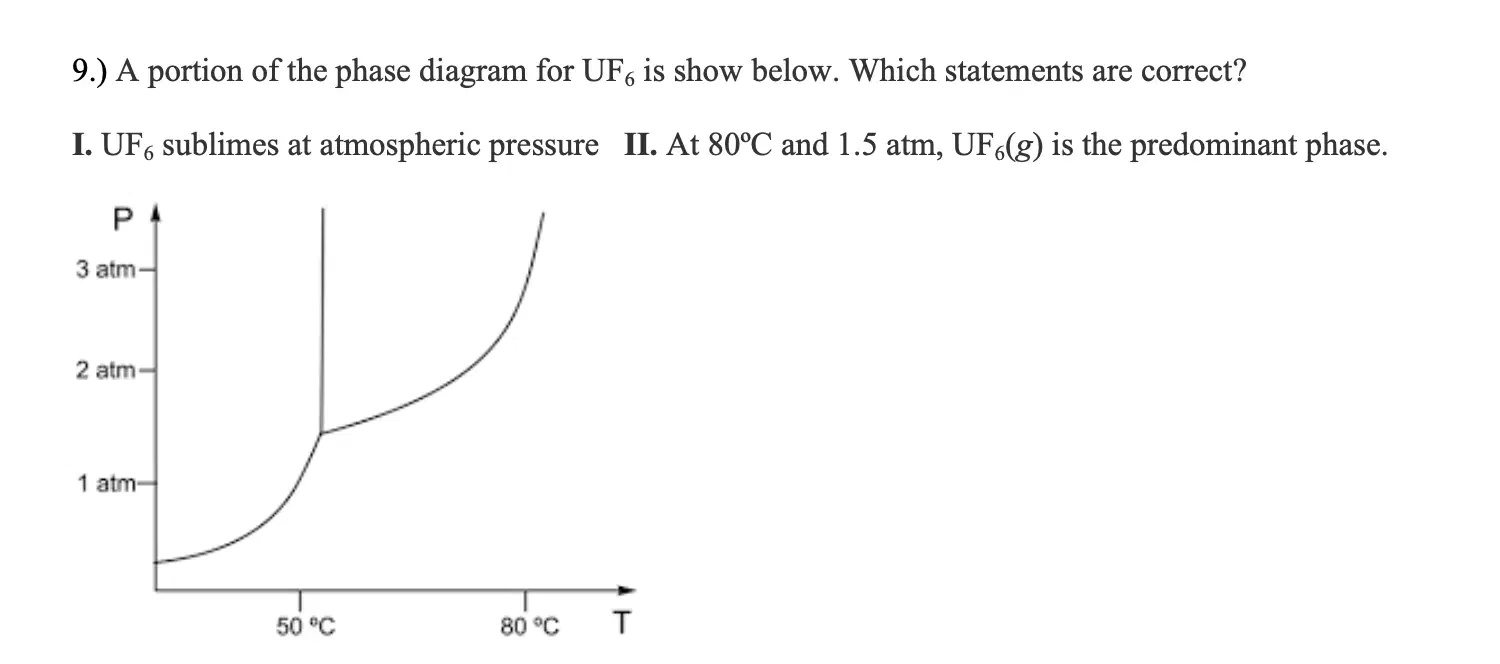
A portion of the phase diagram for UF6 is shown. Which statements are correct?
UF6 evaporates at atmospheric pressure.
At 40 degrees celsius and 2 atm, UF6 (g) is the predominant phase.
both of the statements
neither of the statements
How much energy must be removed from a 125g sample of benzene (molar mass= 78.11g/mol) at 425.0 K to liquify the sample and lower the temperature to 335 K? The following physical data may be useful.
T melting= 279 K, T boiling= 353 K
38.9 kJ
95.4 kJ
67.7 kJ
74.4 kJ
Place the following substances in order of decreasing vapor pressure at a given temperature.
NaCl CH3OH OF2
CH3OH>OF2>NaCl
NaCl>OF2>CH3OH
OF2>CH3OH>NaCl
OF2>NaCl>CH3OH
NaCl>CH3OH>OF2
A metal crystallizes in a body centered cubic structure and has a density of 7.87 g/cm^3. If the radius of the metal atom is 124 pm, what is the identity of the metal?
At
Fe
Pd
Cr
Co
Which of the following forms a molecular solid?
CaCl2
Au
C (s graphite)
HCl
Fe
Define sublimation
the phase transition from solid to gas
the phase transition from gas to solid
the phase transition from gas to liquid
the phase transition from liquid to gas
the phase transition from liquid to solid
Naval brass is 60.5% copper, 37.5% zinc, 1.8% tin and 0.7% lead. Identify the solute(s) in this alloy
copper
tin
zinc
lead
tin, zinc, and lead
Arrange the following in order of increasing boiling point (lowest to highest)
Ne,Xe,Kr
Xe<Kr<Ne
Ne<Kr<Xe
Ne<Xe<Kr
Kr<Ne<Xe
Kr<Xe<Ne
Identify the type of interaction between atoms in a nonbonding atomic solid
polar bonding
ionic bonding
covalent bonding
hydrogen bonding
weak dispersion forces
Which of the following elements would you add to germanium to make an n-type semiconductor
indium
silicon
gallium
arsenic
both indium and arsenic
Choose the pair of substances most likely to form a homogenous mixture
KCl and Hg
NaI and C6H14
NH3 and CH3OH
C3H8 and C2H5OH
Which solid would you expect to have the highest melting point?
H2O
Li (s)
CH3CH2OH (s)
Ar (s)
Ne (s)

