
 Worksheets
Chem Final Semester 1, 2025
Total questions: 109
Worksheet time: 5hrs 53mins

When reading the volume in a graduated cylinder, look at the ___ of the meniscus.
top
bottom
It doesn't matter.
What is a meniscus?

What is the volume?
23 mL
28 mL
36 mL
38 mL
Convert 323 m to km.
0.323 km
3.23 km
323,000 km
3,230 km
Convert 0.75 L to mL.
750 mL
75 mL
75,000 mL
0.0075 mL
Convert 2.2 kg to mg.
2,200,000 mg
0.0000022 mg
2,200 mg
0.0022 mg
Convert: 253 °C to K:
526 K
625 K
0 K
186 K
Convert a 136 oF to oC
57.777 oC
330 K
57.5 oC
220 C
Convert 25.0 oC to oF:
77 oF
77 oC
100 oF
100 oC
Convert 44°F to Kelvin
0 K
310 K
220 K
280 K
On a graph, which axis shows the independent variable?
x-axis
y-axis
neither
it changes

Which of the following is the label for the independent variable.
Money Collected
Raising Money
Boxes Sold
None of the above

What is the DEPENDENT variable in this experiment?
"Do tall people jump further than short people?"
height of the person
weight of the person
how fast the person runs
how far the person jumps

What is the INDEPENDENT variable in this experiment?
"Which type of metal, copper or aluminum, conducts heat faster?"
size of metal
types of metal
time it takes to heat up
shape of the metal

"Is Bounty paper towel more absorbent than sparkle paper towel?
(1.2 X 10⁵) + (5.35 X 10⁶)
6.55 X 10⁵
6.55 X 10⁶
5.47 X 10⁵
5.47 X 10⁶
(3.67 X 10²) - (1.6 X 101)
2.07 X 101
2.07 X 10²
3.51 X 101
3.51 X 10²
Multiply:
(9.4 x 10⁶)(3.2 x 10⁵)
30.08 x 10¹¹
3.8 x 101
3.008 x 10¹²
2.9375 x 101
(6.9 x 10⁷) / (2.3 x 10⁻³)
Energy of position or stored energy is called
Potential Energy
Kinetic Energy
Mechanical Energy
Chemical Energy
The energy of motion is called
Potential Energy
Kinetic Energy
Mechanical Energy
Chemical Energy

At which point is potential energy greatest?
A
B
C
D
E

At which point is kinetic energy greatest?
A
B
C
D
E

When a pendulum swings, at what point is the kinetic energy greatest?
1
2
3
4

When a pendulum swings, at which point is potential energy greatest?
1
2
3
4
Heat transfer occurs
in many directions
both from warm objects to colder ones and from cold objects to warmer ones
only from warm objects to colder ones
only from cold objects to warmer ones
Which particles are moving fastest?
Particles in ice.
Particles in boiling water.
Particles in water from the sink.
Particles in steam.

When the temperatures of materials that are in contact are the same, the materials are said to be in
thermal balance
equality
a powerful situation
thermal equilibrium

_____________________ occurs only in gases and liquids. This is one way heat transfers from one place to another.
Conduction
Convection
Radiation
Containment
What does the Law of Conservation of Energy state?
energy is always created, but not destroyed
energy cannot be created or destroyed
energy cannot be created, but can be destroyed
energy is always being created and destroyed
An uncovered pot of soup is simmering on Mr. B's stove, and there are water droplets on the wall behind it. What sequence can you infer has occurred?
vaporization, then condensation
freezing, then thawing
condensation, then vaporization
Mr. B is making a mess

Describe the substance between letters A and B.
Solid
Liquid
Melting
Evaporating


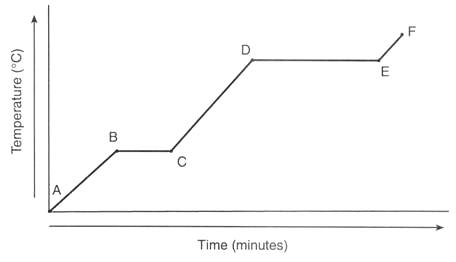
Between which points is the substance changing state?
A-B only.
A-B, C-D, E-F
B-C only.
B-C, D-E


The greenhouse effect is caused by
more heat arriving at the Earth from the sun
the Earth releasing more heat at night
gases in the air trapping heat released by the Earth

The graph shows us that
the earth temperature is always increasing
the earth's temperature has steadily increased since 1900
the earth's temperature has steadily rising since the 1960s
the earth's temperature decreased during the 19th and 20th centuries

Which of the gases is NOT a greenhouse gas?
water vapour
carbon monoxide
carbon dioxide
methane
The main human activity that adds to an individual's carbon footprint.
usage of alternative energies (wind, solar, etc)
respiration and growth
photosynthesis by plants
usage of fossil fuels for energy
A higher albedo results in a surface...
Reflecting more visible light
Absorbing more visible light
Reflecting more infrared light
Absorbing more infrared light
Which greenhouse gas is NOT influenced by human activity?
carbon dioxide
nitrous oxide
water vapor
methane
Floating sea ice melts...
and causes sea levels to rise because it adds water to the ocean.
but does not cause sea levels to rise because the ice displaces the same amount of ocean water as the melted ice would displace.
Melting land ice...
causes sea levels to rise because it adds water to the ocean.
does not cause sea levels to rise because the water fills the space left by the melted sea ice.

Which statement about the albedo of ocean water and sea ice in the summer is correct?
The low albedo of ocean water means the heated water will sink and form ocean currents.
The albedo of sea ice is lower than the albedo of ocean water, leading to the melting of sea ice.
Sea ice absorbs less radiation, making it warmer than ocean water.
Ocean water absorbs more radiation and is warmer than sea ice.

An important example of a "positive feedback loop" in the polar climate system is:
Scientists in remote places check on each others instruments
Warming ocean water opens new areas for marine species
Warmer winters cause more plant growth, providing more food
Sea ice melt opens more ocean to sunlight, causing more melt
Once sea ice begins to melt, a cycle often begins. As more ice melts and exposes more dark water, the water absorbs more sunlight. The sun-warmed water then melts more ice. Over several years, this can influence global climate. This process is an example of:
a positive feedback cycle.
a negative feedback cycle.
a maelstrom.
false reasoning.
The main human activity that releases greenhouse gases is
plastic production
burning fossil fuels
coal mining
eating meat

What has the highest albedo?
the oceans
Ice in the Arctic or Antarctic
the ground
roads
What is the scientific definition of the albedo effect?
How much sunlight an object reflects
How much sunlight an object absorbs
How hot an object gets
How cold an object gets
What is the mass number of an atom?
the number of protons
the number of protons and neutrons
the number of neutrons
the number of protons and electrons

What is the element name of the atom pictured?
Nitrogen
Neon
Krypton
Chlorine

An isotope of Boron has a mass number of 12. How many neutrons does it have?

Ions are atoms that have gained or lost electrons and have:
a positive or negative charge
no charge
ONLY a positive charge
ONLY a negative charge


Boron has 3 valence electrons. What group is it part of?
3
13
2
12
The charge of a proton is
-2
0
+1
-1
The charge of a neutron is
-3
0
-1
+1
The charge of an electron is
-1
+1
+2
0

How many valence electrons are in the atom pictured?
4
2
8
0

What element is represented by this Bohr model of an atom?
Sulfur
Uranium
Argon
Fluorine
Use your periodic table. What element is in group 10, period 4?
copper
nickel
cobalt
palladium

Isotopes are atoms of the same element that have different numbers of ________________.
protons
electrons
neutrons
nuclei
Isotopes of the same element must have the same number of ___________________.
protons
electrons
neutrons
valence electrons
What is the name for the isotope that has 39 protons and 50 neutrons.
Yttrium-11
Tin-39
Tin-89
Yttrium-89

What element is in Period 2 Group 4A?
Calcium
Carbon
Titanium
Doesn't Exist

What element is represented in this Bohr Model?
Carbon
Hydrogen
Aluminum
Lithium
When an atom loses a valence electron, it becomes a _________.
cation
anion
neutral atom
polyatomic ion
When an atom gains a valence electron, it becomes a ___________.
cation
anion
neutral ion
polyatomic ion
Why do elements form bonds?
to get a charge
so they can make friends
to become stable by getting a full valence shell
to become stable by increasing their mass
What is the ion formed from Sulfur? If it has 6 valence electrons.
S+2
S-2
S+6
S-6
How many electrons would a Calcium ion gain/lose? If it has 2 valence electrons.
lose 1
gain 1
lose 2
gain 2
A Bromine ion gains 1 electron, which of the following is the correct symbol for a Bromine ion?
Br-1
Br+1
Br+7
Br-7
An atom with 2 protons, 3 neutrons, and 4 electrons has a charge of ____.
+2
-2
+3
0
Oxygen has 6 valence electrons but wants a full shell. What charge does oxygen tend to form?
6+
2-
6-
2+

What element does this Lewis Dot Digram represent?
Li
Al
C
Be
Which Lewis Dot Diagram would represent Chlorine?


This could be the dot diagram of
Si
Br
B
S
How would you draw a Lewis dot diagram for Magnesium?


Which of the following shows a correct Lewis dot structure?



