
Font size
 Worksheets
1st Semester Review 2023/24
Total questions: 60
Worksheet time: 30mins
What do you call a push or pull on an object?
Chemical
Force
Magnet
Which force holds us to earth's surface?
Friction
Mass
Gravity
At which location would your mass be the greatest?
Earth
Moon
Your mass stays the same everywhere.
Gravity affects which of the following?
Mass
Weight and Mass
Weight
Which of these objects would be attracted to a magnet?
nails
wood
paper
What will happen if you try to put the south pole of one magnet and the south pole of another magnet together?
The magnets will attract or move together
The magnets will repel or move away.
The magnets will not attract or repel

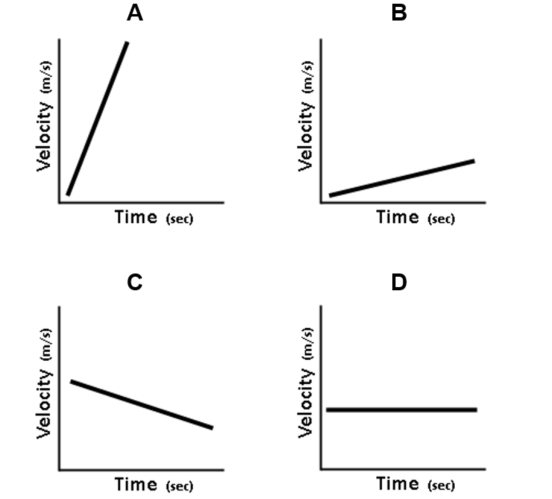
Which graph shows an object moving forward at a constant speed?
A
B
C
D
100 m
Distance
50 m/s
Speed
2 s
Time
50 m/s to the West
Velocity


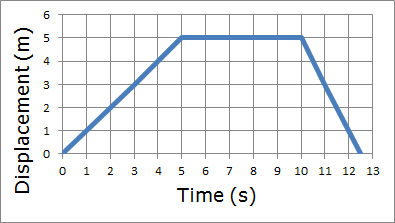
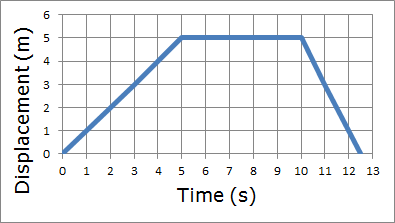
If there are two forces going in opposite directions how would you find the net force?
Subtract
Add
Neither
Multiply


1st
Law of Motion
2nd
Law of Motion
3rd
Law of Motion
an object will remain at rest or in uniform motion in a straight line unless acted upon by an external force
Newtons 1st law
Newtons 3rd law
Newtons 2nd law
the net force acting upon the object and the mass of the object
Newtons 3rd law
Newtons 1st law
Newtons 2nd law
What is an example of Electric Energy
Apple
Rubber Bands
Car Battery
Table
Which statement is true?
Oranges contain Elastic Energy
Food contains Chemical Energy
Phone on the table doesn't contain Gravitational Energy
Radiator contains Nuclear Energy
Vibrations produce _______ energy.
chemical
sound
potential
light
We receive ________ and heat energy from the Sun.
sound
mechanical
light
kinetic
the ability to cause movement or work
energy
power
potential
kinetic
stored energy
work
power
potential
kinetic
energy of motion
work
power
potential
kinetic
unit for energy
Joule (J)
Newton (N)
Watts (W)
meter (m)
unit for Force
Joule (J)
Newton (N)
Watts (W)
meter (m)
What is a dependent variable?
The variable that is changed or tested
The variable that is measured
The variable(s) that stay the same during the experiment
A measurement of how quickly an object is changing speed is (a)
Which of the following is a unit of force?
Joule
Newton
Watt
Meter per second
What is the effect of friction on the motion of objects?
It speeds them up
It slows them down
It changes their direction
It has no effect
Which of the following is a contact force?
Magnetic force
Electrical force
Gravitational force
Frictional force
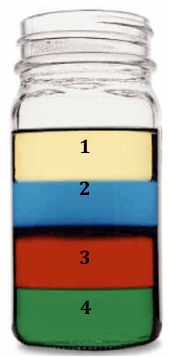


The parts of the experiment that stay the same; rules to the experiment
control
constant
inference
problem
The part of the experiment that changes as a result of the independent variable, Data you collect
independent variable
dependent variable
hypothesis
problem
The part of the experiment where you decide what will happen or make a prediction, stated as if...then
control
title
hypothesis
control
The part of the experiment that I change
independent variable
dependent variable
constant
observation
A conclusion reached on the basis of evidence
observation
inference
problem
hypothesis
The act of looking at something in order to gain information
observation
problem
qualitative
quantitative
Question you are trying to answer using an experiment
problem
observation
hypothesis
control
Information about how something Looks; cannot be measured with numbers
quaLitative
quaNtitative
observation
inference
Information that can be measured with Numbers
quaLitative
quaNtitative
inference
constant

What step in the scientific method allows you to gather information about the question?
Test
Research
Draw a conclusion
Form a hypothesis

