
 Worksheets
Q.4 (H.Chem) Final Exam Review
Total questions: 211
Worksheet time: 5hrs 22mins
Assuming that the number of moles is constant, gas laws involve what three variables?
If 6.0 L of gas at 293K is compressed to 4.0 L, what is the new temperature?
4.0L of a gas is contained at 300 kPa and 200K. What will its volume be in L at 140 kPa and 100K?
A gas at 928 kpa, 129 °C occupies a volume of 569 L. Calculate the volume at 319 kpa and 32 °C.


If the pressure of a gas starts at 200kPa and increases to 600kPa, what would the initial temperature be if it ended up at 300K?
-460 °C
0 °C
air molecules hit the walls of the tire less frequently.
rubber in the tires reacts with oxygen in the atmosphere.
air molecules speed up and collide with the tire walls more often.
The random molecular motion of a substance is greatest when the substance is..
a gas

Match the following units to their names.
Pressure
mmHg
Volume
L
Temperature
K
Pressure
atm
Moles
mol
A sample of gas with a volume of 30.0 mL at 25.0oC is heated to 50.0oC. What is the new volume of the gas?
60.0 mL
15.0 mL
27.5 mL
32.5 mL
Container A: 760 torr
Container B: 1000 torr
Container C: 1500 torr
Container D: 2000 torr
Consider a sample of oxygen gas at 27 °C with a volume of 9.55L at a pressure if 2.97 atm. The pressure is changed to 8.25 atm and the gas is heated to 125 °C. What’s the new volume?
4.56 L
4.6 L
15.9 L
16 L

Which law?
Charles (V/T)
Boyle (P•V)
Avogadro's (P/n)
Amonton's (P/T)
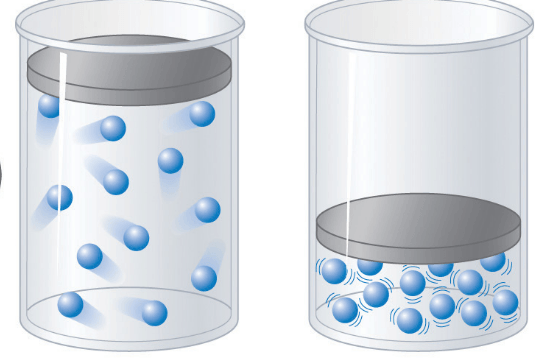
Which container will have a lower pressure?
left
right
they both have the same pressure
I don't know
Three gases, Ar, N2 and H2 are mixed in a 500 L container. Ar has a pressure of 255 torr, N2 has a pressure of 228 torr and H₂ has pressure of 752 torr. What is the total pressure in the container?
483 torr
270 torr
1235 torr

The total kinetic energy of a collection of gas molecules is inversely proportional to the absolute temperature of the gas.
True
False
In the KMT, pressure is the force exerted against the wall of a container by the continual collision of molecules against it.
True
False
According to the kinetic molecular theory, the volume actually occupied by the molecules of a gas is negligibly small; the vast majority of the volume of the gas is empty space through which the gas molecules are moving.
True
False

A student needs to know the temperature at which she should fill a balloon with 0.0470 mol of gas to 1.20 L so that the balloon reaches 0.998 atm of pressure.
Calculate the partial pressure of H2 at 20oC when the vapor pressure of water is 17.5 torr. The total pressure of the gases is 750 torr.
767.5torr
732torr
42.86torr
The total pressure of a mixture of oxygen and nitrogen gas is 400.0 kPa. What is the partial pressure of nitrogen if the pressure of oxygen is 150.0 kPa?
400.0 kPa
550.0 kPa
250.0 kPa
101.3 kPa
2Al + 6HCl --> 2AlCl3 + 3H2
Aluminium reacts with hydrochloric acid. How many grams of aluminum are necessary to produce 11 L of hydrogen gas at STP?
13
8.8
0.99
1.0
Mg3N2 + 3H2O ––> 3 MgO + 2NH3
If 10.3 g of magnesium nitride is used, what volume of ammonia gas would be collected at 20˚C and 0.989 atm?
4.9 L NH3
4.96 L NH3
0.261 L NH3
0.26 L NH3
1Mg + 2H2O --> Mg(OH)2 + H2
What volume of hydrogen will be produced at STP by the reaction 67.3 g of magnesium?
62.0 L
0.12 L
2.77 L
1.15 L
2NaN3 → 2Na + 3N2
At what pressure(atm) is the nitrogen gas sample that is collected when 48.4 g of NaN3 decomposes? The temperature of the gas is 25.0°C and the volume is 18.4 L.
151 atm
1130 atm
0.125 atm
1.48 atm
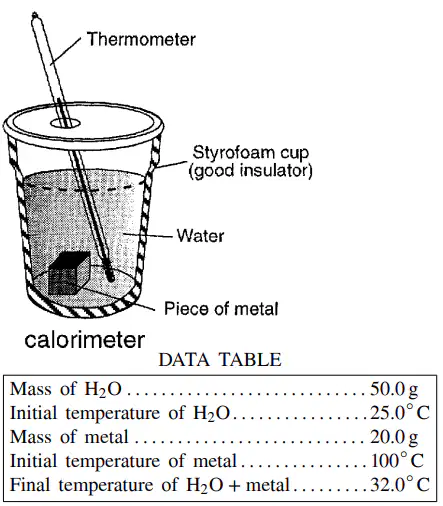
A student using a Styrofoam cup as a calorimeter added a piece of metal to distilled water and stirred the mixture as shown in the diagram. The student's data is shown in the table. Which statement correctly describes the heat flow in calories? (Ignore heat gained or lost by the calorimeter.)
The water lost 1360 calories of heat and the metal gained 140 calories of heat.
The water lost 350 calories of heat and the metal gained 350 calories of heat.
The water gained 1360 calories of heat and the metal lost 140 calories of heat.
The water gained 350 calories of heat and the metal lost 350 calories of heat.

The diagrams shown represents two solids and the temperature of each. What occurs when the two solids are placed in contact with each other?
Heat energy flows from solid A to solid B.
Heat energy flows from solid A to solid B. Solid A increases in temperature.
Heat energy flows from solid B to solid A. Solid B decreases in temperature.
Heat energy flows from solid B to solid A.
Two samples of gold that have different temperatures are placed in contact with one another. Heat will flow spontaneously from a sample of gold at 60°C to a sample of gold that has a temperature of (a) .
60°C
70°C
80°C
Which term represents a form of energy?
heat
degree
kilocalorie
temperature
When a chemical bond is broken, energy is (a) .
neither absorbed nor released
Which form of energy is converted to thermal energy when propane burns in air?
electromagnetic
nuclear
electrical
chemical
The temperature of a sample of water changes from 10°C to 20°C when the sample absorbs 418 joules of heat. What is the mass of the sample?
1 g
10 g
100 g
1000 g
How many joules of heat are absorbed to raise the temperature of 435 grams of water at 1 atm from 25°C to its boiling point, 100°C?
4.5 x 10⁴ J
1.4 x 10⁵ J
2.5 x 10⁷ J
7.4 x 10⁷ J
As a 15.1-gram sample of a metal absorbs 485.7 J of heat, its temperature increases 25.0 K. What is the specific heat capacity of the metal?
0.129 J/g•K
1.95 J/g•K
1.29 J/g•K
7.74 J/g•K
The temperature of 15 grams of water increased 3.0 °C. How much heat was absorbed by the water?
5.0 calories
12 calories
18 calories
45 calories
What is the specific heat of an unknown substance if 100.0 g of it at 200.0 °C reaches an equilibrium temperature of 27.1 °C when it comes in contact with a calorimeter of water. The water weighs 75. g and had an initial temperature of 20.00 °C? (Specific heat of water is 4.18 J/g⋅°C)
0.111 J/g⋅°C
1.29 J/g⋅°C
0.129 J/g⋅°C
22225.85 J/g⋅°C
Calorimetry Question:
A piece of metal with a mass of 32.8 g is heated to 100.5°C and dropped into 138.2 g of water at 20.0°C. The final temperature of the system is 30.2°C. What is the specific heat capacity of the metal? (Specific heat of water is 4.18 J/g⋅°C)
2.56 J/g⋅°C
0.391 J/g⋅°C
5.29 J/g⋅°C
3.50 J/g⋅°C
Consider the reaction:
H2O (l) + energy → H2 (g) + 1/2 O2 (g)
Which phrase best describes this reaction?
exothermic, releasing energy
exothermic, absorbing energy
endothermic, releasing energy
endothermic, absorbing energy
When a substance was dissolved in water, the temperature of the water increased. This process is described as
endothermic, with the release of energy
endothermic, with the absorption of energy
exothermic, with the release of energy
exothermic, with the absorption of energy
Which potential energy diagram represents the reactions A + B → C + energy?


Diagram D
A solid is dissolved in a beaker of water. Which observation suggests that the process is endothermic?
The solution gives off a gas.
The solution changes color.
The temperature of the solution decreases.
The temperature of the solution increases.
Which phase change is exothermic?
H2O(s) → H2O(l)
H2O(l) → H2O(s)
H2O(s) → H2O(g)
H2O(l) → H2O(g)
When NH4NO3 is dissolved in water, the temperature of the water decreases. When NaOH is dissolved in a separate water sample, the temperature of the water increases. Based on these observations, it can be concluded that the dissolving of
both salts is endothermic
both salts is exothermic
NH4NO3 is endothermic and the dissolving of NaOH is exothermic
NH4NO3 is exothermic and the dissolving of NaOH is endothermic
Given the reaction: Fe + S → FeS + energy. Which statement about this reaction is true?
It is endothermic
It is exothermic
The potential energy of the reactants is lower than the potential energy of the product.
The potential energy of the reactants is the same as the potential energy of the product.
Given the reaction:
2H2(g) + O2(g) → 2H2O(l) + 571.6kJ
What is the approximate ΔH for the formation of 1 mole of H₂O(l)?
−285.8 kJ
+285.8 kJ
−71.6 kJ
+571.6 kJ

The potential energy diagram shown represents the reaction
A + B → AB
Which statement correctly describes this reaction?
It is endothermic and energy is absorbed.
It is endothermic and energy is released.
It is exothermic and energy is absorbed.
It is exothermic and energy is released.
Which potential energy diagram represents an exothermic reaction?


Which statement describes characteristics of an endothermic reaction?
The sign of ΔH is positive, and the products have less potential energy than the reactants.
The sign of ΔH is positive, and the products have more potential energy than the reactants.
The sign of ΔH is negative, and the products have less potential energy than the reactants.
The sign of ΔH is negative, and the products have more potential energy than the reactants.
As a result of dissolving a salt in water, a student found that the temperature of the water increased. From this observation alone, the student should conclude that the dissolving of the salt (a) .
produced an acid solution
produced a basic solution
was endothermic
Which phase change is endothermic?
gas → solid
gas → liquid
liquid → solid
liquid → gas
Given the reaction:
H2O(l) + 68.3kcal ⇌ H2(g) + O2(g)
Which statement describes the reverse reaction?
It is endothermic and releases 68.3 kilocalories.
It is endothermic and absorbs 68.3 kilocalories.
It is exothermic and releases 68.3 kilocalories.
It is exothermic and absorbs 68.3 kilocalories.

Which statement correctly describes this reaction?
It is endothermic and energy is absorbed.
It is endothermic and energy is released.
It is exothermic and energy is absorbed.
It is exothermic and energy is released.

Which statement correctly describes this reaction?
It is endothermic and energy is absorbed.
It is endothermic and energy is released.
It is exothermic and energy is absorbed.
It is exothermic and energy is released.

The forward reaction is best described as an (a) .
exothermic reaction in which energy is released
exothermic reaction in which energy is absorbed
endothermic reaction in which energy is released
Given the balanced equation representing a reaction at 101.3 kPa and 298K:
N2 (g) + 3H2 (g) → 2NH3 (g) + 91.8 kJ
Which statement is true about this reaction?
It is exothermic and ΔH equals –91.8kJ.
It is exothermic and ΔH equals +91.8kJ.
It is endothermic and ΔH equals –91.8kJ.
It is endothermic and ΔH equals +91.8kJ.
The enthalpy change for a chemical reaction can be calculated using which of the following formulas?
ΔH=Hproducts−Hreactants
ΔH=Hreactants+Hproducts
ΔH=Hreactants−Hproducts
ΔH=Hproducts/Hreactants
Organize these options into the correct types of energy use.
absorbs energy
releases energy
splitting a molecule
forming a molecule
melting ice
NH4NO3 (s) + H2O(l) + 23.8 kJ → NH4OH(aq) + HNO3
6SOCl2 + CoCl2⋅6H2O → CoCl2 + 6SO2 + 12HCl ΔH=+
H2SO4 (aq) + 2NaOH (aq) → Na2SO4 (aq) + H2O (l) ΔH = −

Are the products or reactants of this reaction storing more energy in their chemical bonds?
Both storing the same
No way to tell
Products
Reactants
Some chemical reactions are (a) where the heat energy is absorbed. Other chemical reactions release heat energy are known as (b) .

In the figure, the reactants have (a) energy than the products. This indicates that energy has been (b) , making this an (c) reaction.
more

In the figure, heat energy is (a) during the reaction. This makes this an (b) reaction.
In an exothermic chemical reaction:
the mass of the products is greater than the mass of the reactants.
the mass of the products is less than the mass of the reactants.
heat is released as the reaction proceeds.
heat is absorbed as the reaction proceeds.

Based on the reaction CH4 (g) + 2O2 (g) → CO2 (g) + 2H2O (g) and its energy profile, the reaction (a) .
has a high activation energy.
is nonspontaneous.
violates the first law of thermodynamics.
Toasting a piece of bread is an example of an (a) .
What factor determines whether a reaction will be exothermic or endothermic?
the difference in energy between reactants and products
the activation energy of the reaction
the speed of the reaction
the relative concentrations of reactants and products in solution
the heat properties of the products
An endothermic reaction corresponds to one in which
(a)
the system releases energy to the surroundings.
the system neither absorbs nor releases energy.
the system's energy remains constant.
In chemical thermodynamics, a system is defined as (a) .

Which line on this diagram represents the enthalpy (potential energy) of the reactants?
A
B
C
D
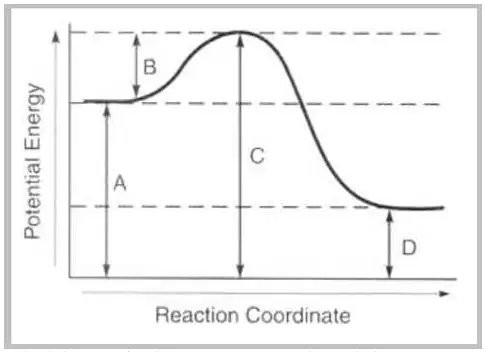
Which line on the diagram represents the enthalpy (potential energy) of the products?
A
B
C
D

Does this diagram represent an endothermic or exothermic overall reaction?
Endothermic, the products are higher in potential energy than the reactants.
Endothermic, the products are lower in potential energy than the reactants.
Exothermic, the products are lower in potential energy than the reactants.
Exothermic, the products are higher in potential energy than the reactants.

Choose the pair that correctly indicates the sign of ΔT and ΔH for the reaction in this diagram.
ΔH +, ΔT +
ΔH +, ΔT –
ΔH –, ΔT +
ΔH –, ΔT –
Which statement would be a correct interpretation of the First Law of Thermodynamics?
Energy can be transformed from one type to another (e.g., potential to kinetic).
Energy can be created spontaneously from nothing.
Energy cannot be transformed from one type to another (e.g., potential to kinetic).
Matter can be transformed into energy in a chemical reaction.
Which of the following will best help determine the direction of heat flow in a system?
temperature
pressure
enthalpy
work
internal energy
What mass of propane, C3H8 (g), must be burned to supply 2775 kJ of heat? The standard enthalpy of combustion of propane at 298 K is −2220 kJ·mol-1.
35.3 g
55.1 g
102 g
75.9 g
44.1 g
The heat of combustion of butane, C4H10, is −2623 kJ/mol. How much heat would be absorbed or evolved when 90. g butane is burned?
4062 kJ evolved
4062 kJ absorbed
2623 kJ absorbed
2623 kJ evolved
Consider the reaction: C2H5OH (l) + O2 (g) → 2CO2 (g) + 3H2O (g), ΔH = −1.37x10³ kJ/molrxn
When a 21.1 g sample of ethyl alcohol, C2H5OH, is burned, what is the change in enthalpy? The molar mass of ethanol is 46.07 g/mol.
−0.458 kJ
0.627 kJ
−6.27x10² kJ
2.89x10⁴ kJ
Consider the reaction:
CH4 (g) + 4Cl2 (g) → CCl4 (g) + 4HCl (g); ΔH = −434 kJ/molrxn
What is the change in enthalpy, ΔH, when 43.7 g of Cl₂ reacts completely as shown above?
−286 kJ
−66.9 kJ
−535 kJ
−134 kJ
When the volume of solvent increases, the mass of solute that can dissolve in a saturated solution...
increases
decreases
stays the same
When the volume of solvent increases, the solubility of a solute at a given temperature...
increases
decreases
stays the same
In general as temperature of a mixture of a solid in a liquid decreases, what happens to the solubility of the substance...
it increases
it decreases
it stays the same
it may increase or decrease depending on whether the solid is ionic or molecular
I have an unsaturated solution of 15.0 grams of KNO3 in 100. grams of water. I can make it saturated by adding what?
KNO3 (s)
H2O (l)
KCl (s)
Ca(NO3)2 (s)
Calculate the molarity of a solution containing 1.5 moles of NaCl in 0.50 L of solution.
1.5 M
0.33 M
30. M
3.0 M
How many moles of NaCl are present in a solution with a molarity of 8.59M and 125 mL of solution?
68.7 mmol
68.7 mol
1.07 mol
14.5 mmol
What is the molarity of a solution which contains 224.1 milligrams of NaCl in 50.0 mL of solution?
0.448 M
0.192 M
3.83 M
0.0767 M
How many moles of a solute are needed to make 2.5 L of a 0.38 M solution?
0.95 mol
6.6 mol
0.15 mol
1.5 mol
What is the molarity of a solution of NaOH that contains 2.5 mol in 12.0 L of solution?
0.21 M
0.30 M
4.8 M
3.0 M
A 360. mg sample of aspirin, C9H8O4, (molar mass 180. g), is dissolved in enough water to produce 200. mL of solution. What is the molarity of aspirin in a 50.0 mL sample of this solution?
0.0800 M
0.0400 M
0.0200 M
0.0100 M
0.00250 M
A 40.0 mL sample of 0.25 M KOH is added to 60.0 mL of 0.15 M Ba(OH)2. What is the molar concentration of OH-(aq) in the resulting solution? (Assume that the volumes are additive.)
0.10 M
0.19 M
0.28 M
0.40 M
0.55 M
Any salt that dissolves in water breaks up entirely into ions. How many mmoles of Na+ ions are in 100. mL of 0.100 M Na3PO4 (aq)?
0.300 mmol
10.0 mmol
30.0 mmol
0.0100 mmol
How many grams of CaCl2 (molar mass = 111 g/mol) are needed to prepare 100. mL of 0.100 M Cl-(aq) ions?
0.555 g
1.11 g
2.22 g
5.55 g
Solid Al(NO3)3 is added to distilled water to produce a solution in which the concentration of nitrate, [NO3-], is 0.10 M. What is the concentration of aluminum ion, [Al3+], in this solution?
0.010 M
0.033 M
0.10 M
0.30 M


True or False?

When Koolaid mix is light colored and tastes watery it is a _______ solution.
concentrated
dilute
When a Koolaid mix in water is dark in color and very sweet it is a __________ solution.
Concentrated
Dilute


According to Brønsted-Lowry acid base theory, an acid ___.
is a proton donor
is a proton acceptor
produces H+ when added to water
turns phenolphthalein pink
According to Arrhenius acid-base theory, an acid ___.
is an H+ acceptor
is a H+ donor
is a substance that produces H+ in water
turns litmus paper blue

Which reactant in the following equation is acting as a Brønsted-Lowry acid?
ammonium
ammonia
hydroxide
water
HSO4-(aq) + H2O(l) → H3O+(aq) + SO42-(aq)
Identify the Brønsted-Lowry acid in the above reaction.
HSO4-
H2O
H3O+
SO42-
CO32-(aq) + H2O(l) → HCO3-(aq) + OH-(aq)
Using the above reaction, which species is the conjugate base?
CO32-
H2O
HCO3-
OH-

Choose the conjugate acid of OH-
HCO3-
OH-
CO32-
H2O

Choose the conjugate base of HNO3
HNO3
H2O
H3O+
NO3-
True or False: All Arrhenius acids are also Brønsted-Lowry acids.
True
False
Which of the following substances is both a Brønsted-Lowry acid and an Arrhenius base?
NH3(aq)
LiOH(aq)
HCl(g)
HCl(aq)
Which of the following is a polyprotic acid?
HCl
H2SO4
HNO3
HF
Which of the following is the hydronium ion?
H+
H2O
OH–
H3O+
Which substance is an Arrhenius base?
KCl
CH3Cl
KOH
CH3OH
The conjugate acid for NH3 is
NH2
N
H3
NH4+
According to Arrhenius acid-base theory, a base ___.
is an H+ acceptor
is a H+ donor
is a substance that produces OH- in water
turns litmus paper red
According to Brønsted-Lowry acid base theory, a base ___.
is a proton donor
is a proton acceptor
produces OH- when added to water
has a bitter taste
Which of the following pH numbers indicate a strong (base)alkali?
Which of the following is alkali?


Which of the following is neutral?
... are used to neutralise acid in the stomach.
Toothpastes
Bacterias
Antacids
More strong acids
What is the purpose of an "indicator"?
changes color if a chemical reaction occurs
changes color if a physical change occurs
changes color in the presence of an acid or base
changes color when a salt dissolves in water

WHAT ARE THE PROPERTIES OF ACID ?
Acids are corrosive, sour,
Lemon
Mint
tastes bitter

How to neutralise wasp sting
baking soda
vinegar
Lime water
Drain cleaner
A STRONG ACID is one that...
completely dissociates in water & produces H3O+
completely dissociates in water & produces OH-
partially dissociates in water & produces H3O+
partially dissociates in water & produces OH-
If something has a pH of LESS THAN 7, it is...
an acid
a base
neutral
not on the pH scale
If a formula has an "O" in it, will it say HYDRO in the name?
no
yes
depends on the other element
yes, if it is combined with a halogen
-ate = ______
-ite
-ic
-ous
-ide
When you add the pH and the pOH it should equal what?
14
20
7
15
Which one is the CONJUGATE BASE in the equation?
HCl + H2O--> Cl- + H3O+
HCl
H2O
Cl-
H3O
If something has a pH of GREATER THAN 7, it is...
an acid
a base
neutral
not on the pH scale
Is HBr a strong or weak acid or base?
strong acid
strong base
weak acid
weak base
If [OH-] = 1.7 x 10⁻³ M, what is the pOH of the solution?
2.77
1.99
9.96
5.01
Is LiOH a strong or weak acid or base?
strong acid
strong base
weak acid
weak base
Which one is the ACID in the equation?
HCl + H2O--> Cl- + H3O+
HCl
H2O
Cl-
H3O+
Which one is the CONJUGATE ACID in the equation?
HCl + H2O--> Cl- + H3O+
HCl
H2O
Cl-
H3O+
Which one is the BASE in the equation?
HCl + H2O--> Cl- + H3O+
HCl
H2O
Cl-
H3O+
Which of the following contains acids?
Milk
Bleach
Ammonia
Chalk
1.0 x 10⁻³M?

CH3NH2 + H2O --> CH3NH3+ + OH-
CH3NH2 can be classified as which of the following? (HINT...follow the H+!!!)
2 HI(aq) + CaO(s) → CaI2(aq) + H2O(l)
(HINT... acid + base → conj.acid + conj.base)
(HINT...check your notesheet "properties of acids & bases")
NH3(g) + H2O(l) → NH4+(aq) + OH-(aq)
(HINT...use your notes that you copied off the board for warm-up today)
(HINT...be careful! Acidity and basicity are determined by the point measured on the pH scale. And don't forget [H+] = 10-pH)
(HINT...pH + pOH = 14 and
[OH-] = 10-pOH)
(HINT...use the calculator...
pH = -log [H+] )

