
 Worksheets
ECONOMICS EXAM 2
Total questions: 36
Worksheet time: 18mins
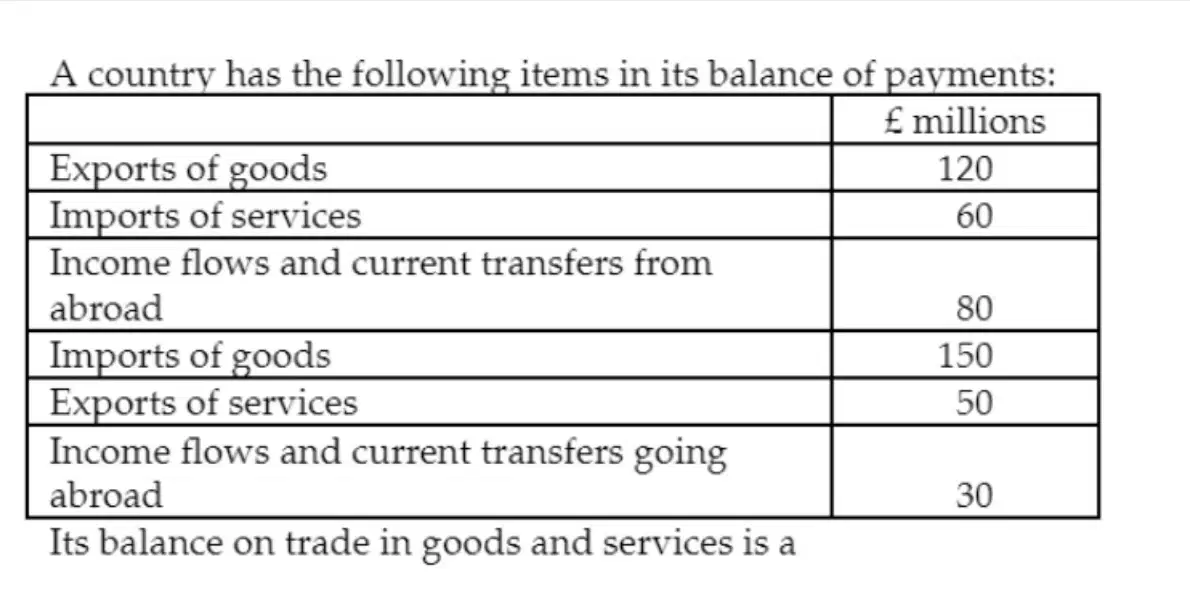
Its balance on trade in goods and services is a
deficit of £30m
deficit of £40m
surplus of £10
deficit of £20m
The price elasticity of demand for bottled water in Yorkshire is -2, while the price elasticity of demand for bottled water in London is -0.8. In other words, demand in Yorkshire is __________ and demand in London is ___________
elastic, unitarily elastic
highly inelastic, slightly inelastic
elastic, inelastic
inelastic, elastic
A central bank wishing to operate a tighter monetary policy might
lower interest rates to encourage spending and discourage saving
reduce interest rates but use open-market operations so as to reduce the money supply
promote investment in other countries by domestic frims
raise interest rates and use open-minded operations so as to reduce the money supply

For a given amount of resources, Japan and the UK can produce the following quantities of motorbikes or bicycles: Which statement is correct?
Japan has a comparative advantage in bicycles
The UK has a comparative advantage in bicycles
The UK has a comparative advantage in motorbikes
The UK has an absolute advantage in bicycles
Assume that the UK's unemployment rate is 10% and the inflation rate is 1%. The most likely policy for the Bank of England to pursue would be to
do nothing because the inflation rate is so low
increase interest rates to try to bring the inflation rate to zero
decrease interest rates so long as predicated inflation remained below 2%
decrease interest rates to try to eliminate unemployment
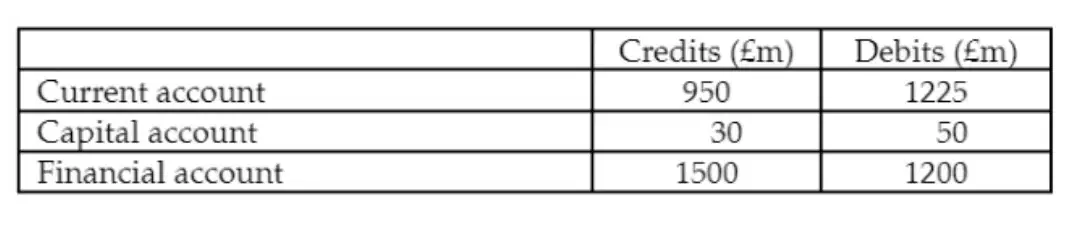
How much are net errors and omissions?
$5
-$5
15$
$20
The government is going to increase the tax on petrol to raise additional revenue for road repairs. The government will be able to raise more revenue by raising the petrol tax if the demand for petrol is
relatively elastic
perfectly elastic
relatively inelastic
unitarily elastic
When the price of a good falls and customers tend to buy more of it instead of the other goods, economists call this the ________________ effect.
diminishing marginal utility
substitution
income
ceteris paribus
If the central bank raises interest rates it will
raise aggregate demand and lower the exchange rate
raise aggregate demand and raise the exchange rate
lower aggregate demand and raise the exchange rate
lower aggregate demand and lower the exchange rate
Which of the following is the most likely cause of a decrease in demand for petrol?
An increase in bus fares
A decrease in the price of cars
A decrease in the price of petrol
The imposition of road charging in most major cities
If the budget deficit is lower than it was last year, we could say that
the government must have an expansionary fiscal stance
other things being equal, the level of aggregrate demand will be lower than it was last year
the general government debt will fall
other things being equal, the level of aggregate demand will be higher than it was last year
A movement upward along the demand curve to the left could be caused by
a rise in income
a decrease in supply
a rise in inflation
a fall in the price of substitutes
Which of the following represents an actions by a central bank which has the effect of increasing the money supply?
Buying government securities in the open market
An increase in government spending
An increase in its repo rate
Requiring banks to keep a higher liquidity ratio
The owner of a local hot dog stand has estimated that if she lowers the price of hot dogs by a low margin she will increase sales from 400 to 500 hot dogs per day (seems like demand is highly responsive to the price). The demand for hot dogs is
unitarily elastic
inelastic
elastic
perfectly elastic
When a decrease in the price of good A causes a increase in demand for good B, the goods are
substitutes
complements
inferior
normal
Inferior goods are best defined as
goods whose supply falls as people's income rises
goods that only those who are relatively poor purchase
goods whose demand falls as people's income rises
goods that have higher-quality alternatives
If a country has negative outward FDI, this means that
inward FDI exceeds outward FDI
sales of existing investments abroad exceed new investments abroad
outward investment as a percentage of inward investment is falling
sales of foreign assets in the country exceed sales of the country's assets abroad
A university decides to raise tuition fees to increase the total revenue it receives from students. This strategy will work if the demand for this institution's education is
inversely related to price
unitarily elastic
inelastic
elastic
Fiscal stance refers to
a government that prefers the use of fiscal to monetary policy for demand management
whether a government is pursuing an expansionary or contractionary fiscal policy
a government that takes a tough stance when it comes to running the country's finances
a government that is running a budget deficit
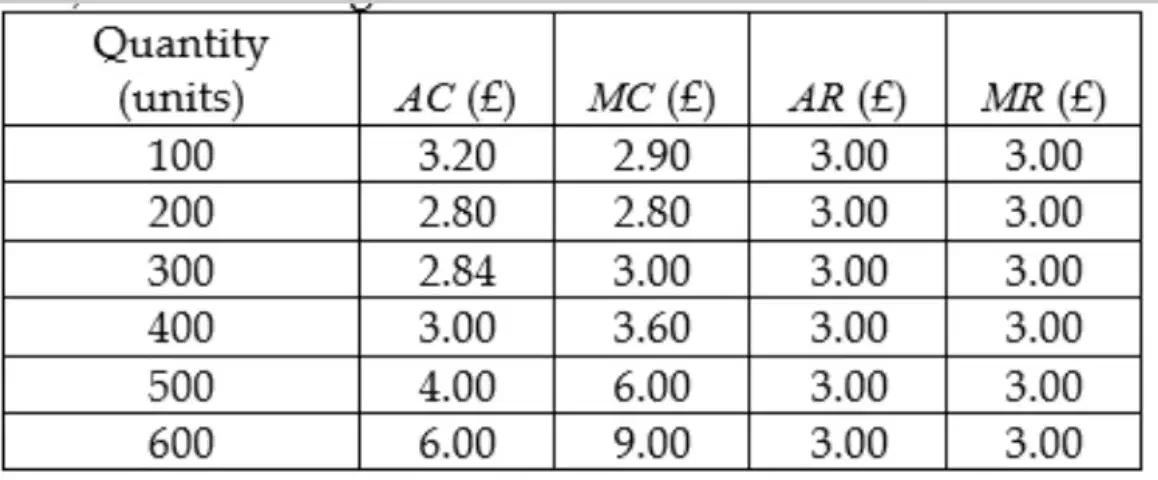
The following table shows costs and revenue schedules for a firm. How much total profit will the firm make at the profit-maximising level of output?
Assume that supply increases by 40 units at all prices. What will be the effect on equilibrium price?
£40
£16
£0
£48
Which one of the following correctly describes how price adjustments eliminate a surplus?
As the price rises, the quantity demanded will increase while the quantity supplied will decrease
As the price rises, the quantity demanded will decrease while the quantity supplied will increase
As the price falls, the quantity demanded will increase while the quantity supplied will decrease
As the price falls, the quantity demanded will decrease while the quantity supplied will increase
Which one of the following statements is correct?
If a supply curve shifts to the left this will lead to a surplus at the original price.
If a supply curve shifts to the left the new equilibrium price will be lower.
If a demand curve shifts to the left this will lead to a surplus at the original price.
If a demand curve shifts to the left the new equilibrium price will be higher.
Which of the following is most likely to be a variable cost for a firm?
The monthly rent on office space that it leased for a year
The taxes that are paid on employee wages
The franchiser's fee that a restaurant must pay to the national restaurant chain
The interest-payments made on loans
If the economy were booming, we would expect
government expenditure to be low and tax revenues to be high so that the public sector might be running a surplus
government expenditure to be low and tax revenues to be low so that the government could pay off the central government debt
government expenditure to be low and tax revenues to be low causing a large budget deficit
none of the above
A vertically integrated multinational is one that
one which exports more than 50% of output
produces the same product in more then one country
produces different products in differents countries
produces various stages of production in different countries
Which of the following correctly describes how price adjustments eliminate a shortage?
As the price rises, the quantity demanded will increase while the quantity supplied will decrease
As the price falls, the quantity demanded will decrease while the quantity supplied will increase
As the price rises, the quantity demanded will decrease while the quantity supplied will increase
As the price falls, the quantity demanded will increase and the quantity supplied will increase
Transfer pricing may be a problem for host countries as
the cost of exchanging one currency for another is costly in monetary terms and time.
profits are always removed to the host country.
prices are transferred to the local currency resulting in losses if exchange takes place on a day when the exchange rate is 'low'.
profits may not be accurately recorded as occurring in the host country.
How much are net errors and omission?
-£20m
+£20m
-£10m
+£10m
The law of diminishing marginal utility allows us to conclude that
demand curves slope downward to the right
total utility will increase by an increasing amount as consumption increases
supply curves slope upward
a consumer will buy positive amounts of all goods

the following table shows the demand and supply schedules for good X
Fall by £1
Fall by £2
Rise by £1
Rise by £2
Reasons for supply curves being positively sloped include:
the higher the demand for a good the more firms can charge
typically, as output rises, unit costs rise, so price must also rise
firms always want to raise prices to boost profits
all of the above
Which of the following is the most likely cause of a decrease in demand for petrol?
An increase in bus fares
A decrease in the price of cars
A decrease in the price of petrol
The imposition of road charging in most major cities
If Argentina has an absolute advantage in the production of wheat and Chile has an absolute advantage in the production of copper, then
neither country has anything to gain from specialisation and trade.
it is reasonable to expect that specialisation will benefit both countries, but trade will not
it is reasonable to expect that trade will benefit both countries, but specialisation will not.
it is reasonable to expect that specialisation and trade will benefit both countries.
Which of the following explain why China has received relatively high levels of FDI?
Heavy investment by the government in infrastructure
The economy is growing rapidly
It is a huge economy, with the largest population in the world
All of the above
There are two goods A and B. In Which of the following cases will good A have the more price elastic supply? 34
A higher proportion of national income is spent on A than on B.
The cost of producing extra units increases more rapidly in the case of A than in the case of B.
Consumers find it easier to find alternative to A than to B
If it is less costly to shift from producing A to another product than it is to shift from producing B to another product.
The main advantage of trade between two countries os that
trade makes both countries more self-sufficient
both countries can consume beyond their previous resource and productivity constraints.
both countries can produce beyond their previous resource and productivity constraints
employment in both countries will increase

