
 Worksheets
vanstaden Standard WORLD FINAL Spring 24
Total questions: 107
Worksheet time: 54mins
Name
Class
Date
1.
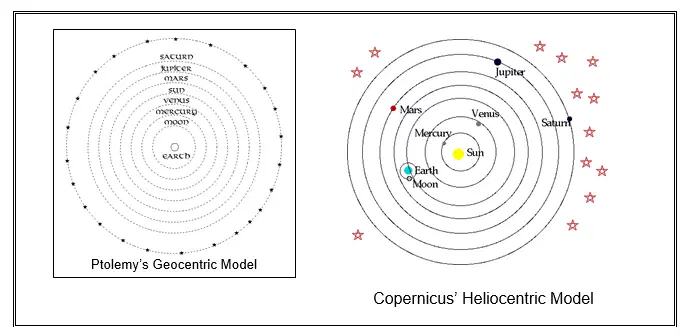
In what movement, was the Heliocentric Model (showed below) discovered and proved?
a)
The Enlightenment
b)
The French Revolution
c)
The Scientific Revolution
d)
The Industrial Revolution
2.
What definition best describes Globalization?
a)
the idea that the Globe is actually actually less circular than earlier thought
b)
the idea that communities becomes less connected and more isolated as time goes by
c)
the idea that politically most countries are exactly the same but socially they are very diverse
d)
the idea that the world has become more connected economically, politically, socially, and culturally over time
3.
The U.S Economy is based on which of the following?
a)
Materialism
b)
Organicism
c)
Frugality
d)
Conservationism
4.
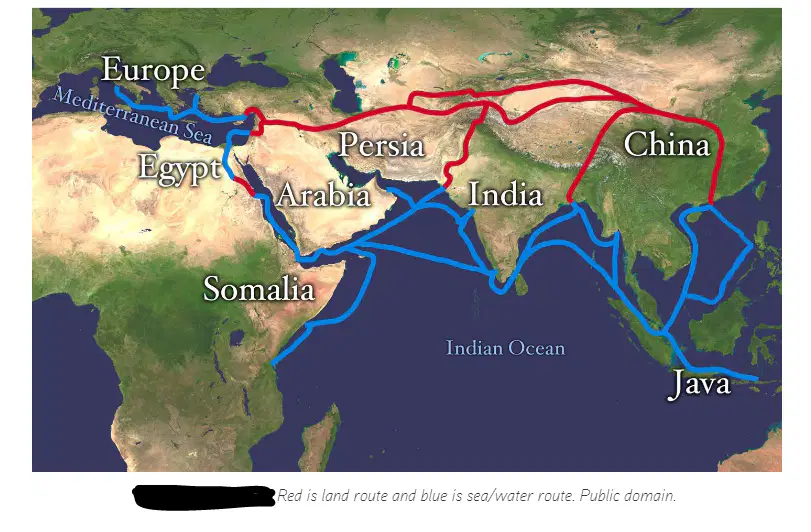
What famous route is displayed on the map below?
a)
Silk Road Routes
b)
Spread of Black Death
c)
Mansa Musa Pilgramage
d)
Columbian Exchange
5.
Which of the following would be considered a primary source.
a)
Textbooks
b)
Wikipedia
c)
photographs
d)
Books on History
6.
True or False? The Silk Road only spread physical goods like silk, spices, weaponry, and pottery.
a)
True
b)
False
7.
Where was the Black Plague the worst?
a)
China
b)
Europe
c)
South America
d)
Southern Africa
8.
How did the success of the Mongol state (Pax Mongolica) help the Black Death spread?
a)
The Mongols actually did not help the Black Death spread but it is a common misconception.
b)
The Mongols established relative peace which encouraged trade, increased trade then helped the disease to spread.
c)
The Mongols invented the black death as a form of biological warfare
d)
The Mongols slowed down trade - this allowed the disease to worsen in certain contained areas.
9.
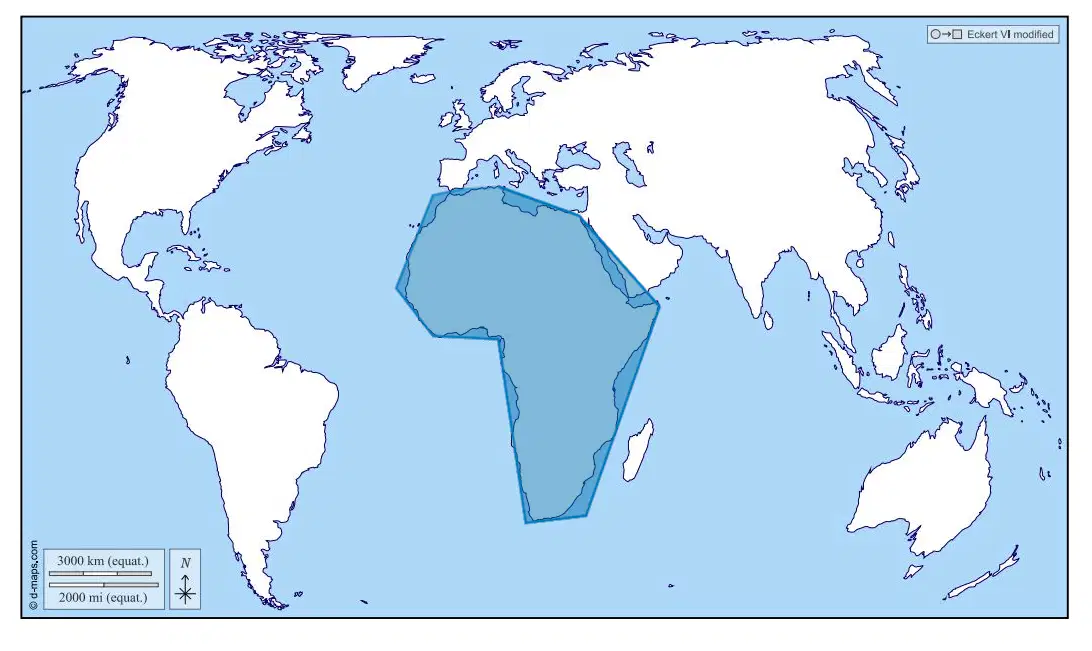
What continent is circled in Blue?
a)
North America
b)
Africa
c)
South America
d)
Asia
10.
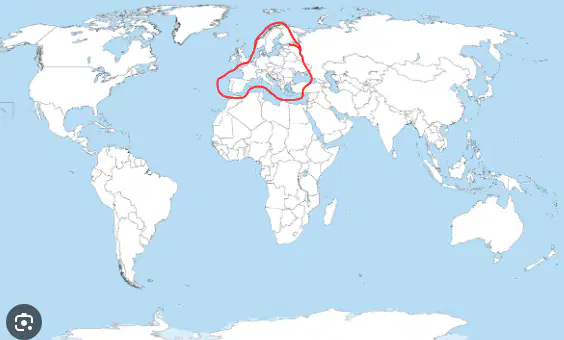
What continent is circled in red?
a)
North America
b)
Asia
c)
Africa
d)
Europe
11.
A list of sources (books, journals, Web sites, periodicals, etc.) one has used for researching a topic is referred to as a
a)
Bibliography
b)
Annotation
c)
Summary
d)
Listograph
12.
Which of the following are unobservable elements of culture?
a)
Emotions
b)
Language
c)
Art
d)
Behaviour
13.
What was the system of Segregation called in South Africa?
a)
Apartheid
b)
Boka Haram
c)
Rwandan Genocide
d)
The Troubles
14.
What event led to the schism in the Christian Church in Europe and created an entirely new religion?
a)
Rwandan Reformation
b)
Independence of Ireland
c)
Protestant Reformation
d)
Mansa Musa Pilgramage
15.
_____ are the raw materials of history — original documents and objects that were created at the time under study.
a)
Primary sources
b)
Secondary Sources
c)
Credibility
d)
Bias
16.
_______ are created later by someone that did not experience firsthand or participate in the events in which the author is writing about.
a)
Primary sources
b)
Secondary Sources
c)
Credibility
d)
Bias
17.
________ is an economic and social system in which people were given land and protection by people of higher rank, and worked and/or fought for them in return.
a)
Imperialisms
b)
Feudalism
c)
Caliphatism
d)
Dynastic Cycle
18.

Madrid (shown below) is the capitol city of this Country that is bordered by Portugal and France. What country is this?
a)
Spain
b)
Germany
c)
England
d)
Egypt
19.

What country (shown below) is a large island of the east cost of Africa?
a)
Madagascar
b)
South Africa
c)
Namibia
d)
Zimbabwe
20.
What is gunpowder diplomacy?
a)
Using a fleet or army to force other countries to agree to economic or diplomatic terms.
b)
Using gunpowder as a trading commodity to get allies to work with you.
c)
Giving gunpowder to the colonized people so that they will attack each other.
d)
Refusing to use gunpowder as a show of pacifism and creating a domino effect of peaceful coexistence
21.
Define Imperialism.
a)
extending a country's power and influence through diplomacy or military force.
b)
travel in or through (an unfamiliar country or area) in order to learn about or familiarize oneself with it.
c)
an unusual and exciting, typically hazardous, experience or activity.
d)
the subjugation and assumption of control of a place or people by use of military force.
22.

What body of water is between the Arabian Peninsula and the continent of Africa?
a)
Mediterantian Sea
b)
Red Sea
c)
Persian Gulf
d)
Black Sea
23.
Fill in the blank: _________ are complex political organizations where a dominant central state controls weaker peripheries.
a)
Feudalisms
b)
Empires
c)
Cultures
d)
National Identities
24.
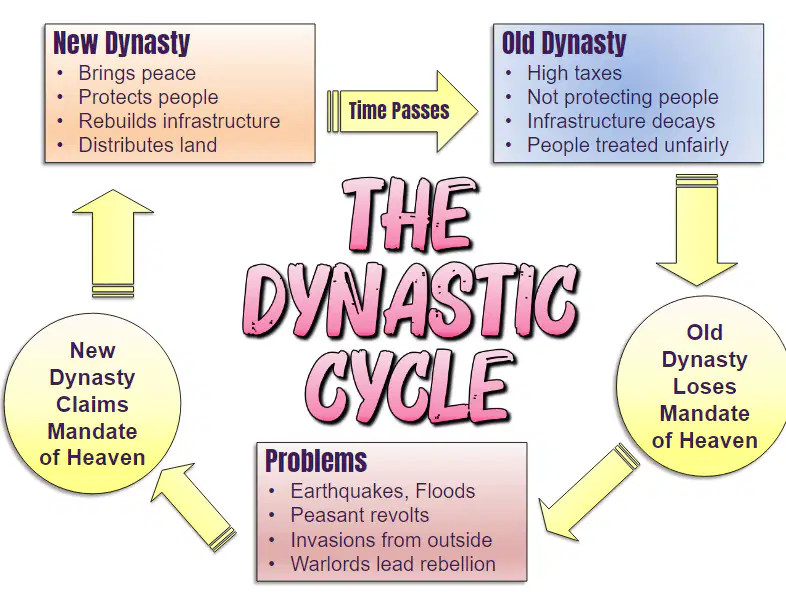
Which Empires are most associated with the Dynastic cycle?
a)
Islamic Empires
b)
Roman Empire
c)
Japanese Empires
d)
Chinese Empires
25.
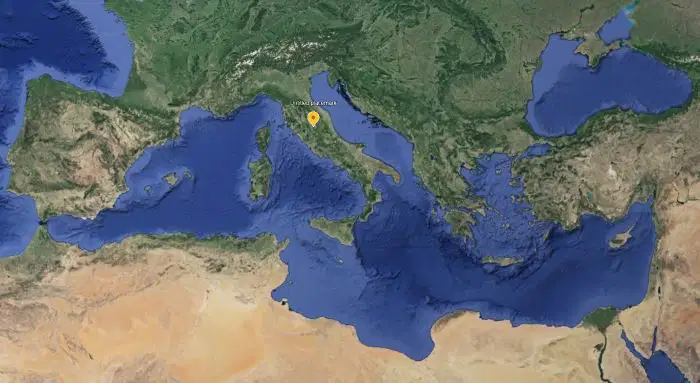
The yellow mark denotes which nation?
a)
Italy
b)
France
c)
Sardinia
d)
Croatia
26.
What body of water is between Europe and North Africa?
a)
Mediteranian Sea
b)
Red Sea
c)
Pacific Ocean
d)
Indian Ocean
27.
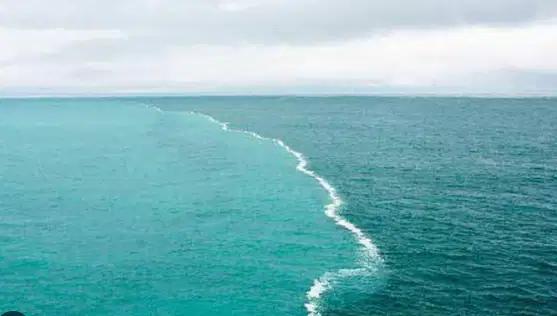
What two bodies of water meet at the tip of Africa? (Choose 2)
a)
Indian Ocean
b)
Pacific Ocean
c)
Atlantic Ocean
d)
Arabian Ocean
28.
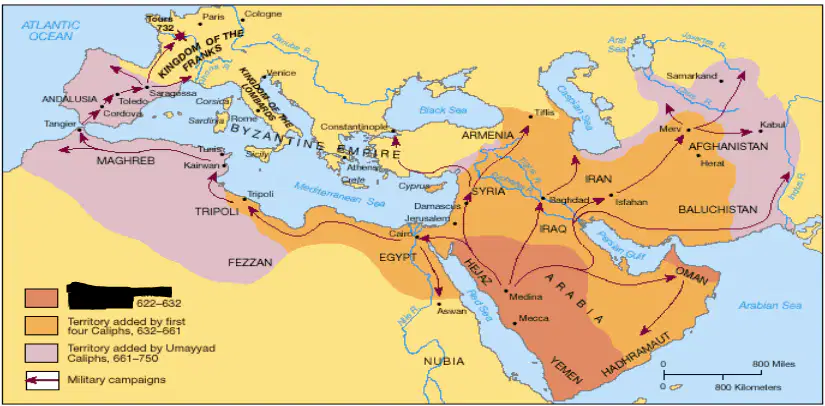
What is the Map below showing?
a)
Growth of Islamic Empires
b)
Division of Roman Empires into Western and Eastern Roman Empires
c)
Growth of Mongol Empire
d)
Division of Daimyos over time in Japanese Empires
29.

This is Cairo capital city of Egypt. What is the name of the river flowing through town?
a)
The Nile
b)
The Amazon
c)
The Mississippi
d)
The Danube
30.

This highway connects the Moroccan border to Tunisia. In order do this the highway must pass through what nation?
a)
Algeria
b)
Libya
c)
Spain
d)
Egypt
31.

Roman ruins of Volubilis, Morocco. This site is proof that the Roman Empire expanded in to which region?
a)
Northern Africa
b)
The Middle East
c)
The Anatolian Peninsula
d)
The Sinai Peninsula
32.

The Springboks on their tour of their country after winning the 2019 Rugby World Cup.
Which is their country?
a)
South Africa
b)
Egypt
c)
Algeria
d)
East India
33.

The nations highlighted in red show the peak landholdings in 1921 of what empire?
a)
England
b)
France
c)
Germany
d)
USA
34.
How did emperors use religion to increase their authority?
a)
Many often claimed their authority to rule came from a God or the heavens.
b)
Most Emperors allowed absolute religious freedom, in this way more religions meant more power for them.
c)
Most Emperors choose to keep religion and government completely separate.
d)
Many emperors were atheist and completely reject religion - they would then force their subjects to do the same.
35.
Which invention allowed the textile factories to operate away from a source of moving water?
a)
Richard Arkwright's water frame.
b)
Jethro Tull's seed drill.
c)
Henry Cort's puddling process.
d)
James Watt's steam engine.
36.
What below statement is true in regards to Fair Trade?
a)
Off the Rack Fashion Corporations (H&M, Old Navy, Shein) are fair trade because they have fair prices.
b)
Companies like People Tree are fair trade because they ensure their materials are ethical and their workers have adequate pay.
c)
Fair Trade is the reason why workers are paid so little in developing companies - they lobby politicians to keep pay low.
d)
Fair Trade is the idea that consumption is positive for communities and mental health.
37.
True or False? Socialism is an economic system where the gap between rich and poor is completely eliminated.
a)
True
b)
False
38.
Which scientist was responsible for proving the Heliocentric Theory?
a)
Nicolas Copernicus
b)
Galileo Galilei
c)
Issac Newton
d)
Versalius
39.
The French Revolution is most linked to which issue.
a)
Excessive taxation of the largest and poorest population.
b)
The end of Slavery
c)
Taxation without Representation
d)
Opposition to the Chinese Communist Party and restriction of rights
40.
How is Monsanto different than Norman Borlaug?
a)
They are not. Both patented their seeds for profit.
b)
Normal Borlaug's ultimate goal was profit and the breaking apart of farming communities.
c)
Monsanto patents their seeds for profit - Norman Borlaug did not.
d)
Monsanto discouraged the use of chemical pesticides and fertilizers, Norman encouraged their use.
41.
The American Revolution is most linked to which issue.
a)
Excessive taxation of the largest and poorest population.
b)
The end of Slavery
c)
Taxation without Representation
d)
Opposition to the Chinese Communist Party and restriction of rights
42.
The Haitian Revolution is most linked to which issue.
a)
Excessive taxation of the largest and poorest population.
b)
The end of Slavery
c)
Taxation without Representation
d)
Opposition to the Chinese Communist Party and restriction of rights
43.
The Hong Kong Protests are most linked to which issue.
a)
Excessive taxation of the largest and poorest population.
b)
The end of Slavery
c)
Taxation without Representation
d)
Opposition to the Chinese Communist Party and restriction of natural rights
44.
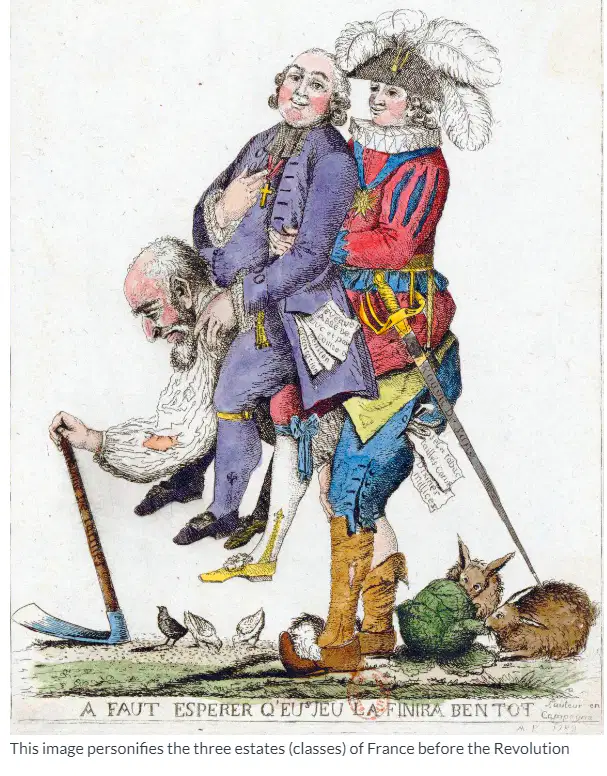
Which revolution is represented below?
a)
French Revolution
b)
Haitian Revolution
c)
American Revolution
d)
Hong Kong Protests
45.

Pictured Below is
a)
President Xi Jingping
b)
Chairman Mao
c)
President Vladimir Putin
d)
Prime Minister Fumio Kishida
46.
What nation had control of Hong Kong before returning it to China.
a)
England
b)
Austrailia
c)
United States
d)
France
47.
In Hong Kong, which of the following best describes the protesters?
a)
The majority were an Older population because they understood what they would lose if China took full control of Hong Kong.
b)
The majority were a Middle Aged population who were concerned about the future for their children.
c)
The protests were made up of a diverse group of people - which showed the unity from the public of Hong Kong.
d)
The protests were made up of mostly young high school and college aged students who wanted to safeguard their futures and felt they had nothing to lose.
48.
This man is considered the father of modern anatomy.
a)
Andreas Vesalius
b)
Nicholas Copernicus
c)
Godwin Frankenstien
d)
Sapien Vivisect
49.
What European first proposed that the earth revolves around the sun?
a)
Isaac Newton
b)
Andreas Vesalius
c)
Nicholas Copernicus
d)
Galileo Galilei
50.
What European first codified the laws of gravity?
a)
Isaac Newton
b)
Andreas Vesalius
c)
Nicholas Copernicus
d)
Galileo Galilei
51.
The ____________ was 12,000 years ago and includes the process of humans transitioning from hunter gatherers to the domestication of plants and animals.
a)
Scientific Revolution
b)
First Agricultural Revolution
c)
Second Agricultural Revolution
d)
Green Revolution
52.
The ____________ occurred at first in England and describes the process by which land in England began to be enclosed and used for large scale farming - the goal of farming changed from feeding your own community to making a profit from farming. New technology and higher yield crops were used to increase yield.
a)
Scientific Revolution
b)
First Agricultural Revolution
c)
Second Agricultural Revolution
d)
Green Revolution
53.
True or False? New technology from the Green Revolution benefited small rural farmers the most.
a)
True
b)
False
54.
What two things were needed for Norman Borlaug's approach to agriculture?
a)
Small divided tracts of land
b)
Chemical Fertilizer
c)
Irrigation System
d)
Wheat Rust
55.
Which of the following describes urbanization?
a)
the process through which cities grow, and higher and higher percentages of the population come to live in the city.
b)
an open swath of land that has few homes or other buildings, and not very many people.
c)
the art and science of cultivating the soil, growing crops, and raising livestock.
d)
a practice of domination, which involves the subjugation of one people to another.
56.
Which of the following describes rural?
a)
an open swath of land that has few homes or other buildings, and not very many people.
b)
the art and science of cultivating the soil, growing crops, and raising livestock.
c)
a practice of domination, which involves the subjugation of one people to another.
d)
the process through which cities grow, and higher and higher percentages of the population come to live in the city.
57.
What were two negative impacts of the Green Revolution?
a)
More chemicals in environment
b)
Pollution from factories increased by 63%.
c)
Cultural disruption in the lives of small farmers in India and Mexico
d)
Food supply decreased
58.
Where do fossil fuels come from?
a)
They began forming hundreds of millions of years ago from the remains of plants and animals that were buried deep in sediment underground.
b)
They began forming only in the 1800's which is what made the Industrial Revolution possible.
c)
Labs formed them as a part of the Scientific Revolution.
d)
They are a byproduct of the Agricultural Revolution - they came from waste from the harvests.
59.
Which of the following statements about Capitalism are true? (choose 2)
a)
Capitalism encourages private property and and little to no government regulation.
b)
Capitalism lessons the gap between rich and poor.
c)
Capitalism promotes inequalities in social classes.
d)
Capitalism focuses on protecting the working class and their safety.
60.
True or false? Socialism supports the violent overthrow of the rich/capitalists class.
a)
True
b)
False
61.
Karl Marx should most be associated with which economic system?
a)
Capitalism
b)
Socialism
c)
Communism
d)
Agriculturalism
62.
Which of the following statements about Communism are true?
a)
Communism believes that private ownership promotes competition.
b)
Communism believes that capitalism is flawed, in the pursuit of profit, capitalists take advantage of working class
c)
Communism seeks to completely eliminate the gap between rich and poor.
d)
Communism encourages competition among private businesses and corporations.
63.
Which of the following is not taken into account in measuring profit and the GDP? (choose 2)
a)
Environmental Cost
b)
People's work and struggle
c)
Price of goods and items
d)
Price of materials
64.
Which of the following is true about industrialization in England in the 1800's and Industrialization in developing countries in modern times?
a)
In both, Industrialization was encouraged by the enclosure movements which enclosed public land.
b)
In both, Industrialization was limited by government intervention - governments stepped into ensure the safety of workers.
c)
In both, Family units were or are being broken apart in some way.
d)
In both, innovations failed and caused capitalists to revert to the cottage industry.
65.
GMO stands for _____________________________________.
a)
Genetically Modified Organism
b)
General Monetary Organization
c)
Genetically Moderated Organization
d)
Geriatric Morphing Organism
66.
Adam Smith should most be associated with which economic system?
a)
Capitalism
b)
Socialism
c)
Communism
d)
Agriculturalism
67.
Which of the following are impacts of the Industrial Revolution?
a)
Cleaner air
b)
Movement from cities to countryside
c)
Population decrease
d)
Poor working conditions for the working class
68.
Select the correct definition from the list, for Culture
a)
A system of beliefs that only have to do with afterlives, Gods, worship rituals, and often a holy book that outlines rules for life.
b)
The habits, traditions, behaviors and beliefs of groups, and peoples.
c)
An event in history that has monumental and lasting significance also called a watershed
d)
an over-generalized belief, opinion, or prejudiced attitude about a particular group or category of people; or about what someone or something is like
69.
Which person is most associated with Islam?
a)
Muhammed
b)
Siddthartha Guatma
c)
Noah
d)
Jesus Christ
70.
The policy of legal segregation that targeted the majority black community in South Africa was known as ____________. This policy created the following laws: Classifying all South Africans into racial categories: “white,” “black,” and “colored” (mixed race), Making it illegal for people to marry across those categories, and Mandating segregation (separation of races) in schools and all public.
a)
Segregation
b)
Treaty of Versailles
c)
Apartheid
d)
Cold War
71.
Which person is most associated with Christianity?
a)
Muhammed
b)
Siddthartha Guatma
c)
Noah
d)
Jesus Christ
72.
Which person is most associated with Buddhism?
a)
Muhammed
b)
Siddthartha Guatma
c)
Confucius
d)
Jesus Christ
73.
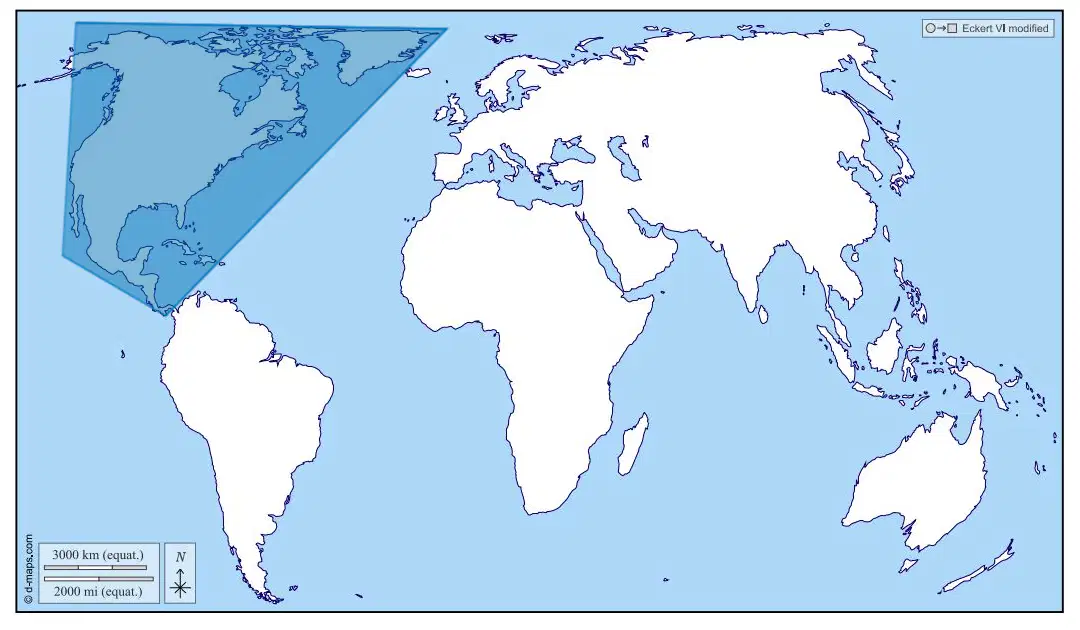
Which continent is being circled in blue below?
a)
South America
b)
Africa
c)
North America
d)
Europe
74.
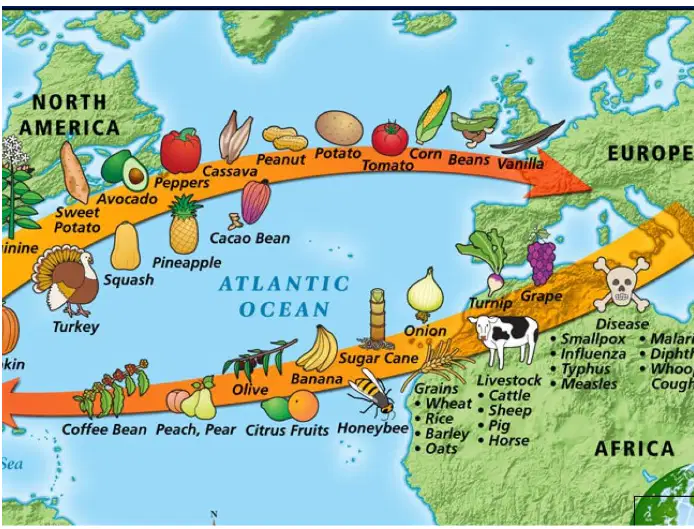
What does the below picture best represent?
a)
Imperialism
b)
Scramble for Africa
c)
Containment
d)
Columbian Exchange
75.
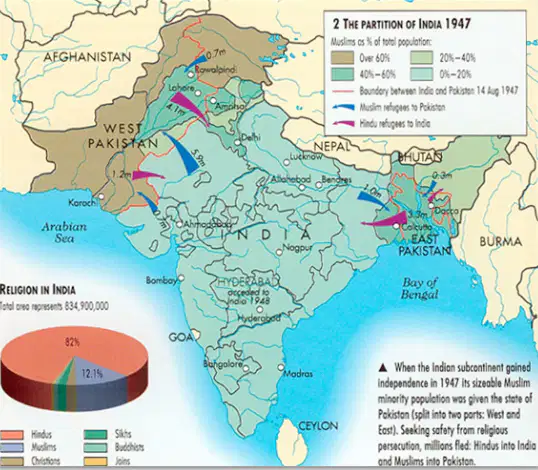
According to this map, in what year did the partition of India take place?
a)
1947
b)
1982
c)
1974
d)
1834
76.
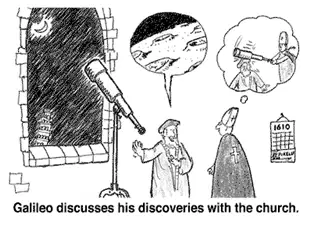
True or False? The Catholic Church was supportive of the Scientific Revolution.
a)
True
b)
False
77.

According to this source, what is a social contract?
a)
An agreement between the governed and the government that ensures equality to all involved
b)
An agreement that the government may do what it wished to the governed as long as it maintain stability
c)
An agreement on social protocols and manners
d)
An agreement on economic approaches and regulations
78.
Which of the following is the best explanation of imperialism?
a)
the policy or practice of acquiring full or partial political control over another country, occupying it with settlers, and exploiting it economically.
b)
the belief or desire of a government or people that a country should maintain a strong military capability and be prepared to use it aggressively to defend or promote national interests.
c)
a policy of extending a country's power and influence through diplomacy or military force.
d)
advocating class war and leading to a society in which all property is publicly owned and each person works and is paid according to their abilities and needs.
79.
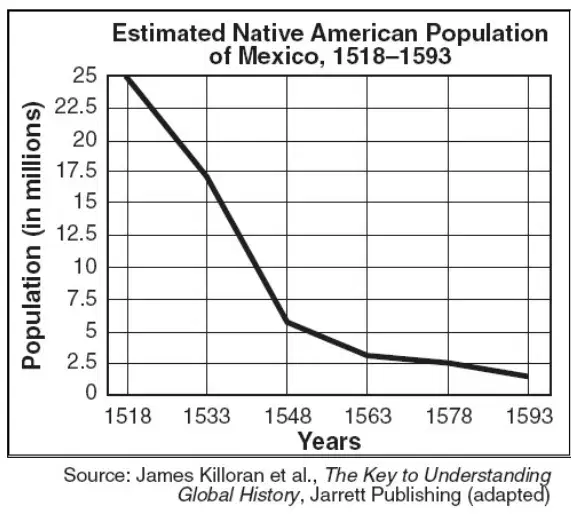
Which effect of Colonization does the below graph show?
a)
Population Surge of Europeans after Columbian Exchange
b)
Exchange rate of enslaved people during the Atlantic slave trade
c)
Price of Natural Resources gained by European Powers
d)
The population decline of Native American People in Mexico
80.
Which of the following is an example of xenophobia?
a)
If a teacher were to think "Girls brains aren’t made to be smart and hold information - just cook and clean and take care of babies" so they didn't teach girls
b)
American’s fear of Japanese Americans after bombing of Pearl Harbor (and the government as a result putting them in internment camps)
c)
The application of the xeno lens on historical events
d)
The fear of people named Phoebe
81.
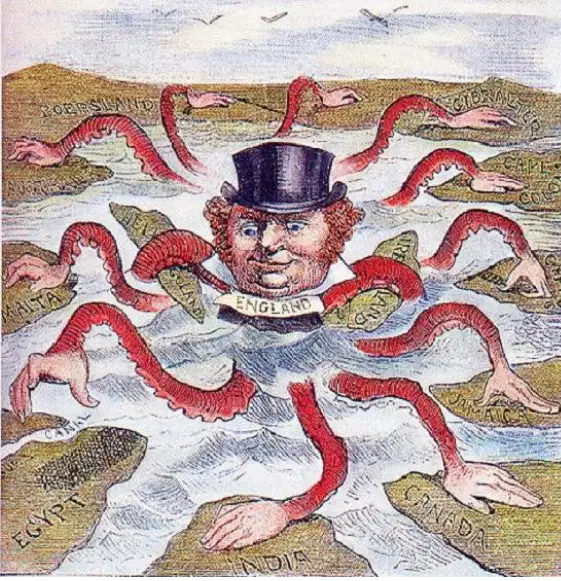
What does this picture best display?
a)
Columbian Exchange
b)
Imperialism
c)
Bias
d)
Cultural Identity
82.
Which religion utilized a strict Caste system and believed in ideas like karma and dharma?
a)
Hinduism
b)
Christianity
c)
Buddhism
d)
Islam
83.
If a particular religion believes that there is only one God, then that religion would be considered
a)
Monotheistic
b)
Single Godly
c)
Monochromatic
d)
Polytheistic
84.
Which of the following religions in Polytheistic?
a)
Hinduism
b)
Islam
c)
Christianity
d)
Judaism
85.
Which of the following would be considered a history skill?
a)
Questioning
b)
Organization
c)
Observation
d)
All of the above
86.
According to the documentary "The True Cost", which of the following statements are true?
a)
Workers in developing countries receive a fair wage
b)
Workers in developing countries have safe working conditions
c)
The Fashion industry has drastically negative effects on the environment
d)
Workers in developing countries choose their own wages
87.
According to the documentary "The True Cost", which of the following statements are true?
a)
Farmers in India and their communities greatly benefit from GMO's
b)
When a focus on Materialism/consumption rises in a community, Mental Health problems also increase
c)
Clothing cycles have gotten longer because people are buying less
d)
Organic cotton doesn't really help anyone
88.
According to the documentary "The True Cost", the year of the 3 worst disasters in fashion history is also the year that the fashion industry saw record numbers of profits.
a)
True
b)
False
89.
What were the years of World War 1?
a)
1914 - 1918
b)
1935 - 1939
c)
1918 - 1922
d)
1939-1945
90.
What were the years of World War 2?
a)
1914 - 1918
b)
1935 - 1939
c)
1918 - 1922
d)
1939-1945
91.
Select all of the Religions that worship the God of Abraham
a)
Christianity
b)
Judaism
c)
Islam
d)
Hinduism
92.
World War 1 was characterized by ____________?
a)
Horses throughout the War
b)
Island Hopping in the Pacific
c)
Secret Tunnels in Laos
d)
Trench Warfare
93.
Which of the following conflicts were caused by Imperialism? (Multiple Answers)
a)
Morant Bay Rebellion
b)
Korean War
c)
The Boxer Rebellion
d)
Vietnamese War
94.
Which of the following were the long term causes of WW1?
a)
Imperalism
b)
Militarism
c)
Nationalism
d)
Alliances
e)
Neutralism
95.
Which of the following is the best definition of Foreign Policy?
a)
Foreign policy is how a country uses different strategies to guide its relationships with other countries and international organizations.
b)
Foreign policy is the idea that the US would provide political, military, and economic aid to democratic countries under the threat of communist influences in order to prevent the expansion of communism.
c)
Foreign policy is a method used by Hitler in the second world war that focused on fast moving armies and tanks to overwhelm their enemies
d)
Foreign policy covers the systems for setting levels of taxation, government budgets, the money supply and interest rates as well as the labour market, national ownership, and many other areas of government interventions into the economy
96.
Which of the following wars ended with the use of Atomic weapons?
a)
WWI
b)
WWII
c)
Korean War
d)
The Hong Kong Protest
97.
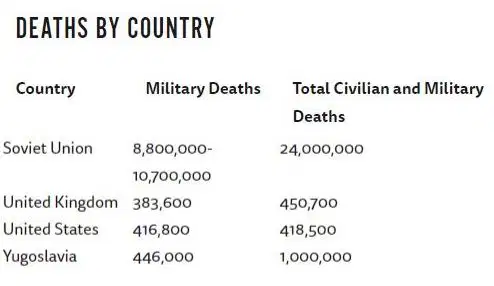
According to the data provided by the WWII National Museum, how many Soviet Union (Russian) Civilians died as a result of WWII
a)
At least 13,000,000
b)
24,000,000
c)
8,800,000
d)
1,000,000
98.
Which of the following wars could be considered a proxy war?
a)
WWII
b)
WWI
c)
Vietnam
d)
The Zulu War
99.
Which is the best definition of Militarism?
a)
a policy of extending a country's power and influence through diplomacy or military force.
b)
the belief or desire of a government or people that a country should maintain a strong military capability and be prepared to use it aggressively to defend or promote national interests.
c)
the policy or practice of acquiring full or partial political control over another country, occupying it with settlers, and exploiting it economically.
d)
identification with one's own nation and support for its interests, especially to the exclusion or detriment of the interests of other nations.
100.
True or False? New technology from the Green Revolution benefitted small rural farmers the most.
a)
True
b)
False
101.
What two things were needed for Norman Borlaug's approach to agriculture?
a)
Small divided tracts of land
b)
Chemical Fertilizer
c)
Irrigation System
d)
Wheat Rust
102.
True or False? After the Green Revolution the global supply of food was driven up enormously and World Hunger was solved.
a)
True
b)
False
103.
Which invention allowed the textile factories to operate away from a source of moving water?
a)
Richard Arkwright's water frame.
b)
Jethro Tull's seed drill.
c)
Henry Cort's puddling process.
d)
James Watt's steam engine.
104.
Which of the following describes urbanization?
a)
the process through which cities grow, and higher and higher percentages of the population come to live in the city.
b)
an open swath of land that has few homes or other buildings, and not very many people.
c)
the art and science of cultivating the soil, growing crops, and raising livestock.
d)
a practice of domination, which involves the subjugation of one people to another.
105.
Which of the following describes agriculture?
a)
the art and science of cultivating the soil, growing crops, and raising livestock.
b)
a practice of domination, which involves the subjugation of one people to another.
c)
the process through which cities grow, and higher and higher percentages of the population come to live in the city.
d)
an open swath of land that has few homes or other buildings, and not very many people.
106.
Which of the following describes rural?
a)
an open swath of land that has few homes or other buildings, and not very many people.
b)
the art and science of cultivating the soil, growing crops, and raising livestock.
c)
a practice of domination, which involves the subjugation of one people to another.
d)
the process through which cities grow, and higher and higher percentages of the population come to live in the city.
107.
Select all of the following that resulted from the Industrial Revolution.
a)
Overcrowded Urban areas.
b)
Displaced rural families
c)
Increased the rate of alcoholism to record levels within England
d)
Provided a new society where everyone enjoyed a peaceful life
100 %

