
Font size
 Worksheets
California Regions & Natural Disasters Final
Total questions: 67
Worksheet time: 34mins
What is the first condition necessary for the formation of a tornado?
Presence of a cold front
Presence of a supercell
Presence of a warm front
Presence of a hurricane
What is the name of the area in the United States where the deadliest and most destructive tornadoes occur?
Tornado Valley
Tornado Zone
Tornado Alley
Tornado Path
What scale is used to rank the strength of a tornado?
Richter scale
Fujita scale
Saffir-Simpson scale
Beaufort scale
How many categories does the Fujita scale have?
Four
Five
Six
Seven
The winds of a tornado can reach speeds of up to ______________, but the tornado itself moves at around ______________.
100 mph, 10 mph
300 mph, 30 mph
200 mph, 20 mph
150 mph, 15 mph
For tornadoes to form, there have to be three weather conditions: ______________________, ______________________, and ______________________.
high humidity, low pressure, strong winds
high pressure, low humidity, weak winds
low pressure, high humidity, strong winds
low humidity, high pressure, weak winds
A funnel cloud is created when ___________________________________________.
the air pressure increases
the air pressure decreases
the wind speed increases
the wind speed decreases
What is a hurricane?
A small storm that forms over land
A large storm that forms over warm ocean waters
A type of earthquake
A tornado that forms over the ocean
What is the calmest part of a hurricane called?
Eyewall
Rainbands
Eye
Storm cloud
What causes the air to rise and form a hurricane?
Cold air above the ocean
Moist air above the ocean
Dry air above the ocean
Warm air above the ocean
What is the most dangerous part of a hurricane?
Eye
Rainbands
Eyewall
Storm cloud
What is the speed range of a hurricane over the open ocean?
5 to 10 mph
10 to 20 mph
20 to 30 mph
30 to 40 mph
What is the scientific name for a storm that forms above the North Atlantic and the Eastern Pacific Oceans?
Typhoon
Cyclone
Hurricane
Tornado
What are tropical storms called when they occur above the Northwest Pacific Ocean?
Hurricanes
Cyclones
Typhoons
Tornadoes
In which direction do tropical storms rotate in the Northern Hemisphere?
Clockwise
Anti-clockwise
Randomly
Both directions
What is the name of the effect that causes storms in the Southern Hemisphere to rotate in the opposite way to those in the Northern Hemisphere?
Doppler Effect
Coriolis Effect
Greenhouse Effect
Butterfly Effect
During which months do hurricanes and typhoons typically develop?
January and February
March and April
June and November
December and January
What is the Saffir-Simpson Hurricane Wind Scale (SSHWS) used to indicate?
The size of a hurricane
The strength of a hurricane
The duration of a hurricane
The temperature of a hurricane
What is the minimum wind speed for a storm to be classified as a hurricane according to the SSHWS?
50 mph
60 mph
74 mph
90 mph
What is the scientific name of a hurricane?
Cyclone
Tornado
Typhoon
Tropical Cyclone
Due to the Coriolis Effect, how do storms rotate in the Northern Hemisphere?
Clockwise
Counterclockwise
Randomly
Vertically
Due to the Coriolis Effect, how do storms rotate in the Southern Hemisphere?
Clockwise
Counterclockwise
Randomly
Vertically
What category of hurricane is the strongest type and has wind speeds of above what value?
Category 1, 74 mph
Category 3, 111 mph
Category 4, 130 mph
Category 5, 157 mph
Hurricanes and typhoons typically occur from June to November, but cyclones usually form between December and April. Why do you think these storms do not occur in the same period?
Different ocean temperatures
Different wind patterns
Different humidity levels
Different sea levels
What are the pieces of the Earth's crust called?
Tectonic plates
Seismic belts
Fault lines
Shock waves
What is the outermost layer of the Earth called?
Mantle
Core
Crust
Lithosphere
What is the San Andreas Fault?
A type of earthquake
A famous part of the Ring of Fire
A type of volcanic eruption
A seismic belt
What is the term for the point on the Earth's surface directly above the focus of an earthquake?
Epicenter
Hypocenter
Fault line
Seismic belt
Where do most earthquakes occur?
In the desert
On beaches
Near the edges of tectonic plates
In space
What natural phenomenon can earthquakes sometimes cause?
Rainbows
Tsunamis
Snowstorms
Sunny weather
How can earthquakes affect rivers?
Change their color
Make them dry up instantly
Alter their course
Make them flow uphill
How do earthquakes affect buildings?
They make them stronger
They have no effect
They can cause damage or collapse
They paint them
What is a natural disaster?
A natural event that causes minor inconvenience
A man-made event that causes destruction
A natural and violent event that causes serious destruction and kills or injures people
A natural event that only affects animals
What triggers geological hazards?
Processes in the atmosphere
Water processes
Organic substances
Movement of tectonic plates
Which type of hazard includes hurricanes, tornadoes, and wildfires?
Geological hazards
Meteorological hazards
Hydrological hazards
Biological hazards
What causes hydrological hazards?
Processes in the atmosphere
Water processes
Organic substances
Movement of tectonic plates
What is an example of a biological hazard?
Earthquakes
Floods
Epidemics
Tsunamis
What is a tsunami an example of?
Geological hazard only
Hydrological hazard only
Both geological and hydrological hazard
Biological hazard
Why is it difficult to predict geological disasters?
They take a long time to form
They need specific weather conditions
They occur without any warning
They are caused by organic substances
What has caused the number of natural disasters to multiply by five in the past 50 years?
Improved warning signs
Climate change
Better preparation
Increased population
By how much has the number of deaths decreased due to improved warning signs and better preparation?
50%
60%
70%
80%
Which of the following disasters are formed in the atmosphere?
Tornadoes
Landslides
Volcanic Eruptions
Blizzards
In which states are the Klamath Mountains located?
California & Nevada
Oregon & Washington
California & Oregon
Nevada & Idaho
What is the highest peak in the Klamath Mountains?
Mount Shasta
Mount Eddy
Mount Hood
Mount Whitney
What is the Cascade Range?
A series of non-volcanoes and volcanoes from Canada to California
A series of mountains in the eastern United States
A series of hills in the Midwest
A series of islands in the Pacific Ocean
The Cascade Range is part of which geological feature?
The Atlantic Ridge
The Pacific Ring of Fire
The Great Plains
The Rocky Mountains
When did the last Cascade volcano erupt in California?
1900-1905
1914-1921
1930-1935
1950-1955
What type of geological feature is Mount Shasta?
Mountain
Hill
Volcano
Plateau
Where is Mount Shasta located?
Southern California
Northern California
Central California
Eastern California
What is the largest freshwater lake in the Sierra Nevada?
Lake Tahoe
Lake Michigan
Lake Superior
Lake Erie
Which two important bays are located in NorCal?
San Francisco Bay and Monterey Bay
San Francisco Bay and Chesapeake Bay
Monterey Bay and Hudson Bay
Chesapeake Bay and Hudson Bay
Why is it cold and windy in the Bay Area?
Because it's near the mountains
Because it's near the sea
Because it's near the desert
Because it's near the forest
In what year did Yosemite become a national park?
1870
1880
1890
1900
Where is Joshua Tree National Park located?
Northern California
Southern California
Central California
Eastern California
Joshua Tree National Park is known for being part of which two deserts?
Sonoran & Great Basin Desert
Chihuahuan & Sonoran Desert
Colorado & Mojave Desert
Great Basin & Chihuahuan Desert
What special feature does Joshua Tree National Park have that allows visitors to see the Milky Way?
It is an International Dark Sky Park
It has a high elevation
It is located far from cities
It has clear weather year-round
Which desert is known for its aridity, harsh conditions and haunting landscapes?
Sahara Desert
Mojave Desert
Gobi Desert
Kalahari Desert
In which states is the Mojave Desert located?
California, Nevada, and Arizona
California, Utah, and Arizona
Nevada, Utah, and Arizona
California, Nevada, and Utah
The Anza-Borrego Desert is part of which larger desert?
Mojave Desert
Sonoran Desert
Colorado Desert
Great Basin Desert
Where is San Diego Bay located?
Near the U.S./Mexican border
Near the Canadian border
Near the Atlantic Ocean
Near the Gulf of Mexico
Where are the Channel Islands located?
Off the coast of Florida
Off the coast of California
Off the coast of Texas
Off the coast of Washington
Where is the Salton Sea located?
Northern California
Southern California
Central California
Eastern California
What is the highest peak in the Sierra Nevada mountain range?
Mount Everest
Mount Kilimanjaro
Mount Whitney
Mount McKinley
What is the San Joaquin Valley an important source of?
Technology
Food
Minerals
Tourism
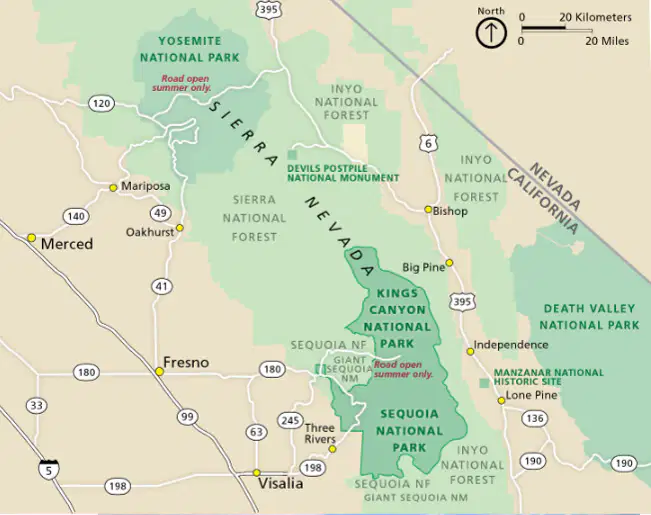
Which national park is located near Kings Canyon according to the map?
Yosemite National Park
Yellowstone National Park
Grand Canyon National Park
Zion National Park
Which national park is located next to Sequoia National Park?
Yosemite National Park
Kings Canyon National Park
Death Valley National Park
Grand Canyon National Park
What is Sequoia National Park known for?
Desert landscapes
Mountain ranges
Giant trees
Coastal views

