
Font size
 Worksheets
ECG quiz
Total questions: 20
Worksheet time: 7mins
Normal P wave is always positive in except
Lead aVF
Lead aVR
Lead III
Lead II
Following are the features of Myocardial Ischemia except
ST segment elevation
Abnormality in U wave
T wave inversion, deep and symmetrical
Tall R wave
Which coronary arteries are most likely occluded if there are ST-segment elevations in leads II, III, and aVF?
Left anterior descending artery
Left Circumflex artery
Right coronary artery
Left main coronary artery
In a patient with a suspected posterior MI, which additional ECG leads should be placed to confirm the diagnosis?
V7, V8, V9
V3R, V4R
I, aVL
V1, V2
Following are the features of LBBB
QRS duration ≥ 120ms
Broad monophasic R wave in lateral leads (I, aVL, V5-6)
Wide, slurred S wave in lateral leads (I, aVL, V5-6)
RSR' pattern in V1-3 ("M-shaped" QRS complex)
Which ECG finding is most characteristic of a Right bundle branch block (RBBB)
Monophasic R wave in lead V1
RSR' pattern in lead V1
Wide S wave in leads V1-V3
ST-segment elevation in leads I and aVL
Which pharmacological treatment is indicated for symptomatic bradycardia in the context of hemodynamic instability?
Beta-blockers
Calcium channel blockers
Atropine
ACE inhibitors
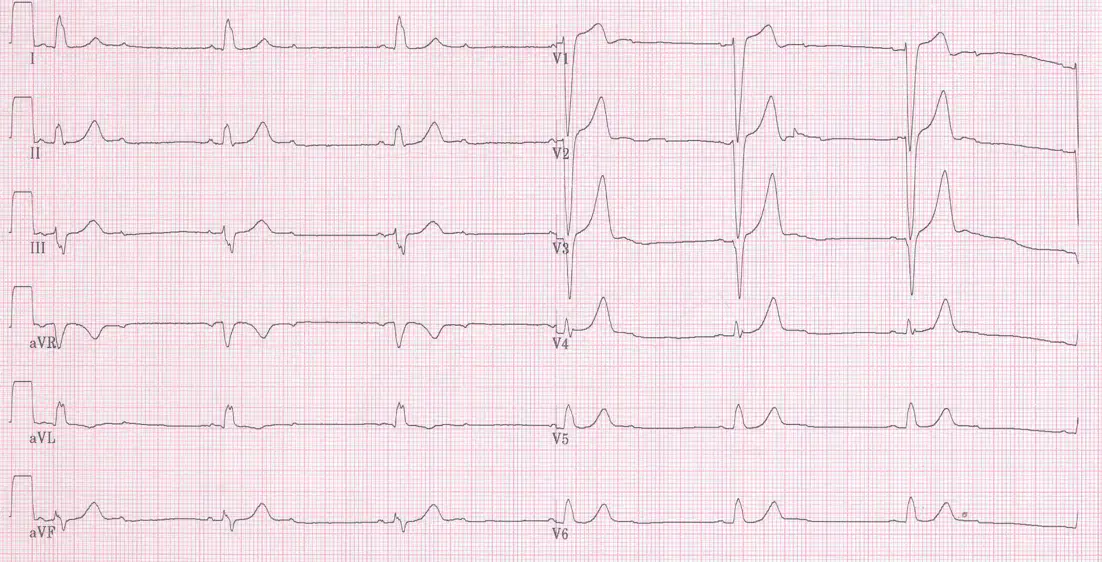
Given ECG belongs to which Degree of AV Block
First-degree AV block
Second-degree AV block
Mobitz type I
Second-degree AV block
Mobitz type II
Third-degree AV block
Which of the following is a common feature of first-degree atrioventricular (AV) block on ECG?
PR interval less than 120 ms
Dropped QRS complexes
Variable PR intervals
PR interval greater than 200 ms
Decremental conduction is a property of
Purkinje fibres
AV node
HIS bundle
SA node
Following are the features seen in KATZ WACHTEL PHENOMENON except
Increased amplitude of QRS Complex
Wide T wave
Tall R wave
Deep S wave
Which of the following is a typical ECG finding in atrial fibrillation?
Regularly spaced QRS complexes
Absence of P waves
PR interval greater than 200 ms
Delta waves
Which arrhythmia is suggested by a narrow QRS complex tachycardia with a rate of 150-250 beats per minute and sudden onset and termination?
Atrial flutter
Paroxysmal supraventricular tachycardia (PSVT)
Ventricular tachycardia
Sinus tachycardia
Which of the following characteristics of the P wave are seen in
Right Atrial Abnormality
Tall and peaked P wave in lead II
The amplitude is ≤2.5mm in height
the duration is ≤2.5mm wide or ≤100ms
Smooth and well rounded P wave
Type C RVH is seen in
Mitral stenosis
Atrial septal defect
Severe pulmonary stenosis
COPD
Which ECG criterion is used to diagnose left ventricular hypertrophy (LVH)?
S wave in V1 + R wave in V5 or V6 > 35 mm
S wave in V1 + R wave in V5 or V6 > 25 mm
S wave in V1 + R wave in V2 > 25 mm
S wave in V2 + R wave in V6 > 35 mm
Which additional ECG finding can support the diagnosis of RVH in the presence of tall R waves in V1?
Right axis deviation
Left axis deviation
Tall R waves in V5 and V6
Deep S waves in V1 and V2
A patient presents with tall, tented T waves, and widened QRS complexes. Which electrolyte disturbance should be suspected?
Hypokalemia
Hyperkalemia
Hypercalcemia
Hypocalcemia
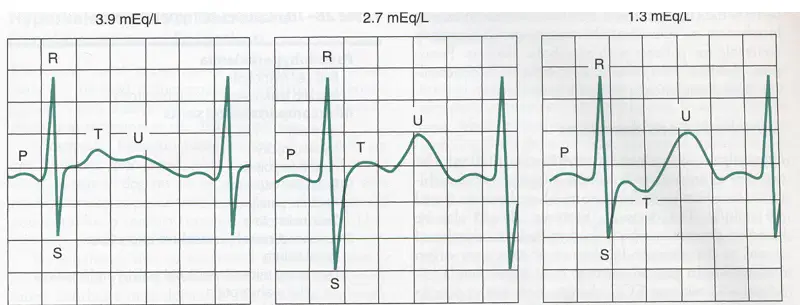
Given image shows the serial ECG changes of which condition
Hypercalcemia
Hypocalcemia
Hypermagnesemia
Hypokalemia
Which of the following ECG findings is most characteristic of Wolff-Parkinson-White syndrome?
Prolonged PR interval
Shortened PR interval with delta wave
ST-segment elevation in leads II, III, and aVF
Deep S waves in leads V1-V2

