
 Worksheets
Chapter 8 Review
Total questions: 199
Worksheet time: 13hrs 47mins


Re-write (5xy)−31 in radical form.
35xy
35xy1
(5xy)31
3xy5

Re-write x87 in radical form.
7x8
7x8
(8x)7
87x
Re-write (y)5 in rational exponent form.
y21
y5
y105
y25

Change to rational exponent form.
x
x12
x34
x43
Match each expression to it's radical form:
255
2525
5252
2552
525
5225
2552
5252
What should be the first step you take to solve the equation below?
2x−5=31
Divide both sides by 2
Square both sides
Add 5 to both sides
Subtract 31 from both sides
To undo a square root in an equation, you need to...
multiply both sides by 2
square both sides
take the square root of both sides
divide both sides by 2
What should be the first step you take to solve the equation below?
(x−2)31=5
Divide both sides by 3
Add 2 to both sides
Cube root both sides
Raise both sides to the power of 3
Solve the radical equation: 11=2+90−x
x = 9
x = 82
x = -9
x = -82
Solve the radical equation: 6+6−15x=15
x = -5
x = 1/5
No Solution
x = -1
Solve the radical equation: x−5=23−x
x = -14
x = 14
No Solution
x = 28
Solve the radical equation: 4+9x=5
x = 9
x = -9
x = 21
x = -21

Solve
x= -9
x= -2 and 3
x= 5
x= 0

Solve. Don't forget to check your answers!
6
9
-6
-9

Solve the radical equation. Don't forget to check your answers!
x = -6
x = 3
x = 7/3
x = -5
(2x−8)32=4 Solve the equation for x.
x = 8
x = 0
x = 7
no solution
Solve for x:
x3/2 + 7 = 71
2
4
16
8
∛(2x)2
Which of the following is in radical form?
453
523

Solve
29
14
21
17

Solve
-4/3
7/3
5/3
-1/3

Solve the Rational Exponent Equation:
A
B
C
D

Rewrite the expression without using a radical:
(2x + 1)3/4
(2x + 1)4/3
4(2x + 1)3
3(2x + 1)4
Solve. (3x - 5)1/4 + 3 = 4
4/3
2
-2
-4/3
Solve. (2x - 5)1/3 = 3
16
3
7
no solution
Solve. (6x - 3)2/3 + 6 = 15
x = -5, x = 4
x = 5
x = 5, x = -4
no solution


(2x - 1)3/4 + 9 = 36
7 + x3/2 = 71
Evaluate: (4)23
6
8
±8
232
Solve for x:
3x2=27
3
±3
81
no solution
(−64)3−2
(a)
(−8)32
(a)
(8)32
(a)
(125)3−1
(a)
(16)2−3
(a)
814−3
(a)
(−64)3−2
(a)
Simplify the radical...
√20a²b⁴
2ab²√5
4ab²√5
5ab²√2
2a²b²√5
√45n3


Simplify the following:
A
B
C
D

Simplify the following:
A
B
C
D

Simplify the following:
A
B
C
D

Simplify the following:
A
B
C
D

A
B
C
D

A
B
C
D
Simplify 16x12y16
8x6y4
4x10y14
4x6y4
Simplify 327x9y12
3x3y4
9x3y4
3x6y9
Simplify 481x4y12
9x2y3
3y8
3xy3
227+83+58
243
243+58
143+102
14 3+3 8
316−3250
3 −234
−332
732
332
5200−58
602
8
402
2 2

Find the area of the rectangle
11
22 +36
22+42−26
34+116
3496−4486−2
3 46−2 2
946−3 2
346−3 2
346−2
15x(5 6−5 5x)
−15x 5x+5
15 10x−25x 3
−8 2x+8x x
10x 3−12x 5x
3340+3340
2435
1235
1835
635
2 27+2 3
0
−2 3
2 3
8 3

Which number is the index?
3
4
5
We get NO SOLUTIONS when we have a negative number under radical and ______
the index is ODD
the index is EVEN
g(x) = x+3,
Find f(x) * g(x)
g(x) = x-9
Find f(x)-g(x).
g(x)=4x+5
What is (f+g)(2)
h(x)=3x-1
Find g(h(x))
g(x) = x - 2
Find f(g(0))
q(x) = 2x2
Find q(p(-2))

Find f(2).
-2
-18
24
6

Find g(5)
3375
375
25
45

g(4x)
1728x3
12x3
192x3
36x3

Find f[g(5)]
30
242
92
2

f(g(x))
3x - 16
3x - 2
3x - 26
4x - 2
g(x) = x-9
Find f(x)-g(x).
g(a) = 4a + 1
h(a) = -3a + 2
Find g(h(1))
3
-3
21
-21
g(n)=3n
Find f(n)+g(n)
If f(x)=2x and g(x)=2x2−1 find f(g(3))
34
71
35
142
If f(x)=2x and g(x)=2x2−1 find g(f(−1))
2
15
7
-9
If f(x)=2x and g(x)=2x2−1 find f(g(x))
4x2−1
4x2−2
8x2−1
16x2−1
If f(x)=2x and g(x)=2x2−1 find g(f(x))
4x2−1
4x2−2
8x2−1
16x2−1
If f(x)=x1 and g(x)=3x+2 find (f∘g)(2)
41
81
27
8
If f(x)=x1 and g(x)=3x+2 find (g∘g)(−4)
44
-40
-30
-28
If f(x)=x1 and g(x)=3x+2 find (g∘f)(x)
3x1+2
3x+2
x3+2
3x+21
If f(x)=x1 and g(x)=3x+2 find f(g(x))
3x1+2
3x+2
x3+2
3x+21
If f(x)=x2 and g(x)=x find g(f(x))
x4
x
x
x2
If f(x)=x2 and g(x)=x21 find (f∘g)(−1)
41
1
−1
−41
When f(x)=x2+9 and g(x)=x−9 , find f(x)−g(x)
x2+x+9
x2−x+9
x2−x
x2−x+18
When f(x)=9−3x and g(x)=5x−7 , find f(x)+g(x)
14x−10
−8x+2
2x+2
2x−2
If g(x)=x2+6 and f(x)=2x−4 , find f(g(x))
2x2−12x−4
2x2+12x−4
2x2+8
x3−2x2+1


g(f(2))
5
3
-1
2
If f(x)=2x+3 and g(x)=−3x−4 , find f(x)⋅g(x)
−6x2−17x−12
6x2+x−12
−x−1
5x+7
If f(x)=x2+3x+2 and g(x)=−3x+1
Find (f+g)(−2)
-3
3
-7
7
If f(x)=x2+3x+2 and g(x)=−3x+1
Find (f⋅g)(1)
-2
2
-12
12
If f(x)=x2+3x+2 and g(x)=−3x+1
Find (gf)(0)
-2
-1
0
2
If f(x)=3x2−2x+1
-52
-7
58
63
If f(x)=2x+1 and g(x)=3x+2
f(g(x)) = 6x + 4
f(g(x)) = 6x + 5
f(g(x)) = 5x + 8
f(g(x)) = 5x + 5
If f(x)=x2−5 and g(x)=2x−3
-5
-3
0
2
If f(x)=2x2+3 and g(x)=2x−1
Find (g∘f)(2)
g(f(2))=−5
g(f(2))=0
g(f(2))=20
g(f(2))=21
If f(x)=2x2+3 and g(x)=2x−1
f(g(−3))=83
f(g(−3))=89
f(g(−3))=99
f(g(−3))=101

Are the relations inverses?
yes
no

Are the relations inverses?
yes
no

Are the relations inverses?
yes
no

Are the graphs inverses?
yes
no

Are the graphs inverses?
yes
no

Are the graphs inverses?
yes
no

Are the graphs inverses?
yes
no

Which of the following points are part of the inverse? Select ALL that apply!
(2,3)
(1,4)
(-8,0)
(-2,5)
(4,-1)

What is the DOMAIN of the INVERSE function?
{-7, -2, -1, 1, 4}
{-6, -3, -2, 0, 3}
{-3, 0, 2, 3, 6}
{-4, -1, 1, 2, 7}

What is the RANGE of the INVERSE function?
{-5, 1, 3, 4}
{-4, -3, -1, 5}
{-4, -2, 0, 7}
{-7, 0, 2, 4}
TRUE OR FALSE:
If the DOMAIN of a function is (-∞, 2], then the DOMAIN of the INVERSE function will also be (-∞, 2].
false
true
TRUE OR FALSE:
If the RANGE of a function is (4, 2], then the DOMAIN of the INVERSE function will also be (4, 2].
false
true
Here is the domain and range for a function:
D: (-∞, ∞)
R: [3, ∞)
What is the domain and range of the inverse?
D: [3, ∞)
R: (-∞, ∞)
D: (-∞, ∞)
R: [3, ∞)
What is the inverse quadratic function?
f-1(x) = x2
f-1(x) = ±√x
f-1(x) = -x2
It doesn't have an inverse.
How do you find an inverse?
Switch x and y
Flip the signs on all the x-values
Flip the signs on all the y-values
Do nothing
Find the inverse of f(x)=41x−7
f-1(x) = 4x + 7
f-1(x) = -4x+28
f-1(x) = -4x - 7
f-1(x) = 4x+28
f(x)=6x−2
Find f−1(x)
2x−6
6x+2
2x+6
6(x+2)
Find the inverse of f(x)=10+7x
f−1(x)=10x−7
f−1(x)=7x−10
f−1(x)=10+7x1
f(x)= (x-2)5+3

If the equation of f(x) goes through (1, 4) and (4, 6), what points does f-1(x) go through?
(1, 4) and (4, 6)
(-4, -1) and (-6, -4)
(-1, -4) and (-4, -6)
(4, 1) and (6, 4)

Which is the inverse of the table?


f(1) = -3
f(2) = -2
f(-1) = 2
f(3) = -1
If f is an invertible function and f(a) = b, then f-1(b) = a.
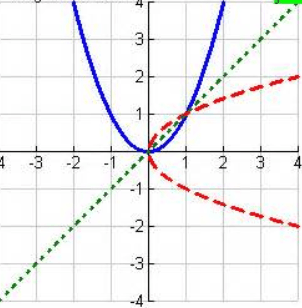
Find Inverse Function
y=2(3x−5)
y=−x+35
y=61x−35
y=61x+35
y=−53x+6
Find Inverse Function
y=21x2+1
y=2x+2
y=±2x−2
y=±2x−1
y=±x−2

Solve for x.
-13
4
19
Extraneous root


Solve the following
There is one solution.
There are two solutions.
There are no solutions.
4x−24=x−6
Two solutions
One solution
No solution


What number represents the h in this cubic function?
y = 43x+2−8
4
3
2
-8
Which number represents the "a" in this cubic function?
y =2 3x −2+5
2
-2
3
5

How to you think the graph compares to the parent function?
Right 5, Down 2
Left 5, Down 2
Right 2, Up 5
Left 2, Up 5

What is the cubic function of this graph?
y = 33x+2−1
y = 3x+2−1
y = 3x−2+1
y = 33x−2+1

Which is the cubic function of the graph?
y = 33x−2−2
y =33x+2−2
y = 33x+2+2
y = 3x+2−2


(- ∞, -2 ]
[ -2, ∞ )
All Real Numbers
[ 0, ∞)
y = 2√x
y = -√x

Solve the Rational Exponent Equation:
A
B
C
D
Solve. (3x - 5)1/4 + 3 = 4
4/3
2
-2
-4/3
Solve. (6x - 3)2/3 + 6 = 15
x = -5, x = 4
x = 5
x = 5, x = -4
no solution
(x + 2)1/2 - 5 = -2
(2x - 1)3/4 + 9 = 36
7 + x3/2 = 71


