
 Worksheets
Algebra 2 Honors Semester 2 Exam Review
Total questions: 200
Worksheet time: 12hrs 59mins
(1/8)x = 23


Use the change of base rule to rewrite this problem:
log364
log(64)/log(3)
log(3)/log(64)
Use the change of base rule to rewrite this problem:
log575
log(75)/log(5)
log(5)/log(75)
Use the change of base rule to rewrite this problem:
log6216
log(6)/log(216)
log(216)/log(6)
Use the change of base rule to rewrite this problem:
log364
log(64)/log(3)
log(3)/log(64)

Solve.
0.2560
0.4926
3.9069
7.5


Solve each equation. Select the closest answer.
-0.3
-0.4
-0.2
No solution

Solve each equation. Select the closest answer.
-0.2
0.2
0.3
0

Solve each equation. Select the closest answer.
4.5
1.5
1.8
5
Rewrite in simplified exponential notation:
(3−2)−4
381
36
38
361
Simplify the following: ((4a3b2c)3)0
Assume that a, b, and c are not equal to zero.
64a9b6c3
4a6b5c4
1
0

Identify whether the function, f(x) = 3(.5)x has exponential growth or decay?
growth
decay
cannot be determined
both exponential growth and decay
What is the equation of an exponential function that is shifted 5 units to the right and down 9 units?
f(x) = 2x + 5 - 9
f(x) = 2x - 5 - 9
f(x) = 2x - 9 - 5
f(x) = 2x + 9 - 5
What are the transformations of f(x) = 2x + 7 + 1
left 7
down 1
left 7
up 1
right 7
down 1
right 7
up 1

What are the transformations of this graph from y = log4x ?
Right 1 Up 5
Right 1 Down 5
Left 1 Up 5
Left 1 Down 5
What transformation is occurring when y = log x is changed to y = log x - 6
Horizontal shift left 6
Horizontal shift right 6
Vertical shift up 6
Vertical shift down 6
When the function y = log5x is changed to y = log 5 (x + 1) + 1, select all the transformations that apply.
Horizontal shift left 1
Horizontal shift right 1
Vertical shift up 1
Vertical shift down 1

Describe the transformation?
shifted up 3 units
shifted down 3 units
shifted right 3 units
shifted left 3 units
Describe the transformation?
shifted up 3 units
shifted down 3 units
shifted right 3 units
shifted left 3 units
Which is the reasonable graph of f(x) = log2(x - 5)


What is the x-intercept of log7(x)?
Pizza
-1
0
1

What is the equation of the asymptote?
x = -3
x=3
y= -3
y=5

Match the graph with its equation
y = log6(-x) + 1
y = log6(x − 2) + 1
y = log6(x + 2) - 1
y = log(x-8) + 1

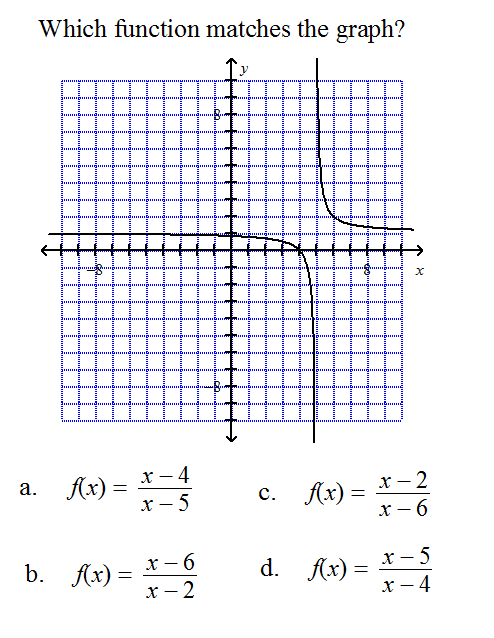
Which graph matches the function
*remember the transformation has shifted it right 3 and down 3


Is f-1(x) a function?
(1,3)(2,4)(6,8)

9
3
5
√15

9 - √17
4
2
√8

What is the value of x in the equation 3x+28=4 ?
-16
-12
24
36
What is the inverse, f−1(x) , of the function f(x)=5(x+2)−1 ?
f−1(x)=log2(x+1)−5
f−1(x)=log5(x−2)+1
f−1(x)=log1(x+5)−2
f−1(x)=log5(x+1)−2
What is the value of x in the equation? log3(x−2)=2
3
10
2
11
What is the inverse function of y=32x+7 ?
y=2(x−7)3
y=2(x+7)3
y=2(x+7)3
y=2(x−7)3

What are the x-intercepts?
x= 2/3
x= 4, x = -2
x= -8, x = 1
x= -4, x = 2

What is the horizontal asymptote to this function?
y=4
y=0
y=-2
y=1

What's the horizontal asymptote of the function?
y = 0
No horizontal asymptote
y = 1
y = 9

What is the Horizontal Asymptote?
None
y= 0
y= 1
y= 5/4
Does this function have any vertical asymptotes? If so, what are their equations? y=(x−4)(x+3)(x−4)(x+7)
No vertical asymptotes.
One vertical asymptote: x = 4
Two vertical asymptotes: x = -3 and x = -7
Three vertical asymptotes: x = -3, x = 4, and x = -7
Which equations below state the asymptotes for the graph of the rational function?
f(x)=x2−9x2
Check all that apply.
x=3
x=−3
x=9
y=0
y=1
Which of the following rational functions has the three attributes: vertical asymptote at x = -3, horizontal asymptote at y = 0, and a zero at -1?
f(x)=(x+3)2(x+1)
f(x)=(x+3)(x+1)
f(x)=(x+3)(x+1)2
f(x)=(x−3)2(x−1)
Which of the following functions has the given three attributes: no vertical asymptote, a horizontal asymptote at y = 3, and a y-intercept at 5.
g(x)=x2+53x2+10
g(x)=x23x2+5
g(x)=x2+13x2+5
g(x)=x−53x2
Find the vertical asymptote(s) of the following rational function. Select all that apply.
f(x)=x2+2x−15x2−3x−10
x = 3
x = 5
x = -5
x = -2
Find the horizontal asymptote of the following rational function.
f(x)=x2+2x−15x2−3x−10
y = 0
y = 1
y = 2
y = 3
Find the x-intercept(s) of the following rational function. Select all that apply.
f(x)=x2+2x−15x2−3x−10
-5
5
-2
3
Find the y-intercept(s) of the following rational function. Select all that apply.
f(x)=x2+2x−15x2−3x−10
2/3
1
-2
5

Find the y-intercept
(0, -3.5)
(0, -5)
(0, 7)
(0, -2)

Find the horizontal asymptote
y = 1
y = -1
y = 2
y = -2

Find the x-intercept
(0, 6)
(6, 0)
(0, 4)
(4, 0)
(1.5, 0)

Find the y-intercept
(6, 0)
(0, -2)
(3, 0)
(0, -3)
Is the function even, odd, or neither?
f(x) = x2 + 2
Even
Odd
Neither
f(x) = (x+4)2 - 1
f(x) = 4x3
Which of the following best describes this sequence?
Arithmetic
Geometric
Neither
Both
Which of the following best describes this sequence?
Arithmetic
Geometric
Neither
Both
Which of the following best describes this sequence?
Arithmetic
Geometric
Neither
Both
Which explicit formula describes the sequence?
an=−4+(n−1)(−1)
an=(−4)(−1)(n−1)
an=−1+(n−1)(−4)
an=(−1)(−4)(n−1)

The diagrams represent the first three terms of a sequence. Assuming the pattern continues, how many shaded squares are in the 6th term?
26
28
30
32
What is the formula for the nth term of the sequence 3, -6, 12, -24, 48, ...?
an=−2(3)n
an=3(−2)n
an=−2(3)(n−1)
an=3(−2)(n−1)
Which of the following best describes this sequence?
An arithmetic sequence with a common ratio of 3.
A geometric sequence with a common difference of 3.
An arithmetic sequence with a common difference of 3.
A geometric sequence with a common ratio of 3.
Which of the following best describes this sequence?
An arithmetic sequence with a common ratio of 31
A geometric sequence with a common difference of 3.
An arithmetic sequence with a common difference of 3.
A geometric sequence with a common ratio of 31
What is the 16th term of the following sequence?
36
38
40
42
What is the 12th term of the following sequence?
6,411
−6,411
354,294
−354,294
A plumber charges $55 for 1 hour of work, $90 for 2 hours, and $125 for 3 hours. Which function represents the sequence of hourly charges?
an = 55 + 35n
an = 55(35)n-1
an = 35 + (n-1)55
an = 55 + (n-1)35
An arithmetic sequence has a1=2 and d=4. What is the Explicit Rule for an and use it to find the 20th term.
an = 2 - 4(n-1)
a20 = 82
an = 2 + 4(n-1)
a20 = 78
an = 2(4)n-1
a20 = 2199023255552
an = 4 + 2(n-1)
a20 = 42
A geometric sequence has a1 = 3 and r = 2. What is the Explicit Rule for an and use it to find the 10th term.
an = 3 + 2(n-1)
a10 = 21
an = 2(3)n-1
a10 = 39366
an = 3(2)n-1
a10 = 1536
an = 2 + 3(n-1)
a10 = 29
Identify the inverse variation relationship from the following equations:
y=2x
y=5x2
y=6x
y=x4
Solve the inverse variation equation: y=x6 for x when y = 3
5
7
4
2
Apply inverse variation to a real-life scenario: If the number of workers is inversely proportional to the time taken to complete a task, and 8 workers can complete the task in 6 hours, how long will it take for 12 workers to complete the same task?
10 hours
4 hours
5 hours
2 hours
Apply inverse variation to a real-life scenario: If the speed of a car is inversely proportional to the time taken to reach the destination, and a car traveling at 60 mph reaches the destination in 4 hours, how long will it take for a car traveling at 80 mph to reach the same destination?
2 hours
3 hours
4 hours
5 hours
Willie invests $8,515 in a retirement account with a fixed annual interest rate of 5% compounded continuously. What will the account balance be after 20 years?
$22,017.32
$23,146.17
$20,021.95
$20,943.52
Mark invests $3,285 in a retirement
account with a fixed annual interest rate of
7% compounded continuously. What will
the account balance be after 18 years?
$12,420.73
$13,321.33
$12,671.64
$11,581.01
Sumalee invests $6,227 in a savings account with a fixed annual interest rate of 8% compounded continuously. What will the account balance be after 6 years?
$10,685.57
$11,011.00
$10,369.77
$10,063.30
Adam invests $5,208 in a savings account with a fixed annual interest rate of 8% compounded continuously. What will the account balance be after 8 years?
$9,876.87
$10,699.49
$9,489.59
$8,803.91
Chelsea invests $2,709 in a savings account with a fixed annual interest rate of 8% compounded continuously. What will the account balance be after 6 years?
$4,248.56
$3,941.57
$4,377.95
$4,041.35
In the formula A= Pert
T is time in ...
Months
Years
Days
Weeks
Decades
Mei invests $6,285 in a savings account with a fixed annual
interest rate of 4% compounded continuously. How many years will it take for the account balance to reach $7,989.80? (Type answer in WHOLE number of years NO Decimals)
(a)
Julio invests $3,853 in a savings account with a
fixed annual interest rate of 4% compounded continuously. How long will it take for the account balance to reach $5,098.02? Type answer in WHOLE years NO decimals)
(a)
Eduardo invests $3,071 in a savings account with a
fixed annual interest rate of 7% compounded continuously. How long will it take for the account balance to reach $7,113.56?
12
13
14
15
Which of these equations shifts a radical equation right 5 times and down once?
f(x)=x−5−1
f(x)=x+5−1
f(x)=x−5+1
f(x)=x+5+1
Which of these equations shifts a radical equation left 3 times?
f(x)=x+3
f(x)=x−3
f(x)=x+3
f(x)=x−3

Solve for x.
−3 x−2+1=−11
144
121
16
18
Solve for x.
2 x+3 −5=3
4
9
13
16

Solve for x. 9x−2=3x+10
x = 2
x = -2
x = 4
No Solution

f(x) = 3x2 + 7x and g(x) = 2x2 - x - 1, find (f + g)(x).
f(x)= x+3
g(x)= x-2
Find (g(x) / f(x))
Be careful!!
(x + 3)/(x - 2)
(x - 2)/(x + 3)
-2/3
3/2
g(x) = x2+3 , find f(g(x)).
g(x) = x - 2
Find g(f(-10))
g(x) = x - 2
Find (f∘g)(0)
f(x)= x2 - 1
g(x)= x - 1
Find (f(x)/g(x))
Then simplify using x = 10
9
11
90
110


Solve for x
4
2
-2
-4


3/5
3/4
1/4
4/5

2
1
-1
-4
Simplify this rational expression:
(x+10)(x−1)
(x+10)(x+2)
(x+2) (x+2)
(x+2)
Simplify this rational expression:
1
Does not simplify
(x+4) (x−3)
(x−3) (x+4)
Simplify this rational expression:
(x−6) (x+5)
(x+1) (x+5)
(x−6) (x−3) (x+5)(x+1)
(x−6)(x+1) (x+5)(x−3)
Simplify this rational expression:
(x+7)(x−3)
(x+7)(x+5)
(x+5)(x−3)
Does not simplify
Simplify this rational expression:
(x+5)(x−4)
(x+5)(x+3)
(x+3)(x+3)
Does not simplify


Simplify the following


a−7a2−5a−14÷5a3+30a2a2−a−6
15aa+9
a−35a2(a+6)
a−11
a+99a
b2+14b−40b−4÷b2−3b−70b2+6b+8
6b−3
92b
75b(b−6)
(b+4)(b+2)b+7
3x+18x2+3x−18÷x2+x−90x2+7x−30
3x2(x−9)
3x−9
60x+7
(x−3)(x+10)
10n2+40n8n÷10n2+20nn2+10n+16
(n+4)(n+8)8n
80n2
7(n−10)n−4
n−332n2
10m+7010m−20×m+1m2+8m+7
3m+2
203
m−2
m+7m+4
n2−11n+3016n−56÷n2−11n+3010n−35
n+8n+7
10
58
n−57(n−1)
80n2+10n+9×n2+10n+98
64
n+627n3
101
67n(n+10)
Divide the Rational Expression
x2−3x+2x2−4x−5÷x2−4x2−3x−10
x−1x−5
x−1x+1
x−11
x+1
x25x+63x+12÷5x+15x+4
x+3x+4
15x+2
x+215
x+25
Simplify x2−18x+80x−8÷x2−7x−8x+1
x−10x−8
x+107x2
x+75x
3x24


A
B
C
D
Factor 4x2-9
(4x-9)(4x+9)
(2x-3)(2x+3)
2x-3
(2x-4.5)(2x+4.5)
25x2-81
Which of these can factor using difference of two squares?
144x2 - 49y2
x2 + 4x - 12
100x2 + 20x + 1
14x - 16
k2+7x+10
k2 -2k - 24
3a2 + 4a + 1
x2 + 9x - 36
factor x2 + 7x - 30
PRIME
(x + 10)(x + 3)
(x - 10)(x + 3)
(x + 10)(x - 3)


Simplify
A
B
C
D

Simplify the expression:
A
B
C
D

Simplify
A
B
C
D

Simplify
A
B
C
D

A
B
C
D

A
B
C
D

A
B
C
D

A
B
C
D

A
B
C
D
Expand the expression using the Binomial Theorem.
(2x+5)4
2x4 + 40x3 + 300x2 + 1000x +625
16x4 + 160x3 +600x2 +1000x + 625
16x4 + 1000x3 + 600x2 + 160x +625
Expand: (a−b)5
a5+5a4b+10a3b2+10a2b3+5ab4+b5
a5−5a4b+10a3b2−10a2b3+5ab4−b5
a5−5a4b+10a2b3−10a3b2+5ab4−b5
a5−5a4b−10a3b2−10a2b3−5ab4−b5
What would be the 5th term of the expansion of (n+4)4?
257
256
n4
259
What would be the 2nd term of the expansion of (y+4)4?
253y
16y3
64y
96y2
What would be the 4th term of the expansion of (a+3)4?
108a
12a3
81
27a
What would be the 6th term of the expansion of (m-3)5?
m5
-243
-244
405m

yx31⋅xy23
x34y25
x32y21
x31y23
x32y34
Evaluate log28
(a)
Evaluate log864
(a)
Evaluate log77
(a)
Evaluate log381
(a)
Evaluate log101000
(a)
Evaluate log61
(a)
Evaluate log881
(a)
Evaluate log7491
(a)
Evaluate log55
(a)
Evaluate log93
(a)

3
1/3
-3
-1/3
Which shows the log expression completely expanded correctly
log6(4y5)
log65 + log64 + log6y
log65 − log64 + log6y
log65 − log64 − log6y
log65 − log64y
None of these
Which shows the log expression completely expanded correctly
log4(a2+b5)
2log4(a)+5log4(b)
2log4(a)⋅5log4(b)
log4(2a)+log4(5b)
log4(2a)⋅log4(5b)
None of these
Which shows the log expression completely expanded correctly
log4(a2b5)
2log4(a)+5log4(b)
log4(2a)+log4(5b)
alog4(2)+blog4(5)
log(4)+2log(a)+5log(b)
None of these

