
 Worksheets
AUT-103 FINAL
Total questions: 61
Worksheet time: 3hrs 26mins
Another name or term for Gear Reduction is:
Overdrive
Underdrive
Toque multiplier
Speed converter
When a large gear is driving a smaller gear you will have:
A speed decrease in the driven gear
A torque increase in the drive gear
Overdrive
Underdrive
When a small gear is driving a larger gear you will have:
Underdrive
Overdrive
A speed increase
A torque decrease
The Helical gear is:
Cut with straight teeth
Cut with a double offset
A noisy gear set
Cut on an angle
The spur gear is:
Straight cut
Angle cut
Cut on two diagonal lines
a very quite running gear set
In a gear set that has a ratio of 2:1. Choose All correct answers. There may be more than one.
Torque will double from the input drive gear
Speed of the driven gear will be reduced by half
Toque of the driven gear will be reduced by half
Speed of the driven gear will be double
In a gear set that has a ratio of .5:1. Choose All correct answers. There may be more than one.
Torque will double from the input drive gear
Speed of the driven gear will be reduced by half
Toque of the driven gear will be reduced by half
Speed of the driven gear will be double

Which gearset would be used for 1st gear?
A
B
C
D

Which gear is used for reverse?
A
B
Which gearset would be used for 3rd gear?
A
B
C
D
Which gear is used for direct drive?
A
B
C
D

The clutch system component that applies/releases frictional force to/from the clutch disc is
clutch release bearing
the flywheel
a pressure plate
clutch fork

The depicted gear set has a ratio of:
1:4
4:1
2:8
20:5
What is the purpose of synchronizers in a manual transmission?
To increase fuel efficiency
To reduce engine noise
To match the rotational speeds of the gears before engaging them
To prevent gear slippage
The manual transmission interlock mechanism is used to:
Interlock the synchronizer sleeve to the speed gear
Prevent the engagement of two gears at the same time.
Engage reverse idler gear
Interlock the transfer case to the transmission.
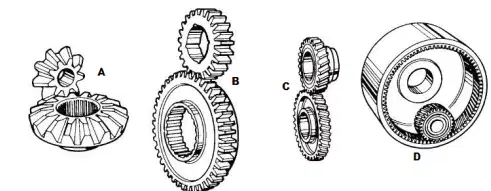
Match the following
Used to connect shafts that are not parallel to each other. Mainly used in final drives and transaxles
A. bevel gears
Straight-cut gears that may be used for reverse gears in a manual transmission.
B. Spur gears
Gears with teeth cut on an angle. Used in manual transmissions and transaxle final drives.
C. helical gears
Used as part of planetary gears in an automatic transmission.
D. ring gear
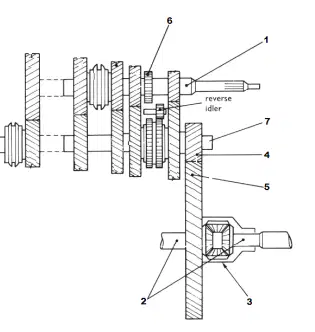
Match the following
4
ring gear
5
pinion gear
6
reverse gear
7
secondary shaft
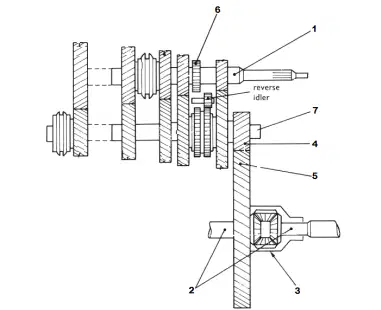
Look at the diagram and match the number to the description.
1
input shaft
2
drive shaft
3
differential assembly
Label the A of this assembly
Blocker / Baulk ring
Splined Hub
Engagement Sleeve
Metal Inserts
Radial Spring
Label B of this assembly
Blocker / Baulk ring
Splined Hub
Engagement Sleeve
Metal Inserts
Radial Spring
Label E of this assembly
Blocker / Baulk ring
Splined Hub
Engagement Sleeve
Metal Inserts
Radial Spring
Calculate the Gear Ratio for:
Driver: 15 teeth
Driven: 60 teeth
8:1
2:1
6:1
4:1
Label D of this assembly
Blocker / Baulk ring
Splined Hub
Engagement Sleeve
Metal Inserts
Radial Spring
Label C of this assembly
Blocker / Baulk ring
Splined Hub
Engagement Sleeve
Metal Inserts
Radial Spring
Calculate the Gear Ratio for:
Driver: 12 teeth
Driven: 87 teeth
(a) :1
What is the function of the clutch fork in the transmission?
To connect the transmission input shaft to the engine crankshaft
To press against the release or throwout bearing
To disconnect power flow from the transmission input shaft
To control the gear shifting process
1. The Manual transmission receives power from the engine by way of the:
Drive shaft
Clutch assembly
Gear set
Final drive.
What manual transmission component eliminates gear grinding when shifting?
Synchronizer.
Shift fork
Counter shaft
Input shaft
A front wheel drive vehicle generally uses a:
Transmission
Transaxle
Transfer case
Trans Siberian orchestra
What component moves the synchronizers from gear to gear?
Gears
Counter shaft
Input shaft
Shift forks
Which of these is not part of a manual transmission?
Input shaft
Throw out bearing
Synchronizer
Output shaft
What keeps the transmission from popping out of gear?
The shift fork.
The detent and balls in the shifter.
Synchronizer.
Anti popper valve
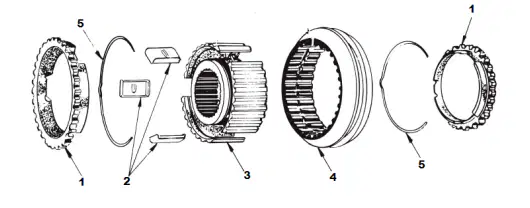
Match the number with its description:
1
Baulk ring
2
Inserts
3
hub
4
sleeve
5
insert spring
The clutch friction disc always rotates with the _______.
Flywheel
Pressure Plate
Transmission Input Shaft
Engine Crankshaft
Technician A says the pressure plate assembly squeezes the clutch disc onto the flywheel. Technician B says the pressure plate moves away from the clutch disc so that the disc can stop rotating. Who is correct?
A only
B only
Both A and B
Neither A nor B
When the clutch is disengaged, the power flow stops at the ______.
Driven disc hub
Transmission input shaft
Torsion springs
Pressure plate and flywheel
When an idler gear is placed between the driving and driven gear, the driven gear ______.
Rotates in the direction opposite to the driving gear
Rotates in the same direction as the driving gear
Rotates faster
Remains stationary
Technician A says helical cut gears have teeth cut at a 90-degree angle to the side of the gear. Technician B says helical gears run without creating gear whine. Who is correct?
A only
B only
Both A and B
Neither A nor B
What is the purpose of a clutch in a manual transmission?
To control the speed of the vehicle.
To change gears in the transmission.
To increase fuel efficiency in the engine.
To engage and disengage the engine from the transmission.
What are the signs of a worn-out clutch?
The part of the synchronizer that applies pressure to the blocker ring is:
The keys
The hub
The spring
The retention ring
The part of the synchronizer that grabs the gear for synchronization is:
The Hub
The Sleeve
The Keys
The Blocker ring
Which part of a synchronizer is splined to a shaft?
Synchronizer sleeve
Hub
Speed gear
Synchronizer blocker ring
A customer complained of hard shifting, particularly into first gear and reverse. Technician A says that the blocking ring maybe worn. Technician B says that the clutch may be defective or out of adjustment. Which technician is correct?
Technician A only
Technician B only
Both technicians
Neither technician
A four-speed transmission is making a grinding noise only while shifting into second gear. This could be caused by ________.
A damaged main drive gear
A faulty 1-2 synchronizer sleeve
Either A or B
Neither A nor B
When one synchronizer is shifted into gear, the movement of the other shifter forks is blocked by the ________.
Detents
Interlocks
Both A and B
Neither A nor B
A growling sound is heard with the engine running and the transaxle is in neutral with the clutch engaged (foot off of the clutch pedal). What is the most likely cause?
Excessive main shaft endplay
An input shaft bearing
An output shaft bearing
A pilot bearing
48-62.
Answer the questions below after watching the video
What is the primary purpose of a manual transmission in an automobile?
To power the vehicle's electrical systems
To increase fuel efficiency only
To control the speed and torque to the drive wheels
To enhance the vehicle's aesthetics
What is achieved by reducing the transmission speed when climbing a hill?
Higher torque
Decreased engine load
Increased speed
Lower fuel consumption
What principle do manual transmissions operate on?
Hydraulic force
Magnetic induction
Gear ratios
Electrical resistance
What is a key disadvantage of sliding mesh transmissions?
High fuel consumption
Difficulty in sliding gears to engage
Excessive noise production
Low torque output
How does a constant mesh transmission differ from a sliding mesh?
Gears are always engaged
Gears are never in contact
Uses hydraulic fluid to change gears
Operates only at high speeds
What component helps synchronize the gear speed with the shaft in manual transmissions?
Gear lever
Synchronizer ring
Clutch pedal
Countershaft
What does the sleeve do in a manual transmission system?
Increases the gear ratio automatically
Connects the gear to the shaft
Separates the gears for safety
Cools down the transmission fluid
What is the main function of the hub in a gearbox?
To increase the gear ratio
To hold the synchronizer sleeve
To generate additional power
To lubricate the transmission
What action is performed before moving the sleeve in a gearbox?
Accelerating the vehicle
Pressing the clutch pedal
Turning off the engine
Checking the oil level
Why is it necessary to press the clutch pedal before shifting gears?
To discontinue power flow to the gear
To check the transmission fluid
To increase the engine's RPM
To activate the vehicle's brakes
What happens when the synchronizer ring presses against the cone?
The vehicle stops
Gear speed matches the shaft speed
The engine's power increases
Transmission fluid is released
How is the gear locked with the shaft in a manual transmission?
Using a hydraulic lock
Through a magnetic mechanism
Automatically when the vehicle starts
By sliding the sleeve to engage the synchronizer cone
Which gear allows the output shaft to turn at a higher speed than the input shaft?
Fifth gear
Fourth gear
Third gear
First gear
Why does the reverse gear lack a synchronizer mechanism?
To reduce costs
To simplify the design
Gearbox must stop before engaging
To increase durability
What role does the idle gear play in reverse gear functionality?
Acts as a synchronizer
Reduces the speed of the vehicle
Changes the direction of the output shaft
Increases the torque
What is the purpose of a differential in a manual transmission?
To engage and disengage the engine from the transmission.
To increase fuel efficiency in the engine.
To change gears in the transmission.
To allow the wheels to rotate at different speeds while turning.

What component is this?
Clutch
Solid clutch disc
Sprung clutch disc
Flywheel

What component is this?
Flywheel
Tail shaft housing
Clutch disc
Pressure plate

What component is this?
Pressure plate
Flywheel
Solid clutch disc
Sprung clutch disc

What component is this?
Flywheel
Pressure plate
clutch disc
bell housing
Many all-wheel drive (AWD) vehicles have a ___________ differential. This differential
allows the torque to be split at different amounts between the front and back.
front
back
center
left
Which of the following is a manual transaxle?


It serves the same function as both the transmission and differential
Clutch
Drive shaft
Manual transaxle
Rear axle
When calculating gear ratios in a simple gear train, which is the correct formula?
Driven divided by Driver
Driver multiplied by Driven
Driven multiplied by Driver
Driver divided by Driven
What is the gear ratio in a simple gear train if the Driver has 17 teeth and the Driven has 53?
0.32:1
4.38:1
3.11:1
0.22:1

Name this component
pickle fork
clutch fork
shift lever
piston ring spreader
This is another name for a throw out bearing :
release bearing
pilot beaing
input bearing
wheel bearing

What does an idler gear do?
Changes driven gear direction
Multiplies torque
Multiplies speed
Changes gear ratio

