
 Worksheets
Unit 9 Review - Oceanography
Total questions: 53
Worksheet time: 13hrs 15mins
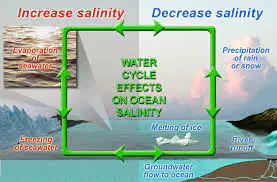
Which factors increase the salinity of seawater and therefore cause an increase in density of seawater? (check all that apply)
Higher Evaporation
Lower Evaporation
Colder temperatures leading to ice forming
Warmer temperatures leading ice melting
Which environmental factors decrease the salinity of seawater and therefore decrease the density of seawater? (check all that apply)
Increased precipitation
Decreased precipitation
Runoff of rivers into ocean basins
Warmer temperatures leading ice melting
Groundwater flow from aquifers into ocean basins
The density of ocean water is determined by 2 factors; they are
salt and temperature
temperature and latitude
pH level and salt
temperature and ocean basin
The most abundant salt in seawater is
calcium chloride
magnesium chloride
potassium chloride
sodium chloride
What is a thermocline?
A rapid change in temperature with depth
A rapid change in temperature with latitude
A rapid change in salinity with depth
A rapid change in density with depth
Warmer water will remain ______ because ________
at the surface; lower density than cool water
at the surface; higher density than cool water
deep; lower density than cool water
deep; higher density than cool water


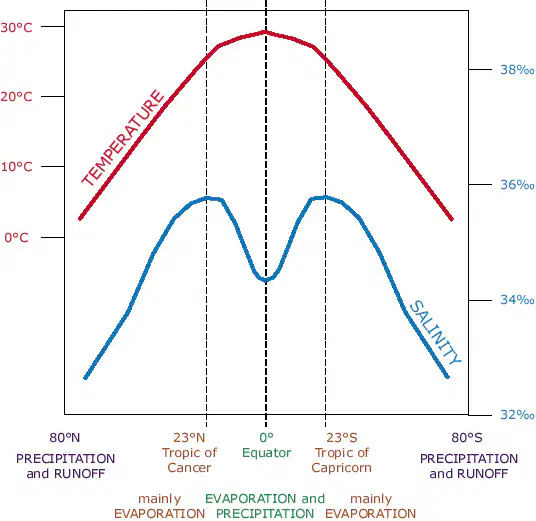
What is the average salinity of ocean water?
about 33 parts per thousand
about 20 parts per thousand
about 35 parts per thousand
about 37 parts per thousand
Where would the least dense ocean water be found and why would this be the case?
At the equator because salinity is higher due to evaporation
At the tropics because temperature is highest and salinity is highest
At the equator because temperature is highest and salinity is slightly lower than the tropics
At the poles because temperature is low and salinity is low
At the tropics because salinity is low and temperature is high
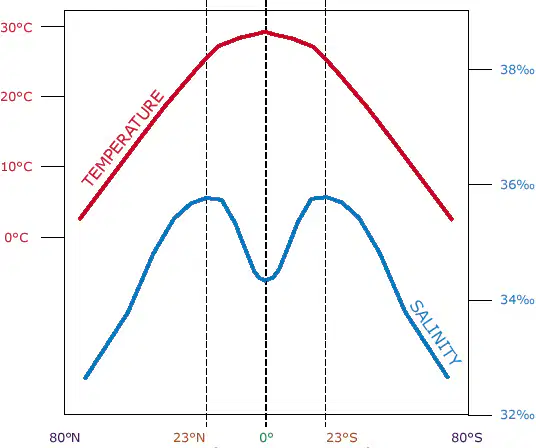
Where is salinity the highest and what is the reason for this?
At the equator
At the tropics
At the poles
Low evaporation and high precipitation
High evaporation and low precipitation
The equator receives the most direct sunlight on average throughout the year. If sunlight leads to evaporation which increases salinity, why does the equator have a lower salinity than the tropic of cancer and tropic of capricorn?
There are high temperatures at the equator
Salt is evaporating at a high rate at the equator
High levels of precipitation and runoff
The ocean water has a high density at the equator
The majority of the Sun's radiation is concentrated near the Equator, the ocean helps redistribute some of this heat by...
causing a lot of rain at the poles, cooling it down.
Carrying thermal energy to the poles through clouds.
Carrying thermal energy trapped in warm water to the poles.
Pushing warm water deep below the ocean surface through downwelling.

This Image represents...
Downwelling
Upwelling
Thermohaline circulation
Rip Current
Which three factors most directly affect surface currents in the oceans?
upwelling, convection, and the sun’s energy
deep currents, convection currents, and surface winds
dissolved solids, dissolved gases, and the sun’s energy
surface winds, the Coriolis Effect, and continental deflection
Which of the following can cause an increase in density that results in a deep ocean current?
The sun heats the water’s surface.
A warm wind blows across cold water.
An iceberg melts, adding fresh water to ocean water.
Warm water loses energy to its surroundings and cools.

Ocean currents affect climates around the world. Based on the map, which area MOST likely has a warmer climate than expected?
1
2
3
4
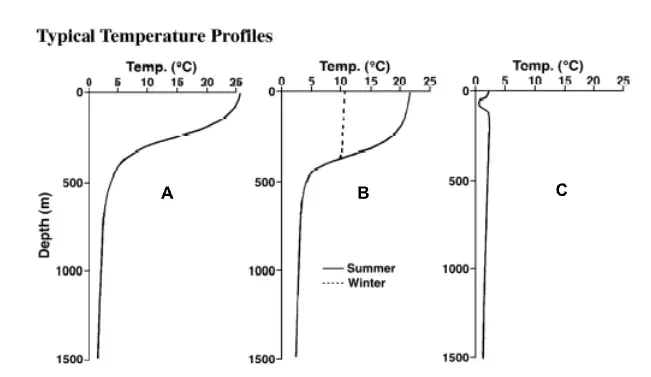
What do these three graphs show?
The halocline at different latitudes
The thermocline at different latitudes
The pycnocline at different latitudes
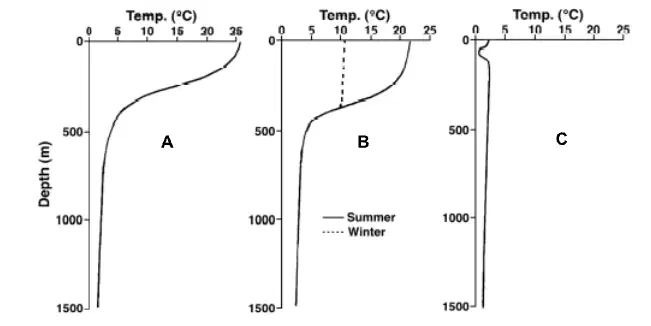
What information do these three graphs convey?
Variation of the halocline at different latitudes
Variation of the thermocline at different latitudes
Variation of the pycnocline at different latitudes
Which of these three graphs best represents the thermocline at high latitude locations (60N/S to 90N/S)?
A
B
C
Which of these three graphs best represents the thermocline at mid latitude locations (30N/S to 60N/S)?
A
B
C
Which of these three graphs best represents the thermocline at mid latitude locations (30N to 30S)?
A
B
C
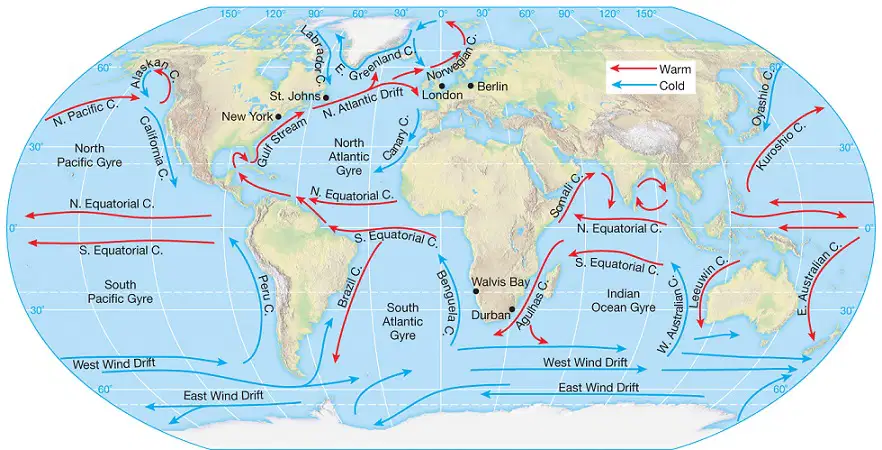
Using the map of surface currents, where are most WARM currents found?
On the southern coast of continents
On the western coast of continents
On the northern coast of continents
On the eastern coast of continents
Using the map of surface currents, where are most COLD currents found?
On the southern coast of continents
On the western coast of continents
On the northern coast of continents
On the eastern coast of continents
Which best describes many cold currents? (check all that apply)
Start at high latitudes and end at low latitudes
Are located on the eastern coast of continents
Start at low latitudes and end at high latitudes
Are located on the western coast of continents
Which best describes many warm currents? (check all that apply)
Start at high latitudes and end at low latitudes
Are located on the eastern coast of continents
Start at low latitudes and end at high latitudes
Are located on the western coast of continents

In the northern hemisphere, prevailing winds (grey arrows) deflect to the _________ due to the __________.
Right
Left
Coriolis Effect
Density changes
Salinity changes
In the southern hemisphere, prevailing winds (grey arrows) deflect to the _________ due to the __________.
Right
Left
Salinity changes
Density changes
Coriolis Effect
In the southern hemisphere, surface currents form due to ___________ between the prevailing winds and the ocean's surface. They deflect to the ____________ due to the _____________
Right
Left
Temperature exchange
Friction
Coriolis Effect
In the Northern hemisphere, surface currents form due to ___________ between the prevailing winds and the ocean's surface. They deflect to the ____________ due to the _____________
Right
Left
Temperature exchange
Friction
Coriolis Effect
Look at the map!
Which prevailing wind drives the movement of the Gulf Stream Current?
The polar easterlies
The Northeast trade winds
The westerlies.
Look at the map!
Which prevailing wind drives the movement of the Greenland Current?
The polar easterlies
The Northeast trade winds
The westerlies.

The picture represents a(n) ___ event.
El Nino
La Nina
Non-El Nino (normal conditions)

Examine the diagram. This is what occurs during ______________.
El NIno
La Nina
La Chica
Why do the fisherman of Peru and South America not welcome a strong El Nino?
El Nino poisons the fish
El Nino causes strong winds and currents which move fish westward
El Nino bring cold water to the surface which kills the base of the food chain
El Nino shuts off upwelling and nutrients needed for the marine food chain do not rise to the surface
El Niño ___________________ the trade winds causing the warm pool to move ___________.
weakens or reverses; west
intensifies; east
weakens or reverses; east
intensifies; east
La Niña is characterized by ______________ of the Western Pacific Ocean.
a warming
a cooling
average temperatures
Consider the following food chain:
Algae > Mayfly > Minnow > Trout
In a polluted ecosystem, which organism would likely have the HIGHEST level of toxic chemicals in its body?
Algae
Mayfly
Minnow
Trout

Which organism in the food web shown would
contain the lowest concentration of chemical pollutants?
producers
primary consumers
secondary consumers
tertiary consumers
The phenomenon by which toxins concentrate in the organisms at higher trophic levels within an ecosystem is known as...
Biotoxicity
Biomagnification
Eutrophication
Predation


Calculate the density of the cube.
2 g/cm3
4 g/cm3
6 g/cm3
8 g/cm3

A plastic ball with a volume of 19.7 cm3 has a mass of 15.8 g. Calculate the density of the plastic ball.
Would this ball sink or float in a container of gasoline? Gasoline's density is 0.66-0.69 g/cm3.
0.802 g/cm3, Float
0.802 g/cm3, Sink
1.25 g/cm3, Float
1.25 g/cm3, Sink

These five balloons escaped from the balloon seller in the park. Each one is filled with one of the gases listed in the table below. Next to each balloon, write the name of the gas that you think that balloon contains.
2-Carbon Dioxide, 1-Hydrogen, 4-Helium, 5-Nitrogen, 3-Air
2-Carbon Dioxide, 1-Air, 4-Nitrogen, 5-Helium, 3-Hydrogen
2-Carbon Dioxide, 1-Nitrogen, 4-Helium, 5-Hydrogen, 3-Air
2-Carbon Dioxide, 1-Helium, 4-Air, 5-Nitrogen, 3-Hydrogen
What is the formula for calculating density?
Density = Volume / Mass
Density = Mass * Volume
Density = Mass + Volume
Density = Mass / Volume
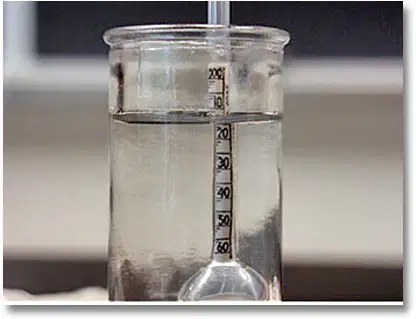
Measures density or specific gravity by how high it floats.
graduated cylinder
hydrometer
sling psychrometer
hygrometer
An environmental science student tests three unknown liquids using a hydrometer. The student records the following results:
Liquid 1 = +22
Liquid 2 = -46
Liquid 3 = 0
If the student were to rank the liquid in order of most dense to least dense, which of the following would be correct?
3, 2, 1
1, 2, 3
3, 1, 2
1, 3, 2
What is the definition of the tragedy of the commons?
When humans overuse a natural resource
When the short-term, positive effects go to the individual, while the long-term, negative effects are spread out to the group
When humans act selfishly, thinking of their own self-interest
When plants and animals compete for space, resources, and/or food
What are considered "the commons"
Common house hold items like knifes, spoons, and forks.
A renewable resource owned by no one and available for use by anyone at little or no charge
A field where college students can sit outside in between classes

