wayground logo

Free Printable Worksheets

Font size

S
M
L
XL
Worksheets

ES2 Final Exam

Total questions: 26

Worksheet time: 15mins

Name
Class
Date
1.

Convection currents occur because

a)

cold air is less dense than warm air.

b)

warm air rises and cold air sinks.

c)

warm air is heavier than cold air.

d)

cold air rises and warm air sinks.

2.
Weather is
a)
the changes that occur in cloud formations from day to day.
b)
the amount of rain or snow that falls in a day.
c)
convection and conduction that occurs within air masses.
d)
the condition of Earth’s atmosphere at a given time and place.
3.

As you move TOWARD the center of a low pressure system, the atmospheric pressure at the surface _______________.

a)

increases.

b)

decreases.

c)

stays the same.

d)

cools down.

4.

Which of the following statements about air is true?

a)

Air cannot be compressed.

b)

Air does not have mass.

c)

Air is a mixture of gases including oxygen and nitrogen.

d)

Air gets all its heat energy from the ground.

5.
__________ are lines that connect points of equal air pressure.
a)
Isotherms
b)
Fronts
c)
Troughs
d)
Isobars
6.
Days are hotter at the equator than at the poles because
a)
the equator is the thickest part of Earth.
b)
more direct light shines on the equator.
c)
more indirect light shines on the equator.
d)
the equator is closer to the Sun.
7.
The solar angle is a term that refers to the
a)
how long it takes light to reach Earth from the Sun.
b)
the distance from one beam of light to another.
c)
the amount of solar energy that falls on different parts of Earth’s surface.
d)
angle at which sunlight strikes Earth’s surface.
8.

What is the typical direction of surface wind flow around a high pressure system in the Northern Hemisphere?

a)

counter-clockwise and spiraling outward

b)

counter-clockwise and spiraling inward

c)

clockwise and spiraling outward

d)

clockwise and spiraling inward

9.
When discussing air pressure, which of the following statements is true?
a)
Increased pressure = increased volume.
b)
Increased pressure = increased density.
c)
Increased pressure = more cloud cover.
d)
Increased pressure = increased precipitation.
10.
The reason why it is so hot near the equator is ___.
a)
the sun heats the lava under that area.
b)
the area near the equator gets lots of direct sunlight.
c)
the area near the equator gets lots of indirect sunlight.
d)
the light near that area is less intense.
11.
Wind moves from areas of
a)
high pressure to areas of low pressure.
b)
low pressure to areas of high pressure.
c)
high humidity to areas of low humidity.
d)
low humidity to areas of high humidity.
12.

A front is

a)
the beginning of a storm that brings strong winds and heavy rain.
b)
a boundary that separates air masses with different moisture content and temperature.s.
c)
an imaginary line that connects locations of equal air pressure.
d)
All of the above.
13.

The forecast predicts that a low pressure system will move in what weather is expected?

a)
Foggy
b)
Clear and colder
c)
Sunny
d)
Cloudy and rainy
14.
Heat transfer between two substances that are in contact is called
a)
conduction.
b)
thermal energy.
c)
convection.
d)
radiation.
15.
Large clouds that often produce thunderstorms are called
a)
stratus clouds.
b)
cumulonimbus clouds.
c)
cirrus clouds.
d)
nimbostratus clouds.
16.
Which of the following statements is true?
a)
Land heats less rapidly than water.
b)
Land heats more rapidly than water.
c)
Water heats more rapidly than land.
d)
Land and water heat at the same rate.
17.
Warm air is _____________ with __________ pressure.
a)
denser, low
b)
denser, high
c)
less dense, low
d)
less dense, high
18.

The primary source of heat transfer in the atmosphere is
a)
convection
b)
radiation
c)
conduction
d)
absorption
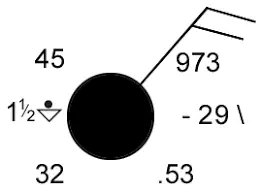
19.

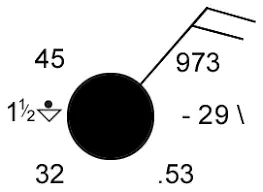
What is temperature?

a)

32

b)

-29

c)

45

d)

973

20.

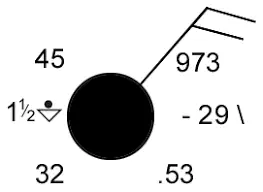
What is the current air pressure (mb)?

a)

973mb

b)

10973mb

c)

1097.3mb

d)

997.3mb

21.

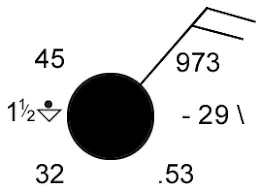
What direction is the wind blowing?

a)

South

b)

South west

c)

North west

d)

North east

22.

What is the wind speed?

a)

20

b)

30

c)

10

d)

5

23.

What is does this symbol represent?

(a)  

24.

What does this symbol represent?

(a)  

25.

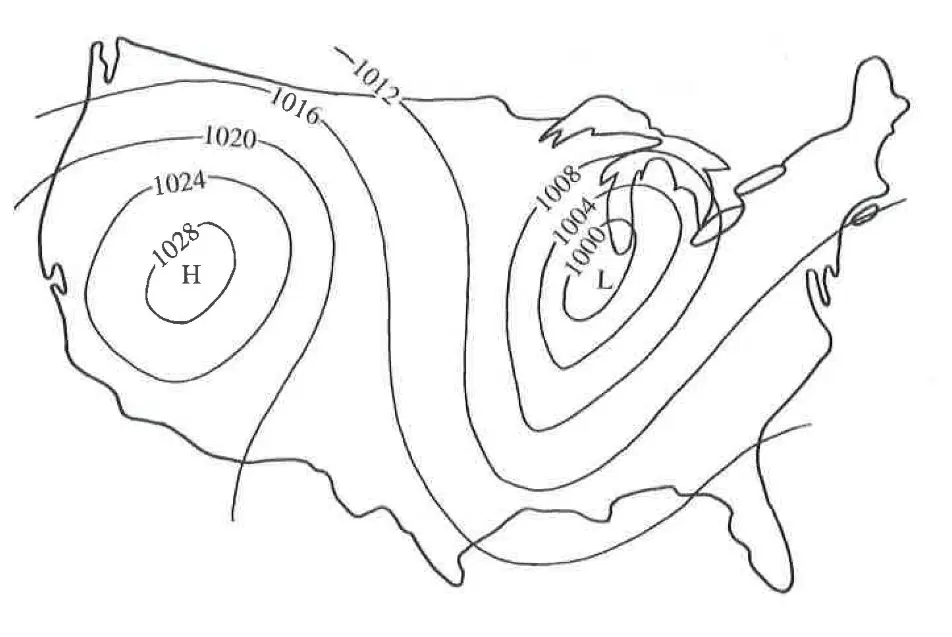
what do the lines on the map represent?

(a)  

26.

How many types of clouds are there?

a)

4

b)

3

c)

2

d)

5