
Font size
 Worksheets
Chap 4+8 kế toán quản trị
Total questions: 48
Worksheet time: 26mins
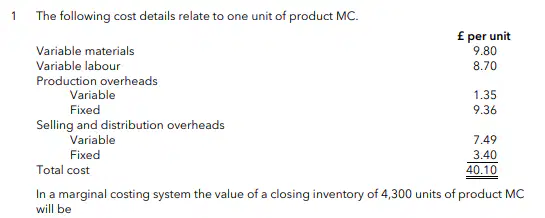
A £85,355
B £117,562
C £125,603
D £172,430
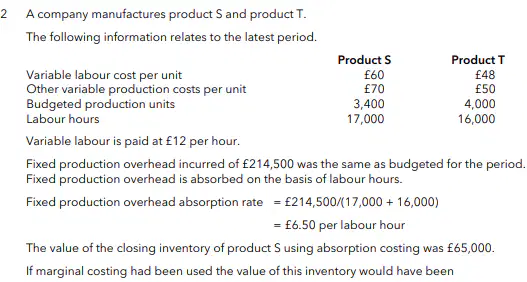
A £52,000
B £53,150
C £260,000
D £442,000
Ticktock Ltd makes clocks with a selling price of £50 per clock. Budgeted production and sales volume is 1,000 clocks per month. During September 1,000 clocks were made and 800 clocks were sold. There was no opening inventory.
The variable cost per clock is £25. Fixed costs in September were, as budgeted, £5,000.
Using marginal costing the contribution and profit for September would be calculated as
A Contribution: £25,000, Profit: £20,000
B Contribution: £20,000, Profit: £15,000
C Contribution: £20,000, Profit: £16,000
D Contribution: £25,000, Profit: £16,000
Which three of the following statements concerning marginal costing are true?
A Marginal costing is an alternative method of costing to absorption costing.
B Contribution is calculated as sales revenue minus fixed cost of sales.
C Closing inventories are valued at full production cost.
D Fixed costs are treated as a period cost and are charged in full to the income statement of the accounting period in which they are incurred.
E Marginal cost is the cost of a unit which would not be incurred if that unit were not produced.
Which two of the following statements concerning marginal costing systems are true?
A Such systems value finished goods at the variable cost of production.
B Such systems incorporate fixed overheads into the value of closing inventory
C Such systems necessitate the calculation of under- and over-absorbed overheads.
D Such systems write off fixed overheads to the income statement in the period in which they were incurred.
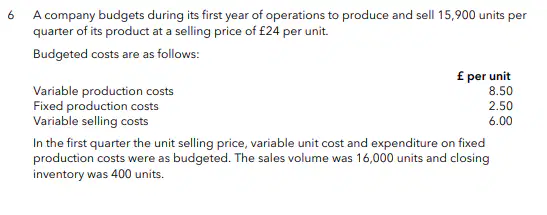
The absorption costing profit for the quarter was
A £110,750
B £112,000
C £112,250
D £113,250
Which of the following statements about profit measurement under absorption and marginal costing is true (assuming unit variable and fixed costs are constant)?
A Profits measured using absorption costing will be higher than profits measured using marginal costing.
B Profits measured using absorption costing will be lower than profits measured using marginal costing.
C Profits measured using absorption costing will be either lower or higher than profits measured using marginal costing
D Profits measured using absorption costing may be the same as, or lower than, or higher than profits measured using marginal costing.
f the number of units of finished goods inventory at the end of a period is greater than that at the beginning, marginal costing inventory will result in (assuming unit variable and fixed costs are constant)
A less operating profit than the absorption costing method
B the same operating profit as the absorption costing method
C more operating profit than the absorption costing method
D more or less operating profit than the absorption costing method depending on the ratio of fixed to variable costs
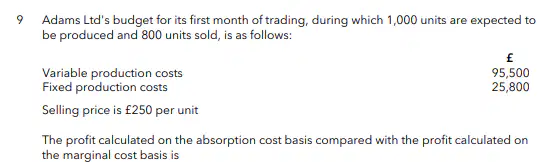
A £24,260 lower
B £5,160 higher
C £5,160 lower
D £24,260 higher
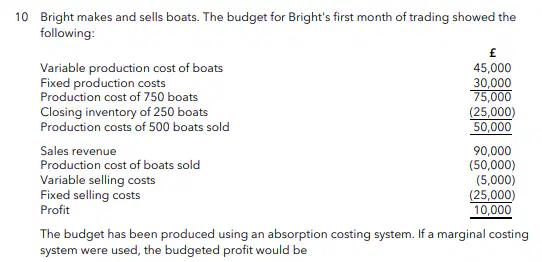
A £22,500 lower
B £10,000 lower
C £10,000 higher
D £22,500 higher

A £47,500
B £57,500
C £59,500
D £62,500
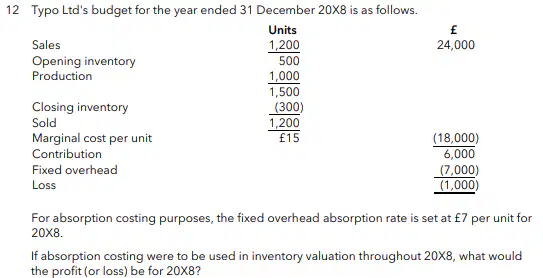
A £400 loss
B £400 profit
C £2,400 profit
D £2,400 loss
A company had opening inventory of 48,500 units and closing inventory of 45,500 units. Profits based on marginal costing were £315,250 and on absorption costing were £288,250.
What is the fixed overhead absorption rate per unit?
A £5.94
B £6.34
C £6.50
D £9.00
In March, a company had a marginal costing profit of £78,000. Opening inventories were 760 units and closing inventories were 320 units. The company is considering changing to an absorption costing system.
What profit would be reported for March, assuming that the fixed overhead absorption rate is £5 per unit?
A £74,200
B £75,800
C £76,400
D £80,200
When comparing the profits reported under marginal and absorption costing when the levels of inventories increased (assuming unit variable and fixed costs are constant)
A absorption costing profits will be lower and closing inventory valuations higher than those under marginal costing
B absorption costing profits will be lower and closing inventory valuations lower than those under marginal costing
C absorption costing profits will be higher and closing inventory valuations lower than those under marginal costing
D absorption costing profits will be higher and closing inventory valuations higher than those under marginal costing
Which two of the following statements are advantages of marginal costing as compared with absorption costing?
A It complies with accounting standards
B It ensures the company makes a profit
C It is more appropriate for short-term decision-making
D Fixed costs are treated in accordance with their nature (ie, as period costs)
E It is more appropriate when there are strong seasonal variations in sales demand
When comparing the profits reported under marginal and absorption costing when the levels of inventories decreased (assuming unit variable and fixed costs are constant)
A absorption costing profits will be lower and closing inventory valuations higher than those under marginal costing
B absorption costing profits will be lower and closing inventory valuations lower than those under marginal costing
C absorption costing profits will be higher and closing inventory valuations lower than those under marginal costing
D absorption costing profits will be higher and closing inventory valuations higher than those under marginal costing
Which two of the following statements are correct?
A Absorption unit cost information is the most reliable as a basis for pricing decisions.
B A product showing a loss under absorption costing will also make a negative contribution under marginal costing.
C When closing inventory levels are higher than opening inventory levels and overheads are constant, absorption costing gives a higher profit than marginal costing.
D In a multi-product company, smaller volume products may cause a disproportionate amount of set up overhead cost.
E Marginal unit cost information is normally the most useful for external reporting purposes.
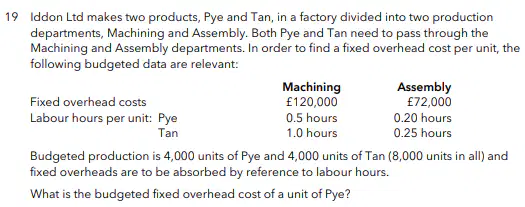
A £18
B £20
C £24
D £28
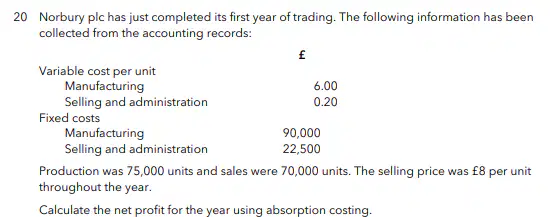
A £13,500
B £19,500
C £21,000
D £22,500
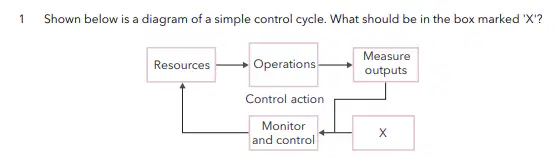
A Feedback
B Fixed costs
C Activity levels
D Budgets and standards
Which of the following is not a feature of effective feedback reports?
A Made available in a timely fashion
B Produced on a regular basis
C Distributed to as many managers as possible
D Sufficiently accurate for the purpose intended
Which of the following describes exception reporting?
A Reporting of exceptional activities within an organisation
B Reporting only controllable matters to managers
C Reporting only of variances which exceed a certain value
D Reporting of all variances to the relevant manager
Which two of the following statements about management control reports are correct?
A Reports should be completely accurate.
B Reports should be clear and comprehensive.
C Reports should not include information about uncontrollable items.
D Based on the information contained in reports, managers may decide to do nothing
Which of the following is not a style of performance evaluation identified in Hopwood's studies?
A Budget constrained
B Non-accounting
C Revenue focused
D Profit conscious

A
B
C
F
G
A company have recently implemented a new budgetary planning and control system after several years of trading.
Having made a significant investment in the new system, the company's management team were surprised to learn that it is not designed to do which of the following?
A Improve control of actual performance
B Improve coordination of activities
C Improve gross profit
D Improve communication of ideas and plans
Which of the following is a reason for adopting a decentralised rather than a centralised organisational structure?
A Improved goal congruence between the goals of divisional management and the goals of the organisation
B Rapid management response to changes in the trading environment
C Availability of objective performance measures
D Improved communication of information between the group's managers
Division P is an investment centre within PC Ltd. Over which of the following is the manager of division P likely to have control?
(1) Transfer prices
(2) Level of inventory in the division
(3) Discretionary fixed costs incurred in the division
(4) Apportioned head office costs
A (1), (2), (3) and (4)
B (1), (2) and (3) only
C (1) and (2) only
D (1) only
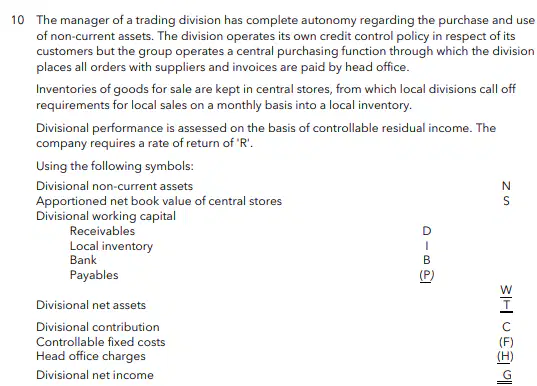
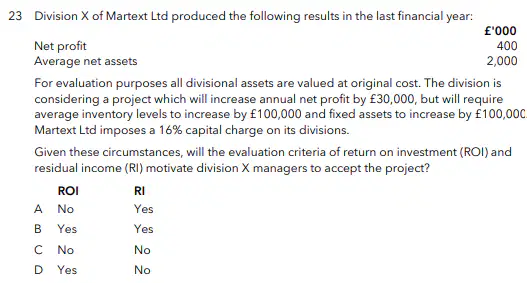
Which of the following formulae calculates the division's controllable residual income?
A [C – F] – [(N + D + B) R]
B [C – F] – [(N + D + I + B) R]
C C – [(N + D) R]
D G – (T R)
Division D of Distan Ltd is considering a project which will increase annual profit by £15,000 but will require average receivables levels to increase by £100,000. The company's target return on investment is 10% and the imputed interest cost of capital is 9%. Division D currently earns a return on investment of 13%.
Would the return on investment (ROI) and residual income (RI) performance measures motivate the manager of Division D to act in the interest of the Distan company as a whole?
ROI: A or B
RI: C or D
A Manager would wish to act in the interest of Distan Ltd
B Manager would not wish to act in the interest of Distan Ltd
C Manager would wish to act in the interest of Distan Ltd
D Manager would not wish to act in the interest of Distan Ltd
Division B of a national house-building group is projected to earn profits of £4.5 million in the current year on capital employed at the year end of £25 million. The division has been set a target return on investment (ROI) of 20%.
The manager of division B is considering disposing of some slow-moving houses which have a full market value of £16 million, but are held in the books at cost of £12 million, for a reduced figure of £14 million.
Which of the following statements is true?
A The revised divisional ROI will be below 20% and the manager will make a goal congruent decision.
B The revised divisional ROI will be above 20% and the manager will not make a goal congruent decision.
C The revised divisional ROI will be below 20% and the manager will not make a goal congruent decision
D The revised divisional ROI will be above 20% and the manager will make a goal congruent decision.
On the last day of the financial year a division has net assets with a total carrying amount of £300,000. The return on investment for the division is 18%.
The division manager is considering selling a non-current asset immediately before the year end. The non-current asset has a carrying amount of £15,000 and will sell for a profit of £5,000.
What would be the division's return on investment (ROI) immediately after the sale of the asset at the end of the year?
A 17.7%
B 19.3%
C 20.3%
D 20.7%
Which of the following is not a perspective that is monitored by the balanced scorecard approach to performance measurement?
A Financial
B Customer
C Supplier
D Innovation and learning
Indicate which of the following statements are true.
(1) If a company uses a balanced scorecard approach to the provision of information it will not use ROI or residual income as divisional performance measures.
(2) The residual income will always increase when investments earning above the cost of capital are undertaken.
(3) The internal business perspective of the balanced scorecard approach to the provision of information is concerned only with the determination of internal transfer prices that will encourage goal congruent decisions.
(4) An advantage of the residual income performance measure is that it facilitates comparisons between investment centres.
A (1) only
B (2) only
C (3) only
D (1) and (4) only
Which of the following describes a flexible budget?
A A budget comprising variable production costs only
B A budget which is updated with actual costs and revenues as they occur during the budget period
C A budget which shows the costs and revenues at different levels of activity
D A budget which is prepared using a computer spreadsheet model
Which of the following statements is/are correct?
(1) Fixed budgets are not useful for control purposes.
(2) A prerequisite of flexible budgeting is a knowledge of cost behaviour patterns.
(3) Budgetary control procedures are useful only to maintain control over an organisation's expenditure.
A (1), (2) and (3)
B (1) and (2) only
C (1) and (3) only
D (2) only
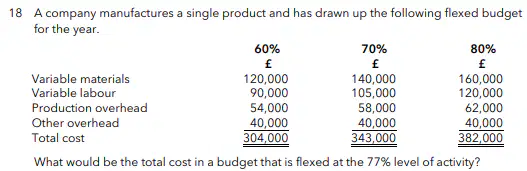
A £330,300
B £370,300
C £373,300
D £377,300
Within decentralised organisations there may be cost centres, investment centres and profit centres. Which of the following statements is true?
A Cost centres have a higher degree of autonomy than profit centres.
B Investment centres have the highest degree of autonomy and cost centres have the lowest.
C Investment centres have the lowest degree of autonomy.
D Profit centres have the highest degree of autonomy and cost centres have the lowest.

Which of the following is the correct formula for calculating the controllable residual income of the division?
A P – [(F + S) R]
B N – [(F + S) R]
C N – (Z R)
D P – (Z R)
Which of the following sentences best describes what is necessary for a responsibility accounting system to be successful?
A Each manager should know the criteria used for evaluating his or her own performance.
B The details on the performance reports for individual managers should add up to the totals on the report of their superior.
C Each employee should receive a separate performance report.
D Service department costs should be apportioned to the operating departments that use the service.
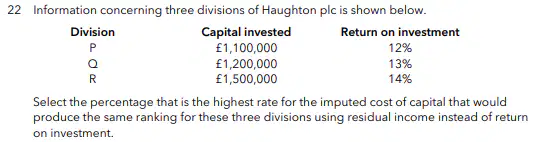
A 11.9%
B 13.9%
C 17.9%
D 23.9%
A
B
C
D
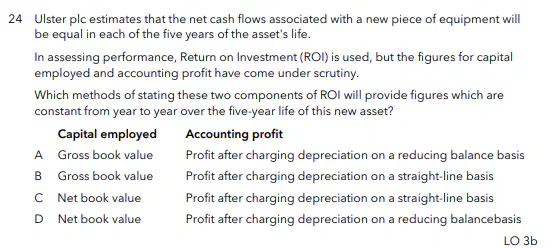
A
B
C
D
Consider the following statements:
(1) Cloud accounting software allows multi-user access.
(2) Cloud accounting software is more expensive than accounting software packages.
Which of the following is correct with regards to the statements above?
A (1) and (2) are correct
B (1) and (2) are incorrect
C (1) is correct and (2) is incorrect
D (2) is correct and (1) is incorrect
Which two of the following are true when management information is provided by a shared service centre (SSC)?
A Management information quality is improved as best practice can be implemented
B There is a more consistent management of business data
C Specific finance issues affecting individual departments will be taken into account
D The costs of providing management information will increase
When a company decides to use cloud accounting, which of the following does it no longer need?
A Accounting software update manager
B Trained accounts staff
C Management reporting timetables
D Internet access
The shared service centre (SSC) of Oilspill Ltd operates its payroll, finance and project management functions. It has adopted the balanced scorecard for measuring its performance.
Which two of the following would be appropriate for the SSC to use as performance measures in the ‘customer perspective’ quadrant?
A Cost per accounting transaction processed
B Time saved updating payroll file for overtime payments
C Number of complaints about processing delays
D Number of new projects set up
F Percentage of reports issued to department heads on time

