
Font size
 Worksheets
Unit 11 Organic Chemistry
Total questions: 117
Worksheet time: 2hrs 24mins
What is the general formula for saturated hydrocarbons?
CnH2n+2
CnH2n
CnH2n-2
CnH2n+3
Which functional group is present in aldehydes and ketones?
Amino group
Ester group
Hydroxyl group
Carbonyl group
Name the functional group present in alcohols.
-CH3
-NH2
-OH
-COOH
What is the common name for ethanoic acid?
acetic acid
propionic acid
butyric acid
formic acid
What are polymers made up of?
Monomers
Molecules
Proteins
Atoms
How many carbon atoms are present in a molecule of butane?
5
4
6
3

Ethyl ethanoate is used as a solvent for varnishes and in the manufacture of artificial leather. The formula represents a molecule of ethyl ethanoate.
Write the name of the class of organic compounds to which this compound belongs.
(a)
What is the IUPAC name for the compound that has a condensed structure of CH3CH2CH2CHO?
butanol
butanal
propanol
propanal
What is the IUPAC name for the compound that has a condensed structure of CH3CH2CH2CHO?
butanol
butanal
propanol
propanal
Which formula represents a hydrocarbon?
CH3CH2CH2CHO
CH3CH2CH2CH3
CH3CH2CH2COOH
CH3CH2COOCH3

Given the reaction shown. This reaction is an example of
fermentation
saponification
addition
esterification
Given the balanced equation with an unknown compound “X”:
C6H12O6(AQ) → 2 X + 2 CO2(G)
Which compound is represented by X ?
CH3OH(AQ)
CH2(OH)4(AQ)
CH3CH2OH(AQ)
CH2OHCH2OH(AQ)
What is the total number of electrons shared in the bonds between the carbon atoms in a molecule of:
H−C≡C−H
6
2
3
8
The compounds CH3OCH3 & CH3CH2OH are isomers of each other.
These compounds must have the same
density
reactivity
melting point
molecular formula
Which type of organic reaction produces both water and carbon dioxide?
addition
combustion
esterification
fermentation

Classify the compound based on the functional group present.
alkane
alkene
alkyne
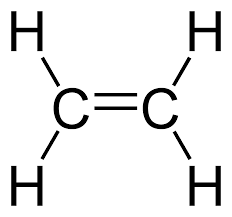
Classify the compound based on the functional group present.
alkane
alkene
alkyne
aromatic

Classify the compound based on the functional group present.
alkane
alkene
alkyne
aromatic
How many carbon atoms are in propane
1
2
3
4
If an alkane has 20 carbon atoms, how many hydrogen atoms will it have?
20
22
40
42

Name this alkane
Methane
Ethane
Propane
Butane
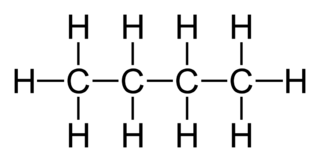
Name this alkane
Methane
Ethane
Propane
Butane
The "ane" ending in "alkane" tells someone that they are dealing with _________-bonded carbons.
single
double
triple
quadruple
Give the name of this compound...
C3H8
Propene
Butane
Butene
Propane


C3H8


Alkene are (a) compounds
Organic Compound having 3 carbon atoms in a chain has root word as (a)
Alkynes are (a) bonded compounds
CnH2n+2 is the general formula for (a) series .
Which formula represents a saturated hydrocarbon?
C2H2
C2H4
C6H10
C6H14
What is the molecular formula for CH3CH2COOCH3?
C2H4O
C2H4O2
C4H8O
C4H8O2

Given the formula for a compound:
What is the IUPAC name of the compound?
2,3-dimethyloctane
2,3-dimethylhexane
4,5-dimethyloctane
4,5-dimethylhexane

Given the formula representing a compound:
This compound is classified as an
amide
amine
ester
ether
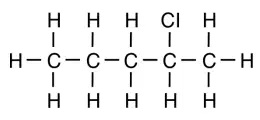
Given the formula representing a compound:
What is the chemical name for the compound?
2-chloropentene
2-chloropentane
4-chloropentene
4-chloropentane
The compounds CH3CH2CH2OH and CH3OCH2CH3 have different
numbers of carbon atoms per mole
numbers of hydrogen atoms per mole
functional groups
molecular masses
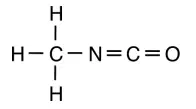
A scientific sampling instrument landed on a comet. Four of the organic compounds detected on the comet are methyl isocyanate, propanone, propanal, and ethanamide. The structural formula for methyl isocyanate is shown.
Identify the element in these four compounds that makes them organic compounds.
(a)
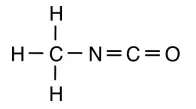
A scientific sampling instrument landed on a comet. Four of the organic compounds detected on the comet are methyl isocyanate, propanone, propanal, and ethanamide. The structural formula for methyl isocyanate is shown.
Write the names of the TWO organic compounds detected on the comet taht are isomers of each other
(a)
Draw a structural formula for 1-bromopropane.


Name this compound.
Butanol
Butene
Oxybutanol
Butanoic acid

Name this compound.
Nitroethane
Ethylamine
Aminoethane
Ethamine

Name this compound.
1-Propane
2-Bropane
2-Propane(Br)
2-Bromopropane

What is the organic family for propanamine?
aldehydes
amides
amines
organic acids

Classify the compound based on the functional group present.
Ketone
Carboxylic acid
Ester
Ether

Classify the compound based on the functional group present.
Ether
Ketone
Ester
Carboxylic acid

Name the structure.
4-hexanol
3-hexanol
4-heptanol
3-heptanol


Name this structure.
hexanal
hexanoic acid
hexanone
hexanoate

Name this structure.
heptanoic acid
heptane
6-heptanone
2-heptanone

Name this structure.
propanal
1-propanol
propane
3-propanol

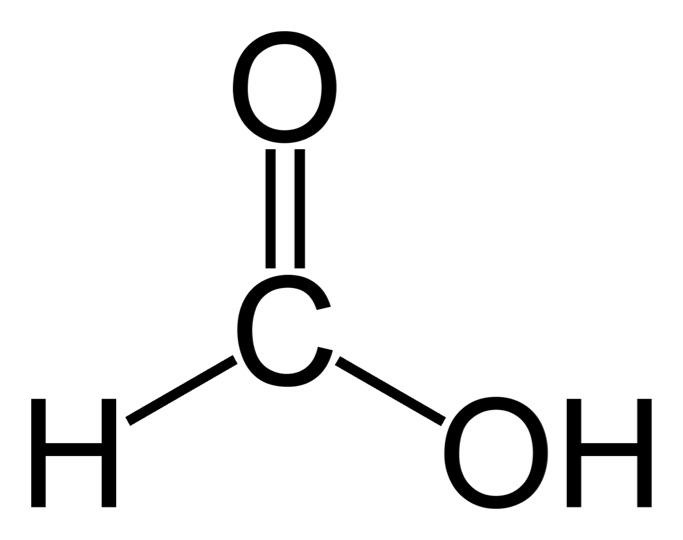

Name this compound...
methane
methene
methanol
methoxymethane


name this diagram:
ethanol
ethanoic acid
methyl methanoate
Formic acid

Name the compound
hexane
hexanol
propoxypropane
3-hexanol

The name of the substance in the image is...
ethanol
propanol
ethane
propane

What functional group is shown?
amide
ketone
organic acid
amine
What is the organic family for propanamine?
aldehydes
amides
amines
organic acids

What is the organic family for propanamide?
aldehydes
amides
amines
organic acids

Name the organic functional group for this structure:
aldehydes
amides
amines
organic acids
What is a functional group?
Atoms or group of atoms that give specific characteristics to a molecule
Group of molecules that make up a group of atoms
Group of molecules that give specific characteristics to an atom
Group of atoms that give specific characteristics to an element
Classify the compound based on the functional group present.
Ketone
Carboxylic acid
Ester
Ether


What is the name of this compound?
2,3-bromobutane
2,3-dibromo butane
1,1-dibromo-1-methyl propane
Bromobutane


In the reaction, which answer represents the product X?


Complete the reaction:
C5H12 + Cl2 --> ________________________________
C5H11Cl + HCl
C5H10Cl2 + H2
C5H12Cl2
C4H11Cl2 + CO2
Complete the following reaction:
C2H4 + O2 --> ___________________________
C2H4O2
C2H3O + OH
C2H2O2 + H2
H2O + CO2
Which statement describes the two isomers of butane?
They have the same molecular formula but different structural formulas.
They have the same molecular formula and the same structural formula.
They have different molecular formulas and different structural formulas.
They have different molecular formulas but the same structural formula.
Which term represents an organic reaction that produces soap?
esterification
fermentation
saponification
solidification
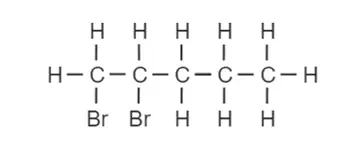
Given the formula representing a compound.
What is a chemical name of this compound?
1,1-dibromopentane
2,2-dibromopentane
1,2-dibromopentane
4,5-dibromopentane

What is the correct name for the alkyne shown?
butyne
1-butyne
2-butyne
1-methyl-1-propyne
Which is the structures with IUPAC nomenclature
2,2,4-trimethylpentane


molecule with the same molecular structure but different structural formula
fats
lipids
fossil fuels
isomers



