
Font size
 Worksheets
Year 10 Triple Sci - Cycle 3 Baseline Assessment
Total questions: 117
Worksheet time: 2hrs 48mins
What do you call the cell that forms from fertilization?
fertilized egg
sperm cell
zygote
egg cell
What do you call the type of reproduction in which the genetic materials from two different cells combine, producing an offspring?
pollination
sexual reproduction
fertilization
asexual reproduction
In this cell division, one diploid cell divides and makes four haploid sex cells. What do you call this special kind of cell division?
mitosis
meiosis
fertilization
pollination
Which of the following is an advantage of sexual reproduction?
Genetic variation
Down syndrome
Mutation
New trait formed
What type of reproduction takes place when one parent organism produces offspring without meiosis and fertilization?
pollination
sexual reproduction
asexual reproduction
fertilization
Which of the following is a disadvantage of asexual reproduction?
All organisms have genetic variation
Parents produces identical off spring which is not suitable for survival in a changing environment
Finding a mate is not needed
It can produce a lot of offspring
What is a dominant allele
An allele which if present will give the organism that characteristic
A bossy allele
You need two of these to give that characteristic
A strong one
What is the genotype of the organism?
How the organism looks
The type of jeans a human wears
The arrangement of genes in the organism
The way it is affected by its environment
Which of these is a possible homozygous genotype
Bbb
CC
Dd
aAaA
Why might 2 parents who do not have cystic fibrosis have a child with it?
The disease relies on a dominant allele
Its all random
They are unlucky
They could be carriers
Name another hereditary condition
Salmonella
Measles
HIV
Polydactyly
What is the shape of DNA?
A long rope
A genetic cross
A double helix
Three strands with complementary base pairs
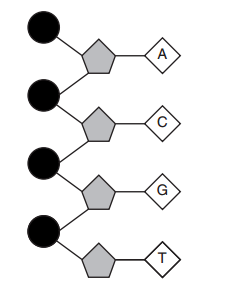
The diagram below represents a portion of a DNA molecule. The letters represent different types of
sugar molecules
nitrogenous bases
enzymes
proteins


What is one of the processes involved in selective breeding?
allowing organisms to reproduce without interference
choosing individuals with desirable characteristics to be parents of the next generation


1. An embryo is split into smaller groups of cells.
2. Each group of cells develops into an embryo and is transplanted into a host animal.
3. The host animals give birth to offspring that are all genetically identical to each other.

1. The nucleus is removed from an unfertilised egg cell and is replaced with a nucleus that has been removed from a skin cell.
2. The new cell is given an electric shock which causes it to start dividing.
3. The embryo is inserted into a host mother.
4. The offspring will be genetically identical to the adult skin cell.


Explain why there are no fossils of many early forms of life
Early forms of life where too soft to form fossils
Early forms of life were very, very small so finding fossilised remains is very difficult.
Most dead organisms do not form fossils they decay
All of the above

Lily sees a skeleton of a dinosaur at a museum. What is true about the bones that make up the skeleton?
The bones are made up of minerals.
The bones are those of the dinosaur itself.
The bones were formed from mud that hardened.
The bones are made up of amber.

Which of these are causes of extinction
Habitat Destruction
A New Predator
A New Disease
A New Competing Species
All of the above
Known as the father of modern genetics:
Watson
Crick
Darwin
Mendel
How does a catalyst work in speeding up a reaction?
By lowering the activation energy or reaction
by giving them more energy
by making them more available


The speed at which a chemical reaction occurs
Fast
Slow
Rate
Ratio

The amount of something; how many particles in a volume of a mixture
Rate
Collision
Catalyst
Concentration
2SO2(g)+O2(g) ⇌ 2SO3(g) + Heat
Adding SO2(g) will
shift equilibrium right
shift equilibrium left
increase rate of reaction
have no change

2SO2(g)+O2(g)⇌2SO3(g)
Removing O2(g) will
shift equilibrium right
shift equilibrium left
increase pressure
have no change
Adding SO3(g) will


If an alkane has 10 carbon atoms, how many hydrogen atoms will it have?
20
22
40
42


C3H8
Which homolgous series contains a C=C double bond?
alkanes
alkenes
alcohols
carboxylic acids

-COOH is the functional group for...
alcohols
esters
carboxylic acids
amides

-COO is the functional group for...
alcohols
esters
carboxylic acids
amides

-OH is the functional group for...
alcohols
esters
carboxylic acids
amides
An alcohol can be __________________ to form a carboxylic acid
oxidised
reduced
polymerised
broken down

Name this carboxylic acid
ethanoic acid
prpoanoic acid
butyl butanoate
butanoic acid
carboxylic acid + ? --> ester
water
alkene
alcohol
alkane

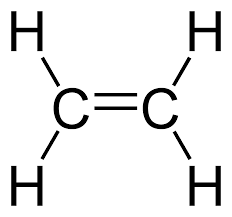

What does the Reaction of Alkenes and Steam form?
Alcohols
Carboxylic Acid
A chain of repeating units (called monomers)
monomer
dimer
replicate
polymer
What happens in a Condensation Polymerisation reaction?
Two different functional groups bond together and expel a small molecule (often water)
A small molecule is added
All atoms used up when monomers join together
What happens in an Addition Polymerisation
Two different functional groups bond together and expel a small molecule (often water)
A small molecule is added
All atoms used up when monomers join together
Which functional groups do amino acids have? (2 answers)
NH2
H2O
OH
COOH
What do amino acids form during a condensation reaction?
Alkenes
Polypeptides
Amines
Cellulose
What is formed from different amino acids joined in a long chain?
Lipids
Carbohydrates
Proteins
Sugars
What is the structure of DNA?
One monomer chain made from nucleotides in the form of a single helix
One polymer chain made from nucleotides in the form of a single helix
Two monomer chains made from nucleotides in the form of a double helix
Two polymer chains made from nucleotides in the form of a double helix
What monomers are starch and cellulose made of?
Glucose
Protein
Carbohydrate
Lipids
Butene is made into a polymer. the polymers name would be....
Poly(butane)
Poly(butene)
Poly(pocket)
Poly(putakettleon)
Polymerisation of alkenes is classed as a .....
condensation polymerisation
addition polymerisation
Polymerisation to form poly(esters) is classed as a .....
condensation polymerisation
addition polymerisation

Which is not a natural polymer?
kevlar
protein
cellulose
DNA

