
 Worksheets
2024 - Final Exam - Mechanical Fundamentals
Total questions: 85
Worksheet time: 1hrs 1mins
A prefix commonly used in SI units to denote 10^3 (thousand) is:
Mega (M)
Kilo (k)
Centi (c)
Giga (G)
A prefix commonly used in SI units to denote 10^-3 (thousandth) is:
deci (d)
centi (c)
milli (m)
micro (µ)
The two vectors in the figure have the same magnitude but opposite directions, the vector -V is called:
Unit vector
Parallel vector
Negative vector
Perpendicular vector
For every action, there is an equal and opposite reaction. This statement represents:
Newton's First Law
Newton's Second Law
Newton's Third Law
Law of Universal Gravitation
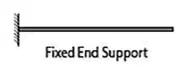
What is the reaction force for Fixed End Support?


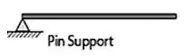
What is the reaction force for Pin Support?
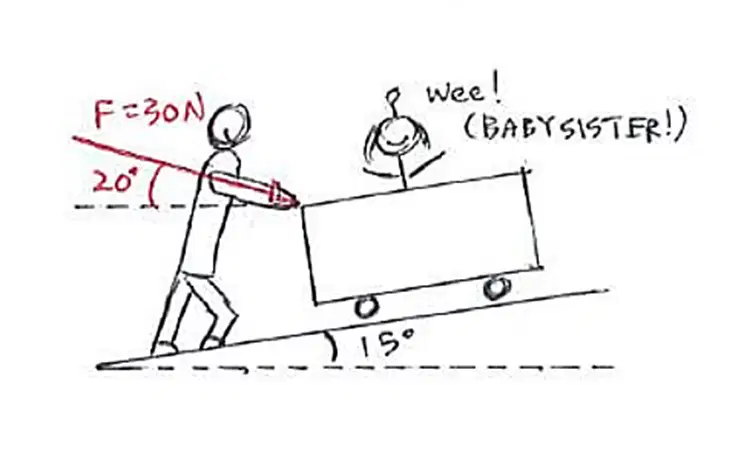
You're pushing your baby sister up the slope. Calculate the components of F that are.
(a) parallel to the slope
(b) perpendicular to the slope
你把你的小妹妹推上斜坡。计算F的分量.
(a) 与斜坡平行
(b) 垂直于斜坡
F (parallel) = 26.6 ; F (Perpendicular) = 16.2
F (parallel) = 23.6 ; F (Perpendicular) = 17.9
F (parallel) = 24.6 ; F (Perpendicular) = 17.2
F (parallel) = 25.6 ; F (Perpendicular) = 18.2
The basic type of motion of a body is translation motion only.
True
False
The simplification of the couple is done based on the ______________.
The clockwise of the anti-clockwise rotation sign convention
The simplification is not possible
The couple is a vector and thus can’t be simplified
The couple is a scalar and can’t be simplified
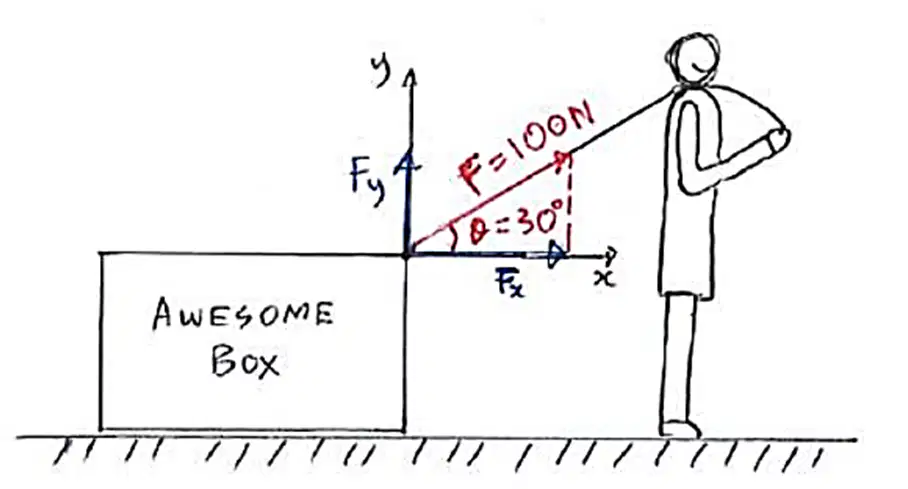
Say you want to move the same awesome box of yours, but this time you pull it instead via a string on your shoulder, exerting 100 N at 0 = 3o° from the horizontal. Calculate the x- and y- components of this force (假设你想移动你的同一个很棒的盒子,但这次你通过肩膀上的绳子拉动它,在距离水平面0=3°处施加100 N。计算该力的x和y分量)
Fx = 85.6 N ; Fy = 53 N
Fx = 87.6 N ; Fy = 52 N
Fx = 88.6 N ; Fy = 51 N
Fx = 86.6 N ; Fy = 50 N

The components of F in the x - directions.
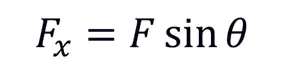
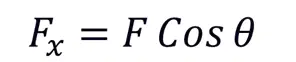
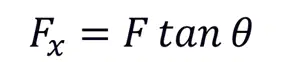

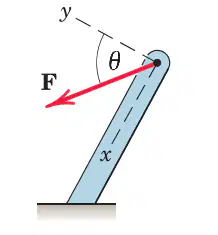
The components of F in the x - directions.
The components of F in the y - directions.


The angle (theta) of F can be calculated as:


The resultant force can be calculated as:


The first condition of equilibrium of a body is ____________.
Sum of all force on a body should be zero
Sum of all moments on a body should be zero
Sum of the initial and final force should be zero
Relative difference of forces should be zero
If a body returns to its original state of equilibrium after giving it a small displacement, the equilibrium is known as ______.
Stable equilibrium
Unstable equilibrium
Simple equilibrium
Neutral equilibrium
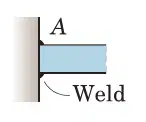
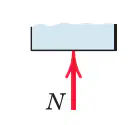
What is the reaction force for Fixed End Support as shown in the figure?
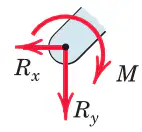
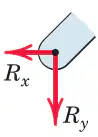

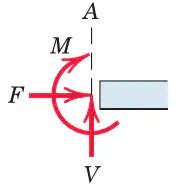
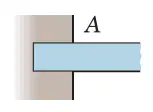
What is the reaction force for Fixed End Support as shown in the figure?
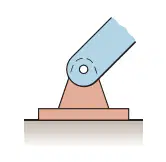
What is the reaction force for Pin Connection (not free to turn) as shown in the figure?
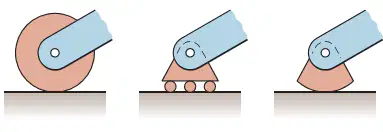
What is the reaction force for roller support as shown in the figure?
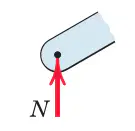

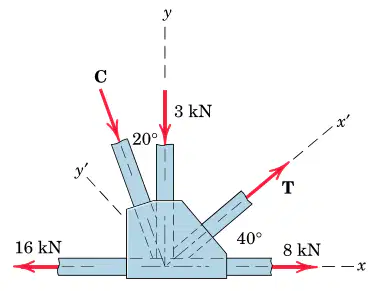
Determine the magnitudes of the forces C and T, which, along with the
other three forces shown, act on the bridge-truss joint.
T = 10.09 kN
C = 4.03 kN
T = 8.09 kN
C = 2.03 kN
T = 9.09 kN
C = 3.03 kN
T = 9.99 kN
C = 3.33 kN
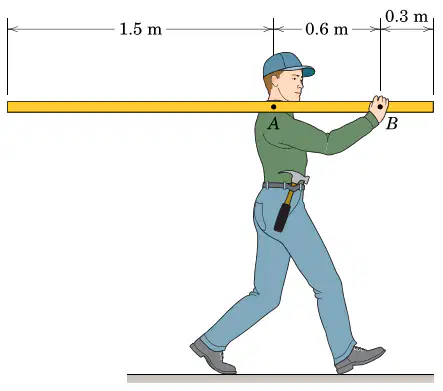
A carpenter carries a 6 kg uniform board as shown. What downward force does he feel on his shoulder at A?
NA = 89.3 N
NA = 88.3 N
NA = 98.3 N
NA = 78.3 N
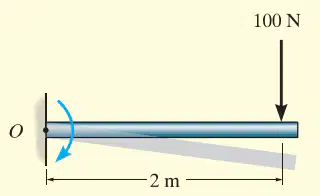
The moment of the force about point O is ___________.
200 N.m
220 N.m
202 N.m
201 N.m
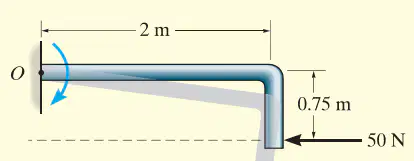
The moment of the force about point O is ___________.
36.9 N m
37.5 N m
36.5 N m
37.5 N m
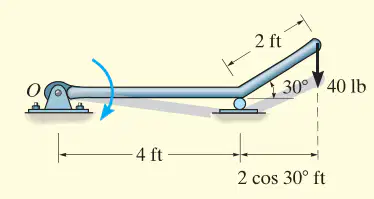
The moment of the force about point O is ___________.
228 lb . ft
229 lb . ft
228 lb . ft
227 lb . ft
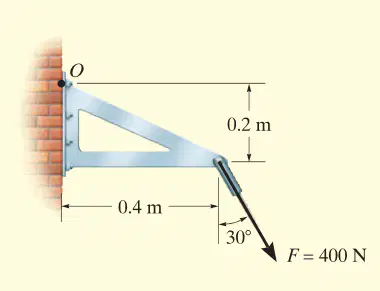
Force F acts at the end of the angle bracket as shown in figure. The moment of the force about point O is ________.
99.6 N m
98.6 N m
97.6 N m
96.6 N m
A rigid body is in equilibrium if:
It is moving at a constant speed.
It is accelerating.
The vector sum of all forces acting on it is zero.
The vector sum of all forces acting on it is not zero.
A cable car hangs suspended with two cables. If the weight of the car (W) acts downwards, the tension (T) in each cable will be:
T = W/2
T = W
T > W
T < W
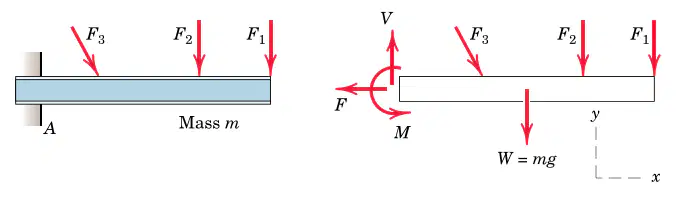
The Free Body Diagram cantilever beam is drawn correct.
True
False
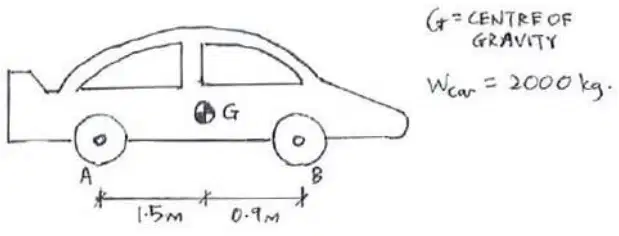
The normal reaction force at point A and B are if the weight of car is 2000 kg:
Fa = 7356.5 N
Fb = 12261.5 N
Fa = 7357.5 N
Fb = 12262.5 N
Fa = 7257.5 N
Fb = 11262.5 N
Fa = 7057.5 N
Fb = 12062.5 N
Deformation in statics refers to:
The breaking point of a material under stress.
The movement of an object from one position to another.
A change in an object's shape or size due to applied forces.
The weight of an object.
Tension occurs when:
An object experiences a twisting force.
An object is pulled in opposite directions along its axis.
An object is squeezed along its length.
An object is bent at an angle.
Compression occurs when:
An object is pulled in opposite directions along its axis.
An object is squeezed along its length.
An object is bent at an angle.
An object experiences a twisting force.
A beam supported at both ends and loaded in the middle will experience:
Only tension
Only compression
Tension on top and compression on the bottom
Shearing
Plastic deformation is:
A permanent change in shape or size.
A temporary change in shape or size.
Independent of the material properties.
Only observed in high-strength materials.
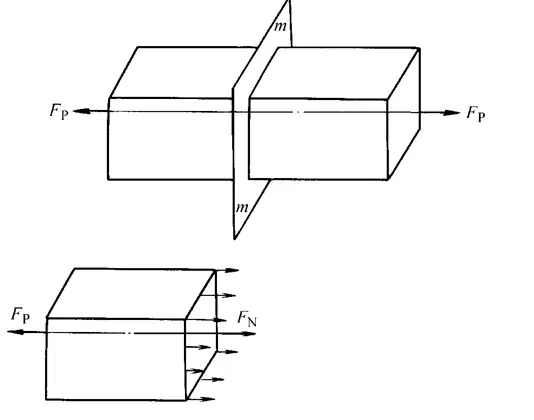
Taking the picture as a reference, the equilibrium equation ∑𝐹𝑥=0, it can be concluded that


None
The (a) method is a commonly used method to determine the internal forces of a component.
The strength of an object refers to its ability to:
Change its shape permanently
Change its color under stress
Resist deformation or fracture under load
Conduct electricity efficiently
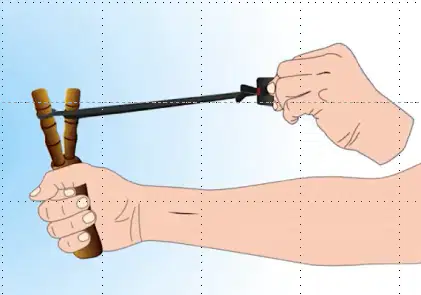
Which type of force does the application of a catapult represent?
Compression
Tension
Gravity
none
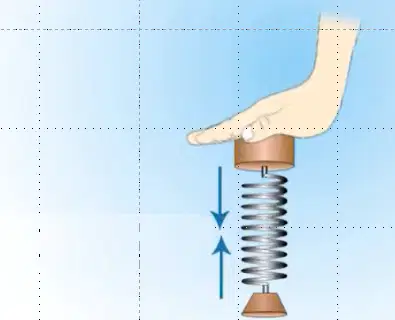
Which type of force does the application of a spring represent?
Compression
Tension
Gravity
none
The section method is most applicable for components subjected to:
Complex bending moments only.
Any type of loading, including axial and shear.
Axial loads (tension or compression) only.
Torsional loads only.
The concept of "yield strength" refers to the:
Maximum stress an object can withstand before breaking
Point at which permanent deformation begins
Minimum force required to cause any deformation
Ability of an object to return to its original shape after deformation
Define elastic modulus.
A measure of a material's color
A measure of a material's volume
A measure of a material's stiffness
A measure of a material's weight
State Hooke's Law.
F = ax
F = -kx
F = mx
F = kx
Explain ultimate tensile strength.
Ultimate tensile strength is the ability of a material to stretch without breaking.
Ultimate tensile strength is the minimum amount of tensile stress a material can withstand before breaking.
Ultimate tensile strength is the maximum amount of tensile stress a material can withstand before breaking or fracturing.
Ultimate tensile strength is the maximum amount of compressive stress a material can withstand before breaking.
Discuss the factors affecting strain.
Length, time, and speed
Density, volume, and temperature
Material type, color, and smell
Modulus of elasticity, cross-sectional area, and applied force.
Calculate the elastic modulus if stress is 500 MPa and strain is 0.02.
10000 MPa
30000 MPa
25000 MPa
15000 MPa
What happens to a material beyond its yield point?
It becomes more flexible
It returns to its original shape
It becomes stronger
Permanent deformation or plastic deformation occurs
Why is Hooke's Law only applicable within the elastic limit?
Hooke's Law is only applicable within the elastic limit because it is a recent discovery
Hooke's Law is only applicable within the elastic limit because beyond this limit, the material undergoes permanent deformation or breakage.
Hooke's Law is only applicable within the elastic limit because it is based on temperature variations
Hooke's Law is only applicable within the elastic limit because it is a suggestion, not a rule
Differentiate between engineering stress and true stress.
Engineering stress is based on final cross-sectional area, while true stress is based on initial cross-sectional area.
Engineering stress is measured in pounds per square inch, while true stress is measured in newtons per square meter.
Engineering stress is used for brittle materials, while true stress is used for ductile materials.
Engineering stress is based on original cross-sectional area, while true stress is based on instantaneous cross-sectional area.
What is the definition of torque?
Torque is the measure of the force that can cause an object to rotate around an axis.
Torque is the measure of the force that can cause an object to shrink in size.
Torque is the measure of the force that can cause an object to move in a straight line.
Torque is the measure of the force that can cause an object to change color.
How do you calculate torque?
Torque = Power x Time
Torque = Mass x Acceleration
Torque = Force x Distance
Torque = Work / Time
Explain the relationship between torque and rotational motion.
Torque is inversely proportional to the linear velocity of an object in rotational motion.
Torque has no effect on the rotational motion of an object.
Torque is only relevant in linear motion, not rotational motion.
Torque is directly proportional to the angular acceleration of an object in rotational motion.
Give an example of torque in a mechanical system.
The weight of an object
The force applied to a wrench to tighten a bolt.
The speed of a moving car
The temperature of a room
How does torque affect levers?
Torque increases the weight of levers
Torque has no effect on levers
Torque affects levers by determining the rotational force applied to an object.
Torque causes levers to move in a straight line
What is the relationship between torque and angular acceleration?
Torque is inversely proportional to angular acceleration.
Torque has no effect on angular acceleration.
Angular acceleration is not related to torque.
Torque is directly proportional to angular acceleration.
Define torque in the context of physics.
Torque is a measure of volume in physics.
Torque is the measure of the force that can cause an object to rotate around an axis.
Torque is a measure of speed in physics.
Torque is a measure of temperature in physics.
Calculate the torque produced by a force of 10 N applied at a distance of 5 meters from the pivot point.
25 Nm
50 Nm
40 Nm
15 Nm
Calculate the angular acceleration of an object with a torque of 20 Nm and a moment of inertia of 5 kgm^2.
2 rad/s^2
6 rad/s^2
8 rad/s^2
4 rad/s^2
What is tensile stress?
Tensile stress is the force per unit area experienced by a material when subjected to a twisting force
Tensile stress is the pressure experienced by a material when compressed
Tensile stress is the resistance of a material to bending
Tensile stress is the force per unit area experienced by a material when subjected to a pulling force.
Define compressive stress.
Compressive stress is the stress that occurs when an object is being stretched.
Compressive stress is the stress that occurs when an object is being compressed or squashed.
Compressive stress is the stress that occurs when an object is at rest.
Compressive stress is the stress that occurs when an object is twisted.
Explain shear stress.
Shear stress is the force per unit area that acts parallel to the surface of a material, causing it to deform or slide.
Shear stress is the force acting perpendicular to the surface of a material.
Shear stress is only applicable to liquids, not solids.
Shear stress does not cause any deformation in materials.
How is bending stress defined?
Tensile stress in a material
Shear stress in a material
Internal resistance of a material to deformation under bending moments.
External resistance to deformation
What is torsional stress?
Torsional stress is the stress caused by shearing forces acting on an object.
Torsional stress is the stress caused by twisting forces acting on an object.
Torsional stress is the stress caused by tensile forces acting on an object.
Torsional stress is the stress caused by compressive forces acting on an object.
What is the formula to calculate tensile stress?
Mass / Volume
Length / Width
Force / Cross-sectional area
Pressure / Temperature
How is compressive stress calculated?
Compressive Stress = Force - Area
Compressive Stress = Force * Area
Compressive Stress = Area / Force
Compressive Stress = Force / Area
What are the units of shear stress?
Kilograms
Pascals (Pa) or newtons per square meter (N/m^2)
Liters
Meters
How is bending stress measured?
Bending Stress = (P * L) / A
Bending Stress = (M * c) / I
Bending Stress = (F * d) / A
Bending Stress = (T * r) / J
Give an example where tensile stress is encountered.
Wood plank being bent
Plastic bottle being filled with water
Rubber band being stretched
Iron rod being compressed
When does bending stress become critical in engineering applications?
When it is below the elastic limit of the material
When it is less than the ultimate strength of the material
When it exceeds the yield strength of the material
When it is equal to the tensile strength of the material
How is torsional stress relevant in mechanical systems?
Torsional stress is important in mechanical systems as it can cause material failure or deformation due to twisting forces.
Torsional stress is beneficial for mechanical systems
Torsional stress only affects electrical systems
Torsional stress has no impact on mechanical systems
What are the two types of shear stress?
normal shear stress
compressive shear stress
tensile shear stress and shear stress
bending shear stress
How is shear stress calculated?
Shear stress = Force / Area
Shear stress = Area / Force
Shear stress = Force * Area
Shear stress = Force - Area
What is the formula for calculating shear stress in a beam?
Shear Stress = F / A
Shear Stress = P / A
Shear Stress = V / A
Shear Stress = M / I
What is the difference between shear stress and normal stress?
Shear stress is only present in liquids, while normal stress is only present in solids.
Shear stress acts parallel to the surface, while normal stress acts perpendicular to the surface.
Shear stress acts perpendicular to the surface, while normal stress acts parallel to the surface.
Shear stress is always compressive, while normal stress is always tensile.
What is the symbol used to represent shear stress?
τ
σ
φ
θ
What is the relationship between shear stress and shear strain?
Shear stress is proportional to normal stress
Shear stress is inversely proportional to shear strain
Shear stress is directly proportional to shear strain in a linear elastic material.
Shear stress has no effect on shear strain
What is the significance of shear stress in engineering applications?
Shear stress is only relevant in theoretical studies
Shear stress has no impact on engineering applications
Shear stress is important for understanding material behavior, designing structures, and ensuring structural integrity.
Shear stress is primarily used in medical research
What is the formula for design strength calculations?
Design Strength = Nominal Strength / Safety Factor
Design Strength = Nominal Strength * Safety Factor
Design Strength = Nominal Strength - Safety Factor
Design Strength = Nominal Strength + Safety Factor
What is the process of maximum stress analysis?
Determine the highest stress a material can withstand before failure.
Identify the strain in a material
Estimate the minimum stress a material can withstand
Calculate the average stress in a material
How do you calculate the factor of safety in engineering design?
Factor of Safety = Ultimate Stress * Allowable Stress
Factor of Safety = Ultimate Stress - Allowable Stress
Factor of Safety = Ultimate Stress + Allowable Stress
Factor of Safety = Ultimate Stress / Allowable Stress
Why is design strength important in structural engineering?
Structural stability can be achieved without design strength
Design strength only adds unnecessary costs
Design strength ensures structural stability and safety.
Design strength is irrelevant in structural engineering
How does temperature affect the allowable stress of materials?
Temperature decreases the allowable stress of materials
Temperature increases the allowable stress of materials
Temperature has no effect on the allowable stress of materials
Temperature affects the allowable stress of materials by causing thermal expansion and changes in material properties.
What are the common failure modes considered in factor of safety calculations?
yielding, buckling, fatigue, creep
corrosion
thermal expansion
cracking

