
NEW
Font size
 Worksheets
Project Management Quiz
Total questions: 58
Worksheet time: 29mins
Which of the following is a factor leading to the increased use of project management?
Decreased customer focus
Compression of the product life cycle
Reduced global competition
Knowledge reduction
What is one of the sociocultural aspects of project management?
Scope
WBS
Leadership
Schedules
Which of the following is NOT a factor leading to the increased use of project management?
Corporate downsizing
Emerging markets
Knowledge explosion
Decreased customer focus
Which of the following is a technical aspect of project management?
Teamwork
Negotiation
Resource allocation
Politics
What is the primary role of a Planner in project management?
Ensuring the project is defined properly and completely for success
Managing the project budget
Overseeing the project timeline
Communicating with external stakeholders
Which of the following is NOT a responsibility of a Planner in project management?
Engaging all stakeholders
Determining the work effort approach
Ensuring required resources are available when needed
Conducting market research
Which of the following techniques is used by an organizer to determine the complete work effort for a project?
Work breakdown, estimating, and scheduling
Budgeting, marketing, and sales
Designing, testing, and implementing
Recruiting, training, and managing
What does an organizer determine using work breakdown, estimating, and scheduling techniques?
The proper sequence of the work activities
The marketing strategy
The company's mission statement
The product design
Which of the following is NOT determined by an organizer using work breakdown, estimating, and scheduling techniques?
When the work will be accomplished
Who will do the work
How much the work will cost
The company's annual revenue
Which role serves as the central point of contact for all oral and written project communications?
Quartermaster
Facilitator
Point Person
Project Manager
What is the primary responsibility of the Quartermaster in a project?
Ensuring stakeholders understand each other
Serving as the central point of contact
Ensuring the project has the resources, materials, and facilities it needs
Managing the project budget
Who ensures that stakeholders and team members from different perspectives understand each other and work together to accomplish the project goals?
Point Person
Quartermaster
Facilitator
Project Sponsor
Which role is responsible for gaining agreement from stakeholders on project definition, success criteria, and approach?
Problem Solver
Persuader
Analyst
Coordinator
What does a Problem Solver utilize to resolve unforeseen technical issues?
Stakeholder expectations
Project definition
Root-cause analysis process experience
Success criteria
Which role manages stakeholder expectations throughout the project while managing the competing demands of time, cost, and quality?
Problem Solver
Persuader
Analyst
Coordinator
What is one of the key responsibilities of a Problem Solver in project management?
Managing stakeholder expectations
Gaining agreement on project definition
Utilizing prior project experience to resolve issues
Defining success criteria
What is the primary role of the "Umbrella" in a project team?
To determine and communicate the role of each team member
To shield the project team from politics and noise
To provide constructive and timely feedback on individual performances
To find ways to motivate each team member
Which role is responsible for determining and communicating the role each team member plays?
Umbrella
Coach
Manager
Leader
What does the Coach do to improve the skills of each team member?
Shields them from politics and noise
Provides constructive and timely feedback
Determines the importance of their role
Communicates the project’s success
What are skills developed through?
Natural talent
Training and practice
Genetic inheritance
Luck
How are "Hard" or technical skills often validated?
Through peer reviews
Through testing or certification
Through self-assessment
Through casual observation
Which type of skills are harder to validate?
Hard skills
Soft skills
Technical skills
Physical skills
Which of the following is an example of a "Soft" skill?
Coding
Team work
Data analysis
Machine operation
Which of the following is considered a hard skill?
Empathy
Communication
Coding ability
Leadership
Which of the following is a soft skill?
Photoshop knowledge
Foreign language skills
Technical understanding of SEO
Time management
What type of skill is described as "specific, technical abilities required to do a job, typically acquired through education and experience"?
Soft skills
Hard skills
Social skills
Emotional intelligence
Which skill is NOT listed under soft skills?
Empathy
Communication
Writing proficiency
Leadership
Which of the following is NOT a hard skill?
Foreign language skills
Coding ability
Leadership
Photoshop knowledge
Which of the following is a skill necessary for effective project management?
Technical writing skills
Great communication and interpersonal skills
Advanced coding skills
Financial auditing skills
What skill is crucial for managing time effectively in project management?
Time management
Public speaking
Advanced programming
Market analysis
Which of the following skills is important for planning in project management?
Good planning skills
Advanced graphic design
Legal knowledge
Proficiency in foreign languages
How is the management approach described in General Management?
Ability to adapt to change
Critical
Manage by exception
Informal
What is the planning approach in Project Management?
Important
Routine
Critical
Predetermined
How is budgeting handled in General Management?
Start from scratch, multiple budget periods
Modify budget from previous budget period
Must be determined
Informal
What is the sequence of activities in Project Management?
Often predetermined
Routine
Must be determined
Well defined
Where does the location of work occur in General Management?
Crosses organizational units
Within an organizational unit
Informal
Unique
How is the managerial hierarchy described in Project Management?
Well defined
Informal
Routine
Critical
Which of the following aspects are managed in a business context?
Time, Cost, Scope, Quality
Time, Cost, Employees, Quality
Time, Resources, Scope, Quality
Time, Cost, Scope, Resources
What are the three constraints that project managers need to balance in order to maintain a high-quality final product?
Scope, cost, and time
Quality, budget, and resources
Time, resources, and quality
Budget, scope, and resources
What is the term used to describe the challenge of balancing scope, cost, and time in project management?
Project management triangle
Project management square
Project management circle
Project management hexagon
Which of the following is NOT mentioned as a frustration experienced by project managers?
Too little time
Not enough budget
Impossibly large scope
Lack of team members
What are the three main constraints in the iron triangle of project management?
Cost, Time, Scope
Quality, Budget, Resources
Time, Budget, Quality
Scope, Resources, Budget
What is the main challenge in managing the project triangle?
Changing one variable without affecting the other two
Increasing the budget without extending the deadline
Reducing the scope without increasing the budget
Meeting the deadline without compromising on quality
What is the project manager's primary responsibility according to the text?
To increase the project's budget
To balance all three elements of the project triangle
To extend the project's deadline
To reduce the project's scope
Which of the following is NOT mentioned as a part of the project manager's job?
Keeping the project within budget
Ensuring the project is on deadline
Fulfilling the project's scope specifications
Increasing the project's profitability
What are the three constraints mentioned in the concept of "Working with triple constraints"?
Cost, Quality, Time
Cost, Time, Scope
Scope, Quality, Time
Cost, Quality, Scope
According to the concept of "Working with triple constraints," what happens if you increase the scope of a project?
The cost and time remain the same.
The cost increases but time remains the same.
The time increases but cost remains the same.
The cost and time both increase.
What does the term "scope" refer to in a project?
The timeline of the project
The budget of the project
The size of the project in terms of quality, detail, and magnitude
The team members involved in the project
As the size of the project increases, what will it naturally require more of?
Less time and money
More time and money
More team members
Less team members
Which of the following is NOT an element of project scope?
Project complexity
Quantity of finished product(s)
Output quality
Project location
What is the critical path in project management?

A
B
C
D

What is the total duration of Activity G?
4 days
11 days
7 days
5 days
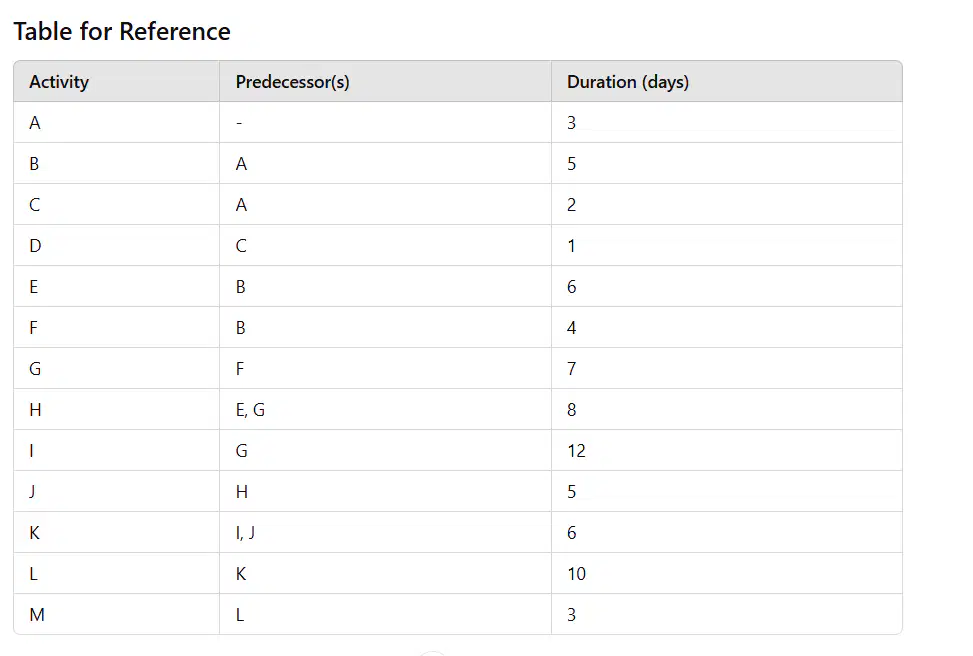
Which activities can start immediately after completing Activity B?
C and D
E and F
G and H
I and J
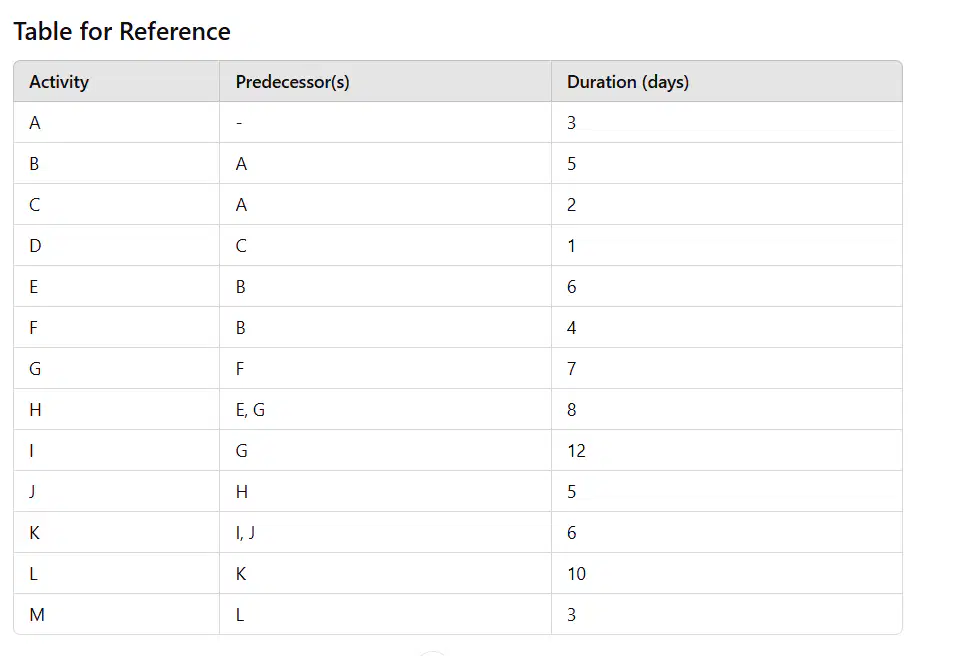
What is the duration of the critical path in this project?
34 days
39 days
30 days
42 days
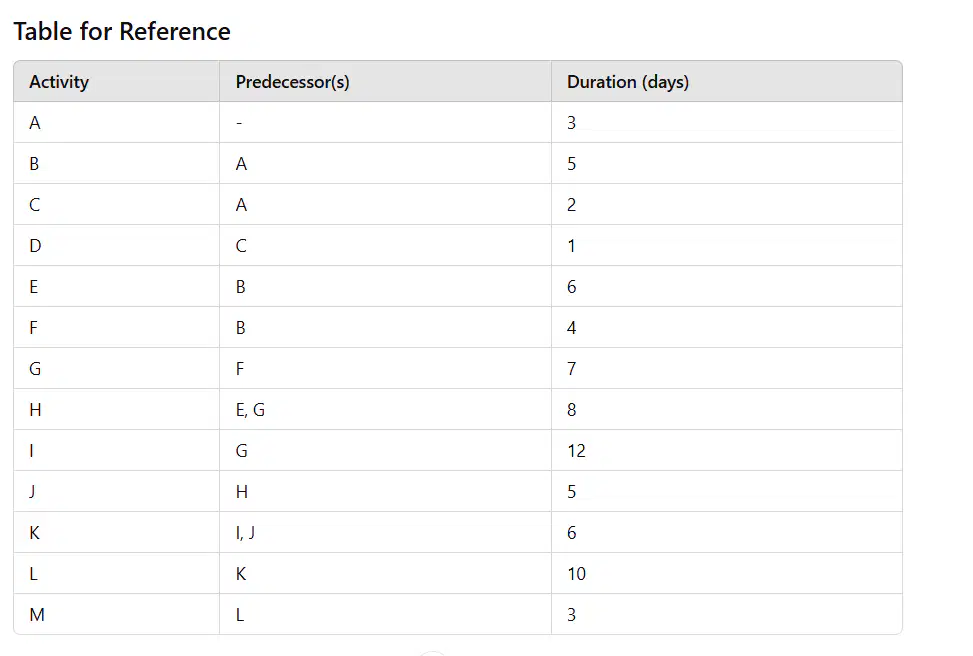
Which of the following activities are on the critical path?
A, B, E, H, J, K, L, M
A, B, F, G, I, K, L, M
A, C, D, G, I, K, L, M
A, B, F, G, H, J, K, L, M
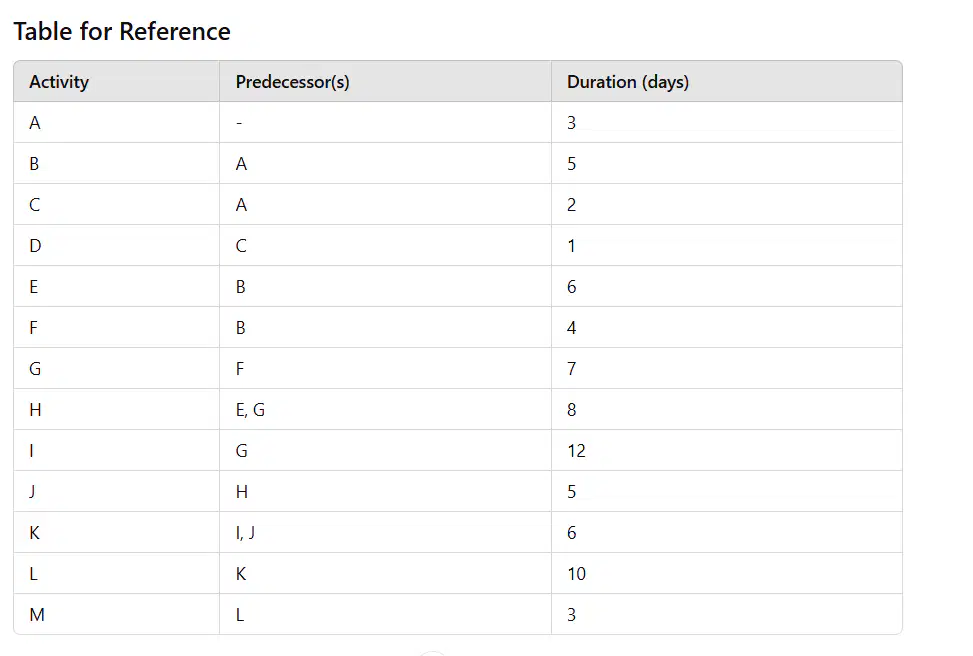
If Activity H is delayed by 2 days, how will it affect the project completion date?
Project will be delayed by 2 days
No effect
Project will be delayed by 5 days
Project will be delayed by 3 days
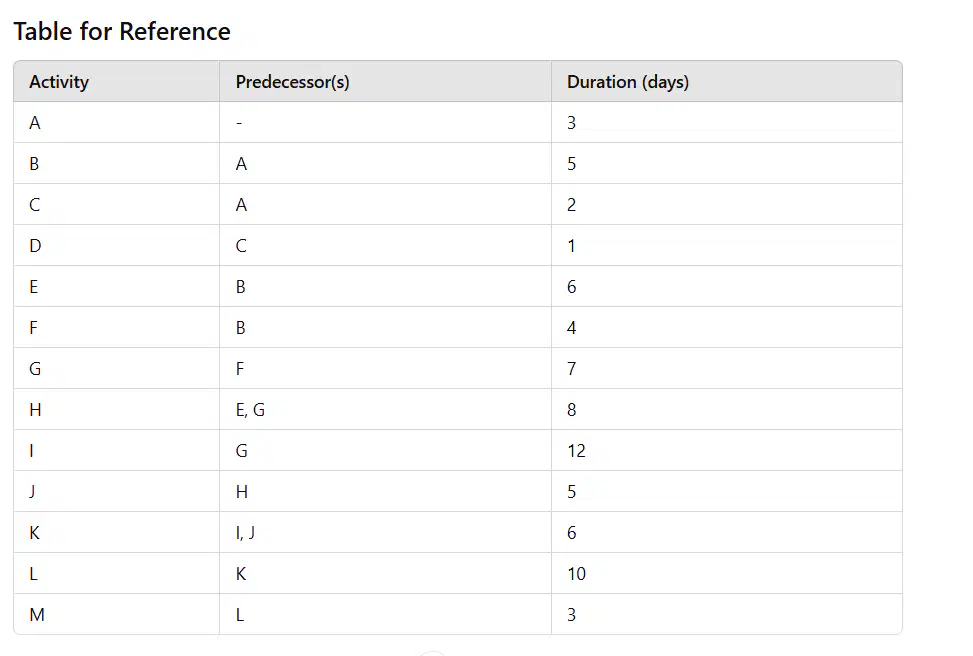
What is the slack time for Activity C?
3 days
2 days
I day
0 days

