
 Worksheets
Accelerated Learning ACP Review
Total questions: 105
Worksheet time: 2hrs 37mins

In the given Production Possibilities Curve (PPC/PPF), if a point lies on the curve (B) this means the company/country/individual is being EFFICIENT. If a point lies INSIDE the curve (D), what does that tell?
They are being over efficient
There is an idle, or unproductive, or use of resources (inefficient)
It is not impossible with the given resources
They are still efficient, just at another point

In the given Production Possibilities Curve (PPC), what does point A, B, C represent?
Economy is in decline
Impossible/Unattainable points given current resources
Inefficient: The economy is not using its resources to the full capacity
Efficient: The economy producing at its maximum potential
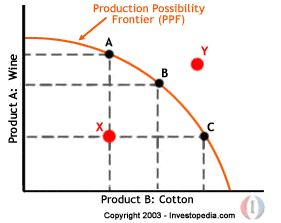
Efficiency: producing at maximum potential
Unattainable / impossible given current resources
Inefficiency: wasting resources; not using full capacity
The basic idea of CHOICE presents what PROBLEM in economics?
Choice is a way of life
Decisions produce costs
People decide what they want
Business sell what they want
Our ____ are limited, yet our needs and wants are ____, so we have to weigh all ____
resources; undefined;
sales
opportunities; short; possibilities
resources; unlimited; opportunities
opportunities; limited; resources
Which of the following requires people to take risks and combine land, labor and capital to start their own business?
Entrepreneurship
Capitol
Land
Labor
In which type of economy does the government answer ALL THREE economic questions of What to Produce? How to Produce? For Whom to Produce?
Perfect Economy
Which type of economy is run by individuals' and businesses' choices and is based on Supply and Demand?
Command Economy
Perfect Economy
Communist Economy
Market/Free Enterprise Economy(Capitalism)
If my business produces meat and the government creates laws to inspect to make sure that the meat is safe for public consumption, what economic system does this represent?
Mixed market system
Traditional economic system
Market system
Command economy
The idea of the "Invisible Hand" (as adopted by Adam Smith) supported the belief that:
There should be a classless society
competition and self-interest benefits everyone and government should leave the market alone (Laissez Faire)
Government should control the market when necessary
Government should always control the market especially when there are economic depressions
What type of economy do most countries in the world have?
Market economy
Command economy
Traditional economy
Mixed economy
Which is an example of investing in physical capital?
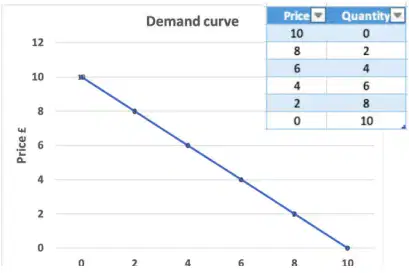
In the given demand curve, at the price of $6 what is the quantity demanded?
8
6
4
2
Choices: Chocolate, Vanilla, Strawberry, Mint, Caramel.
1). If Abigail chooses Strawberry, what are her TRADE OFFS?
2). Assume Abigail's top two choices are Strawberry and Coffee. If she chooses Strawberry in the end, what is her opportunity cost?
Trade offs: Strawberry, Mint
Opportunity Cost: Strawberry
Trade offs: Chocolate, Vanilla, Mint, Caramel
Opportunity Cost: Coffee
Trade offs: Chocolate, Strawberry, Caramel
Opportunity Cost: Strawberry
Trade offs: Strawberry, Coffee, Caramel
Opportunity Cost: Chocolate

The law of DEMAND says that as PRICE increases, QUANTITY DEMANDED _____ and vice versa.
Shifts
decreases
Doubles
Rises too

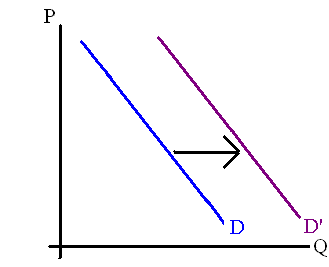
Look at this graph....what changed? how?
Supply decreased
Supply increased
Demand increased
Demand decreased
Look at this graph....what happened to the quantity supplied and price as the supply curve shifted to the right?
Price decreased; quantity increased
Price increased; quantity decreased
Price decreased; quantity remains the same
Price increased; quantity remained the same
A waiter at a restaurant, a police officer, and your teacher are examples of which factor of production?
capital
land
labor
Entrepreneurs
The three Economic questions every society faces are:
What is the unemployment rate?
What is the per capita GDP?
What is the inflation rate?
Why to Produce?
When to Produce?
What resources to use?
How much money should we have?
How much population show we have?
How much unemployment should we have?
What to Produce?
How to Produce?
For Whom to Produce?

Cold weather in Florida has damaged this year’s orange crop. Farmers have only half of the usual amount of oranges to sell. What will happen?
supply will decrease
demand will decrease
Supply will increase

People start seeing a Tiktok trend that watermelon increases weightlifting abilities. What happens to demand for watermerlon?
Demand will decrease
Demand will rise
Neither supply nor demand decreases
Price will decrease
Label Equilibrium price, equilibrium quantity, shortage, surplus, demand, and supply
supply
Equilibrium price
equilibrium quantity
shortage
surplus
demand
What is sole proprietorship?
two or more owners, tend to be small
one owner, tend to be large
one owner, tend to be small
legal entity that is similar to indviduals, may be small or large
Why does no one firm dominate in a perfect competition? KEY WORDS --> "In a perfect competition"
No firm wants to dominate the market; it is too much work
Each firm sells to different people so that each person buys from a different company
Products are practically identical and each company produces so little of the total supply that they cannot influence prices
One firm will eventually dominate and make it a monopoly so the company tries to step away from price control altogether
The jeans industry would fall into what type of market structure? ( jeans are similar but there are some differences in the product) - remember this market requires advertisement
A market that has few sellers of basically the same products that can "Collude" or work together to fix prices and reduce production to decrease competition IS CALLED....?
Perfect Competition
Pure Monopoly
Monopolistic Competition
Oligopoly
What type of competition/ market structure has many firms and uses non-price competition such as promotions, giveaways, advertisements to differentiate their product from their competitors:
Perfect/Pure
Monopolistic
Oligopoly
Monopoly
List the four market structures in order from least competitive (less sellers) to most competitive (most sellers).
What are the three types of business organizations?
partnership, sole proprietorship, corporation
command, traditional, & market
partnership, corporation, liability
proprietorship, publically-owned, privately-owned
What is a corporation?
one owner, tends to be small, smaller profit
two or more owners, tend to be small and not many employees; profit is less than corporation
legal business that is taxed separately from its owner(s); tends to be large and multinational; most profit
business that gives the owner full liability for what happens in the business
What is a BENEFIT of a sole proprietorship?
one person that receives all the profits and income
multiple people that share all the profits and income
multiple people who make decisions for the better of the company
the owner is liable for all decisions and debt
What is a BENEFIT of a corporation?
owners have limited liability
requires legal advice to start with minimal paperwork
may have absentee ownership
relatively easy to start and owners can share in decision-making
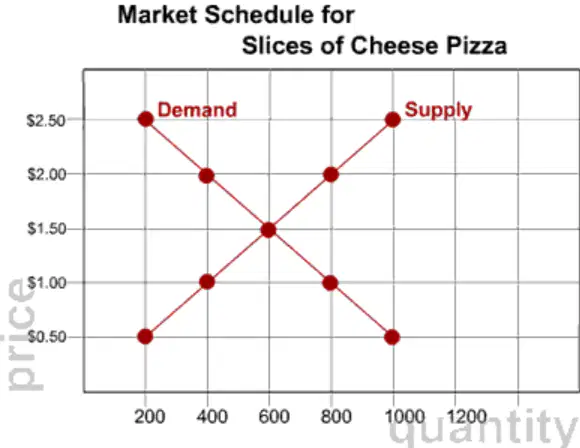
In the given graph for the slices of cheese pizza, the equilibrium price and equilibrium quantity is (READ ANSWER CHOICE CAREFULLY)
$1.50, 200
$2.00, 800
$1.00, 500
$1.50; 600
In the graph for the slices of cheese pizza, at the price of $2.00 there is a
surplus of 800
shortage of 800
shortage of 400
surplus of 400
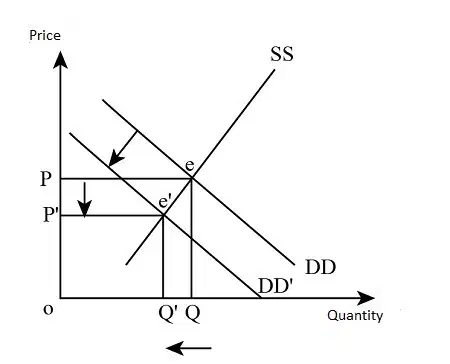
An increase in price of cream cheese decreased the demand for bagels, thus shifting the demand curve to the LEFT. This occurred because: (SELECT THE DETERMINANT)
cream cheese and bagels are substitutes
cream cheese and bagels are inferior goods
cream cheese and bagels are superior goods
cream cheese and bagels are complements
The government policy that restrict imports from other countries to help domestic (local) businesses from international competition is called
export
Import
Free Trade
Protectionism
In order to convince Iran to stop developing nuclear weapons, the United States stopped trading with them. This protectionist trade policy is known as ______
Quota
Embargo
Standards
Subsidies
Tariffs
The U.S. sent back a shipment of dog food from China because it was not labelled properly. This protectionist trade policy is known as ______
Embargo
Standards
Tariffs
Subsidies
Pakistani government doubles the amount of tax on imported goods made from pork meat due to religious reasons. This protectionist trade policy is known as ____
Quotas
Embargo
Tariffs
Standards
Subsidies
All of the following are trade barriers EXCEPT
Tariffs & Quotas
Embargoes
Free Trade
Standards
Subsidies
Benefits of renting include all of the following EXCEPT
Easier to relocate
Little to no responsibility for maintenence
Amenities (pool, gym etc)
increased privacy
Match the definition to the term!
GDP (Gross domestic Product)
Dollar value of new things within year
Inflation
The overall increase in price of goods
Unemployment rate
Percentage of people without jobs
Consumer Price Index (CPI)
A measure of average price changes in a basket of goods and services
What is the best measure of the nation's standard of living? (a measure of how wealthy people are on average)
Negative GDP
GDP per capita
Real GDP
Nominal GDP
US Dollars are a standard form of currency that we can use to estimate the worth of a product. For instance, a Versace purse seems more valuable because its price is higher than a target purse. Select that function of money that is BEST demonstrated in this example.
Store of Value
Medium of Exchange
Standard of Value (Unit of account)
When a country can produce more of something than the other country, using the same amount of resources, then this trade scenario is called
(Note: Whoever produces the most items)
Opportunity Cost
Free Trade
Absolute Advantage
Comparative Advantage
Comparative advantage is achieved by having
quotas on trade
a HIGHER opportunity cost than another country for producing the same product
multiple trade barriers
a LOWER opportunity cost than another country for producing the same product
Select the statement which reflects the difference between Nominal GDP and Real GDP
(GDP: Gross Domestic Product)
Both nominal and real GDP are calculated at current prices for 5 years
Both nominal and real GDP are calculated at base year constant prices for 5 years
Real GDP is based on current prices and Nominal GDP is measured on base year constant prices ie. (adjusted for inflation)
Nominal GDP is based on current prices and Real GDP is measured using base year constant prices ie. (adjusted for inflation)
The statements below represent which type of investment?
Sold by the U.S. Treasury Department
Worth full value upon redemption
Earn interest until final maturity date
Fully backed by the U.S government
Individual Retirement Account (IRA)
Mutual Funds
Corporate Stock
Savings Bond
To earn as much interest as possible, you should open a savings account that earns ____ interest and has the ____ interest rate.
Compound; highest
Compound; lowest
Simple highest
Simple lowest
This type of loan convert many of your debts into one loan payment, simplifying how many payments you have to make and offer lower interest rate
Pay day loan
Debt Consolidation loan
Personal loan
Mortgage
All of the following are type of loans EXCEPT
Credit Builder Loans
Debt Consolidation Loan
Mortgage
Certificate of Deposit
Home Equity Line of Credit
Congress decides to increase welfare benefits for elderly, unemployed, disabled and poor, decreases taxes on the businesses to promote economic and funds trade schools to train people with new skills.This is an example
Expansionary monetary policy
Contractionary monetary Policy
Expansionary Fiscal Policy
Contractionary Fiscal Policy
The Federal (central) Reserve Bank can increase or decrease money supply and interest rates when the economy is moving too slow or fast. When the FED increases interest rate on loans, what happens?
Expansionary monetary policy: The government gives subsidies to businesses
Contractionary monetary Policy: People take out less loans and spend less
Expansionary Fiscal Policy: People take out more loans and spend more
Nothing: this doesn't affect consumers
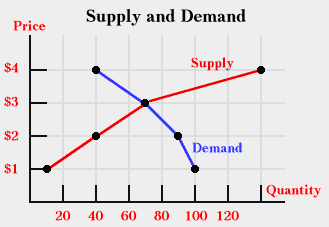
In the given supply and demand curves, the equilibrium price and equilibrium quantity are
$1; 20
$2; 90
$3; 70
$4; 60
Look at the graphy carefully
In the given demand and supply graph, at the price of $4
there is a
shortage of 40 units
shortage of 100 units
surplus of 40 units
surplus of 100 units
Look at the graphy very carefully
In the given demand and supply graph, at the price of $1
there is a
shortage of 80 units
shortage of 90 units
surplus of 80 units
surplus of 90 units

This type of investment account can be opened at a bank or credit union in which money can be deposited to earn interest, but the interest rate is very low.
Certificate of Deposit (CD)
Mutual Funds
Savings account
Bonds
This type of investment is a loan given to an organization (usually the government) which borrows the funds and agrees to pay the funds back with interest after a defined period of time (maturity date)
Stock/Shares
Mutual Funds
Bond/Savings Bond
Certificate of Deposit
This type of investment represents a part ownership in a company and in return the investor receives dividends (sum of money) from the profit. The investor also has the option to resell the investment at a higher price to earn money.
Bond/Savings Bond
stocks/shares
Certificate of deposit (CD)
Mutual funds
A mutual fund is an investment type which
is a loan to the government to earn interest at the maturity date
is a type of checking account to use for daily purchases
is a share of ownership in a company owned by many people.
invests in a mix of different type of investments by pooling money from other investors
Which of the following statements about Certificate of Deposit is TRUE?
(CD is a type of investment)
Bank pays LOWER interest for depositing your money for a specified length of time
Bank pays HIGHER interest for depositing your money for a specified length of time
A Certificate of Deposit is an acknowledgement of part ownership of the bank
The risk of losing investment in CD is very HIGH
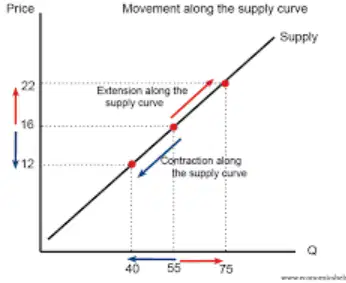
The Law of Supply states that
The relationship between price and quantity depends on the product
There is an inverse (negative) relationship between price and quantity supplied
There is a direct (positive) relationship between price and quantity supplied
price and quantity are always in equilibrium
When the economy is in a recession, the U.S. government takes the following actions to increase demand and increase money circulation.
decrease taxes and decrease interest rates
increase interest rates
increase taxes and decrease overall spending
decrease taxes and increase overall government spending
During high economic growth, the U.S. government takes the following actions to control inflation and slow down the economy
increase money supply
decrease interest rates
increase taxes and decrease overall spending
decrease taxes and increase overall government spending
During a recession, the Federal Reserve Bank takes the following action(s) to encourage economic growth and increase money supply. (Expansionary Monetary Policy)
decrease money supply and interest rates
increase the reserve requirement, increase interest rates and sell bonds
decrease the reserve requirement, decrease interest rates and buy bonds
decrease taxes and increase overall government spending
The determinants of Demand include the following
Taste and preferences, Related goods, technology, cost of production
# of buyers, Income, tastes and preferences, Buyers’ expectations, Related goods (complements and substitutes)
Cost of production (inputs), # of producers, Government actions (taxes, subsidies, regulations), Technology, Seller's expectations
Government actions, income, Buyer's expectations
The determinants of Supply include the following
Taste and preferences, Related goods, technology, cost of production
# of buyers, Income, tastes and preferences, Buyers’ expectations, Related goods (complements and substitutes)
Cost of production (inputs), # of producers, Government actions (taxes, subsidies, regulations), Technology, Seller's expectations
Government actions, income, Buyer's expectations
Match the description on the left to the appropriate economic system on the right.
1. Most common economy in the
world today.
2. Includes private
sector and government control.
3.Individuals and businesses operate as owners for the private sector.
Mixed Economy
1. Least demand for resources.
2. People do the same kind of work as their parents and grandparents.
3.Economy based on customs
regardless of a person's ability or
potential.
Traditional Economy
1. Private ownership of resources
and property.
2. Competition between producers.
3. Consumer sovereignty.
4. Profit motivated.
Free Market Economy
The government makes
decisions for the country.
2. There is a lack of consumer choice.
3. There is no competition.
4. There is central ownership of property and resources.
Command Economy
GDP will begin to decline at-
the peak.
the trough.
the contractionary phase.
When GDP rises faster than the long-run trend then the economy is experiencing-
a recession
an expansion
a recovery

When contraction (recession) begins in a business cycle- the economy will experience
higher unemployment
lower inflation (deflation)
both a & b
Recessions can end if
workers choose to accept lower wages
government policy is enforced to help the economy recover
both a & b
Business cycles are more stable if
the government consistently passes stimulus money
the government raises taxes
both banks and government set policies to meet the three economic goals
The Business Cycle measures ___ over time.
wealth
inflation
economic growth (GDP)
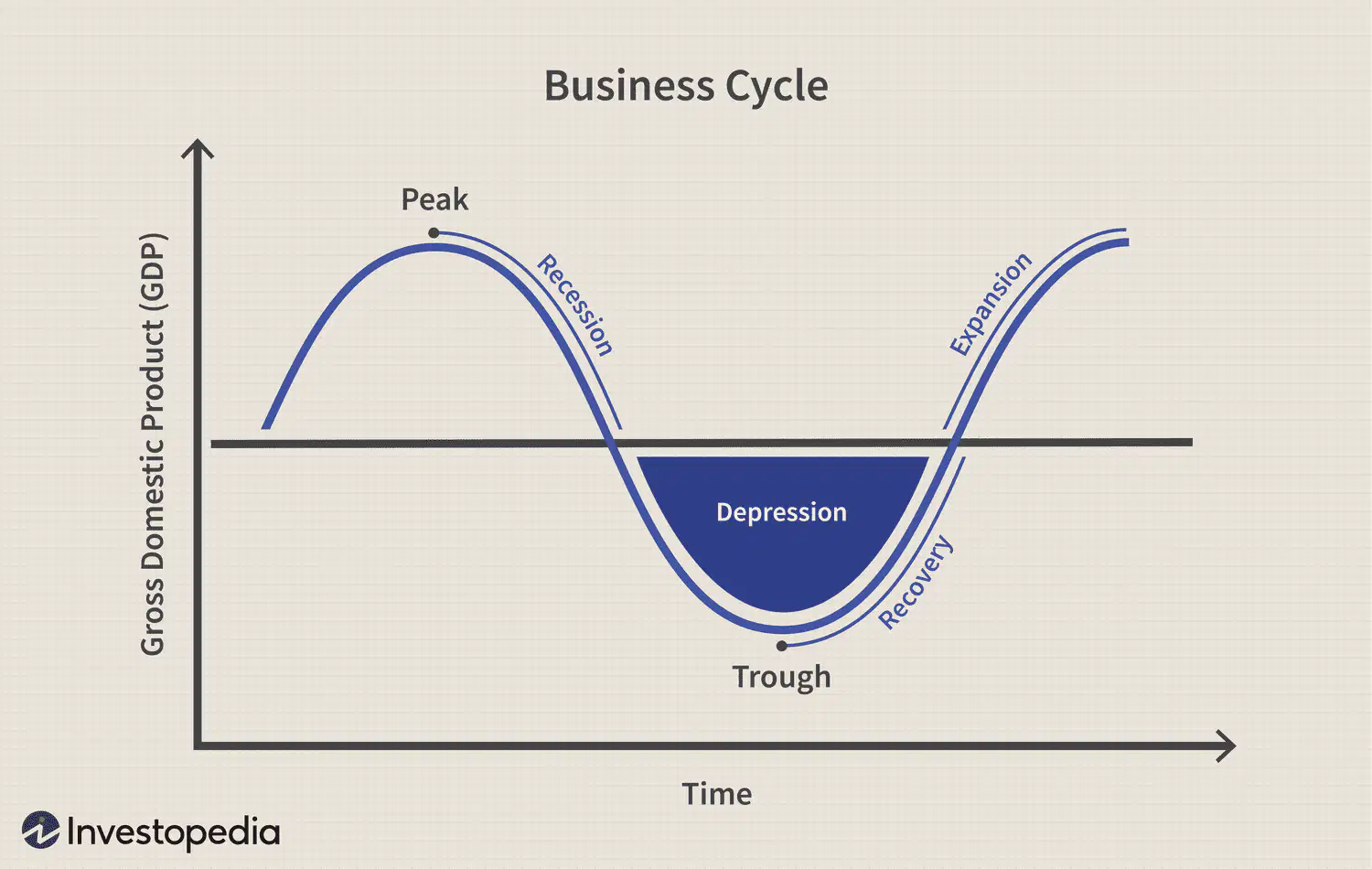
A trend line will show-
an increase in Real GDP over time.
only economic recessions.
only economic expansions.
GDP declines during a(an)
peak
contraction
expansion
Economic recovery begins-
above the trend line
at the end of a recession (trough)
at the "boom" period

Which of the following is an expansion, or recovery?
A
B
C
D
Which of the following is a trough?
A
B
C
D
Which of the following is a recession, or contraction?
A
B
C
D
Which of the following is a peak?
A
B
C
D
In what market do businesses sell goods and services to households?
Product Market
Factor Market
Resource Market
None of the above
In what market are the factors of production bought and sold?
Product Market
Resource Market (AKA- Factor Market)
In a free market economy who owns the resources?
state governments
the federal government
households
local governments
True or False- Businesses demand in the resource market and supply in the product market
True
False
What model shows how products, resources, and money flow in the economy?
Circular flow model
aggregate model
GDP output expenditure model
the Cobb-Douglas production function
Which of the following is a key takeaway about fiat money?
Fiat money allows for unlimited printing without the risk of hyperinflation
Fiat money is always backed by a physical commodity to maintain its value
Fiat money gives central banks greater control over the economy because they can control how much money is printed
Fiat money is redeemable for a set amount of a physical commodity
What is a potential danger of fiat money?
It is too difficult for governments to print more money
It is backed by physical commodities which can fluctuate in value
Governments can print too much of it, resulting in hyperinflation
It is linked to physical reserves, limiting its availability
The phrase "the customer is always right" is most often associated with what term?
Consumer Sovereignty
Entrepreneurship
Customer Service
Supply and Demand
The driving force behind people starting a business is:
profit margin
profit motive
opportunity cost
taxes
Who invented communism?
Plato
Karl Marx
Paul Samuelson
Adam Smith
You can easily carry money in a pocket or in a purse. This reflects what characteristic of money?
durability
legal tender
divisibility
portability
Which of these can cost you money in large interest payments?
a debit card
a credit card
a checking account
a savings account
The value of fiat money depends on supply and demand and was introduced as an alternative to commodity money and representative money. __________________ money is created from precious metals such as gold and silver, while ___________________ money represents a claim on a commodity that can be redeemed.
Commodity; representative
Fiat; representative
Representative; commodity

Antonio does not like carrying cash or writing checks, but he wants to have access to his money in his account. What service that fits his preferences can a bank offer him?
Credit Card
Deposit Box
Overdraft
Debit Card
Study the list and answer the question: Open an account in a bank or a credit union, Avoid retail credit cards, Get a job and keep it, Pay service providers on time. This list represents strategies to —
improve one’s stock trades
get a higher credit card limit
improve one’s personal credit score
get a long-term car loan
Study the list under "How To Avoid Credit Card Debt" and answer the question: Pay credit card bills on time, Avoid unnecessary purchases, Limit the number of credit cards, __? Which choice best completes the list?
Obtain as many credit cards as possible
Use credit cards for food and gas purchases
Make payments on the interest first
Apply for a prepaid debit card
One of the main negatives of the free market system.
the rich get richer and the poor get poorer
free markets make too many people rich
free markets make too many people poor
free markets give consumers lots of choices

