
 Worksheets
8th Grade SS Test Prep
Total questions: 75
Worksheet time: 38mins
Name
Class
Date
1.
1. “No state shall make or enforce any law which shall abridge the privileges of citizens…..nor shall any state deprive any person of life, liberty, or property, without due process of law…. _____ The major purpose of these provisions of the 14th amendment was to….
a)
limit the power of the federal government
b)
expand the civil rights of women
c)
maintain competition in business
d)
protect the rights of African Americans
2.
2. The 13th, 14th, and 15th amendments were added to the Constitution during the Reconstruction period to
a)
bring an end to the Civil War
b)
limit the powers of the president
c)
improve the operation of the electoral college
d)
grant legal rights to African Americans
3.
3. Laws that established literacy tests, poll taxes, and grandfather clauses were passed by Southern states to
a)
raise money to rebuild the South after the Civil War
b)
improve the education of United States citizens
c)
limit the rights of formerly enslaved persons
d)
support the Radical Republicans
4.
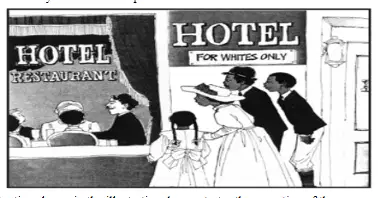
4. Which term best describes the practice shown in this illustration?
a)
populism
b)
segregation
c)
socialism
d)
integration
5.
5. The time period in American history where the nation was trying to rebuild itself and repair the damages from the Civil War was called….
a)
WWI
b)
Civil War
c)
Reconstruction
d)
Reparations
6.
6. Abraham Lincoln created this and was told that he was too easy on the Confederate states at the start of Reconstruction....
a)
Radical Republicans
b)
10% Plan
c)
Freedman's Bureau
d)
Segregation
7.
7. “We simply ask that we shall be recognized as men; . . . that the same laws which govern white men shall govern black men; . . . that, in short we be dealt with as others are—in equity and justice.” –petition of an African American convention, 1865. As suggested by this passage, after the Civil War most formerly enslaved people sought _____.
a)
revenge for the wrongs done to them
b)
power over whites in government
c)
respect and equality as human beings
d)
repayment for wages owed them
8.
8. A formal change to the Constitution which Abolished (or ended) Slavery.
a)
Jim Crow Laws
b)
13th Amendment
c)
14th Amendment
d)
15th Amendment
9.
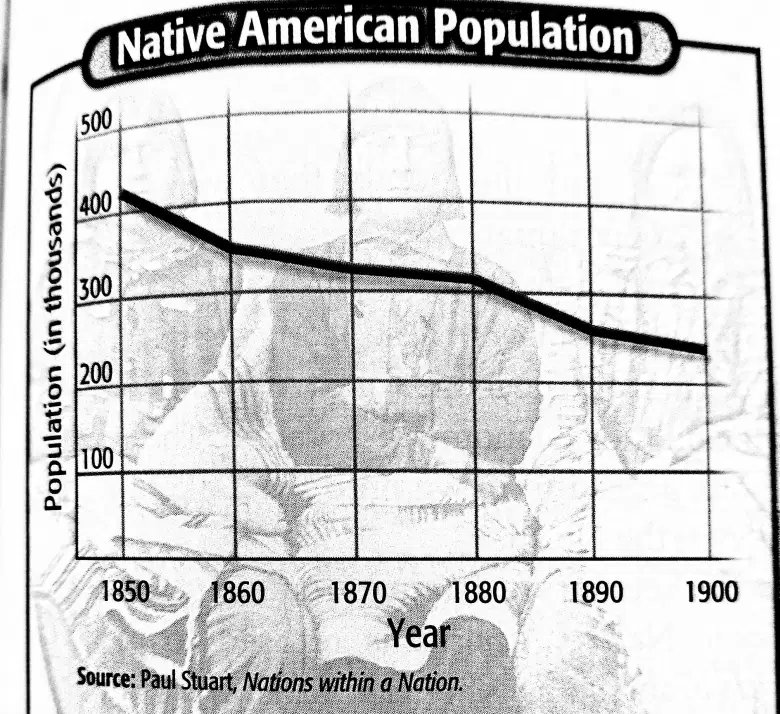
9. What is the overall trend shown on the chart below?
a)
Population is increasing
b)
Population is decreasing
c)
Population remained the same
d)
none of the above
10.
10. Why did farmers move t0 the Great Plains in the late 1800's?
a)
They felt that the soil was better than the South to grow cash crops like cotton and tobacco
b)
The government passed the Homestead Act, giving them 160 acres of land for free if they farmed it for 5 years
c)
They knew that they can also find gold on their new land
d)
none of the above
11.
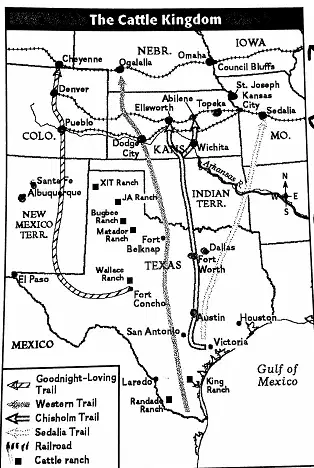
11. The different cattle trails on the map end at distinct towns. Which of the following do all the towns have in common?
a)
They are all in Kansas
b)
They are all in the Rocky Mountains
c)
They are all on railroad lines
d)
They are all on the Arkansas River
12.
12. “There is not among these three hundred bands of Indians [in the United States] one which has not suffered cruelly at the hands either of the Government or of white settlers. The poorer, the more insignificant, the more helpless the band, the more certain the cruelty and outrage to which they have been subjected. This is especially true of the bands on the Pacific slopes. These Indians found themselves of a sudden surrounded by and caught up in the great influx of gold-seeking settlers, as helpless creatures on a shore are caught up in a tidal wave. There was not time for the Government to make treaties; not even time for communities to make laws. . . .” -–Helen Hunt Jackson, A Century of Dishonor According to the excerpt, during the Gold Rush in California, the groups of Native Americans on the Pacific slopes were _____.
a)
protected by treaties with the U.S. government
b)
treated with particular cruelty
c)
able to trade profitably with the new settlers
d)
able to continue to live on their lands
13.
13. Mining towns were very unsafe. When people living there took the law into their own hands, capturing lawbreakers and gunfighters themselves they were called.....
a)
cowboys
b)
vigilantes
c)
terrorists
d)
all of the above
14.
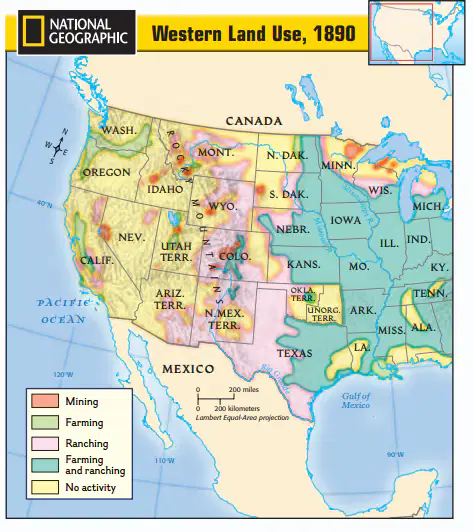
14. Based on the map, which of the following statements is correct?
a)
Mining, Ranching and Farming were the major uses of land in the West in 1890
b)
Ranching in Idaho was developing at a terrific rate.
c)
States east of the Mississippi depended on California and Oregon for food.
d)
none of the above
15.
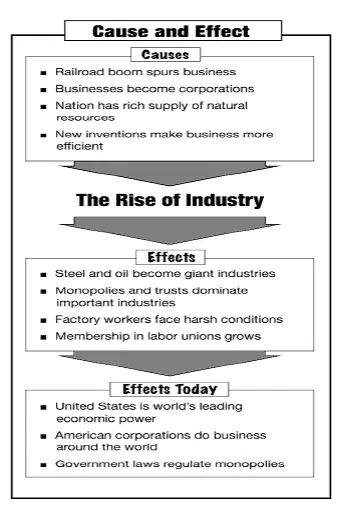
15. What was a cause of the Industrial Revolution?
a)
railroad boom hurts businesses
b)
the nation has a rich supply of natural resources
c)
membership in unions grow
d)
the US is a leading economic power
16.
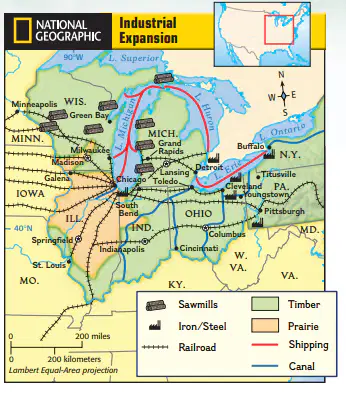
16. What industry grew in the timbered regions of Wisconsin and Michigan?
a)
sawmills
b)
iron plants
c)
steel plants
17.
17. Henry Ford will be remembered as the man who
a)
used a moving assembly line to mass produce automobiles cheaply
b)
made the first airplane in the United States
c)
discovered the process of hardening rubber
d)
all of the above
18.
18. At seven o’clock we all sit down to our machines and the boss brings to each one the pile of work that he or she is to finish during the day. . . . This pile is put down beside the machine and as soon as a skirt is done it is laid on the other side of the machine. . . . The machines go like mad all day, because the faster you work, the more money you get. Sometimes in my haste I get my finger caught and the needle goes right through it. . . . We all have accidents like that. . . . Sometimes a finger has to come off. . . . All the time we are working the boss walks about examining the finished garments and making us do them over again if they are not just right. So we have to be careful as well as swift. . . .”–Account of a young woman working in New York City’s garment industry. According to this passage, working too fast in a sweatshop could cause _____.
a)
Accidents, injuries, and mistakes to occur
b)
machines to break down
c)
coworkers to get angry
d)
all of the above
19.
19. One advantage that corporations of the late 1800's had over individually-owned businesses is that corporations
a)
needed fewer employees
b)
hired only skilled workers
c)
received the support of labor unions
d)
had stockholders who invested money
20.
20. Antitrust laws such as the Sherman Antitrust Act were passed by Congress in an effort to
a)
regulate the power of big business
b)
limit low-priced imported goods
c)
encourage more immigration
d)
provide safer consumer products
21.
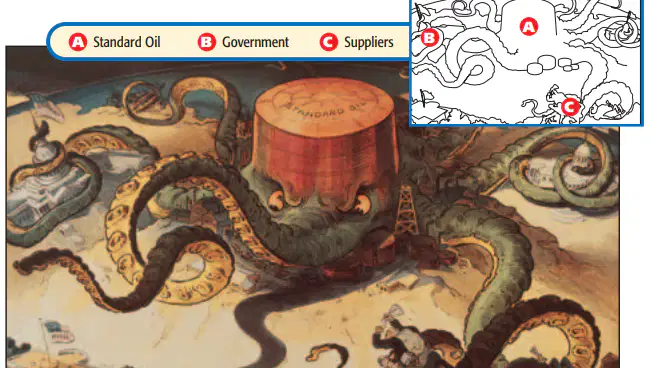
21. Standard Oil was often portrayed as a "monopoly monster," with its arms reaching out to control government and suppliers. Why do you think the cartoonist chose an octopus to represent Standard Oil?
a)
it lives in the ocean
b)
it represents the government
c)
it has its various arms wrapped around various things like government and its suppliers
22.
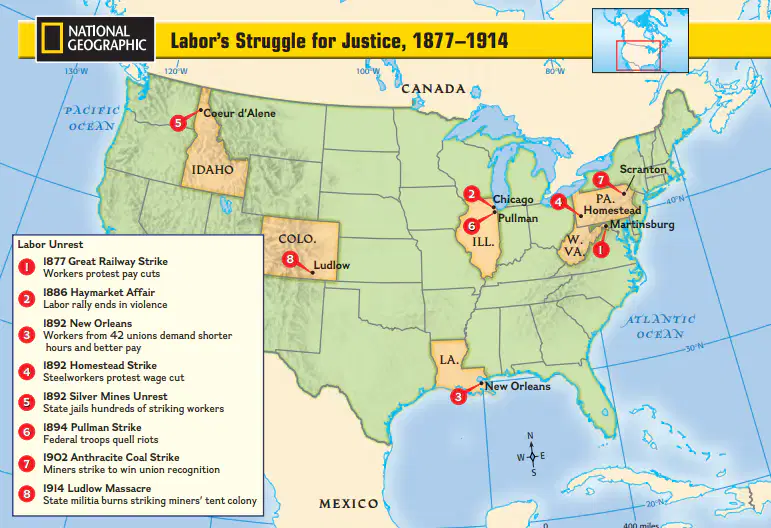
22. Which strike occurred in Martinsburg?
a)
Great Railway Strike
b)
Silver Mines Unrest
c)
New Orleans
23.
23. ….”Keep ancient lands, your storied pomp!” cries she with silent lips. “Give me your tired, your poor, your huddled masses yearning to breathe free, the wretched refuse of your teeming shore. Send these, the homeless, tempest-tost (tossed) to me, I lift my lamp beside the golden door!”-----------------Emma Lazarus, “The New Colossus” In this poem, the phrase “homeless, tempest-tost” refers to ....
a)
Soldiers
b)
Immigrants
c)
Native Americans
d)
Unemployed Workers
24.
24. ….”Keep ancient lands, your storied pomp!” cries she with silent lips. “Give me your tired, your poor, your huddled masses yearning to breathe free, the wretched refuse of your teeming shore. Send these, the homeless, tempest-tost (tossed) to me, I lift my lamp beside the golden door!”-----------------Emma Lazarus, “The New Colossus” On which national monument is this poem located?
a)
Washington DC
b)
Statue of Liberty
c)
Liberty Bell
d)
NY City museum
25.
25. After passing the Statue of Liberty, immigrants were processed in which processing station to be processed?
a)
Angel Island
b)
Ellis Island
c)
One World Observatory
d)
The Washington Memorial
26.
26. “. . . The coming of Chinese laborers to the United States be, and the same is hereby, suspended; and during such suspension it shall not be lawful for any Chinese laborer to come, or, having so come after the expiration of said ninety days, to remain within the United States.” - Chinese Exclusion Act, 1882. The point of view expressed in the quotation above would most likely be supported by which group?
a)
Progressives
b)
Suffragists
c)
Nativists
d)
Democratic Republicans
27.
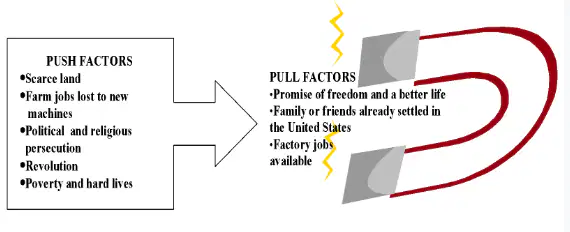
27. Two push factors that led immigrants to come to the United States were
a)
religious persecution and family settled in the United States
b)
revolution and factory jobs
c)
scarce land and revolution
d)
the promise of freedom and of a better life
28.
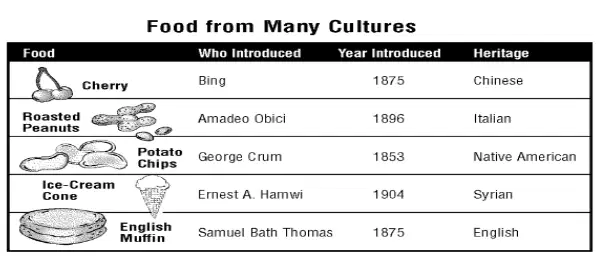
28. Which food in the table below were introduced to Americans from Syria?
a)
cherry
b)
potato chips
c)
ice cream
d)
none of these
29.
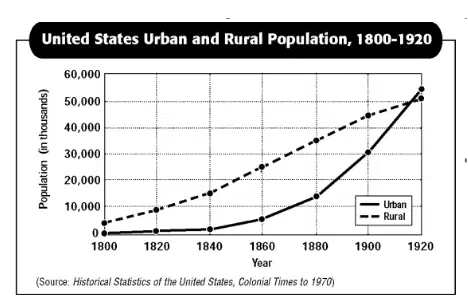
29. Which of the following trends is shown in the line graph above?
a)
a decrease in urban and rural populations
b)
an increase in rural and urban populations
c)
a decrease in urban population and in increase in rural population
d)
a decrease in rural population and in increase in urban population
30.
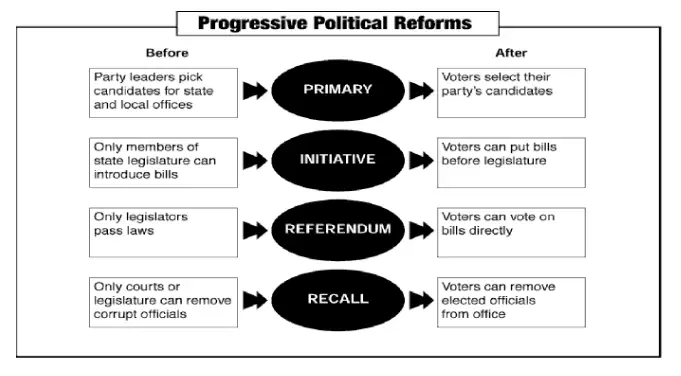
30. Which Political Reform has to do with voting on bills to become laws?
a)
initiative
b)
recall
c)
both initiative and referendum
d)
None of the above
31.
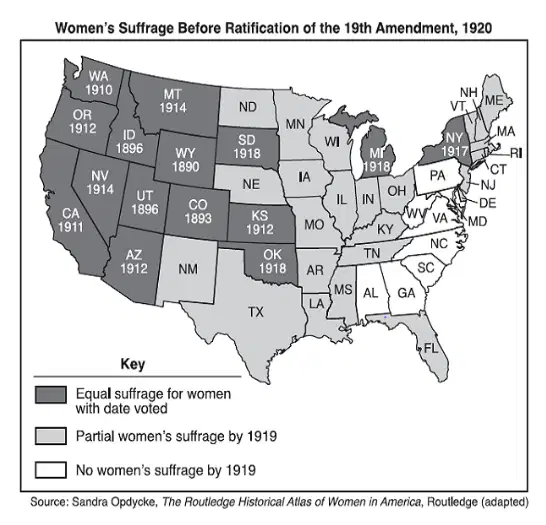
31. Which amendment granted Women’s Suffrage nationwide?
a)
18th Amendment
b)
14th Amendment
c)
19th Amendment
d)
21st Amendment
32.
32. Muckrakers were…..
a)
people who believed that slavery should be abolished
b)
government officials who thought that they should not interfere in business
c)
journalists who exposed the corruption in business, cities and government
d)
corrupt government officials
33.
33. "I saw with my own eyes hams, which had spoiled in pickle, being pumped full of chemicals to destroy the odor. I saw waste ends of smoked beef stored in barrels in a cellar, in a condition of filth which I could not describe in a letter. I saw rooms in which sausage meat was stored, with poisoned rats lying about, and the dung of rats covering them. I saw hogs which had died of cholera in shipment, being loaded into box cars to be taken to a place called Globe, in Indiana, to be rendered into lard. "My education as a physician teaches me that disease follows the same law whether in animals or human beings. An accurate post mortem requires close inspection of all the internal organs together with the use of the microscope before a physician can say there is no disease present." -Upton Sinclair’s Letter to President Theodore Roosevelt. According to the passage, what were conditions like in the meat packing industry?
a)
fair and safe
b)
healthy and secure
c)
unsanitary and dangerous
d)
none of these
34.
34. Which social (life) factors contributed to the need for governmental reform during the Progressive Era?
a)
Poor living conditions, poor working conditions, poor quality of food
b)
Tammany Hall needed renovations
c)
Thomas Nast drawing political cartoons
d)
all of the above
35.
35. “We used to go in the small hours of the morning into the worst tenements to count noses and see if the law against overcrowding was violated and the sights I saw there gripped my heart until I felt that I must tell of them or burst.”–Jacob Riis. This excerpt from the late 1800s indicates urban problems that called for _____, to fix these problems .
a)
change and reform to improve life
b)
trusts to become larger
c)
political officials to get a raise
d)
all of the above
36.
36. What is a political machine/boss?
a)
someone like William Marcy "Boss" Tweed
b)
someone who uses the spoils system, fixes elections, or steals money
c)
a corrupt politician who is guity of wrongdoing
d)
all of the above
37.
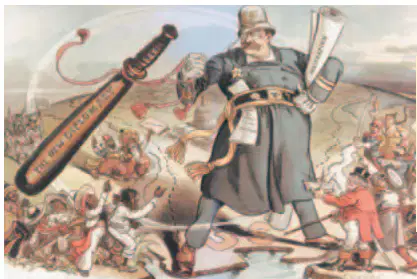
37. Which foreign policy is being shown in the political cartoon?
a)
The Big Stick Policy
b)
The Marshall Plan
c)
Isolationism
d)
The Platt Amendment
38.
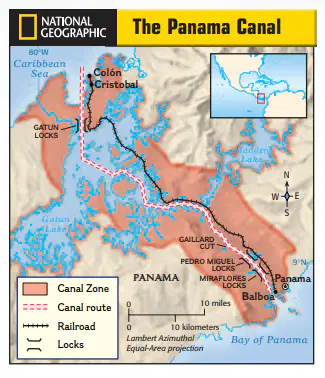
38. Which two bodies of water did the length of the Panama Canal connect?
a)
Bay of Panama and Madden Lake
b)
Bay of Panama and Colon Cristobal
c)
Bay of Panama and Caribbean Sea
d)
Caribbean Sea and Gatun Lake
39.
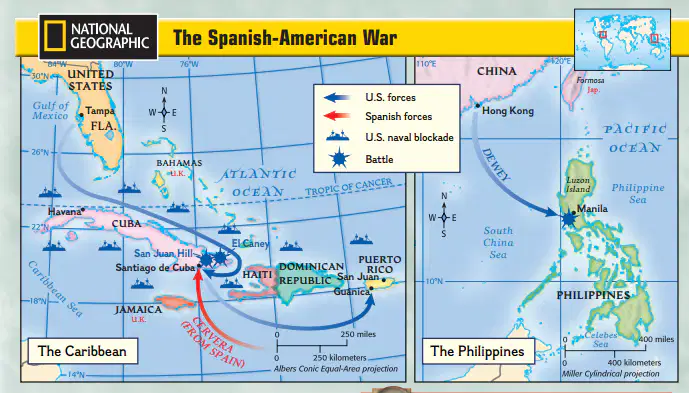
39. According to the two maps, in which area did more of the fighting take place?
a)
The Caribbean
b)
The Philippines
c)
the Bahamas
d)
none of these
40.
40. Non-involvement in world affairs is called....
a)
isolationism
b)
expansionism
c)
imperialism
d)
none of these
41.
41. What did yellow journalism do to American public opinions in the late 1800's?
a)
influenced readers to support a side
b)
led to the US involvement in the Spanish American War
c)
made them want revenge for the USS Maine
d)
all of these
42.
42. Which overseas action most clearly demonstrates the use of Theodore Roosevelt’s Big Stick foreign policy?
a)
the purchase of Alaska from Russia
b)
declaration of war against Germany in 1917
c)
Building the Panama canal, the opening of Japan, and the taking of Hawaii
d)
the US entering WWII
43.
43. Sometimes the United States resorted to ________________________ to coerce other nations.
a)
conversations and suggestions
b)
gunboat diplomacy
c)
ambassadors
d)
athletic competitions
44.
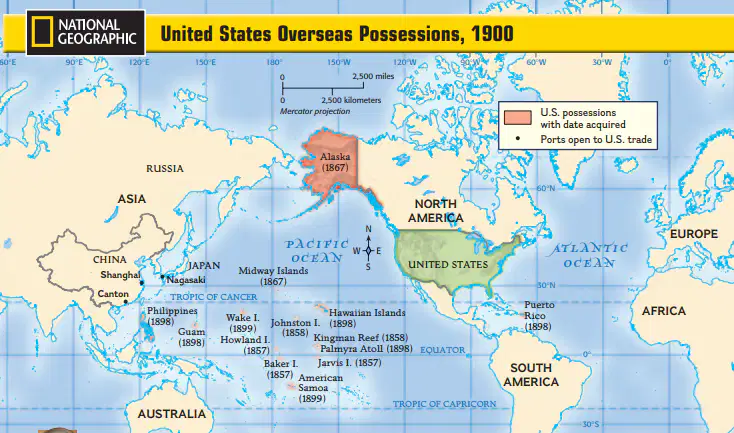
44. Why were many of these overseas possessions taken by the United States?
a)
to provide natural resources for the US
b)
to provide markets to sell goods for US businesses
c)
to have military bases on the way to Asia
d)
all of the above
45.
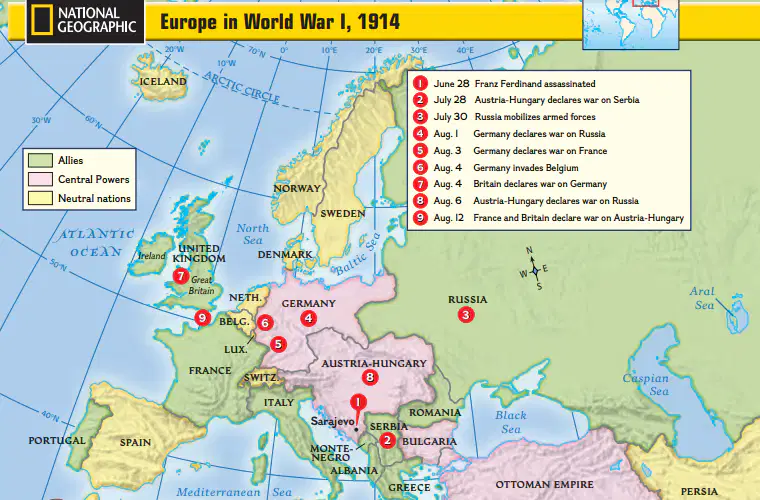
45. Which incident sparked the beginning of WWI?
a)
Russia mobilizes armed forces
b)
Germany invades Belgium
c)
Franz Ferdinand is assassinated
d)
France and Britain declare war on Austria Hungary
46.
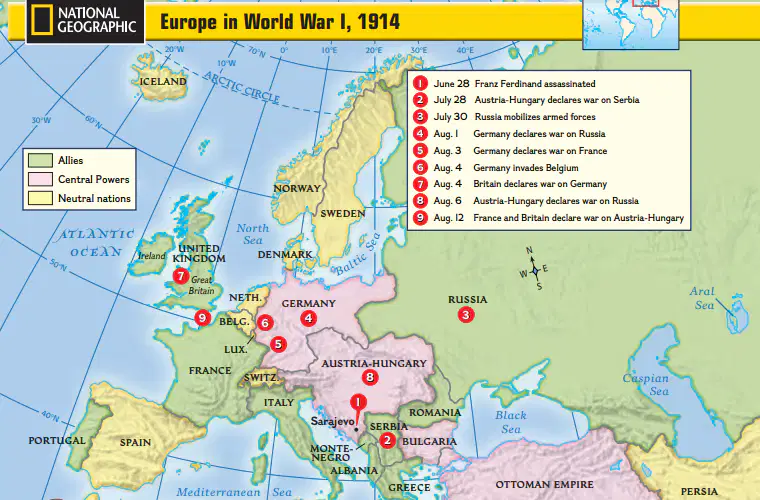
46. Which nations made up the Central Powers?
a)
German, Austria-Hungary, Ottoman Empire
b)
Germany, Spain, and Persia
c)
France, Italy, United Kingdom
d)
none of these
47.
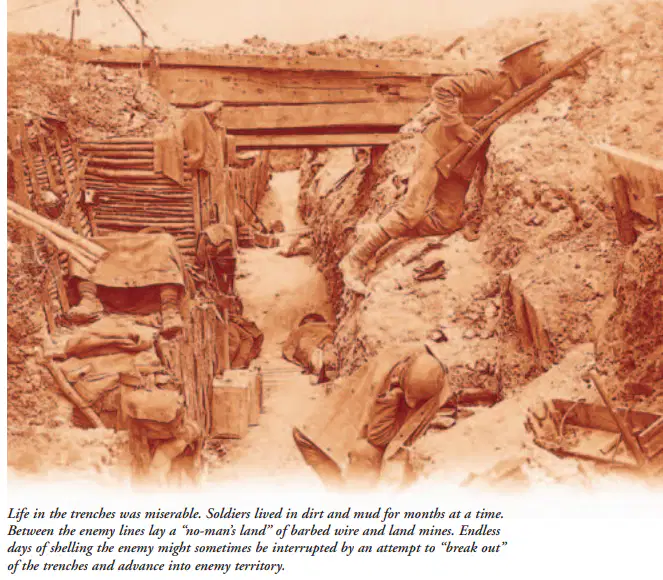
47. For soldiers, the dirty and muddy conditions of trenches often led to....
a)
diseases and lack of healthy food
b)
trench foot and infections
c)
sleepless nights and lack of proper medical care
d)
all of these
48.
48. "On the first of February, we intend to begin submarine warfare unrestricted. In spite of this, it is our endeavor to keep neutral the United States of America....If this attempt is not successful, we propose an alliance with Mexico. We shall make war together and together make peace. Mexico is to reconquer the lost territory in New Mexico, Texas, and Arizona. You are instructed to inform the President of Mexico of the above in the greatest confidence."- January 1917. This quotation to Mexico is a quotation from the....
a)
Monroe Doctrine
b)
Sussex Pledge
c)
Zimmerman Telegram
d)
Selective Service Act
49.
49. What did Americans on the home front do to help the war effort?
a)
plant victory gardens
b)
purchase liberty/war bonds
c)
donate various materials to make supplies
d)
all of these
50.
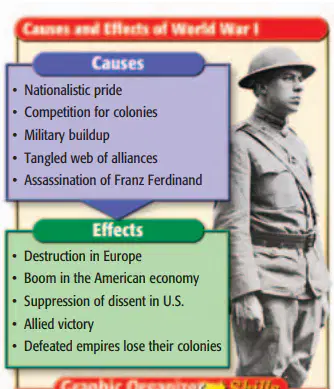
50. Some major underlying reasons that WWI began were....
a)
militarism
b)
secret alliances
c)
imperialism and nationalism
d)
all of these
51.
51. What was the main way that WWI was fought on the battlefield?
a)
nuclear warfare
b)
trench warfare
c)
guerilla warfare
d)
quiet peace talks
52.
52. What were reparations?
a)
when a country puts generals of the loosing nation in jail for a long period of time
b)
the reason the US went to war with Germany
c)
payments made by the losing side of the war to the ones that won the war for damages
d)
all of the above
53.
53. "DREAMS- Hold fast to dreams For if Dreams die Life is a broken-winged bird That cannot fly. Hold fast to dreams For when dreams go Life is a barren field Frozen with snow. -Langston Hughes" This poem, written during the Harlem Renaissance, was most likely meant to encourage African Americans to ....
a)
flee from slavery
b)
accept racial segregation
c)
look to the future
d)
deal with the Great Depression
54.
54. Which of the following terms directly relate to the time period of the Roaring 20's?
a)
flappers and Jazz Music from people like Luis Armstrong
b)
Prohibition and mobsters like Al Capone
c)
The Scopes "Monkey" Trial and Sports Stars like Babe Ruth
d)
all of the above
55.
55. “My conviction is that I have suffered for things that I am guilty of. I am suffering because I am a radical and indeed I am a radical; I have suffered because I was an Italian and indeed I am an Italian; I have suffered more for my family and for my beloved wife than for myself…”-Bartolomeo Vanzetti, to Judge Thayer upon being sentenced to death, Sacco-Vanzetti case, April 9th, 1927' Why does Bartolomeo Vanzetti think he was sentenced to death?
a)
because of his religious beliefs
b)
because he was a democrat
c)
because he was politically radical and an Italian immigrant
d)
because of his educational background
56.
56. What was one reason that national Prohibition failed?
a)
Stores did not sell alcohol
b)
Many Americans did not support the law
c)
The federal government refused to enforce Prohibition Laws
d)
The United States Supreme Court declared Prohibition unconstitutional
57.
57. What was the effect of the Harlem Renaissance?
a)
Many African American veterans of WWI were unemployed
b)
Prohibition ended for African Americans
c)
The federal government refused to enforce Prohibition Laws
d)
African Americans cultural pride flourished in the cities
58.
58. "These storms were like rolling black smoke. We had to keep the lights on all day. We went to school with headlights on, and with dusk masks on." This boy, living in Kansas in the 1930's is describing life during....
a)
The Dust Bowl
b)
Hurricane Margaret
c)
WWI chemical Warfare
d)
the Holocaust
59.
59. What were some women called during the 1920's?
a)
flappers
b)
volsteaders
c)
jazzers
d)
nativists
60.
60. Which hate group saw a resurgence in numbers during the 1920's?
a)
The Scopes
b)
Nazis
c)
KKK
d)
all of these
61.
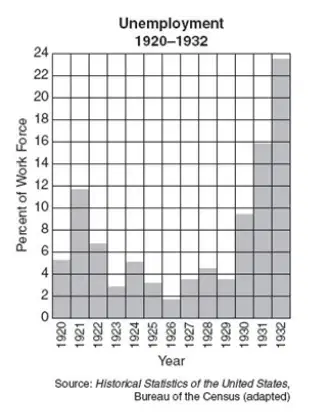
61. Which event was a factor related to the rapid change in unemployment after 1929?
a)
passage of the Espionage and Sedition Acts
b)
US refusal to join the League of Nations
c)
increase in immigration
d)
stock market crash
62.
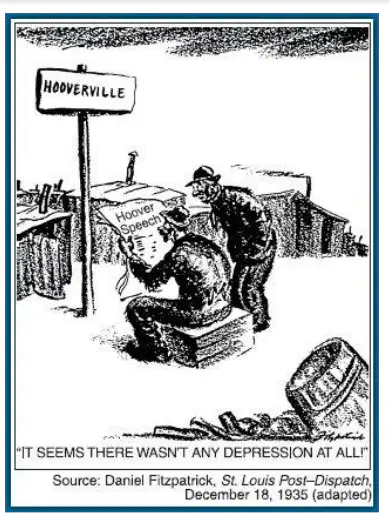
62. The point of view of the cartoonist was that President Hoover....
a)
developed policies that effectively ended the great Depression
b)
blamed poor people for causing the Great Depression
c)
failed to meet the needs of many Americans
d)
supported the creation of more “Hoovervilles”
63.
63. In the early 1930s, many communities of homeless Americans were referred to as “Hoovervilles” because President Herbert Hoover
a)
grew up in a poverty-stricken area
b)
guaranteed jobs to the unemployed
c)
provided food and clothing for the poor
d)
opposed direct federal aid for the unemployed
64.
64. During the Great Depression, one main objective of President Franklin D. Roosevelt’s fireside chats was to
a)
reassure people about the future of the economy
b)
convince listeners to buy war bonds
c)
encourage bankers to donate their money
d)
help farmers pay their loans
65.
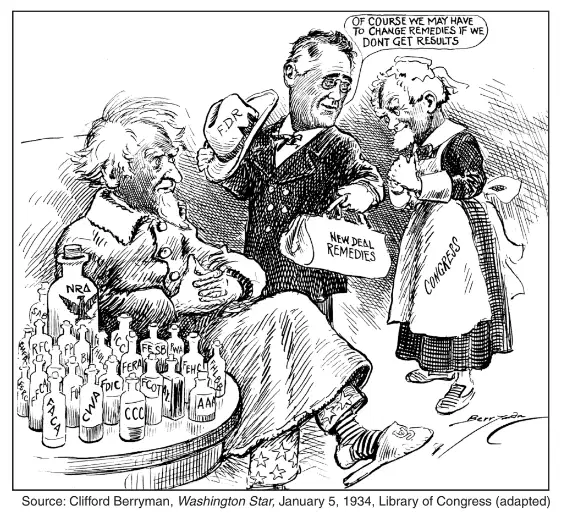
65. In the political cartoon, "Doctor" Franklin Roosevelt is suggesting a number of remedies for the country. What do the bottles on the table represent?
a)
his New Deal Programs
b)
a plan to pack the courts
c)
the names of the people who will support him in Congress
d)
the countries we will be at war with in WWII
66.
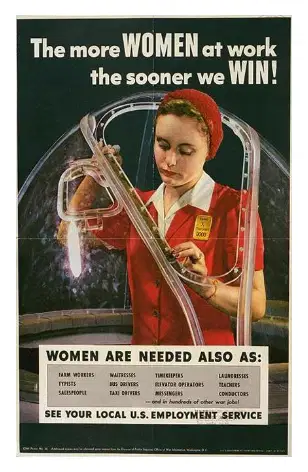
66. During World War II, posters like this were used to ....
a)
prevent antiwar protests
b)
recruit more women workers
c)
convince women to enlist in the military services
d)
gain acceptance for wartime rationing programs
67.
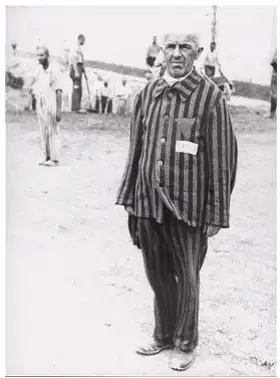
67. The picture below depicts a Jewish prisoner in a concentration camp during WWI. This time period in history is often referred to as....
a)
The Jewish Holocaust
b)
The Cold War
c)
Westward Expansion
d)
Japanese Internment
68.
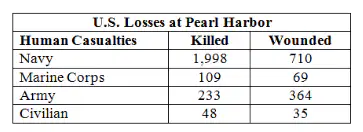
68. Who suffered the highest casualty rate at the Japanese bombing at Pearl Harbor, Hawaii?
a)
US Navy
b)
US Marine Corp
c)
US Army
d)
US Civilian Population
69.
69. “…it is known that there are Japanese residents of California who have sought to aid the Japanese enemy by way of communicating information…”-Culbert Olson, Governor of California, February 1942. This statement helped influence President Franklin D. Roosevelt to
a)
Ask congress to declare war on Japan
b)
Force most Japanese Americans to leave the United States
c)
Send federal troops to guard California’s capital
d)
Restrict the civil liberties of Japanese Americans
70.
70. Which event brought the United States into World War II?
a)
election of Hitler as Chancellor of Germany
b)
invasion of Poland by Germany
c)
attack on Pearl Harbor by Japan
d)
conquest of Ethiopia by Italy
71.
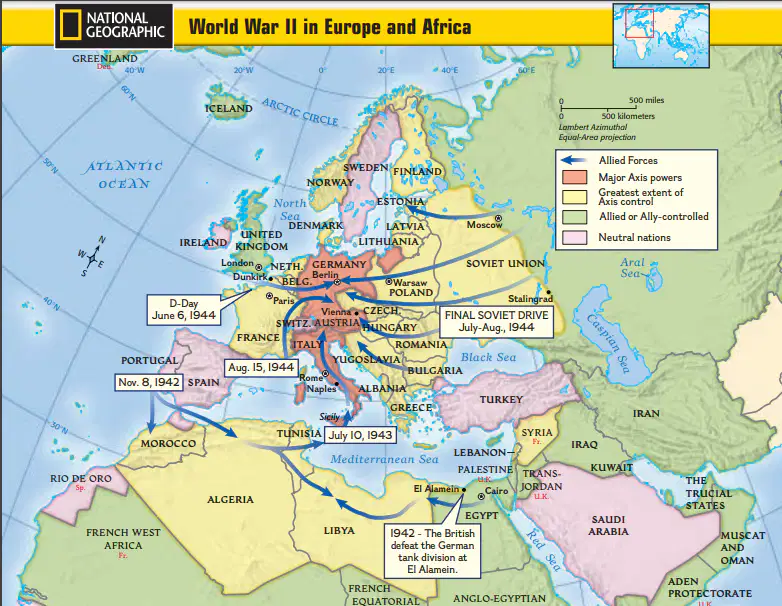
71. In which country did the D-Day invasion take place?
a)
Germany
b)
Spain
c)
France
d)
Libya
72.
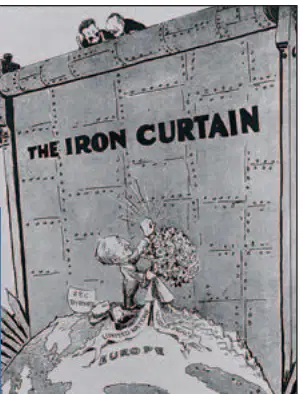
72. What did the Iron Curtain separate during the Cold War?
a)
The Nazi's from the Allied Forces
b)
The Western Democratic Powers from the Communist East
c)
The Europeans from the Asians
d)
The Americans from the Polish
73.
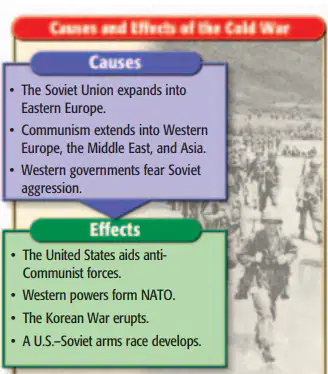
73. What organization did the Western Powers form?
a)
NATO
b)
Sputnik
c)
NASA
d)
Warsaw Pact
74.
74. "For years now I have heard the word "Wait!". It rings in the ear of every Negro with piercing familiarity. The 'Wait' has almost always meant 'Never'. We must come to see....that 'justice too long delayed is justice denied." -"Letter from Birmingham Jail" written by Martin Luther King. During the Civil Rights Movement, activists like Martin Luther King want....
a)
to end segregation and integrate cities and schools
b)
equality for all races
c)
A Civil Rights Bill to prohibit discrimination
d)
all of the above
75.
75. In Brown vs. Board of Education of Topeka, Kansas, the Supreme Court ruled that Topeka's school district had engaged in which unconstitutional practice?
a)
Prohibiting school prayer
b)
bussed students to school far away from their homes
c)
had set up different schools for white and black students (segregating them)
d)
refused to offer required courses
100 %

