
 Worksheets
US History Unit 6 Test
Total questions: 70
Worksheet time: 35mins
Name
Class
Date
1.
What was NOT included in Truman's "Fair Deal"?
a)
proposed increase of the minimum wage
b)
proposed increase of aid farmers and agriculture
c)
proposed national health insurance program
d)
proposed increase in inflation
2.
How did the workforce change as the result of the changing economy?
a)
labor unions lost membership due to becoming unpopular
b)
white color works began to out number blue collar workers
c)
women became half of the workforce
d)
African Americans received employee benefits for the first time
3.
Which type of worker is described by the following:
-factory worker
-paid an hourly wage
-usually has a skilled trade
-once the largest part of the US workforce
a)
Blue-collar worker
b)
White- collar worker
4.
Which type of worker is described by the following?
-professional such as lawyer or doctor
-paid a set salary
-often working in an office
a)
Blue-collar worker
b)
White-collar worker
5.
What was the baby boom?
a)
the decrease in the birthrate from 1900-1946
b)
the decrease in the birthrate from 1946-1964
c)
the increase in the birthrate from 1960-1980
d)
the increase in the birthrate from 1946-1964
6.
Which of these states would not be in the "Sunbelt"?
a)
California
b)
Florida
c)
Texas
d)
New York
7.
Which of the following MOST ACCURATELY describes planned postwar communities like Levittown?
a)
simple, low-cost housing for the working poor in cities
b)
large country homes designed to attract wealthy buyers
c)
small suburban homes that middle-class families could afford
d)
custom-designed homes built to meet the needs of individual buyers
8.
Read the descriptions below. Which person do these descriptions best fit?
• He commanded Allied forces in World War II.
• He supported a program of "modern Republicanism"
• He worried about the "military-industrial complex.
a)
Thomas Dewey
b)
Dwight D. Eisenhower
c)
Richard Nixon
d)
Harry Truman
9.
Which was NOT a goal for creating the Interstate Highway System?
a)
connecting major cities
b)
providing a route for evacuation of urban area
c)
providing the increased desire for Americans to purchase an automobile
d)
providing a method for easily transporting troops and weapons
10.
What medical advancement help end the fear of polio in the 1950s?
a)
forced isolation helped end the disease
b)
development of a vaccine by Dr. Jonas Salk
c)
the polio virus ended when penicillin was invented
d)
development of the iron lung ended polio
11.
The title "The Other America" is .....
a)
the title of a Bob Dylan song
b)
a book written by M. Harrington in 1962
c)
a famous poem by Langston Hughes
d)
a documentary series from the 1950s
12.
What is the "poverty line"?
a)
the maximum income needed to meet basic needs
b)
the income needed to hold a respectable place in society
c)
income basis for the elderly and unemployed
d)
the minimum income needed to meet basic needs
13.
Which of these statements BEST describes the impact of “The Other America” when it was published in 1962?
a)
It incited riots among poverty-stricken minorities.
b)
It was ignored by politicians, who blamed the poor for their poverty
c)
It led to the formation of a new political party for people in poverty
d)
. It woke up the nation to the reality that poverty still existed in many places
14.
What was the Housing Act of 1949?
a)
an act the moved the poverty stricken to rural areas across America
b)
an act the created Hull House
c)
an act that created public housing and urban renewal programs
d)
an act that authorized the resettlement of the poor into commercial business districts
15.
How did the Housing Act of 1949 worsen poverty, rather than help it?
a)
It caused hundreds of thousands of poor people to be displaced from their homes
b)
It raised the cost of owning a house, causing middle-class people to lose money.
c)
It increased the price of other necessities, such as education and grocery items.
d)
It discriminated against African Americans who often needed the housing the most
16.
How did the rise of agribusiness in the 1950s hurt small farmers
a)
by hiring small farmers to run corporate farms
b)
by buying land once owned by small farmers
c)
by driving seed and fertilizer prices up for small farmers
d)
by producing crops more efficiently than small farmers could
17.
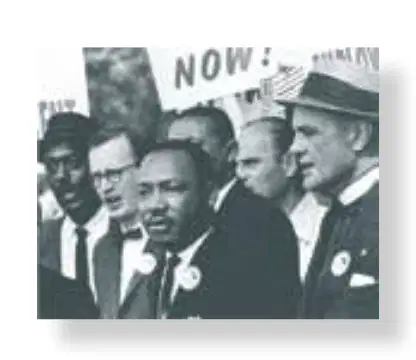
This photograph shows Dr. Martin Luther King, Jr., and other Civil Rights leaders at the “March on Washington” in 1963.
What conclusion can be made from this photograph?
a)
A. Philip Randolph was unable to attend the March on Washington.
b)
Dr. King refused to work with whites in the struggle against segregation.
c)
Whites, as well as blacks, participated in the struggle against racial discrimination.
d)
The “March on Washington” successfully persuaded states to prohibit racial segregation.
18.
Which four organizations opposed the use of violence in the struggle for African-American civil rights?
a)
NAACP, Urban League, CORE, SCLC
b)
CORE, KKK, Black Panthers, Nation of Islam
c)
SNCC after 1967, SCLC, CORE, Black Panthers
d)
NAACP, Urban League, SNCC after 1967, Nation of Islam
19.
In the Civil Rights Act of 1964, Congress prohibited discrimination in restaurants and hotels on the basis of race, color, religion, or national origin.
What else did Congress provide in the same act?
a)
an official definition for discrimination in housing
b)
accessibility rights for individuals with disabilities
c)
penalties for prohibited acts of racial discrimination
d)
penalties for those instituting “affirmative action” programs
20.

Question is an image
a)
It can limit the actions of Congress.
b)
It can rule state laws unconstitutional.
c)
It can dictate new laws to state legislatures.
d)
It can provide funding for public education.
21.
Which group of leaders discouraged cooperation with members of other racial groups in the struggle to improve conditions for African Americans?
a)
Malcolm X, Stokely Carmichael, and H. Rap Brown
b)
A. Philip Randolph, James Farmer and Fannie Lou Hamer
c)
Rosa Parks, Thurgood Marshall and Constance Baker Motley
d)
Roy Wilkins, Dr. Martin Luther King, Jr., and Dr. Ralph Abernathy
22.
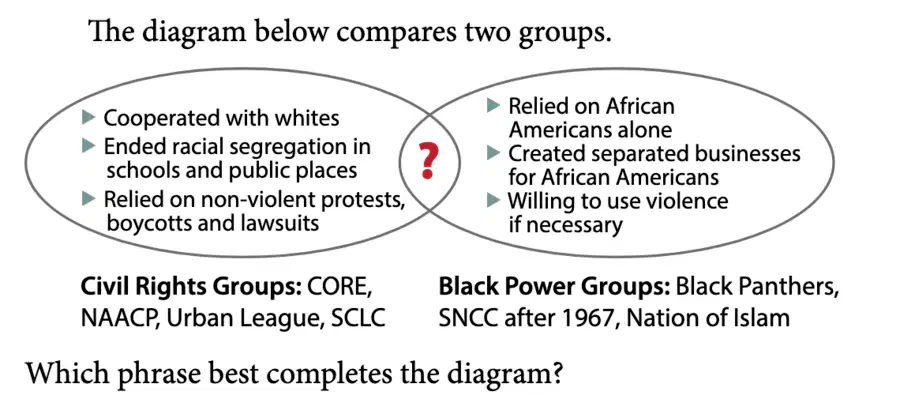
a)
Opposed African-American participation in elections
b)
Expressed pride in being African-American
c)
Ignored racist attitudes in Northern cities
d)
Proposed emigration to Africa
23.
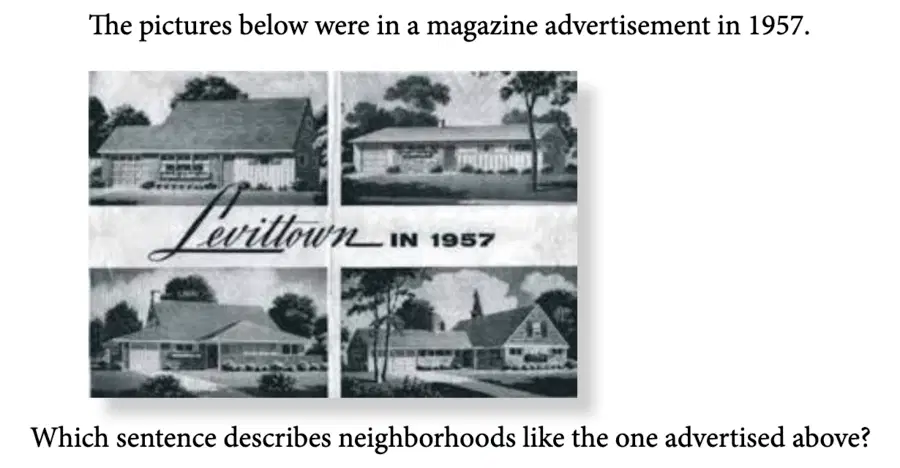
a)
They welcomed Americans of all ethnic backgrounds.
b)
Their construction was federally funded by the G.I. Bill.
c)
Their spread was encouraged by the Federal Highway Act.
d)
They were built for propaganda purposes during the Cold War.
24.

a)
Congress passed the Voting Rights Act of 1965.
b)
Southern states enacted their own new voting laws.
c)
Desegregated restaurants and hotels made voting easier.
d)
Newly integrated schools encouraged African Americans to vote.
25.
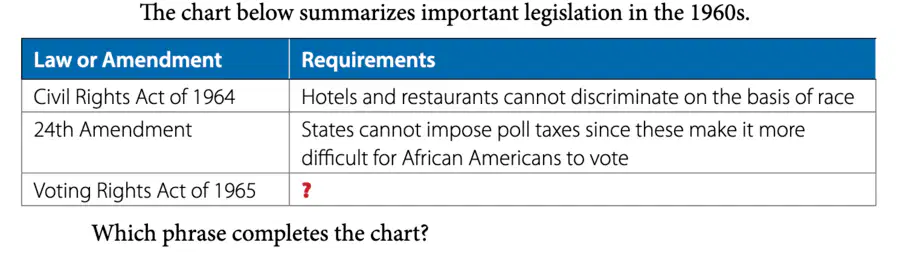
a)
A state cannot deny citizens the right to vote on the basis of gender.
b)
A state cannot impose procedures that deny citizens the right to vote on account of age.
c)
A state cannot impose procedures that deny citizens the right to vote on account of race.
d)
A state cannot deny the right to vote to American Indians who choose to remain on federal reservations.
26.
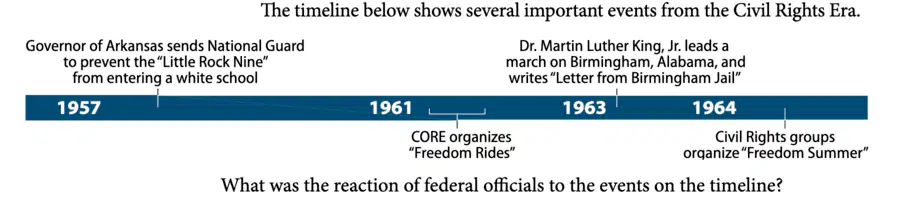
a)
They sent emergency assistance in the form of troops and marshals to stop the violence.
b)
They immediately passed new laws ending discrimination in housing, employment, and voting.
c)
They failed to act because they needed the support of white Southerners to stay in office.
d)
They tended to side with white Southern segregationalists against Civil Rights demonstrators.on 1
27.

a)
The armed forces of the United States were desegregated.
b)
Free education was promised to veterans who had served in World War II.
c)
Southern members of the Democratic Party left and formed a new political party.
d)
Equal opportunity in education was established to promote advances in science and mathematics.
28.
Which of these tactics did Martin Luther King Jr. and the Southern Christian Leadership Conference use most effectively in their struggle to win equal rights for African Americans?
a)
armed rebellion
b)
affirmative action
c)
nonviolent resistance
d)
reverse discrimination
29.
How did President Eisenhower respond to the refusal to desegregate a school in Little Rock, Arkansas?
a)
He took the governor and school board to the Supreme Court.
b)
He sent in federal troops to enforce the school's integration.
c)
He had Congress implement laws requiring the desegregation.
d)
He visited Little Rock and walked the Black students into the school.
30.

Examine the table below. Which of these campaigns was aimed at registering African Americans in the state with the lowest percentage of Black voters?
a)
Freedom Rides
b)
Freedom Summer
c)
March on Washington
d)
Montgomery Bus Boycott
31.
What was a challenge the Little Rock Nine faced in their quest to desegregate Central High?
a)
President Eisenhower did not allow the federal government to intervene with force.
b)
The National Guard prevented African American students from entering the high school.
c)
Governor Orval Faubus declared he would not support desegregation.
d)
all of the above
32.
What was a result(s) of the Montgomery Bus Boycott?
a)
Martin Luther King Jr. earned a national reputation as a civil rights leader.
b)
The Supreme Court ruled that segregation on buses was unconstitutional.
c)
An Alabama court ruled that segregation on buses was unconstitutional.
d)
all of the above
33.
The 1963 ________ was one of the largest political gatherings ever held in the United States.
a)
The Interstate Commission issued clear rules stating that buses involved in interstate travel must be integrated.
b)
The Supreme Court ruled that segregation in interstate transport was illegal.
c)
The Freedom Rides did not experience violence when they entered southern states.
d)
all of the above
34.
In what way(s) were the Freedom Rides successful?
a)
The Interstate Commission issued clear rules stating that buses involved in interstate travel must be integrated.
b)
The Supreme Court ruled that segregation in interstate transport was illegal.
c)
The Freedom Rides did not experience violence when they entered southern states.
d)
all of the above
35.
The SNCC members planned and participated in direct action throughout the South. What does direct action refer to?
a)
political acts; including protests of all types, designed to have a prolonged, downstream impact
b)
political acts; deliberately designed to break laws considered unjust
c)
political acts; including protests of all types, designed to have an immediate impact
d)
violent protests; designed to protest against unjust laws Page of
36.

a)
Stokely Carmichael
b)
James Meredith
c)
Elijah Muhammad
d)
Malcolm X
37.
Black nationalists rejected the goals of the civil rights movement in the 1960s because they
a)
supported a doctrine that called for Black people to completely separate from White society
b)
believed that nonviolent protesting was necessary for achieving racial equality.
c)
sought to avoid the conformity and materialism in American culture.
d)
were more concerned with spreading propaganda about White people than gaining equal rights.
38.
The Civil Rights Act of 1968 banned discrimination in which of the following areas?
a)
employment
b)
housing
c)
public facilities
d)
university admissions
39.
Which of these groups sent observers into the streets armed with law books and shotguns to protect Black people from police mistreatment in the 1960s?
a)
Black Panthers
b)
Nation of Islam
c)
Congressional Black Caucus
d)
Student Nonviolent Coordinating Committee (SNCC)
40.
The ruling in Regents of the University of California v. Bakke prohibited
a)
race from being used as the only criterion in admissions decisions.
b)
race from being used to determine student housing placements.
c)
affirmative action from being used to attract more minority students
d)
affirmative action from being used in university hiring decisions.
41.
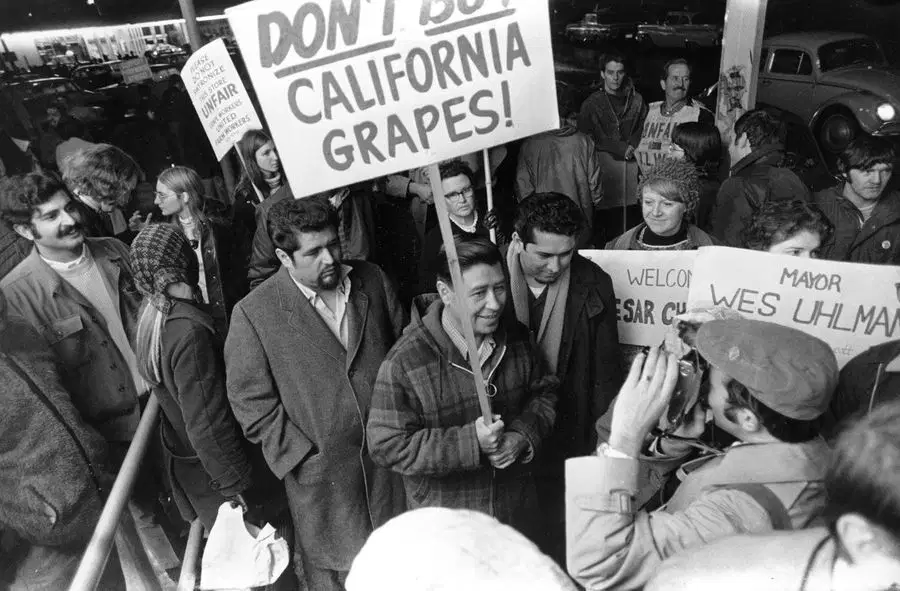
Cesar Chavez and Dolores Huerta organized a boycott when the UFW was still new against...
a)
Texas table grapes
b)
Hawaii table grapes
c)
California table grapes
42.
Cesar Chavez helped which group of people to be treated better?
a)
Businessmen in the Northeast
b)
Congressional leaders in government
c)
Migrant workers
d)
Catholic Christians
43.
What did the efforts of Chavez and his association, the United Farm Workers (UFW), accomplish?
a)
a strong union, bargaining power for workers, and safer working conditions for migrant workers
b)
a better economy across the nation that started with the national banks
c)
climate change in California that would extend across the U.S.
d)
lower gas prices for all Americans
44.
Betty Friedan found life as a housewife in the suburbs to be _______
a)
very happy and fulfilling
b)
frustrating and lonely
c)
enjoyable and busy
45.
What organization did Friedan help set up in 1966?
a)
The National Women's Liberation Movement
b)
The National Association for the Advancement of Women
c)
The National Organisation for Women (NOW)
46.
What is Title IX
a)
A Law allowing males to have the same opportunities as females
b)
A Law allowing women to have the same opportunities as males
c)
A law
d)
Title IX doesn't exist
47.
Divided Germany into 4 occupation zones
a)
Yalta
b)
Potsdam
48.
The dividing line between the democracies in blue and the Communist in red was referred to as what?
a)
Option 1
b)
The line of demarkation
c)
The DeMilitarized Zone
d)
The Iron Curtain
e)
The 38th Parallel
49.
The United States and its allies had a policy called "containment." This means that they wanted to ...
a)
stop the spread of Fascism.
b)
stop the spread of slavery.
c)
stop other countries from building up their military power.
d)
stop the spread of Communism.
50.
What was the main idea of The Truman Doctrine?
a)
The Truman Doctrine was the American policy in 1947 of providing economic and military aid to Greece and Turkey
b)
To show how everyone in the U.S. care about other countries in the world.
c)
He tried to get the government to leave.
d)
I didnt even listen to you
51.
How did USA use the Marshall Plan to promote democracy?
a)
Containing Communism in areas affected after a war
b)
Providing resources to countries ravaged by war in order to prevent communism
c)
uncovering new sources of wealth to prevent an enemy from receiving resources
d)
Fighting wars by using other countries to stop Communism
52.
Why is the Cold War called a "cold" war?
a)
The areas affected were in the polar regions of the world
b)
The war was fought during winter months only
c)
Leaders of the superpowers were sick with coughs and fevers
d)
There was never direct fighting between the two superpowers
53.
What is the name of a political system characterized by a centrally planned economy with all economic and political power resting in the hands of the central government?
a)
Communism
b)
Capitalism
c)
Democracy
d)
Monarchy
54.
What was a major reason for Cold War?
a)
Ideological differences between USA and USSR
b)
The weather was too low
c)
Insufficient money for war reparations
d)
Inability of the UN to maintain peace
55.
Which of the following organizations supports Democratic ideals and self governance?
a)
Warsaw Pact
b)
Satellite Nations
c)
NATO
d)
Domino Theory
56.
The organization whose members agreed to mutually defend other Communist nations is called--
a)
Korean Pact
b)
Warsaw Pact
c)
NATO
d)
Satellite Nations
57.
What was the purpose of the Berlin Blockade?
a)
Soviet attempt to force Allies out of Berlin
b)
Soviets attempted to make Berlin their ally.
c)
Soviets fought back against the Allies.
d)
Soviet attempt to reunify Berlin
58.
How did the US respond to the Berlin Blockade?
a)
US sent supplies through an airlift
b)
US fought the Soviets
c)
US built the Berlin Wall
d)
US tore down the Berlin Wall
59.
The excerpt from an April 1949 document marked the establishment of which organization?
"The parties agree that an armed attack against one or more of them in Europe or North America shall be considered an attack against them all?"
a)
Warsaw Pact
b)
North Atlantic Treaty Organizaiton
c)
Berlin Blockade
d)
Potsdam Conference
60.
What was the primary cause of the Korean War?
a)
South Korea supported a communist government
b)
Soviet supported North Korea invades South Korea
c)
American troops suport the North Korean government
d)
Soviet troops invade North Korea
61.
What was the outcome of the Korean War?
a)
South Korea overtakes North Korea
b)
North Korea overtakes South Korea
c)
Korea divided into North and South at the 38th parallel
d)
Korea divided into North and South at the 56th parallel
62.
During the Cold War, the Soviet Union and the United States became locked in an arms race. An arms race is:
a)
an event in which two nations race to the brink of war, but avoid declaring war
b)
a competition between nations to achieve a more powerful weapons arsenal.
c)
a battle that only involves nuclear weapons and weapons of mass destruction
63.
Fear of nuclear conflict came to be known as:
a)
Mutually Assured Destruction (MAD)
b)
brinkmanship
c)
Intercontinental Ballistic Mutualism (ICBM)
64.
When Mao formed the People's Republic of China in 1949, to what country did the Nationalists flee to?
a)
Taiwan
b)
Thailand
c)
South Korea
65.
What crime was the subject of the Julius and Ethel Rosenberg trial?
a)
passing atomic secrets to the Soviet Union
b)
plotting to overthrow the U.S. government
c)
recruiting communist sympathizers to spy for the Soviet Union
66.
Which term is BEST defined as the practice of publicly accusing someone of subversive activities without evidence to back up the charges?
a)
censure
b)
blacklisting
c)
McCarthyism
67.
Which statement BEST describes the primary mission of the Federal Civil Defense Administration during the 1950s?
a)
to train U.S. citizens to identify subversive behavior
b)
to help U.S. citizens prepare for a nuclear attack
c)
to recruit troops to defend the United States from a Soviet invasion
68.
The United States supported which side in the Korean War?
a)
North Korea
b)
South Korea
69.
During the 1950s, Secretary of State John Foster Dulles argued that the United States should be prepared to go to war in order to contain communism. What was this policy called?
a)
hegemony
b)
brinkmanship
c)
deterrence
70.
The House Un-American Activities Committee:
Select ALL that apply
a)
was formed to investigate subversive organizations.
b)
asked Julius Rosenberg to testify about communist influence in labor unions.
c)
charged the Hollywood Ten with contempt of Congress.
100 %

