
 Worksheets
Physics Newton's Law
Total questions: 46
Worksheet time: 46mins
After a cannonball is fired into frictionless space, the amount of force needed to keep it going equals
zero, since no force is necessary to keep it moving.
twice the force with which it was fired.
one half the force with which it was fired.
the same amount of force with which it was fired.
one quarter the force with which it was fired.
Which has more mass, a kilogram of feathers or a kilogram of iron?
The feathers
The iron
Neither—they both have the same mass.
A 10-kg brick and a 1-kg book are dropped in a vacuum. The force of gravity on the 10-kg brick is
10 times as much as the force on the 1-kg book.
zero.
the same as the force on the 1-kg book.
A player hits a ball with a bat. The action force is the impact of the bat against the ball. What is the reaction to this force?
The force of the ball against the bat
The weight of the ball
Air resistance on the ball
The grip of the player's hand against the bat
none of the above
A person is attracted towards the center of Earth by a 440-N gravitational force. The force with which Earth is attracted toward the person is
440 N.
very very small.
very very large.
Friction is a force that always acts
perpendicular to an object's motion.
opposite to an object's motion.
in the same direction as an object's motion.
The law of inertia applies to
objects at rest.
moving objects.
both moving and nonmoving objects.
One object has twice as much mass as another object. The first object also has twice as much
velocity.
gravitational acceleration.
inertia.
all of the above
Compared to its weight on Earth, a 10-kg object on the moon will weigh
the same amount.
less.
more.
How does acceleration of an object change in relation to its mass? It is
directly proportional.
Acceleration doesn't depend on mass at all.
inversely proportional.
Suppose the force of friction on a sliding object is 25 N. The force needed to maintain a constant velocity is
more than 25 N.
25 N
less than 25 N.
A girl pulls on a 10-kg wagon with a constant force of 20 N. What is the wagon's acceleration?
0.5 m/s²
2 m/s²
10 m/s²
20 m/s²
200 m/s²
A force of 3 N accelerates a mass of 3 kg at the rate of 1 m/s². The acceleration of a mass of 6 kg acted upon by a force of 6 N is
twice as much.
half as much.
the same.
none of the above
Suppose a cart is being moved by a force. If suddenly a load is dumped into the cart so that the cart's mass doubles, what happens to the cart's acceleration?
It quarters.
It halves.
It stays the same.
It doubles.
It quadruples.
You pull horizontally on a 50-kg crate with a force of 450 N and the friction force on the crate is 250 N. The acceleration of the crate is
2 m/s².
4 m/s².
9 m/s².
14 m/s².
A high school student hits a nail with a hammer. During the collision, there is a force
on the nail but not on the hammer.
on the nail and also on the hammer.
on the hammer but not on the nail.
According to Newton's third law, if you push gently on something, it will push
gently on something else.
on you only if you aren't moving.
gently on you.
on something only under the right conditions.
A box is dragged without acceleration in a straight-line path across a level surface by a force of 13 N. What is the frictional force between the box and the surface?
(a)
When the angle of an incline with a block resting on it increases, the normal support force
increases.
stays the same.
decreases.
On the surface of Jupiter, the acceleration due to gravity is about 3 times that on Earth. How much would a 0.40-kg rock weigh on Jupiter?
On the surface of Jupiter, the acceleration due to gravity is about 3 times that of Earth. What would be the mass of a 170-kg rock on Jupiter?
A 400,000-kg airplane in takeoff uses the 40,000 N thrust of each one of its four engines. What is the acceleration of the plane during takeoff?
A 3 kg block is pulled across a table by a string with force of 40 N. The block experiences a friction force of 5 N. What is the acceleration of the block?
Howard is moving a 90 kg wooden crate from one side of his office to the other. To accomplish this, he ties a rope around his waist and begins to walk, so that the crate is dragged horizontally across the floor. If the coefficient of friction between the crate and the floor is 0.159, what force must Howard apply to the rope to move at a constant speed?
A net force of 1.0 N acts on a 4.0-kg object, initially at rest, for 4.0 seconds. What is the distance the object moves during that time?
Which of the following best describes Newton's Law of Inertia?
An object at rest stays at rest, and an object in motion stays in motion unless acted upon by an external force.
The force of gravity is proportional to the mass of the object.
The acceleration of an object is directly proportional to the net force acting on it.
For every action, there is an equal and opposite reaction.
What is the unit of mass in the International System of Units (SI)?
Gram
Pound
Kilogram
Newton
Which of the following statements is true about free fall?
Objects in free fall experience no acceleration.
Objects in free fall experience a constant acceleration due to gravity.
Objects in free fall experience a constant velocity.
Objects in free fall experience an increasing acceleration.
According to Newton's Third Law, for every action, there is:
A greater reaction.
A lesser reaction.
An equal and opposite reaction.
No reaction.
Which of the following best describes the force of gravity?
It is the force that acts between two masses.
It is the force that acts between two charges.
It is the force that acts between two magnets.
It is the force that acts between two objects in motion.
Which of the following best describes friction?
It is the force that opposes the motion of an object.
It is the force that accelerates an object.
It is the force that acts at a distance.
It is the force that acts in the direction of motion.
Which of the following best describes inertia?
The tendency of an object to accelerate.
The tendency of an object to resist changes in its state of motion.
The tendency of an object to move in a straight line.
The tendency of an object to change its direction of motion.
Which of the following best describes Newton's Second Law of Motion?
The acceleration of an object is directly proportional to the net force acting on it and inversely proportional to its mass.
The acceleration of an object is directly proportional to its mass and inversely proportional to the net force acting on it.
The acceleration of an object is directly proportional to the net force acting on it and directly proportional to its mass.
The acceleration of an object is inversely proportional to the net force acting on it and directly proportional to its mass.
Which of the following best describes Newton's Third Law of Motion?
For every action, there is an equal and opposite reaction.
For every action, there is a greater reaction.
For every action, there is a lesser reaction.
For every action, there is no reaction.
Which of the following best describes the concept of mass?
Mass is a measure of the amount of matter in an object.
Mass is a measure of the volume of an object.
Mass is a measure of the density of an object.
Mass is a measure of the weight of an object.
Which one of Newtons laws does this equation belong to. F=m*a
1st law
2nd law
3rd law
4th law
What is the Unit for Force?
Kilogram
Does mass matter for gravity's acceleration?
Yes
No
It Depends
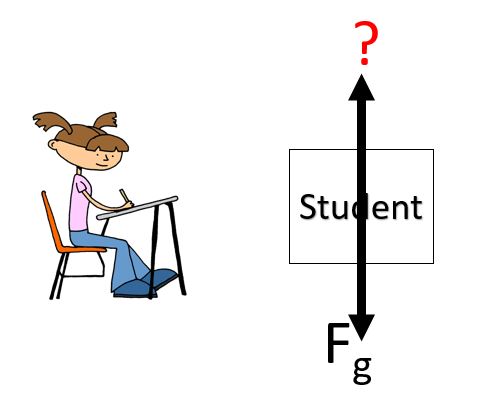
Name the missing force.
Weight force
Normal force
Frictional force
Tension force
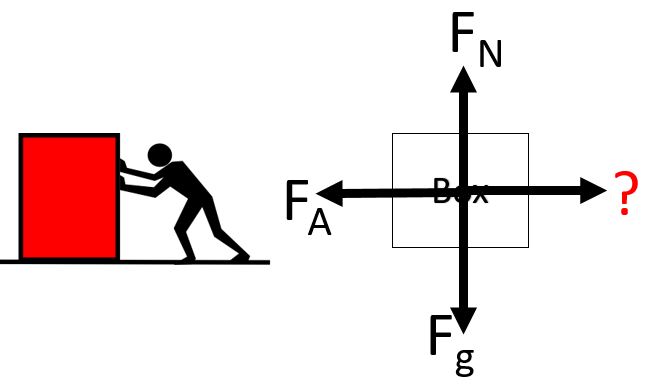
Name the missing force...
Frictional force
Weight force
Thrust
Buoyant force
The force that prevents objects from sinking into surfaces is known as:
normal
abnormal
static
inertia

Force is (a) to mass and acceleration
What is Sir Isaac Newton's Third Law of Motion?
Objects at rest and objects in motion will remain at rest or in motion, unless they are acted upon by an unbalanced force.
For every action there is an equal and opposite reaction.
When a force acts on a mass, acceleration is produced.
When a force acts on a mass, the mass increases.
A -10 N force is on a 1 kg object. What is the acceleration of the object? (a = F/m)
5 m/s squared
4 m/s squared
-10 m/s squared
20 m/s squared

