wayground logo

Free Printable Worksheets

NEW

Font size

S
M
L
XL
Worksheets

Diagnostic Test Grade 9 Physics

Total questions: 50

Worksheet time: 1hrs 21mins

Name
Class
Date
1.
What types of charges attract?
a)
Positive and Positive
b)
Positive and Neutral
c)
Negative and Neutral
d)
Positive and Negative
2.
What charge does a proton have?
a)
negative (-)
b)
positive (+)
c)
neutral or no charge (0)
3.
What charge does an electron have?
a)
negative (-)
b)
positive (+)
c)
neutral or no charge (0)
4.
If a substance has a higher number of electrons than protons on its surface, what type of charge does it have?
a)
A positive charge.
b)
A negative charge.
c)
A neutral charge
d)
No charge at all
5.
Which of the following is caused by static electricity?
a)
a stove getting hot when it is turned on
b)
a magnet being attracted to a refrigerator
c)
a lightning strike during a storm
d)
a light bulb coming on when a switch is turned on
6.
An object becomes postiively charged when which of the following occurs?
a)
loses electrons
b)
gains electrons
c)
loses protons
d)
gains neutrons
7.

The difference between attraction and repulsion is that to attract is to pull something closer and repel is to push something away.

a)

True

b)

False

8.

the positively charged particle in an atom, never leaves the nucleus, determines the element

a)

proton

b)

neutron

c)

electron

9.
In a neutral atom, the number of electrons is equal to the number of _______.
a)
Neutrons
b)
Orbits
c)
Protons
d)
subatomic particles
10.
An object becomes charged when the atoms in the object gain or lose
a)
electrons
b)
protons
c)
neutrons
d)
all of the above
11.
The unit for current is the 
a)
Volt
b)
Ohm
c)
Electron
d)
Amp
12.
In a ________ circuit there are multiple paths for the current to take.
a)
Series
b)
Parallel
13.
In a _________ circuit, if one bulb goes out then the entire circuit doesn't work.
a)
Series
b)
Parallel
14.
What is the unit for resistance?
a)
Volts
b)
Amperes
c)
Ohms
15.
What kind of circuit is this?
a)
Series
b)
Consecutive
c)
Parallel
d)
Training
16.
If the battery produced 12.6 Volts and what would be the current flow be for a 6 Ohm resistor
a)
2.1 Amps
b)
2.4 Amps
c)
1.71 Amps
d)
15 Amps
17.
What voltage is needed to cause a 2A current flow through a 10Ω resistor?
a)
5V
b)
0.2V
c)
20V
d)
200V
18.
What resistance is needed to cause a 20A current flow because of a 100V battery?
a)
0.2Ώ
b)
2000Ώ
c)
120Ώ
d)
19.
Lightning is an example of _________.
a)
static electricity
b)
current electricity
c)
watts
d)
voltage
20.
What is a closed path for electrons to flow through?
a)
static electricity
b)
circuit
c)
amperes
21.
As the resistance in a circuit increases, the electric current __________.
a)
increases
b)
decreases
c)
stays the same
22.
Which formulas represents Ohm's law?
a)
V=IR
b)
R=IV
c)
I=RV
23.
Which type of current comes from a battery?
a)
alternating current (AC)
b)
direct current (DC)
24.
A circuit made of wires, a lamp, a switch, and a cell is shown at the right. What change is needed for the lamp to glow? 
a)
The switch needs to be opened.
b)
The switch needs to be closed.
c)
The cell needs an insulator.
d)
The wire needs to be connected to the bottom of the cell.
25.
Which statement best explains why the lamp does not glow? 
a)
Circuit 1 is an open circuit.
b)
 Circuit 1 is a closed circuit.
c)
 The negative terminal of Circuit 1 is connected to the cell.
d)
The positive terminal of Circuit 1 is connected to the cell.
26.

Which of these will repel each other?

a)

Negatively charged balloon and positively charged sphere.

b)

Negatively charged balloon and neutral sphere.

c)

Negatively charged balloon and negatively charged sphere.

d)

Negatively charged balloon and neutral wall.

27.

Electrons flow in the same direction as the current.

a)

True

b)

False

28.

If the light bulb in the middle burned out, what would happen to the other two?

a)

The light bulb to the left would stay lit, but the one to the right would turn off.

b)

They would both stay lit.

c)

The light bulb to the right would stay lit, but the one to the left would turn off.

d)

They would both turn off.

29.

A material that allows heat and electricity to pass through it.

a)

electron

b)

parallel circuit

c)

conductor

d)

insulator

30.

A material that does not allow heat or electrons to move through it easily.

a)

methods of generating power

b)

closed circuits

c)

conductor

d)

insulator

31.

A circuit that contains more than one path for current flow.

a)

voltage circuit

b)

series circuit

c)

parallel circuit

d)

electric current

32.

coal fired, hydroelectricity, gas fired, solar, wind

a)

parallel circuit

b)

series circuit

c)

methods of generating power

d)

volts

33.

The type of magnet in which the magnetic field is produced by an electric current is called an-

a)

horseshoe magnet

b)

bar magnet

c)

refrigerator magnet

d)

electromagnet

34.

Which electromagnet is stronger?

a)

A

b)

B

35.

Which electromagnet will pick up LESS paper clips?

a)

A

b)

B

36.
In order for an electromagnet to be formed, an __________ current must pass through a coil of __________ wrapped around an ________ core.
a)
wire, iron, electric
b)
electric, wire, iron
c)
iron, electric, wire
d)
excited, hair, apple
37.
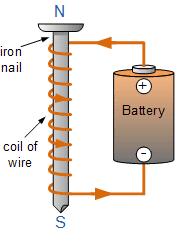
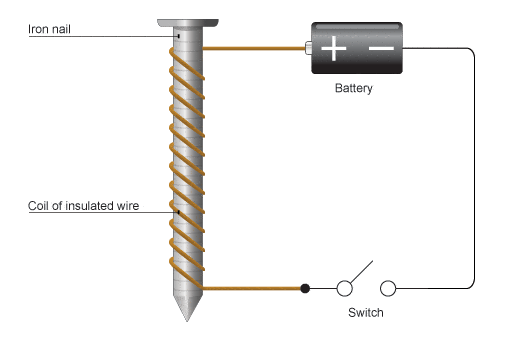
What is most likely to happen when the switch is closed?
a)
A magnetic field should be produced
b)
The nail will rust
c)
The battery will explode
d)
The wire will catch on fire
38.

What are the components of the electromagnets?

a)

battery, wire and bulb

b)

battery , copper wire and paper clips

c)

battery, copper wire and iron nail

d)

battery, wire and aluminum

39.

Which part of the electromagnets turned into a magnet when electricity flows through a coiled wire?

a)

Battery

b)

Copper wire

c)

Iron Nail

d)

Bulb

40.

Electric currents produce _____________

a)

electron clouds

b)

magnetic fields

c)

sound waves

41.
Surrounding every magnet is a __________  __________.
a)
magnetic field
b)
electrical current
c)
another magnet
d)
an enemy
42.

What type of magnet that can turned on and off?

a)

electromagnet

b)

permanent magnet

c)

electricity

d)

battery

43.

To make this electromagnet stronger you could:

a)

use less wire

b)

have fewer wire coils around the nail

c)

have more wire coils around the nail

d)

use a plastic core

44.
A compass needle responds to a magnetic field, because the compass needle is a
a)
A. generator.
b)
B. motor.   
c)
C. magnet.
d)
D. transformer.
45.
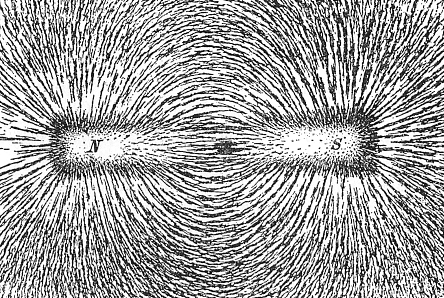
Are the magnetic field lines in the picture correct?
a)
Yes, because they point from north to south.
b)
No, because they point from north to south (they're supposed to go the other way).
c)
Yes, because the North pole is on the left in all pictures.
d)
No, because the North pole is on the left in all pictures (it's supposed to be on the right).
46.
Why does a compass needle point north?
a)
The compass is a bar magnet
b)
Because north is up
c)
Because it's magic
d)
It lines up with the Earth's magnetic field
47.

How are electromagnets different from permanent magnets?

a)

magnets can be turned on/off

b)

you can turn an electromagnet on/off

c)

magnets are more powerful

d)

magnets have a North and South pole

48.

What conclusion can you draw from this graph?

a)

As current increases, magnetic strength decreases.

b)

As current increases, magnetic strength increases.

c)

As current decreases, magnetic strength increases.

d)

There is no relationship between current and magnetic strength.

49.
If a magnet attracts a paperclip, the paperclip must be made of __________.
a)
plastic
b)
rocks
c)
copper
d)
iron
50.
What is true about magnets and electromagnets?
a)
Magnets are attracted to wood
b)
Magnets do not attract other magnets
c)
Magnets repel objects that are made of iron
d)
Magnets have a north pole and a south pole