
 Worksheets
Data Cloud cert prep
Total questions: 114
Worksheet time: 1hrs 18mins
Data Cloud can be used for? (Select all that apply)
Harmonizing data into a dtandard data model
Unifying profiles
Disaster recovery tool
Golden record creation
Which standard profiles can generate segments and activate data in Data Cloud? Select all that Apply
Data Cloud Marketing Admin
Data Cloud for Marketing Manager
Data Cloud Admin
Data Cloud User
Data Cloud Data Aware Specialist
Which permissions are required to expose a Salesforce Object to Data Cloud? Select all that apply
View all
Ready
Modify
Create
What are the core pillars of Data Cloud capabilities?
Connect, Harmonize, Unify, Analyze and Predict, Act
Import, Export, Query, Copy, Paste
Ingest, Augment, Network, Contain, Broadcast
Connect, Transpose, Unify, Accelerate, Act
Which are benefits of using data spaces? Choose two.
Manage user access to designated data spaces using permission sets.
Cross-brand unification.
Ensures your data doesn't cross regional boundaries.
Segregate your data, metadata, and processes by brand, region, or department.
Which of these are valid use cases for Data Cloud’s capabilities? Choose three.
Gain insights on data streams in real time and trigger follow-up actions.
Build complex segments of unified individuals with related data from multiple platforms.
Design, deploy, and deliver campaigns to any region with true 1:1 content recommendations.
Aggregate data from multiple systems to understand a customer’s true lifetime value across multiple accounts and devices.
Build simple segments of hierarchical identities with disparate data from one legacy system.
Which of these are key differentiators of Salesforce Data Cloud? Choose three.
Replaces the need to manage data anywhere else in your organization
User-friendly interface and built on Lightning
Focuses primarily on the financial services industry data
Integrates easily with Salesforce products and AppExchange
Uses the Customer 360 Data Model
What does “Connect” mean as a capability?
Identify and match individuals to create a unified profile.
Create smart segments and activate them anywhere.
Embed data with intelligence and make it available to analytics systems.
Synchronize data from Salesforce and external data sources and transform data when needed.
Which statements are true of Data Cloud platform functionality? Choose three.
It's an open platform that allows you to integrate external systems and data sources.
Data is only ingested in batches.
Data is transformed, cleaned, and harmonized into the standard data model.
Data storage has a maximum threshold.
Data can be activated in Sales Cloud, Marketing Cloud Engagement, Service Cloud, and other Salesforce clouds.
What does “Unify” mean as a capability of Data Cloud?
Consume or activate data to any cloud and any application.
Connect, match, and reconcile customer data.
Create smart segments and activate them anywhere.
Embed data with intelligence and make it available to analytics systems.
The overall system that governs a set of common data model objects, how to describe them, and their relationships.
(a)
A data source brought into Data Cloud.
(a)
A vast pool of raw data whose purpose is not yet defined.
(a)
A standardized piece of information about a DMO.
(a)
Which are data ethics best practices? Choose three.
Collect and use only what you need.
Treat sensitive data carefully.
Choose third-party partners carefully.
Avoid collecting sensitive data.
Collect large amounts of data and determine how to use it later.
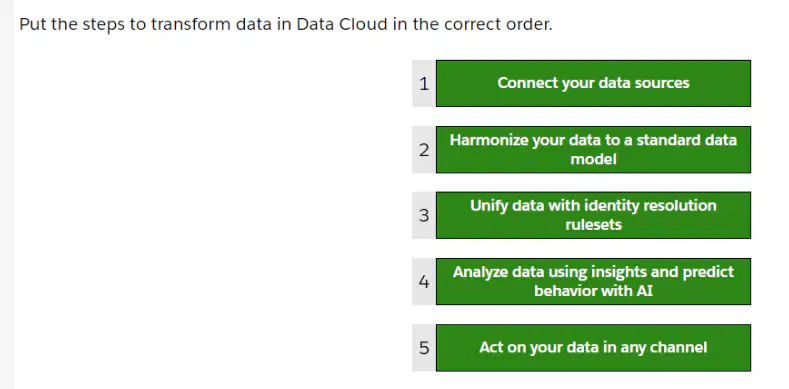
check the order
a
b
Which Permission Set can map data to the data model and create data streams, identity resolution rulesets, and calculated insights?
IT manager
Marketing Manager
Data Cloud Data-Aware Specialist
Data Cloud User
Which tab in the navigation manages the data coming into Data Cloud?
Segments
Data Streams
Activation
Data Model
When creating a data stream, what are the categories you must select from? Choose three.
Profile
Engagement
Other
First Name
What best practices lead to success when determining which data to initially bring in to Data Cloud? Choose two.
Complete a thorough data discovery phase.
Consider only data necessary to accomplish current use cases.
Bring in all of your data and sort it later.
Bring in data that overlaps first.
An inventory of all data sources.
(a)
Identifying sources of data that are relevant to what you want to accomplish.
(a)
View and validate the data that exists in your DMO's DLO's and Calculated Insights.
(a)
A portable and customized bundle of packagable metadata, created with Data Cloud.
(a)
A container for custom objects and metadata created with Package Manager.
(a)
The connections and associated data ingested into Data Cloud.
(a)
What is used to customize and organize Data Cloud Unified Individual Record Pages for surfacing insights?
Salesforce Metadata API
Sharing Rules
Lightning App Builder
Lightning Report Builder
Salesforce Flow
Managed Package
Contains a namespace
Typically used by ISVs on AppExchange
Upgradeable and supported
Unmanaged Package
Commonly used for one-time migration of metadata
Not upgradeable or supported
Developer has no control over the components once installed
Identify a typical use case for customizing and organizing the Data Cloud Unified Individual Record Page
You want only specific teams to view a specific record page.
You need to quickly surface insights relevant to your team.
You want to reduce potential metadata duplications.
You want to trigger an action when a change is made.
Which Data Cloud actions are available via Flow? Choose three.
Publish Calculated Insights
Map Data Model Object Fields
Publish Segments
Trigger Identity Resolution Job
Publish Streaming Insights
Which is a benefit of using a starter data bundle?
It bundles up all of your data into a managed package.
The data is pre-mapped to the Customer 360 Data Model and can be customized.
It automatically assigns permission sets to your users.
It identifies relevant data sources that you should consider using.
Data modeling occurs after which step when establishing the data model in the Data Cloud platform?
Activation
Ingestion
Segmentation
Identity Resolution
Put the data modeling steps in the correct order:
A. Create an inventory of all data streams.
B. Assess how data should be normalized.
C. Map to the data model.
D. Configure the DMO relationships of the data model.
The object that underpins the data stream.
(a)
The target destination for records from the data streams.
(a)
The system that provides data stewardship and governance across the enterprise.
(a)
Consolidates data from data sources through data lake objects.
(a)
How is the Individual Object referenced in other DMOs within a data model?
Via Individual.Id Attribute
Via Contact Point Identifier
Via Party Identification Object
Via Party Attribute
What do you do when datasets have fields that align to one DMO and another portion aligns to another DMO?
Denormalize the data
Create formula fields
Use a subscriber key value
Transpose the single records to multiple records
What are some of the supported ways that data from CRM can be brought into Data Cloud? Choose three.
CRM Objects
Data Bundles
CRM Reports
Data Kits
Big Objects
When setting up the data source object or schema corresponding to the data set that you’re importing, which category would you select when bringing sales order data?
Profile Data
Party Data
Other Data
Engagement Data
How frequently can CRM data be refreshed in Data Cloud?
Every 12 hours
Every 24 hours
Every hour
Every 15 minutes
Can an object be ingested more than once?
Yes
No
Which type of data model is ideal for ingesting into Data Cloud?
Normalized Data Model
Fragmented Data Model
Denormalized Data Model
Standardized Data Model
Which of the following terms refers to a repository of all types of enterprise data, including raw copies of source system data and transformed data?
Database
Data Lake
Metadata
Which of the following use cases is intended for Data Cloud?
Sending marketing communications
Personalizing website experiences
Building smarter audience segments
Which of the following Data Cloud use cases is most applicable when tracking and following a customer’s communication preferences?
Consent Management
Data Unification
Delivery Management
Which of the following ethical best practices refers to limiting your use of data, especially when it comes to demographic, socioeconomic, behavioral, and transactional data?
Treat sensitive data carefully.
Collect and use only what you need.
Use and collect individual information appropriately.
The process of mapping ingested data into the Customer 360 Data Model
(a)
The location where a segment's data is being sent during activation
(a)
The connections and associated data ingested into Data Cloud
(a)
The ability to query data and split it out into groups based on different attributes or characteristics
(a)
Data modeling occurs after which step when establishing the data model in the Data Cloud platform?
Activation
Ingestion
Segmentation
Identity Resolution
What reconciliation rule specifies that the value from the most recently updated record must be selected for inclusion in the unified profile?
Last updated
Source sequence
Most occurring
Oldest record
When using match rules with Individual Attributes and contact points, you risk creating combinations of records when the same contact point (such as a shared business phone number) is used across several individuals. What should you do to prevent this from happening?
Include many attributes and contact points.
Avoid using match rules with Individual Attributes and contact points, since this is not a recommended practice.
Set up match rules with a single connected contact point.
Ensure names are included into the rules.
After the Identity Resolution process completes, what should you examine to validate the Identity Resolution ruleset outcome?
Last Modified Date attribute
Bi-directional ruleset
Resolution Summary
Known Unified Profiles figure
Move the steps of the Identity Resolution process into the correct order:
A Profile data across data sources.
B Configure match rules.
C Configure reconciliation rules.
D Validate results.
The unification process recognizes and matches data belonging to individual humans. Which of the following is the end result of this process?
The matched data appears as records mapped to Individual Data Model Objects (DMO).
This data produces a map allowing your organization to pinpoint all its customers’ locations.
This data produces a map allowing your organization to pinpoint all its customers’ locations at any given point in time.
The matched data creates within Marketing Cloud a separate object for each piece of data from customers.
Which match rules are available to link multiple records into a unified customer profile? Choose three.
Exact Device and Name
Exact org ID
Exact name and email
Exact email
Exact phone number
Which of the following are true of match rules? Choose three.
They establish criteria for relating source Individual records to each other.
They produce a record called Unified Individual.
They make use of most standard and custom attributes mapped to the data model.
They can only be used with standard attributes mapped to the data model.
Which of the following are true of anonymous profiles? Choose two.
Once at least one known individual profile is matched with an anonymous record, that record will be marked as known going forward.
A source profile without the Is Anonymous field mapped on the Individual DMO is always considered anonymous.
For anonymous profiles to be counted correctly, the value of the Is Anonymous field must be set to 0.
They’re excluded from the known profile utilization consumption.
Fuzzy match methods are not available for fields from which object?
Individual
Account
Contact Point Phone
Contact Point Address
Records from your source data streams that Data Cloud reviews to identify matching profiles.
(a)
Stores information related to unified profiles and can be related to many unified contact points.
(a)
Contains match and reconciliation rules that tell identity resolution how to match and reconcile your source profiles.
(a)
Customer data that has been reconciled across multiple sources as a single record using identity resolution rulesets.
(a)
How data is processed and reviewed during matching.
(a)
Tells Data cloud which profiles to unify during the identity resolution process.
(a)
A metric that shows how source profiles are grouped from unified profiles.
(a)
Data Ethics Best Practices
Use and collect individual information appropriately.
Provide clear exchange of value for data.
Treat sensitive data carefully.
Collect and use only what you need.
Choose third-party partners carefully.
(a)
Which step in a segment configuration defines the target entity on which the segment builds?
Publish Schedule
Segment On
Population
Containers
Which attributes in the attribute library have a one-to-many relationship with the segment target?
Related attributes
Direct attributes
Profile attributes
Engagement attributes
Attributes with what data type support Value Suggestion?
Number
Text
Date
All types
What Entity type can be used to "Segment On" in Segmentation?
Profile
Engagement
Other
Profile and Engagement
Profile and Engagement and Other
How can you view details on Segment Membership and who are all in a specific segment?
Open the Segmentation Canvas and see details on who is in a specific Segment
Download the Segment Membership data via the ‘Download’ feature
It is not possible to see details on Segment Membership
View the Segment Membership DMO data via Data Explorer
Which Data Cloud feature helps calculate reusable attributes like Customer Lifetime Value and Customer Satisfaction Score?
Segments
Calculated Insights
Einstein Score
Tableau Connector
Which type of insight is best suited to analyze clickstream data every five minutes?
Calculated Insights
Streaming Insights
Einstein Insights
Insightful Insights
When are Activation Targets created?
Before setting up an activation
Before creating a segment
After setting up an activation
After publishing a segment
What are the types of activations in Data Cloud? Choose two.
Enablement activations
Segment activations
Connector activations
Data actions
Where do you define the location where you want to use your segment?
Calculated Insights
Segment
Activation Target
Activation
How are Calculated Insights added to an Activation?
As an activation target
As an additional attribute
As a contact point
When you set the activation membership
Which are Activation best practices? Choose two.
If you have data from multiple data sources in Data Cloud, default to using the Unified Individual as the Activation Membership.
Always share your data with a third-party partner.
If you have a large number of Data Cloud audiences, publish at the same time each day.
If you have a large number of Data Cloud audiences, stagger your scheduled publish times.
What is the difference between filtering in a segment and an activation?
In a segment, filters narrow your audience. In an activation, filters narrow down relevant values with related attributes that personalize messages.
In an activation, filters broaden your audience. In a segment, filters provide more relevant values with related attributes that personalize messages.
In an activation, filters narrow your audience. In a segment, filters narrow down relevant values with related attributes that personalize messages.
In a segment, filters narrow your audience. In an activation, filters broaden relevant values with related attributes that personalize messages.
Which are examples of Data Cloud objects you can share via data shares? Choose three.
Data lake object
Data model object
Zero Copy object
Permission sets object
Calculated insight object
Which three permission sets allow a user to manage and set up data streams?
Data Cloud Marketing Admin, Data Cloud Marketing Manager, Data Cloud Marketing Specialist
Data Cloud Admin, Data Cloud Marketing Admin, Data Cloud Data Aware Specialist
Data Cloud User, Data Cloud Admin, Data Cloud Marketing Manager
What categories can a user configure for a data stream?
Profile, Engagement, Other
First Party, Third Party
Contact Point, Individual, Party
Which of the following is a valid use of implementing multiple Data Spaces?
Your data has residency requirements, and you need to ensure data does not cross regional boundaries.
Your business has multiple brands and users need to work on data only in the context of their brand.
Your goal is to run analytics across multiple brands and unify segmentation.
What can be packaged using data kits in Data Cloud?
Test data, sample data
Identity Resolution Rulesets
Data Streams, Data Models, Calculated Insights
A logical partitioning of data within a single DC instance
(a)
Used to package data streams, model objects and insights. Used to package and redeploy assets.
(a)
Contains all functionality with Data Cloud. Requires Salesforce administrator role to be able to access Data Cloud Setup
(a)
A data specialist wishes to aggregate data from a data lake object and then split the results into two separate data lake objects. What tool should they use?
Streaming Insight
Calculated Insight
Batch Data Transform
A data specialist, from a large retail brand that operates in 80 countries worldwide, wishes to take their customer’s country data and derive the region from it. What action should they take?
Create a data stream with a mapping of the country with its region, and create a relationship with the individual via the country.
Use formula fields to automatically classify a country to its region.
Create a streaming data transform to automatically calculate the region of the country when the data is ingested.
Which of the following attributes are valid to map to party identification as a unique identifier?
Order number
Birthdate
Driver’s license number
Which of the following identity resolution functions can be adjusted if the number of unified profiles is much higher than originally anticipated?
Reconciliation rules
Match rules
Create a new ruleset
Which of the following serves as the connection between the source data and unified objects?
Unified Individuals
Unified Link Objects
Identity Resolution Rulesets
Which feature contains match and reconciliation rules that specify how to link multiple sources of data into a unified profile?
Rulesets
Ruleset Jobs
Unified Profiles
Which metric is most helpful in determining the cleanliness of your data sources when using Identity Resolution?
Summary by Source
Consolidation Rate
Profile Explorer
Identity Resolution requires which type of relationship in the data model for Contact Point objects?
Many:1
1:1
Many:Many
Your company uses Salesforce Data Cloud for identity resolution. When creating a segment to target high-value customers, which of the following is the most appropriate segment target object?
Account
Unified Individual
Individual
Which data model object (DMO) is most relevant for analyzing the historical membership of a segment in Salesforce Data Cloud?
The Latest Segment Membership DMO
A custom data model object you created for the segment
The Historical Segment Membership DMO
You want to target a new audience similar to your existing customers who frequently buy camping equipment. Which type of Salesforce Data Cloud segment is best suited for this purpose?
Einstein Segment
Standard Segment
Einstein Lookalike Segment
While building a segment on the Data Cloud canvas, you want to filter based on a customer's recent purchase history. What type of attribute is most appropriate to use?
Related Attribute
Direct Attribute
Calculated Insight
A business wants to improve service by alerting support when a customer visits multiple troubleshooting pages within a specific time frame. Which Data Cloud target should they use to automate creating a support case?
Data Model Object
Webhook
Salesforce Platform Event
If a customer searches for an "installation manual" after a purchase, how should a company configure Data Cloud to automatically send installation instructions?
Salesforce CRM Enrichment
Marketing Cloud Data Action Target
Data Action with Flow Builder
A company wants to automate a process when data records change in Data Cloud. What should they create in Salesforce to achieve this automation?
Flow in Data Cloud
Custom Field
Custom Object
To resolve webhook data action target errors where events aren't coming through, what is the first thing you should check?
Confirm a secret key is present.
Generate a new API name for the webhook.
Check the data record change event selection.
Remember the order
A. Connect
B. Harmonize
C. Unify
D. Analyze and predict
E. Activate
What Data Cloud can be used for? (select all that apply)
Presenting Data through a Common Data Model
Backup and disaster recovery
Generating a golden Record
Unifying customer profiles
Reverse ETL
Which Standard permission sets enable generation of segments and activation of data in data cloud? (Select all that apply)
Data Cloud User
Data Cloud for Marketing Admin
Data Cloud for Marketing data Aware Specialist
Data Cloud for Marketing Manager
What object permissions are required to enable data ingestion from Salesforce CRM? (Select all that apply)
Read
View all
Edit
Create
Modify all
Which data sets are ingested via Marketing Cloud starter Data Bundle?
MobilePush
Email Studio
Data Extensions
MobileConnect
system Data Views
Data Cloud is
Data Lake
Data Lakehouse
Data Warehouse
CRM

