
 Worksheets
5. Identifying Joints
Total questions: 24
Worksheet time: 21mins
Types of joints:
No cavity, slightly moveable
(a)
Types of joints:
Connected by cartilage. Movement varies from joint to joint
(a)
Types of joints:
Most movement
(a)
Ball-and-socket joints, plane (or gliding) joints, pivot joints, hinge joints, saddle joints, and condylar joints are all free moving, and examples of (a) joints.

Which synovial joint is shown here?
plane (carpals and tarsals)
ball and socket (hip and shoulder)
hinge (elbow and knee)
condylar (wrist, toes and fingers)
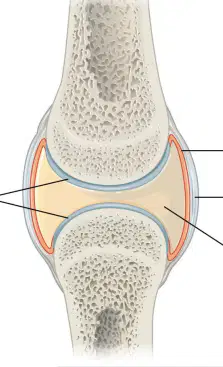
The blue depicts:
Articular cartilage
Synovial layer (of joint capsule)
Fibrous layer (of joint capsule)
Joint cavity (with synovial fluid)
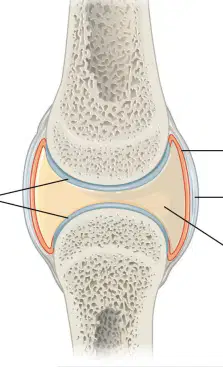
The red depicts:
Articular cartilage
Synovial layer (of joint capsule)
Fibrous layer (of joint capsule)
Joint cavity (with synovial fluid)
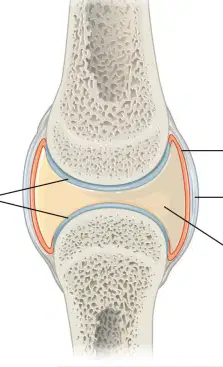
The yellow depicts:
Articular cartilage
Synovial layer (of joint capsule)
Fibrous layer (of joint capsule)
Joint cavity (with synovial fluid)
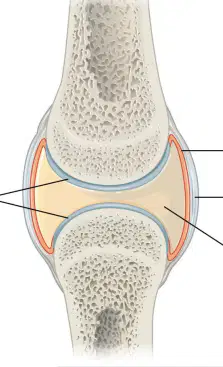
The grey surround depicts:
Articular cartilage
Synovial layer (of joint capsule)
Fibrous layer (of joint capsule)
Joint cavity (with synovial fluid)
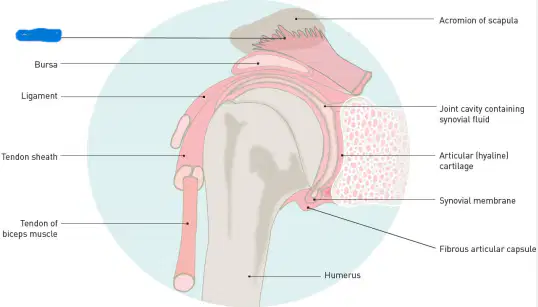
Identify the blank synovial joint feature:
(a)
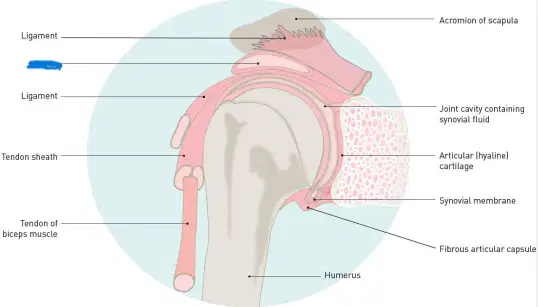
Identify the blank synovial joint feature.
(a)
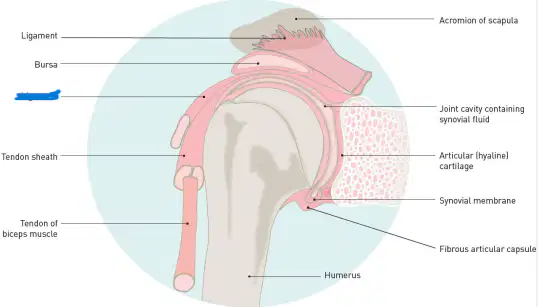
Identify the blank synovial joint feature.
(a)
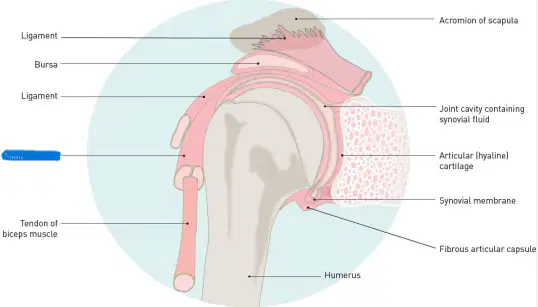
Identify the blank synovial joint feature.
(a)
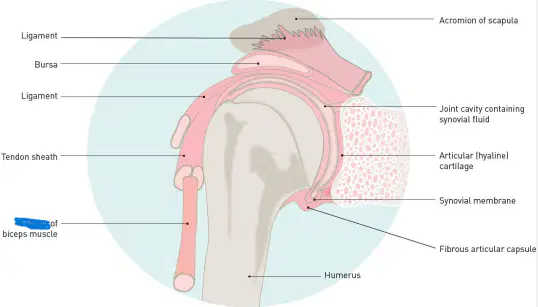
Identify the blank synovial joint feature.
(a)
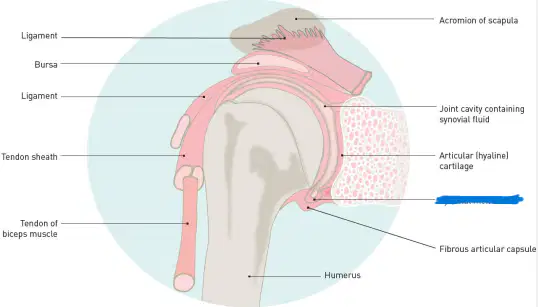
Identify the blank synovial joint feature.
(a)
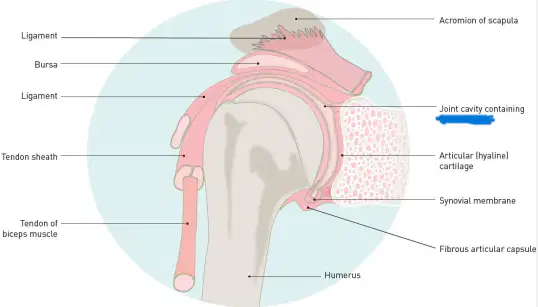
Identify the blank synovial joint feature.
(a)
Joint structure terminology:
This surrounds the joint and is attached to the articulating bones.
(a)
Joint structure terminology:
This is the surface that is in direct contact with the two bones as they move.
(a)
Joint structure terminology:
Synovial fluid provides four key functions:
Decreases friction between joints
Provides nourishment for the articular cartilage
Contains phagocytic cells that remove micro-organisms and debris from joint capsule wear and tear
Forms a fluid cushion acting as a shock absorber for impact
Joint structure terminology:
Small, fluid-filled sac which acts as a cushion between muscles, ligaments and bones and allows structures to move with ease and with minimal friction.
(a)
Joint structure terminology:
Ring of fibrocartilage around the edge of the articular (joint) surface of a bone.
(a)
Joint structure terminology:
Crescent-shaped wedges of fibrocartilage that provide increased stability to the joint when moving.
(a)
Joint structure terminology:
Fibrous connective tissue that attaches bone to bone, and usually serves to hold structures together and keep them stable.
(a)
Joint structure terminology:
Fibrous connective tissue that attaches muscle to bone and serves to move the bone at a particular joint.
(a)

