
 Worksheets
COS 1 & 2 Honors Government
Total questions: 44
Worksheet time: 22mins
Name
Class
Date
1.
Of the 55 representatives present at the ratification of the U.S. Constitution, how many signed off on it?
a)
55
b)
39
c)
35
d)
29
2.

Shay's Rebellion showed the weaknesses of the Articles of Confederation... how?
a)
Under the Articles the U.S. could not pay a standing army due to no taxation
b)
The U.S. had no court system
c)
The U.S. could enforce international treaties
d)
The U.S. was broke after the French and Indian War
3.
Which one was NOT a weakness of the Articles of Confederation?
a)
The government could tax its citizens
b)
The government could not enforce treaties
c)
Congress could not regulate trade
d)
No court system
4.
T or F: No other government at that time had been founded on the principles of human liberty and the consent of the governed until the Declaration of Independence.
a)
True
b)
False
5.
Who is known as the "father of the Constitution"?
a)
George Washington
b)
Ben Franklin
c)
James Madison
d)
Alexander Hamilton
6.
This plan consisted of getting rid of the Articles of Confederation all together. What plan was this?
a)
Virginia Plan
b)
New Jersey Plan
c)
None
7.
Who took a lot of what John Locke believe in and wrote the Declaration of Independence?
a)
Thomas Jefferson
b)
James Madison
c)
Alexander Hamilton
d)
John Jay
8.
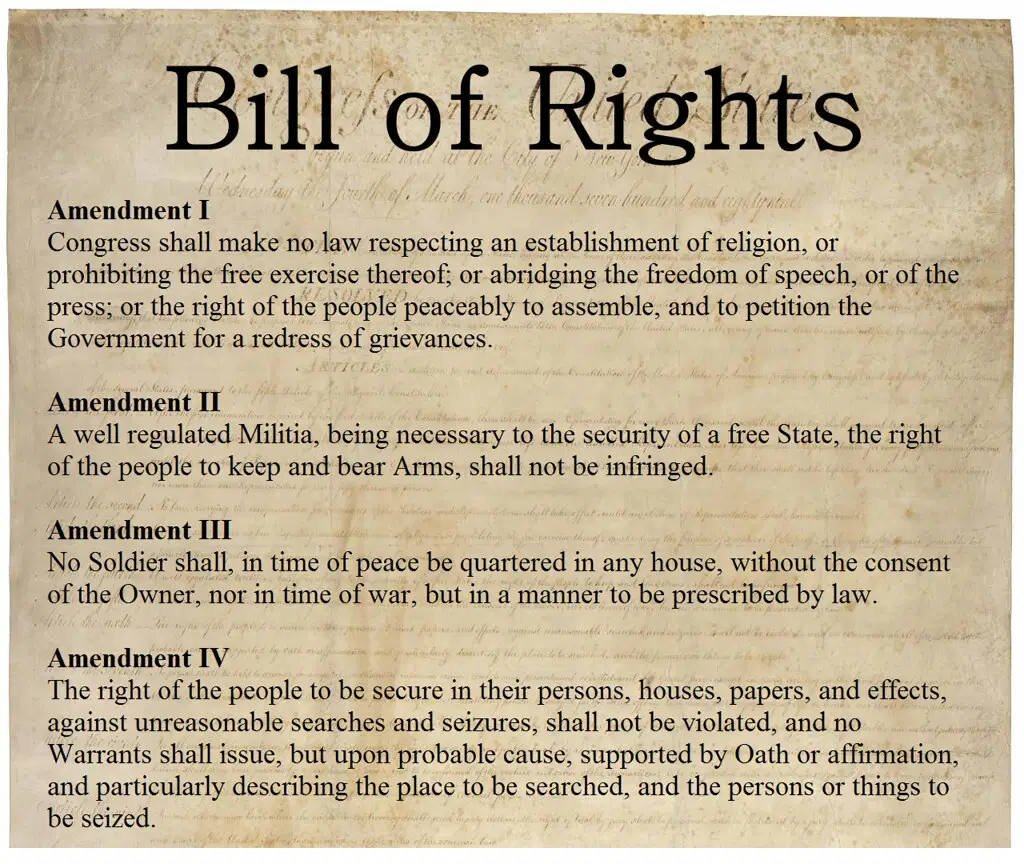
The Bill of Rights had to be added to the Constitution before who would give their approval?
a)
Federalist
b)
Anti-federalist
c)
none of the above
9.
Which one is NOT a complaint the colonists had against England?
a)
Having an unfair amount of representatives (few) in Parliament
b)
Quartering of British soldiers
c)
Having to pay for the French and Indian War
d)
Stamp Act- 1st direct tax on the colonists
10.
Making a decision to boycott British goods and rally up colonial militia was decided where?
a)
1st Continental Congress
b)
2nd Continental Congress
c)
Constitutional Convention
d)
House of Burgesses
11.
Where was it decided that George Washington would become the leader of the Continental Army?
a)
1st Continental Congress
b)
2nd Continental Congress
c)
Constitutional Convention
d)
House of Burgesses
12.
He wrote, that in a "state of nature," no government existed. Without an authority to protect people from one another, life was "nasty, brutish, and short." People needed to surrender to the state in order to maintain order. Who is he?
a)
Montesquieu
b)
Hobbes
c)
Rousseau
d)
Locke
13.
A form of government in which state authority is imposed onto many aspects of citizens' lives.
a)
Constitutional
b)
Leviathan
c)
Libertarian
d)
Authoritarian
14.
The first agreement for self-government in America, signed in 1620. It was signed by the 41 men on a famous ship and set up a government for the Plymouth Colony.
a)
Plymouth Compact
b)
Mayflower Compact
c)
Declaration of Sentiments
d)
Leviathan Compact
15.
Hobbes wrote _, a book defending the right of the king to rule as part of the social contract with his subjects.
a)
Ex Post Facto
b)
Wealth of Nations
c)
Leviathan
d)
The Spirit of the Laws
16.
The royal charter of political rights given to rebellious English barons by King John in 1215. It stated that even the king was not above the law.
a)
Ex Post Facto
b)
In Vino Veritas
c)
Magna Carta
d)
Noble Savages
17.
King William and Queen Mary accepted this document in 1689. It guaranteed certain rights to English subjects and declared that elections for Parliament would happen frequently. By accepting this document, they supported a limited monarchy, a system in which they shared their power with Parliament and the people.
a)
Magna Carta
b)
English Bill of Rights
c)
Petition of Right
d)
The Constitution
18.
A document prepared by Parliament and signed by King Charles I of England in 1628; it challenged the idea of the divine right of kings and declared that even the monarch was subject to the laws of the land.
a)
Petition of Right
b)
Magna Carta
c)
English Bill of Rights
d)
The Social Contract
19.
The theory that holds that the people of an area form an agreement on the rules of conduct and political life.
a)
Utilitarianism
b)
Social Contract Theory
c)
Unified Field Theory
d)
Libertarianism
20.
__________ ___________ have generally large corporations and advanced technology that provide a more comfortable way life. The United States, Japan, England, and Canada are examples of this.
a)
Industrialized Nations
b)
Developing Nations
c)
Underdeveloped Nations
21.
The organization that exercises authority over an area.
a)
Corporation
b)
Firm
c)
Government
d)
Anarchy
22.
Hobbes' idea shifted the authority of the king from the sacred (religious) theory of the _ to the secular (non-religious) social contract theory. Locke's writing in opposition to this idea ended it as a credible political theory in Britain.
a)
social contract theory
b)
divine social contact
c)
divine right of kings
d)
divine acceptance of Kinsaul
23.
A type of government in which a small group holds power. This group gets its power from wealth, military, social position, or a combination of these elements.
a)
Democracy
b)
Oligarchy
c)
Autocracy
d)
Republic
24.
Everyone's vote carries the same weight- a principle often expressed as.... what?
a)
majority rule with minority rights
b)
one person, one vote
c)
Endo v. United States
d)
Fair Elections
25.
Religious revival in the American colonies of the eighteenth century during which a number of new Protestant denominations were established. It undermined traditional authority in the American Colonies.
a)
The Great Awakening
b)
The Articles of Confederation
c)
The Great American Tent Revival
d)
Voltaire's Crusade
26.
_____ is the idea that people can work for economic gain and that wealth should be used aggressively. Competition is key! Government must maintain the free market.
a)
Socialism
b)
Capitalism
c)
Communism
27.
______ is where the government owns the basic means of production, determines the use of resources, distributes the products and wages, and provides social services such as education, healthcare, and welfare.
a)
Socialism
b)
Capitalism
c)
Communism
d)
Rule of Law
28.
_____ ______ was a socialist thinker and writer who wanted violent revolution. He said the capitalist system would collapse. He said the ruling capitalist class would use their economic power to force their will on workers.
a)
Adam Smith
b)
Karl Marx
c)
John Locke
d)
Thomas Hobbes
29.
A government that seeks to subordinate the individual to the state by controlling not only all political and economic matters, but also the attitudes, values, and beliefs of its population.
a)
Libertarian
b)
Magna Carta
c)
Enlightened
d)
Totalitarian
30.
John Locke's thesis on natural rights (life, liberty, property) and the purpose of just government. He also refutes the divine right of kings theory.
a)
Virginia Declaration of Rights
b)
The Wealth of Nations
c)
Two Treatises on Government
d)
The Social Contract
31.
Characteristics of a democracy include individual liberty, majority rule with minority rights, ____ _____, and competing political parties.
a)
social contract
b)
free elections
c)
failing economy
d)
class system
32.
"We the people of the United States, in order to form a more important union..." is a statement at the beginning of our Constitution that sets forth our goals and purposes to be served by the government. What is this statement called?
a)
preamble
b)
law
c)
rule of law
d)
social contract
33.
What are the essential features of a state? ______, territory, sovereignty, and government.
a)
money
b)
security
c)
population
d)
divine right
34.
The idea that GOD wanted a ruler to be king/queen.
a)
divine right
b)
absolute power
c)
petition of right
d)
social contract
35.
_ argued that if the monarch failed to protect the natural rights of the people they should rebel and select a new ruler.
a)
Hobbes
b)
Voltaire
c)
Locke
d)
Adam Smith
36.
A movement in the 18th century that advocated the use of reason in the reappraisal of accepted ideas and social institutions.
a)
Magna Carta
b)
The Illuminati
c)
The Renaissance
d)
The Enlightenment
37.
The condition of absolute freedom that exists when there is no government or law.
a)
State of Decay
b)
State of Nature
c)
Social Contract
d)
Noble Savagery
38.
A communist dictatorship ruled by the Kim Dynasty known for human rights abuses and threats against the United States, Japan, and South Korea.
a)
North Korea
b)
Iran
c)
Thailand
d)
China
39.
The principle that the law applies to everyone, even those who govern.
a)
The Spirit of the Laws
b)
Rule of Law
c)
Civil Rights
d)
The Social Contract
40.
Something related to or consistent with the highest law of a nation.
a)
Constitutional
b)
Legal
c)
Contractual
d)
Utilitarian
41.
What is an agreement between people and the government?
a)
Consent
b)
Natural Rights
c)
Social Contract
d)
Voting
42.
This is the idea that "the people" give the government power to protect their natural rights and must live by the rules?
a)
Separation of Powers
b)
Social Contract
c)
Checks and Balances
d)
Rule of Law
43.
According to the Social Contract theory ...
a)
government emerged when all the people of an area were brought under the control of one person or group
b)
Government emerged from family
c)
People give up some of their natural rights in order to receive protection
d)
A person gains the authority to govern because a god or group of gods gave them that power
44.
An agreement b/w people and gov’t in which citizens consent to be governed so long as the gov’t protects their natural rights.
a)
social contract
b)
elite democracy
c)
republicanism
d)
popular sovereignty
100 %

