
 Worksheets
Pharmaceutical Organic Chemistry - II Quiz
Total questions: 70
Worksheet time: 37mins
Which of the following statement is incorrect about electrophiles?
Electrophiles are positively charged or neutral species having vacant orbitals
The electrophiles are attacked by the most electron-populated part of one nucleophile
Chemical species that do not satisfy the octet rule such as carbenes and radicals are electrophiles
Electrophiles are Lewis base
Identify the correct sequence according to electronegativity.
F > NH2 > CH3 >OH
NH2 > F >CH3 > OH
NH2 > OH > CH3 > F
F > OH > NH2 > CH3
Toluene and phenol have similar boiling points.
True
False
Which reducing agent is used for the reduction of nitro compound to phenyl amine?
LiAlH4
Sn/HCl
Na/alcohol
H2/Ni
In which of the following reactions does amide get converted to amine?
Claisen
Hoffmann
Kekule
Perkin
Phenol is obtained by heating aqueous solution of which of the following?
Aniline
Benzene diazonium chloride
Benzoic acid
Benzyl alcohol
Which of the following aromatic compounds undergo Friedel-Crafts alkylation with methyl chloride and aluminum chloride?
Benzoic acid
Nitrobenzene
Toluene
Aniline
Which of the following groups stabilize carbocation in the electrophilic aromatic substitution reaction: -, - - -
NO2
CN, SO3H
COOH, -CHO
-NH2, -OH
What will be the product formed when phenol reacts with Br2 in CCl4 medium?
3-Bromophenol
4- Bromophenol
3,5-Dibromophenol
2,4,6-Tribromophenol
What is the electrophile in the electrophilic substitution reaction of benzene using oleum and conc. H2SO4?
SO3
NO3
NO2+
NO+
Which of the following compound is yielded from the reduction of nitroalkanes?
Amine
Acid
Diazo compounds
Alcohol
Which of the following is not an electrophile?
(CH3)4N+
Cl2
HBr
Br2
What is the electrophile in the acylation of benzene?
AlCl3
CO+
Cl+
R-CO+

What will be the attacking electrophile in this reaction?
Carbanion
Halonium
Radical
Transition state
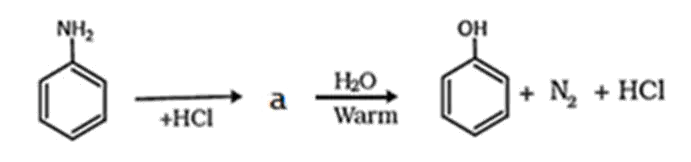
Which of the following will be the product 'a' in the given reaction?
Chlorobenzene
Benzene
Benzene diazonium chloride
Enolate form
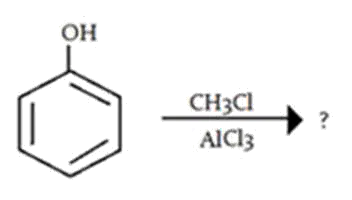
What will be the product in the given reaction?
m-chlorophenol
o-chlorophenol and p-chlorophenol
o-hydroxytoluene and p-hydroxytoluene
m-hydroxytoluene

How would you synthesis the following reaction?
conc. HNO3 + conc. H2SO4
conc. HNO3
anhydrous AlCl3 + Ph-NO2
conc. H2SO4 + Oleum

Which of the following is most readily undergo electrophilic attack?
I
II
III
IV

Which of the following reactants can be used to carry out following reaction?
conc. HNO3 + conc. H2SO4
HCl + CO + AlCl3
anhydrous AlCl3 + Ph-NO2
conc. H2SO4 + Oleum
Which of the following organic compound is formed when aniline reacts with acetaldehyde?
Diazonium salt
Immine
Schiff's base
Carbylamine
Which of the following is the most activating in electrophilic aromatic substitution?
-NO2
-NHCOCH3
-CN
-NH2
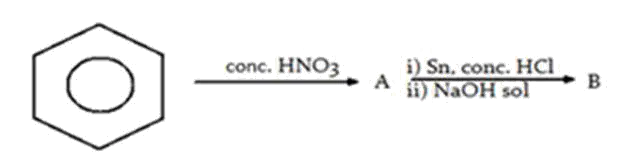
What are A and B in the given sequence, respectively?
Aldehyde, nitro compound
Nitro compound, phenyl amine
Phenyl amine, nitro compound
Phenthalene, phenyl amine
What is the reagent which will react with cumene to give phenol?
Oxygen
Hydrogen
Nitrogen
Ozone
How is carbolic acid prepared from benzene diazonium chloride?
Treating it with nitrous acid at 275K
Preparing an aqueous solution and warming it
Treating it with sodium hydroxide
Freezing it
Resonance forms are in equilibrium with each other.
True
False
Aromatic rings do not have resonance structures.
False
True
Identify the incorrect statement regarding aromaticity.
It is the extra stability possessed by a molecule
p-orbitals must be planar and overlap
Cyclic delocalization takes place
It does not follow Huckel's rule
On heating aqueous solution of benzene diazonium chloride, which of the following is formed?
benzene
chlorobenzene
phenol
aniline
Stability sequence: primary carbocation > secondary carbocation > tertiary carbocation. Is this sequence correct?
Yes
No
Can a linear molecule have aromaticity?
Yes
No
Select the incorrect statement.
A resonance may sometimes cause sp3 atoms to become sp2 hybridized
Delocalizing one lone pair causes aromaticity
One lone pair will be counted as two pi electrons according to Huckel's equation
Two sigma bonds make up a double bond
Phenol can be obtained by ________ of sodium phenoxide.
acidification
oxidation
sulphonation
hydrolysis
Cumene hydroperoxide on hydrolysis with dilute H2SO4 gives
alcohol and phenol
only phenol
phenol and acetone
alcohol and acetone
What is the commercial method of preparation of phenol?
Dows process
From diazonium salt
By decarboxylation of salicylic acid
Hock method
Select the correct statement regarding the aromatic nitrogen molecule.
It is not hybridized
It is sp hybridized
It is sp2 hybridized
It is sp3 hybridized
Which of the following is necessary for the bromination of phenol?
CS2
FeBr3
AlCl3
BF3
Phenols are not soluble in which of the following?
Water
Alcohol
Ether
Sodium hydroxide
Which of the following phenols is the most acidic?
o-Cresol
m-Cresol
o-Nitrophenol
m-Nitrophenol
Reaction of aqueous sodium hydroxide on chlorobenzene gives which of the following products?
o-chlorophenol
o-chlorophenol
phenol
no reaction

Which ring will readily undergo electrophilic attack?
I
II
III
Both I and III
Sodium benzene sulphonate reacts with NaOH and then on acidic hydrolysis, it gives which of the following compound?
Phenol
Benzoic acid
Benzene
Disodium benzaldehyde
Salicylaldehyde can be prepared from which of the following reactants?
Phenol and chloroform
Phenol, chloroform and sodium hydroxide
Phenol, carbon tetrachloride and NaOH
Phenol, carbon tetrachloride
What is the reactant 'x' and 'y' that will react with benzene to give phenol?
X is Oleum and y is molten sodium hydroxide followed by H+
X is Oleum and y is HCl
X is Oleum and y is NH3
X is Oleum and y is water
Which of the following is not a method for preparation of phenol?
Dows process
From diazonium salt
By decarboxylation of salicylic acid
By the decarboxylation of sodium benzoate
Which of the following compounds is formed on the electrolytic reduction of nitrobenzene in presence of strong acid?
Azoxybenzene
Aniline
Azobenzene
p-aminophenol
When phenol is treated with excess of bromine water, it gives which of the following product?
m-bromophenol
o-and p-bromophenol
2,4-dibromophenol
2,4,6-tribromophenol
Phenol reacts with bromine in carbon disulphate at low temperature to give which of the following product?
m-bromophenol
o-and p-bromophenol
p-bromophenol
2,4,6-tribromophenol
Which of the following regents may be used to distinguish between phenol and benzoic acid?
Aqueous NaOH
Tollen's reagent
Molisch reagent
Neutral FeCl3
What is the major product obtained on interaction of phenol with sodium hydroxide and carbon dioxide?
Benzoic acid
Salicylaldehyde
Salicylic acid
Phthalic acid
Picric acid is formed when phenol react with which of the following reactant?
Formaldehyde
Hydrogen
Nitric acid
Hydrochloric acid
Aniline is less basic than
Benzylamine
Triphenylamine
p-Nitroaniline
Diphenylamine
Which of the following method cannot be used for preparation of aromatic amine?
Gabriel phthalimide synthesis
Reduction of nitro compound
Reduction of nitrile with LiAl4
Decarboxylation of amino acids

What is the known name of the reaction given below?
Gabriel phthalimide synthesis
Buchwald-Hartwig Reaction
Chan-Lam coupling
Ullmann reaction
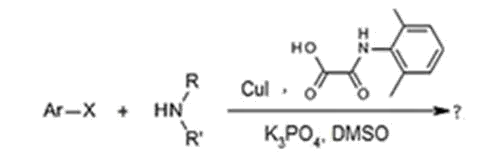
What will be the product for the following reaction?
secondary aliphatic amine
primary aromatic amine
tertiary aromatic amine
secondary aromatic amine

What will be the product in the given reaction?
m-chlorotoluene
o-chlorotoluene and p-chlorotoluene
1-chloro-3-methylbenzene
no reaction
Which of the following is the general formula of Diazonium salt?
RN2+HSO-2
RN2+X-
RN+
RXI
What is the industrial method of preparation of phenol?
Cumene process
From benzene diazonium chloride
By decarboxylation of salicylic acid
Williamson synthesis
Arrange the following in decreasing order of acidity.
a) Phenol > Methanol > Water
b) Methanol > Phenol > Water
c) Water > Phenol > Methanol
d) Methanol > Water > Phenol
Which reagent is used in the nitration of benzene?
a) H2SO4
b) HNO3
c) HCl
d) H3PO4

Which of the following is a tautomer of phenol?
a
b
c
d
Which of the following statements is incorrect about aromatic compounds?
They exhibit extra stability
p-orbitals must be planar and overlap
Cyclic delocalization occurs
They do not follow Huckel's rule
How can phenol be obtained from benzene diazonium chloride?
By treating it with nitrous acid at 275K
By preparing an aqueous solution and warming it
By treating it with sodium hydroxide
By freezing it
Which of the following is the correct product formed when benzoic acid reacts with bromine in the presence of FeBr3?
m-bromobenzoic acid
o-bromobenzoic acid
p-bromobenzoic acid
2,4,6-tribromobenzoic acid
What is the major product formed when salicylic acid undergoes electrophilic substitution with acetyl chloride in the presence of AlCl3?
o-acetylsalicylic acid
m-acetylsalicylic acid
p-acetylsalicylic acid
2,4,6-triacetylsalicylic acid
Which of the following substituents is most likely to decrease the acidity of benzoic acid?
-OH
-NH2
-NO2
-CH3
What is the major product formed when benzoic acid reacts with concentrated sulfuric acid at high temperature?
Phenol
Benzene
Salicylic acid
Toluene
Which of the following reactions is a characteristic test for benzoic acid?
Formation of a white precipitate with ferric chloride
Decolorization with bromine water
Liberation of carbon dioxide with sodium bicarbonate
Formation of a yellow precipitate with silver nitrate
What is the major product obtained when benzoic acid reacts with aqueous sodium bicarbonate?
Salicylic acid
Phenol
Benzoic acid
Benzoate ion
Which of the following substituents would increase the acidity of benzoic acid the most?
-CH3
-NO2
-OH
-NH2
What is the product formed when benzoic acid reacts with thionyl chloride?
Benzoic anhydride
Benzoic acid chloride
Salicylic acid
Phenol

