wayground logo

Free Printable Worksheets

NEW

Font size

S
M
L
XL
Worksheets

[Chem1] Test Review - Unit 3 Atomic Structure

Total questions: 51

Worksheet time: 2hrs 40mins

Name
Class
Date
1.

Has 2 neutrons and 2 protons?

a)
Alpha
b)
Beta
c)
Gamma
d)

Positron

2.
Has the symbol
a)
Alpha
b)
Beta 
c)
Gamma
3.
The splitting of a nucleus into smaller nuclei is
a)
fusion
b)
fission
c)
half-life
d)
gamma radiation
4.
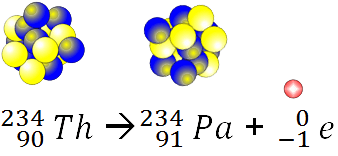
Which type of nuclear radiation is being emitted here?
a)
Alpha
b)
beta
c)
gamma 
d)
none
5.
How is nuclear fusion different from nuclear fission?
a)
In fusion, the product is a larger atomic nucleus.
b)
Fission produces energy but fusion does not.
c)
Fusion produces energy but fission does not.
d)
In fission, the product is a larger atomic nucleus.
6.

Nuclear fission of uranium-235 can start a chain reaction by

a)

releasing enough thermal energy to start nuclear fission in neighboring atoms

b)

producing two smaller atoms that can then strike and split neighboring atoms

c)

producing neutrons that can then strike and split neighboring atoms

d)

combining two atoms with low mass to form one large atom

7.
The three types of nuclear radiation in increasing order of penetrating power are ____.  
a)
  alpha, beta, gamma 
b)
X ray, beta, gamma
c)
alpha, gamma, beta 
d)
X ray, gamma, beta 
8.

Which element has 30 protons and 28 electrons?

a)

cerium

b)

nickel

c)

helium

d)

zinc

9.
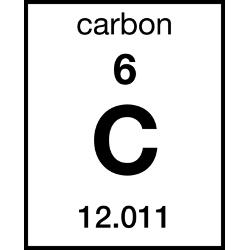
What does the 6 represent above the C
a)
Symbol 
b)
Name 
c)
Mass Number 
d)
Atomic Number 
10.
If an element has 6 protons, 7 neutrons, and 6 electrons, what type of charge does the element have?
a)
positive
b)
negative
c)
neutral
d)
imaginary
11.
How many protons does this isotope of titanium have?
a)
48
b)
22
c)
26
d)
70
12.
How many neutrons does this isotope of titanium have?
a)
48
b)
22
c)
26
d)
70
13.

Which subatomic particle has a positive charge?

a)

proton

b)

neutron

c)

electron

d)

midichlorian

14.

Which subatomic particle has a negative charge?

a)

proton

b)

neutron

c)

electron

d)

cybertron

15.

What is the center of an atom called?

a)

The headquarters

b)

The centrometer

c)

The hypothesis

d)

The nucleus

16.

The nucleus of an atom contains which subatomic particles?

a)

protons and electrons

b)

protons and neutrons

c)

electrons and neutrons

d)

protons, electrons, and neutrons

17.
What is the atomic number for an element with 41 neutrons and a mass number of 80?
a)
39
b)
41
c)
80
d)
121
18.

Adding or subtracting electrons changes the elements overall charge and makes the element change into an...

a)

ion

b)

mixture

c)

isotope

d)

neutral atom

19.

What is a particle with one positive charge called?

a)

proton

b)

electron

c)

neutron

d)

quark

20.
What do these isotopes of carbon all have in common?
a)
neutrons & mass number
b)
atomic number and neutrons
c)
atomic number and electrons
d)
protons, atomic number, and mass number
21.
Which particle does not contribute mass to the atom?
a)
Proton
b)
Neutron
c)
Electron
d)
Nucleus
22.
How many neutrons are in an atom with an atomic number of 20, an atomic mass of 45, and a charge of +2?
a)
20
b)
25
c)
2
d)
18
23.
4.35% of all X atoms have a mass of 39.946 amu. 83.79% have a mass of 41.941 amu, 9.50% have a mass of 42.941 amu, and 2.36% have a mass of 43.939 amu. What is the average atomic mass of atom X?
a)
41.97 amu
b)
42.19 amu
c)
10.43 amu
d)
40.04 amu
24.
An isotope has three forms.  30% have a mass of 4 amu, 20% have a mass of 5 amu and 50% have a mass of 3 amu.  Average atomic mass will be closest to
a)
2 amu
b)
3 amu
c)
4 amu
d)
5 amu
25.
Which of the following could have 82 neutrons?
a)
W-182
b)
Ta-181
c)
Cs-132
d)
Ba-138
26.
How many neutrons in C-14?
a)
6
b)
7
c)
14
d)
8
27.
24.1% of all the isotopes of a an element have a mass of 75.23 amu, 48.7% have a mass of 74.61 amu, and 27.2% have a mass of 75.20 amu.
What is the average mass of this element?
a)
74.92 amu
b)
24.97 amu
c)
75.01 amu
d)
74.51 amu
28.
Isotopes are atoms of the same element that have the same number of __________ but different number of __________ . Therefore, isotopes of the same element have different masses. 
a)
protons, neutrons
b)
protons, electrons
c)
neutrons, protons
d)
electrons, protons
29.

What is the "nuclide name" that goes in box R?

a)

neon-10

b)

neon-11

c)

neon-0

d)

neon-21

30.

What nuclide symbol goes in box N?

a)

b)

c)

d)

e)

31.

What number goes in box B?

a)

12

b)

13

c)

25

d)

0

32.

What number goes in box C

a)

12

b)

13

c)

25

d)

0

33.

What number goes in box D

a)

12

b)

13

c)

25

d)

0

34.

What number goes in box H

a)

32

b)

40

c)

72

d)

0

35.
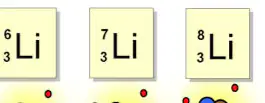
which atom has  4 neutrons?
a)
Li-6
b)
Li-7
c)
Li-8
d)
they have the same # of neutrons
36.

What is a positive ion called?

a)

anion

b)

cation

c)

isotope

d)

covalent

37.

What is a negative ion called?

a)

anion

b)

cation

c)

covalent

d)

isotope

38.

An atom with 2 protons, 3 neutrons, and 4 electrons has a charge of ____.

a)

+2

b)

-2

c)

+3

d)

0

39.

The % of the parent isotope remaining after 3 Half Lives.

a)

50%

b)

25%

c)

12.5%

d)

6.25%

40.
What makes something radioactive?
a)
elements with an atomic number above 81
b)
an unstable nucleus
c)
contaminated sewage
d)
It decays over time
41.

The % of the parent isotope remaining after 1 Half Life.

a)

50%

b)

25%

c)

12.5%

d)

6.25%

42.

A bone sample contains only 1/4 of its original radioactive C14 content. How old is the bone sample?

a)

1 C14 half-life

b)

2 C14 half-lives

c)

3 C14 half-lives

d)

4 C14 half-lives

43.
If 10 mg of iodine 131 is given to a patient, how much is left after 24 days? The half-life of iodine-131 is 8 days.
a)
1.25mg
b)
1.25g
c)
10g
d)
10mg
44.
The half-life of strontium-90 is 25 years. How much strontium-90 will remain after 100 years if the initial amount is 4.0 g?
a)
3.0g
b)
0.25mg
c)
0.3g
d)
0.25g
45.
What is Half-life?
a)
The amount of time it takes for some of the nuclei in a sample of the isotope to decay
b)
The amount of time it takes for half the electrons in a sample of the isotope to decay
c)
The amount of time it takes for half the nuclei in a sample of the isotope to decay
d)
the amount of time it takes to double the nuclei in a sample of the isotope to decay
46.
The half-life of Zn-71 is 2.4 minutes. If one had 100.0 g at the beginning, how many grams would be left after 7.2 minutes has elapsed?
a)
100.0g
b)
50.0g
c)
12.5g
d)
8.5g
47.
If the half-life of uranium-232 is 70 years, how many half-lives will it take for 10 g of it to be reduced to 1.25 g?
a)
1 half-life
b)
2 half-lives
c)
3 half-lives
d)
4 half-lives
48.
If the half-life of a radioactive group of atoms is 100 years, then how old is the rock if there have been two half-lives?
a)
25 years
b)
200 years
c)
400 years
d)
800 years
49.
Which radioactive isotope takes the greatest amount of time to undergo radioactive decay? 
a)
Carbon-14
b)
Potassium-40
c)
Uranium-238
d)
Rubidium-87
50.

What is the symbol for an positron particle?

a)

42He

b)

0-1e

c)

0+1 e

d)

10n

e)

00Y

51.

What is the symbol for an neutron?

a)

42He

b)

0-1e

c)

0+1 e

d)

10n

e)

00Y