
 Worksheets
1B Earth & Space
Total questions: 67
Worksheet time: 55mins
A system of gas, dust, many stars, and the objects that orbit those stars.
Galaxy
Solar System
Planet
Star

What is the name of our galaxy?
(a)
Why can one star appear brighter than another star?
shape
size
distance
temperature/color
It is closer to Earth than the other stars.

What are the basic components of a galaxy?
gas
dust
many stars
the objects that orbit a star
(a) a collection of gas, dust, many stars and the objects that orbit the stars.
The Inner Planets are...
hot
close to the sun
rocky
gas giants
cold

What are the Inner planets?
Select ALL that apply.
Mars
Venus
Mercury
Earth
Saturn
What orbits the sun in the area between Mars & Jupiter?
Keiper belt
Asteroid belt
The 4 Outer planets are (pick 2):
Gas Giants
Jupiter, Saturn, Uranus, and Neptune
Jupiter, Saturn, Uranus and Neptune, Pluto
Mercury, Venus, Earth and Mars
The 4 inner planets are (pick 2):
Mercury, Venus, Earth, and Mars
Mercury, Jupiter, Earth, and Venus
Jupiter, Saturn, Uranus and Neptune
the Rocky Planets
They are terrestrial and have rocky surfaces.
Inner Planets
Outer Planets
Both

The Outer Planets...
are large
far away from the sun
have rings
cold
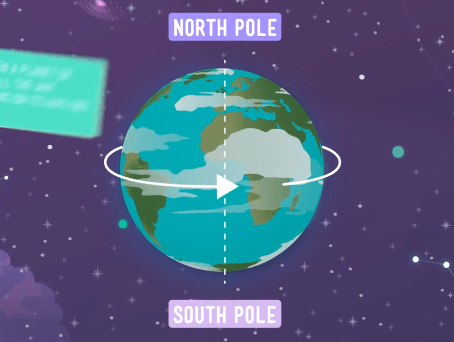
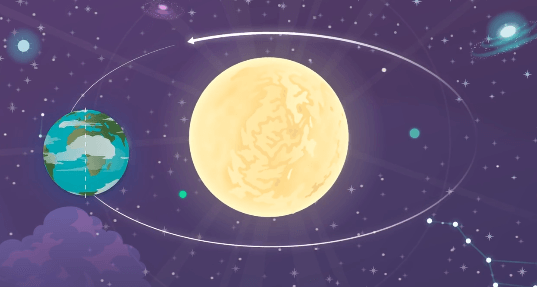
Earth's rotation causes
shadows to appear to move
day and night
apparent movement of the Sun
a year

How long would it take the Earth to move from its winter position to its summer position?
a month
a day
about half a year
about a year
Why does the Sun appear to move east to west?
because it is moving
because the Earth is revolving
because the Earth is rotating counterclockwise; west to east
because it is at the center of the solar system
Revolution...
it takes Earth 365 days to complete one revolution around the Sun
causes constellations (patterns in the stars) to only be seen in different seasons
and Earth's tilt causes the seasons
Earth does NOT revolve
The Earth completes one of these every 365.25 days
rotation
revolution
The motion of one object around another object
The sun appears to move across the sky
The shadows appear to move throughout the day
The day and night cycle
The Earth's _______ is an imaginary line that goes from the North Pole to the South Pole. The earth rotates or spins around it.

revolution
orbit
rotation
tilt of the axis

What causes day and night cycles?
Mars
seasons
Earth's rotation
moon phases
What causes seasons?
The rotation of the Earth and Rotation of the Sun
The Rotation of the Earth and the Earth's Tilt
The Revolution of the Earth and the Earth's Tilt
How close the Earth is to the Sun
Magic


Since WE rotate West to East, in which direction does the sun appear to rise?
In the East
In the North
In the West
In the South
The moon doesn’t produce its own light, it reflects light from the (a) .
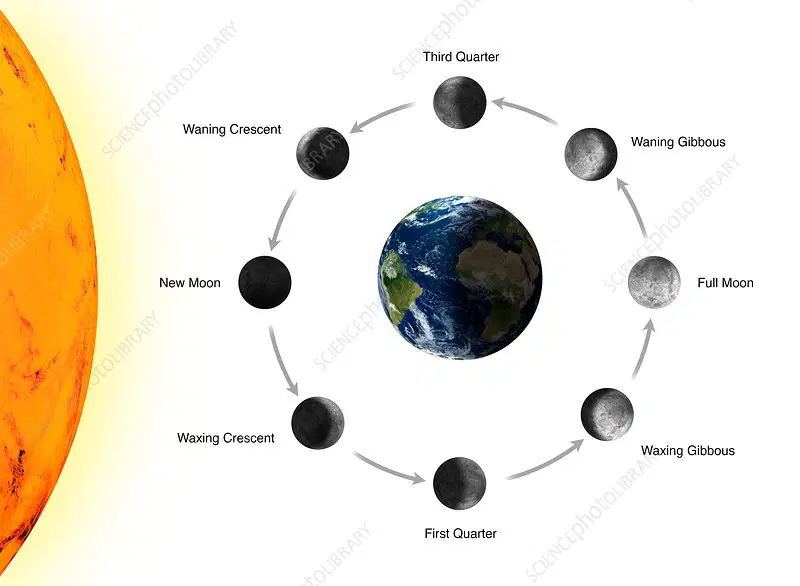
The amount of light the moon reflects changes as it orbits the Earth. These are called ____________.
Rotation
Revolution
Orbit

How much of the sunlit side is visible in this picture?
What phase is this? (Pick 2 answers)
None of the sunlit side
All of the sunlit side
More than half of the sunlit side
Full Moon
New Moon

How much of the sunlit side is visible in this picture?
What shape is it? (Pick 2 answers)
None of the sunlit side
More than half of the sunlit side
Less than half of the sunlit side
Crescent
Gibbous

How much of the sunlit side is visible in this picture?
What phase is this? (Pick 2 answers)
{Hint: Waxing- light on the right}
Half of the sunlit side
Less than half of the sunlit side
All of the sunlit side
First Quarter
Last Quarter

How much of the sunlit side is visible in this picture?
What shape is this? (Pick 2 answers)
Less than half of the sunlit side
Half of the sunlit side
More than half of the sunlit side
Gibbous
Crescent

How much of the sunlit side is visible in this picture?
What phase is this? (Pick 2 anwers)
None of the sunlit side
All of the sunlit side
Less than half of the sunlit side
New Moon
Full Moon

What is the name of the phase where none of the sunlit side is visible?
Full Moon
New Moon
Quarter Moon
Gibbous Moon

What is the name of the phase where all of the sunlit side is visible?
New Moon
Gibbous Moon
Full Moon
Quarter Moon

The light is on the right so it is waxing. What is the name of this phase?
Waning Gibbous
First Quarter
Waxing Crescent
Waxing Gibbous
When the amount of sunlight is getting larger or growing
Waxing
Waning
When the amount of sunlight is getting smaller or shrinking
Waxing
Waning

What is the name of the moon phase pictured?
First Quarter
Waxing Gibbous
Waning Crescent
Waxing Crescent

What is the name of the moon phase pictured?
Third Quarter
First Quarter
Waxing Gibbous
Waxing Crescent
If Samiah sees this moon tonight, how did the moon look a week before this phase occurred?
Hint: think what phase this is and what main phase would happen before this one
Exactly the same
it was a full moon
More than half lit on the right side
it was a new moon

What is the name of the moon phase pictured?
Third Quarter
First Quarter
Waning Gibbous
Waning Crescent
If this moon is seen tonight, what will the moon look like in about 14 days?
Third Quarter
First Quarter
Waning Gibbous
Waning Crescent

What is the name of the moon phase pictured?
Third Quarter
Waxing Crescent
Waning Crescent
Waning Gibbous

What is the name of the moon phase pictured?
Waning Gibbous
Waning Crescent
Third Quarter
Waxing Gibbous

If Kyrie sees this moon tonight, when can he expect to see the next full moon?
Remember: the full moon phase only happens once in its orbit every month
In 7 days
In about a week
In 2 weeks
In about a month
The sun and the moon look about the same size from the Earth. Why does the moon appear to be the same size?
The Sun is closer to Earth.
They are the same size.
The moon is closer to Earth.
The moon is actually bigger.
How many phases does the moon have?
10
6
12
8
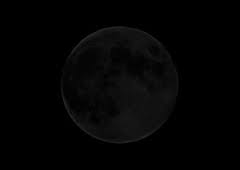
What phase of the moon comes after this phase?
Hint: Think, what phase is this, and what will be coming next?
Waxing Crescent
Waning Crescent
What phase comes after this Waxing Gibbous moon?
Hint: Think, what phase is this, and what will be coming next?
Full Moon
First Quarter
Last Quarter
New Moon

Which phase came before this Waxing Crescent moon?
New Moon
First Quarter
Full Moon
Last Quarter
A group of stars that form a pattern in the sky when viewed from earth is called a _____________.
galaxy
solar system
planet
constellation
Why can't we see constellations during the day?
They move around too quickly.
The stars aren't bright.
The sun is too bright.
They change shape and dissolve.
ball of ice, rock, and frozen gases that orbit the sun
Meteor
Asteroid
Comet

Asteroids orbit the sun, they are made from
rock
metal
ice
dust

