
 Worksheets
Practice Questions for BJU Chem 1 and 2 Assessment
Total questions: 55
Worksheet time: 49mins
The first postulate of the KMT is that all matter is made up of
tiny particles
molecules
cells
mass
According the KMT, the particles are in
different states
organized patterns
constant motion
various containers
According to the KMT, increasing the temperature of particles will
give off energy
increase motion
decrease volume
increase pressure
According to the KMT, the particles of the different states of matter differ in what two key aspects?
volume and mass
density and extention of interactions
temperature and freedom of motion
freedom of motion and extent of interactions
In a solid, what keeps each particle trapped in the same small volume and with the same surrounding particles.
strong attractions between particles
ionic bonds
lack of particle motion
low temperatures
What does increasing the temperature of a solid lead to?
increased mass of particles
decreased space between particles
decreased velocity of particles
increased velocity of particles
How does the particles in a liquid behave?
Neatly organized without any movement.
Move around trapped in a small volume and with the same surrounding particles.
Move fast enough to break attractions and pushing other particles out of the way.
Move freely in a straight line until they collide with another particle.
How doe the particles in a gas behave?
Neatly organized without any movement.
Move around trapped in a small volume and with the same surrounding particles.
Move fast enough to break attractions and pushing other particles out of the way.
Move freely in a straight line until they collide with another particle.
If the particles in a liquid are moving fast enough to complete break the attraction pulling it back towards other particles, what process is occuring?
sublimation
melting
freezing
evaporation
When particles in a gas collide, they change
direction and velocity
velocity and temperature
direction and volume
volume and temperature
In which state of matter are the particles the farthest apart?
gas
liquid
solid

Identify what is happening in the picture below as a chemical or physical change.
Chemical
Physical
Both

When iron is exposed to water vapor and air, it rusts. This ia an example of a _______________ change
Chemical
Physical
Both

Sugar is soluble (dissolves) in tea.
physical change
chemical change
Safety goggles should only be used when working with
an open flame
chemicals
using a mechanical device
all the answers are correct
If you are using a chemical that is corrosive, you should not...
store it near flame
follow the instructions
let it touch your skin
wear goggles
______ chemicals eat away at solids
flammable
hungry
biohazard
corrosive
As matter changes state from liquid to solid, the atoms move ______ .
CLOSER together
FARTHER apart
stay the SAME
Which states that atoms and molecules are perpetually in motion?
The Kinetic Molecular Theory
Newton’s First Law
Law of Conservation of Matter
The Atomic Theory
A concrete road has to built with expansion joints built in or it will buckle in extreme heat. Use KMT to explain why the concrete expands when heated.
The concrete molecules expand when heated.
The concrete molecules vibrate faster, needing more room.
The water in the concrete gets hotter and becomes steam
The concrete molecules slow down and need more space to rest.
If the inside of a balloon is heated, the volume will?
increase
descrease
increase a little, then decrease
none of the above
Gas pressure is caused by ______.
gravity.
gas molecules colliding with each other.
gas molecules colliding with surfaces of the container.
gas molecules reacting with each other.

An inflated balloon is placed in liquid Nitrogen and shrinks until it looks empty. Which statement describes the movement of the gas particles in the balloon?
Gas pressure is caused by ______.
gravity.
gas molecules colliding with each other.
gas molecules colliding with surfaces of the container.
gas molecules reacting with each other.
Define kinetic energy
energy of motion
static energy
stored energy
energy use
Which of the following is an example of a physical change?
Burning wood
Rusting iron
Melting ice
Cooking an egg
What is the main factor that determines the state of matter of a substance?
Color
Temperature
Shape
Weight
The type of separation that would be appropriate if you needed to separate solid particles from a liquid is....
Distillation
Filtration
Separation funnel
Crystallization
Which are methods of separating dissolved particles from the liquid they are dissolved in?
Filtration, separation funnel, crystallization
Filtration, distillation, crystallization
Evaporation, filtration, crystallization
Evaporation, distillation, crystallization
Which separation method is used extremely significantly in recycling plants?
Magnetic
Filtration
Distillation
Crystallization
What separation method is used to separate substances by their boiling point?
Filtration
Evaporation
Crystallization
Distillation
Describe brief methods for separating a mixture of iron, sand, water, and oil.
Which technique would you use to separate salt that has dissolved in water?
filtration
screening
evaporation
centrifugation
You do not like almond nuts in your vegetable salad. Are you going to do to get rid of those?
using strainer
use distillation process
boil the vegetable salad and let almond evaporate
pick them one by one

What process of separating mixture is illustrated on the animated gif posted here?
decantation
distillation
evaporation
condensation
Water changes to water vapor.
condensation
evaporation
precipitation
sublimation

Dry ice is solid. When it is left under room temperature it gives off gas. What process is this?
evaporation
distillation
decantation
sublimation
Metals can be flattened like a sheet. What do you call this physical property of matter?
malleability
flammability
corrosiveness
conductivity

This method is utilized in industries like junkyards to remove metal scraps from other materials.
chromatography
physical manipulation
use of magnet
distillation
What kind of mixture is a combination of substances that has uniform composition and appearance?
colloid
heteregenous
homogeneous
suspension

The following image represents: (Note: each particle is an element.)

The following image represents:
(Note: All the atoms are the same element)

For paper chromatography to work,
the dyes must have different boiling points.
the dyes must have different solubilities in the solvent.
the starting line on the chromatogram must be drawn using pen.
The starting line must be below the level of the solvent.
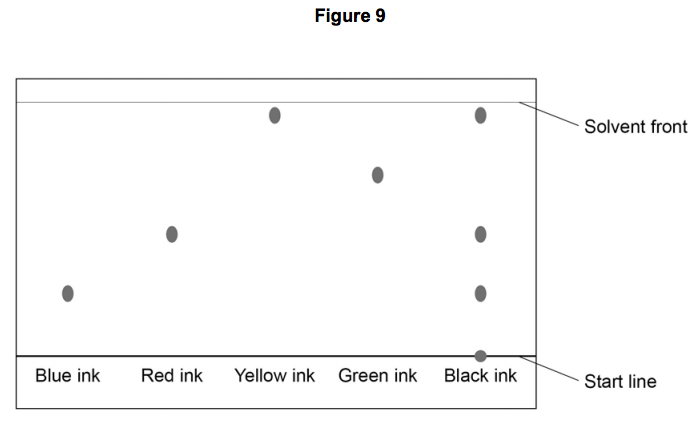
Which ink is a mixture?
Blue
Red
Yellow
Black
Air
Heterogeneous
Homogeneous
M&Ms
Heterogeneous
Homogeneous
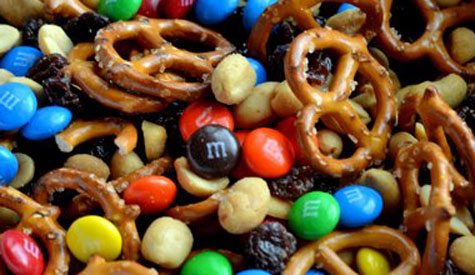
Which is a pure substance?



