
Font size
 Worksheets
Seasons Assignment
Total questions: 15
Worksheet time: 13mins
Earth is in constant motion. It rotates once every 24 hours, which causes day and night.
Earth also orbits the Sun once every year. During Earth's orbit, different parts of Earth experience different seasons. For example, the model below shows Earth at a point in its orbit when it is winter in the Northern Hemisphere and summer in the Southern Hemisphere.
Label the model.
Southern Hemisphere
Northern Hemisphere
North Pole
South Pole
equator

The total amount of sunlight that approaches Earth is about (a) in June as in December.
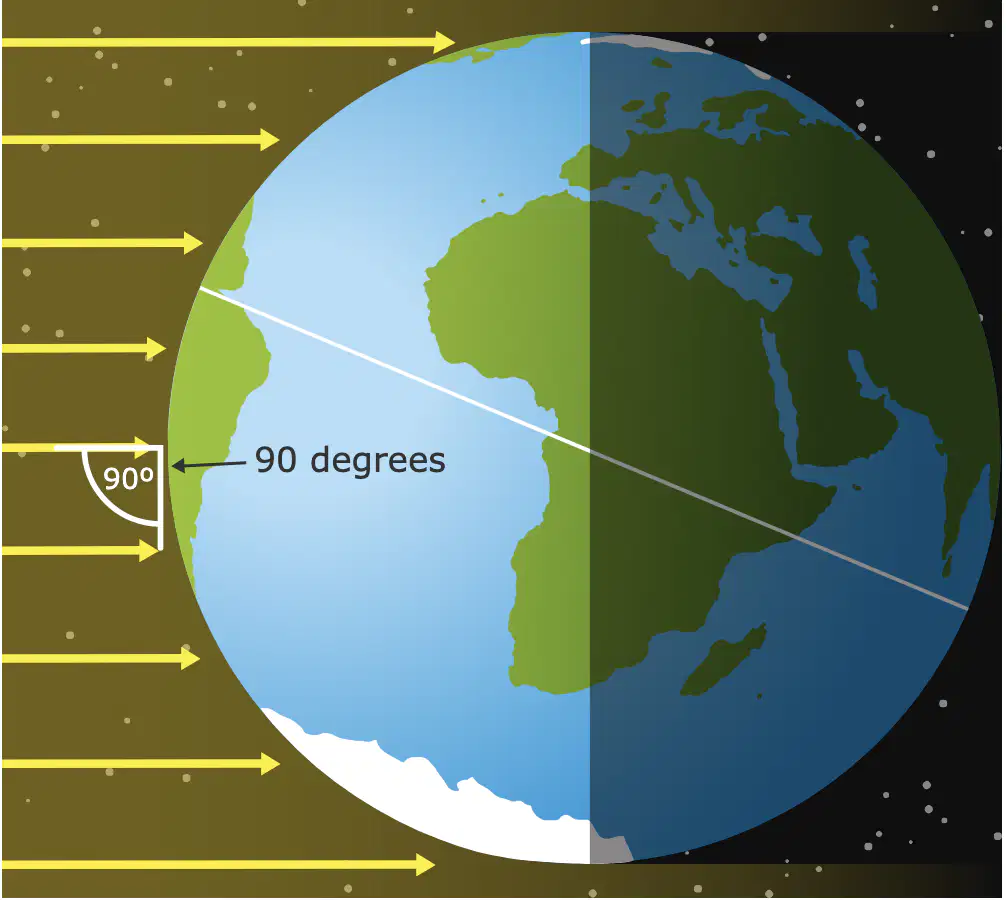
In the model below, the yellow arrows represent sunlight approaching and striking Earth. The sunlight is most intense where it strikes Earth directly, at a 90° angle. This point is labeled below. Locations on Earth that are near this point experience sunlight of greater intensity than locations that are farther away.
At which of the following locations does light strike Earth with the greatest intensity?
the equator
the North Pole
the South Pole

Compared to the sunlight that strikes Earth near the equator, the sunlight that strikes near the North Pole spreads out over a (a)
area.
This difference causes the sunlight that reaches the North Pole to be (b)
intense than the sunlight that reaches the equator.
When sunlight reaches Earth's surface, the surface absorbs some of the energy and heats up. The more intense the sunlight is, the more energy there is to absorb.
The three models below show the same amount of sunlight striking different parts of Earth's surface at different angles. Select the model that shows the part of Earth's surface that would heat up the
least.


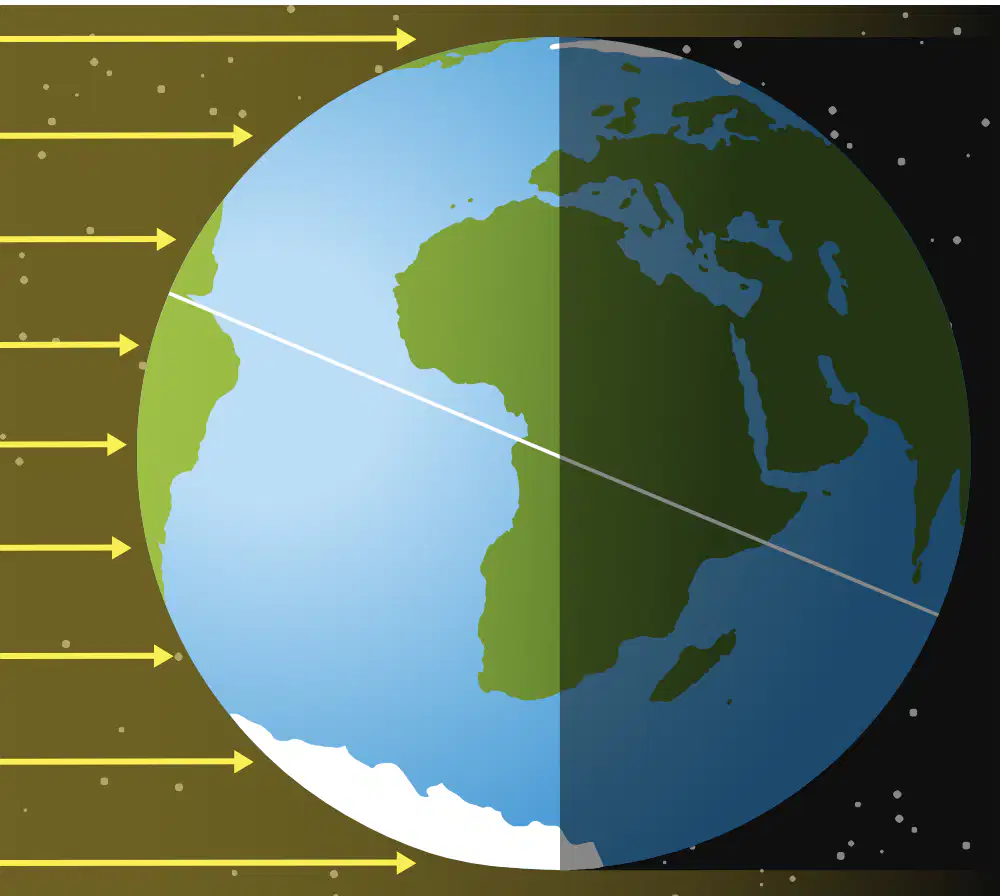
The model below shows Earth at one point in its orbit around the Sun. The yellow arrows represent sunlight approaching and striking Earth.
Correct the statement.
At this point in Earth's orbit (a) Hemisphere is receiving more energy. So, the (b) Hemisphere is heating up more.
At this point in Earth's orbit, the (a) Hemisphere is in winter and the (b) Hemisphere is in summer.
During which season does the Northern Hemisphere receive the most direct sunlight?
Winter
Spring
Summer
What is the primary reason for the variation in sunlight intensity at different latitudes on Earth?
The tilt of Earth's axis
The distance between Earth and the Sun
The speed of Earth's orbit
According to the graph, which latitude receives the most concentrated sunlight in the smallest area?
rotation...
when an object turns or spins around a point located at its center (an axis)
when an object flips around a point located at its center (an axis)
when an object changes around a point located at its center (an axis)
Locations near the equator get less sunlight than other locations.
True
False

Which location has the greatest number of hours of daylight?
A
B
C
D
E
1 Revolution for Earth
365 days
1 Rotation for Earth
24 hours
1 Season for Earth
3 months

