
 Worksheets
THIN LESNSES
Total questions: 92
Worksheet time: 4hrs 39mins

What type of image is formed?
virtual and inverted
virtual and upright
real and upright
real and inverted
How does a concave lens differ from a convex lens?
A convex lens is another way to describe a plane mirror; a concave lens is curved
A concave lens is curved inward on both sides; a convex lens is on only one side
A convex lens has a thick center and thin edges, a concave lens has a thin center and thicker edges
A convex lens has a thin center and thick edges. a concave lens has a thick center and thinner edges

A concave lens has an inward curved shape. It refracts light outward from the lens. They light rays spread apart as they exit the lens. Which represents a concave lens?
A
B
A and B
neither A or B
A ____ lens is sometimes called a converging lens because it_____.
convex; makes parallel light rays curve outward or diverge
concave; makes parallel light rays travel at a faster speed than before they encountered the lens
convex, makes parallel light rays passing through it bend inward and meet (converge) at a spot just beyond the lens known as the focal point.
concave; makes parallel light rays passing through it bend inward and meet (converge) at a spot just beyond the lend known as the focal point.

When light waves move from passing through air to passing through a glass lens when happens to them?
They slow down and change direction
They speed up and change direction
They maintain the same speed and change direction
They maintain their same speed and direction

A thin converging lens is used to produce, on a screen, a focused image of a candle:
The screen and the lens are moved back and forth and various focused images are produced on the screen.
Which statement is always true?
The image is at the principal focus (focal point) of the lens.
The image is bigger than the object.
The image is closer to the lens than the object is.
The image is inverted.

A parallel beam of light falls on a converging lens. Which diagram shows what happens to the beam of light?
A
B
C
D

In the diagram, the distance OP is the focal length of the lens. Through which point will the ray shown pass, after refraction by the lens?
A
B
C
D

An object is placed in front of a converging lens. The lens has a focal length f. The lens produces a real, enlarged image of the object. In which labelled position is the object placed?
A
B
C
D

A student draws a diagram representing three rays of light from point P passing through a converging lens. Each point labelled F is a principal focus of the lens:
Which of the rays has the student drawn correctly?
Ray X and ray Y
ray X and ray Z
ray Y only
ray Z only

The diagram shows a converging lens forming an image of an object:
Which statement about the image is correct?
It is real and can be seen by an eye at X.
It is real and can be seen by an eye at Y.
It is virtual and can be seen by an eye at X.
It is virtual and can be seen by an eye at Y.

A student starts to draw a ray diagram for an object at O, near a thin convex lens, but is not sure
whether the image is formed at X or at F:
The correctly drawn image is
real and formed at F
real and formed at X
virtual and formed at F
virtual and formed at X

Which letter represents the angle of incidence?
A
B
C
D

What is the angle of reflection?
650
500
250
400
What type of image is formed?
virtual and inverted
virtual and upright
real and upright
real and inverted
How does a concave lens differ from a convex lens?
A convex lens is another way to describe a plane mirror; a concave lens is curved
A concave lens is curved inward on both sides; a convex lens is on only one side
A convex lens has a thick center and thin edges, a concave lens has a thin center and thicker edges
A convex lens has a thin center and thick edges. a concave lens has a thick center and thinner edges
A concave lens has an inward curved shape. It refracts light outward from the lens. They light rays spread apart as they exit the lens. Which represents a concave lens?
A
B
A and B
neither A or B
What do a prism, a magnifying glass, a microscope, and eyeglasses ALL have in common.
They are opaque
They refract light
They reflect light
That are translucent
A ____ lens is sometimes called a converging lens because it_____.
convex; makes parallel light rays curve outward or diverge
concave; makes parallel light rays travel at a faster speed than before they encountered the lens
convex, makes parallel light rays passing through it bend inward and meet (converge) at a spot just beyond the lens known as the focal point.
concave; makes parallel light rays passing through it bend inward and meet (converge) at a spot just beyond the lend known as the focal point.

An object is located 35.0 cm from a convex lens. The lens forms a real image at a distance of 15.0 cm. What is the focal length?
0.0953 cm
10.5 cm
26.2 cm
0.0678 cm
An object 8.5 cm high is placed 28 cm from a converging lens. The focal length of the lens is 12 cm. Determine the height of the image.
*Hint: find di first
6.38 cm
8.5 cm
12cm
21 cm


Is a concave lens thicker or thinner in the middle?
Thicker
Thinner
When light waves move from passing through air to passing through a glass lens when happens to them?
They slow down and change direction
They speed up and change direction
They maintain the same speed and change direction
They maintain their same speed and direction

How does a concave lens differ from a convex lens?
A convex lens is another way to describe a plane mirror; a concave lens is curved
A concave lens is curved inward on both sides; a convex lens is on only one side
A convex lens has a thick center and thin edges, a concave lens has a thin center and thicker edges
A convex lens has a thin center and thick edges. a concave lens has a thick center and thinner edges
A concave lens has an inward curved shape. It refracts light outward from the lens. They light rays spread apart as they exit the lens. Which represents a concave lens?
A
B
A and B
neither A or B
How does a concave lens differ from a convex lens?
A convex lens is another way to describe a plane mirror; a concave lens is curved
A concave lens is curved inward on both sides; a convex lens is on only one side
A convex lens has a thick center and thin edges, a concave lens has a thin center and thicker edges
A convex lens has a thin center and thick edges. a concave lens has a thick center and thinner edges
Concave lenses are thick in the middle and thin in the edges.
TRUE
FALSE
_________ is known as refraction
The mixing of colors
the travelling of light in a straight line
The change in the path of light
The bouncing back of the light
Which one of these is a convex lens?


None of the above
Where are lenses used? (multiple correct)
Telescopes
Tables
Eye-glasses
Binoculars

The above lens is a type of ___.
diverging lens
converging lens
divergent lens
convergent lens
Which lens represents the path light takes through a concave lens?


Which figure represents the path light takes through a convex lens?
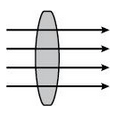
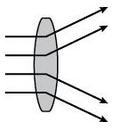
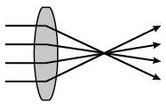
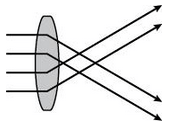
What does the word "converging" mean?
Is a convex lens thicker or thinner in the middle?
Thicker
Thinner
A diverging lens is also known as a ____lens.
refracted
diffracted
convex
concave
What does the word "diverging" mean?
to spread apart
to come together
parallel
perpendicular
A converging lens is also known as a ____ lens.
convex
concave
double
refracted
What does the word "converging" mean?
to separate
to come together
parallel
perpendicular
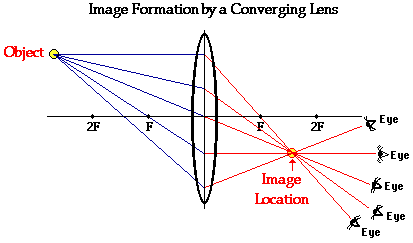
This image is.....
inverted and smaller
inverted and larger
not inverted and smaller
not inverted and larger
When an object is placed between the focal point and the convex lens, the image produced is ___.
real, reduced, and inverted
real, enlarged, and inverted
virtual, enlarged, and upright
virtual, reduced, and upright
An object is placed 20 cm from a convex lens of focal length 15 cm. What is the image distance and the nature of the image?
60 cm, real image
30 cm, real image
Image not formed
15 cm, virtual image
An object is located 35.0 cm from a converging lens. The lens forms a real image at a distance of 15.0 cm. What is the focal length?
0.0953 cm
10.5 cm
26.2 cm
0.0678 cm
What does a concave and convex lens have in common?
They both diverge parallel rays to a focal point
They both converge parallel rays to a focal point
Both of them are curved outwards
Both of them are curved inwards
What are the characteristics of a concave lens? (multiple correct)
It is a diverging lens
it is a converging lens
It is curved outwards
It is curved inwards
Convex lenses create only ____________ images.
Real and erect
Virtual and inverted
Virtual and erect
Real and inverted
Do you think Quizizz as a good learning tool?
Yes...
No...
Maybe.....
Concave lenses are thick in the middle and thin in the edges.
TRUE
FALSE
_________ is known as refraction
The mixing of colors
the travelling of light in a straight line
The change in the path of light
The bouncing back of the light
Which one of these is a convex lens?
None of the above
What is reflection?
Splitting of light
Bouncing back of light
Mixing of colors
A and B
What is also known as a diverging lens?
Concave lens
Convex lens
Where are lenses used? (multiple correct)
Telescopes
Tables
Eye-glasses
Binoculars
When an object is placed between the focal point and the convex lens, the image produced is ___.
real, reduced, and inverted
real, enlarged, and inverted
virtual, enlarged, and upright
virtual, reduced, and upright

