Wayground logo

Free Printable Worksheets

Font size

S
M
L
XL
Worksheets

Unit 1a Review 2024

Total questions: 100

Worksheet time: 57mins

Name
Class
Date
1.
Something that takes up space and has mass.
a)
volume
b)
matter
c)
mass
d)
density
2.
The amount of space something takes up
a)
density
b)
volume
c)
mass
d)
matter
3.
A watermelon has more matter than a grape, so it has more
a)
mass
b)
eat
c)
solid
d)
greater
4.
You can measure ______ with grams.
a)
mass
b)
volume
c)
conductivity
d)
melting point
5.
It occurs when a substance combine with another to form a new substance
a)
Physical Change
b)
Chemical Change 
c)
Physical Property
d)
Chemical Property
6.
It can be observed or measured without changing the composition of matter.
a)
Physical Change
b)
Chemical Change
c)
Physical Property
d)
Chemical Property
7.
Which of the following is not an example of Physical Change?
a)
Melting of an ice cream
b)
Water vapor formed as water boils
c)
Frying an egg
d)
Cutting the paper into pieces
8.
Which of the following is an example of physical change?
a)
an ice cream melts due to heat
b)
food digestion in stomach
c)
rusting of iron due to water exposure
d)
dynamite ignition
9.
Texture, color, states of matter, flexibility, freezing & melting points
a)
Chemical Properties
b)
Physical Properties
c)
States of Mass
d)
Scientific matterology
10.
Which of the following is an example of a chemical property?
a)
melting
b)
bending a paper clip
c)
rusting
d)
boiling water
11.
Which one of these is a chemical property?
a)
melting point
b)
boiling point
c)
color
d)
flammability
12.
Which is an example of a physical property?
a)
ability to react with acid
b)
 state of matter
c)
flammability
d)
ability to react with oxygen
13.

Which property of matter determines if something sinks or floats?

a)

Magnetism

b)

Density

c)

Solubility

d)

Weight

14.

A property of matter that can be measured or observed using the 5 senses.

a)

states of matter

b)

physical properties of matter

15.

"The balls have the same ​ (a)   , but the baseball has more ​ (b)   ."

Choose from the below words
volume
mass
16.

"The balls have the same ​ (a)   , but the foam ball has more ​ (b)   ."

Choose from the below words
mass
volume
17.

One tool to measure mass is:

a)

Graduated Cylinder

b)

Calculators

c)

Scale

18.

One unit to measure mass is

a)

g/mL

b)

grams (g)

c)

milliliters (mL)

19.

One unit to measure volume is

a)

g/mL

b)

grams (g)

c)

milliliters (mL)

20.

One tool to measure volume is:

a)

Graduated Cylinder

b)

Calculators

c)

Scale

21.

These balls look the same size, so they have the same ___.

a)

Mass

b)

Volume

22.

The bowling ball feels heavier, so it has more ___.

a)

Mass

b)

Volume

23.

Gasses do not have a shape or volume of their own. You cannot see most gasess.

a)
True
b)
False
24.

A state of matter that has a definite volume and shape.

a)

solid

b)

liquid

c)

gas

d)

plasma

25.

A state of matter that has a definite volume but indefinite shape.

a)

solid

b)

liquid

c)

gas

d)

plasma

26.

Which is a non-matter?

a)

shadow

b)

powder

c)

wood

d)

dust

27.
Air is an example of a
a)
solid
b)
liquid
c)
gas
28.
Oil is an example of a
a)
solid
b)
liquid
c)
gas
29.
Which of the following statements describes a solid?
a)
It has a fixed shape
b)
It takes the shape of it's container
30.

Which of the following statements describes a liquid?

a)

It has a fixed shape

b)

It takes the shape of its container

31.
Which of the following statements describes a gas?
a)
It has a fixed shape
b)
It takes the shape of it's container
32.
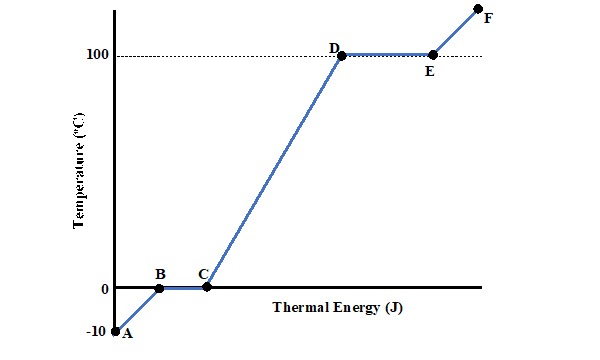
Which segment represents the solid phase? 
a)
1
b)
2
c)
3
d)
4
33.
Which segment represents the liquid phase? 
a)
1
b)
3
c)
4
d)
5
34.
Which segment represents the gas phase? 
a)
5
b)
4
c)
3
d)
2
35.
Which segment represents melting? 
a)
3
b)
5
c)
1
d)
2
36.
Which segment represents vaporization? 
a)
5
b)
1
c)
4
d)
3
37.
What is the boiling point of the substance?
a)
100 degrees Celsius 
b)
0 degrees Celsius 
38.
What is the freezing point of the substance?
a)
100 degrees Celsius 
b)
0 degrees Celsius 
39.
Which set of segments represents phase changes?
a)
1,3,5
b)
2,4
40.

Between which two points is the solid cooling?

a)

A <---- B

b)

B <----> C

c)

C <---- D

d)

D <----> E

e)

E <---- F

41.
The phase change from water vapor to liquid water is known as...
a)
evaporation
b)
precipitation
c)
condensation
d)
sublimation
42.
What happens to particles when they are heated?
a)
They speed up and spread out
b)
They slow down and compress
c)
They stop moving
d)
They move closer together and speed up
43.
All changes in the state of matter of a substance requires
a)
vibration
b)
water
c)
permission
d)
energy
44.
5. What is it called when a solid turns directly into a gas?
a)
Sublimation
b)
Condensation
c)
Liquid
45.
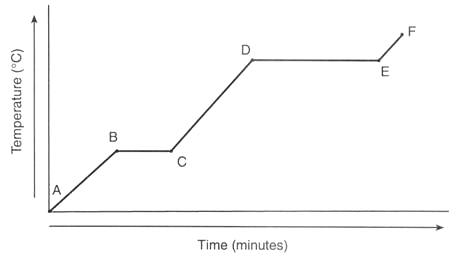
The graph shows a cooling curve for an unknown substance.  What is happening during segment DE?
a)
boiling
b)
condensation
c)
freezing
d)
melting
46.
Change from Gas to Solid is called........
a)
Sublimation
b)
Deposition
c)
Fusion
d)
condensation
47.

Change from Liquid to Solid is called ...

a)

fusion

b)

Freezing

c)

sublimation

d)

evaporation

48.

Change from liquid to gas is called....

a)

expansion

b)

evaporation

c)

condensation

d)

sublimation

49.
A gas
a)
has a definite shape but no definite volume
b)
has a definite volume but no definite shape
c)
has fast-moving particles
50.
In a solid, the particles
a)
vibrate in place
b)
slide past one another
c)
overcome the strong attraction
51.
7. All phase changes (changing states) requires energy to be added or taken away.
a)
True
b)
False
52.
Molecules are closest together in a 
a)
Solid
b)
Liquid
c)
Gas
53.
Which state of matter has molecules that slide past each other but stay close together? They do not form a regular pattern.
a)
solid
b)
liquid
c)
gas
54.
When the temperature of matter increases the particles...
a)
speed up and move closer
b)
speed up and move farther apart
c)
slow down and move closer together
d)
slow down and move farther apart
55.
A substance's heating curve is shown in the graph.  What is its boiling point?
a)
100 C
b)
60 C
c)
80 C
d)
20 C
56.

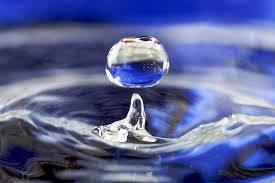
What state of matter is pictured?

a)

Solid

b)

Liquid

c)

Gas

d)

Plasma

57.

On which parts of the graph does the temperature remain the same?

a)

Between C and D

b)

Between D and E

c)

At C, D, or E

d)

On both flat sections

58.

Are the particles moving faster or slower as time goes on?

a)

Faster

b)

Slower

59.

What is happening to the particles in the substance between points A and B?

a)

Melting

b)

Freezing

c)

Speeding Up

d)

Slowing Down

60.

What is happening to the particles in the substance between points D and E?

a)

Melting

b)

Freezing

c)

Vaporizing

d)

Sublimating

61.

What term goes on the y-axis? (A)

a)

Heat(Energy)

b)

Temperature

c)

Phase

d)

Type of Matter

62.

What term goes on the x-axis? (B)

a)

Heat(Energy)

b)

Temperature

c)

Phase

d)

Type of Matter

63.
Which of the following terms would be on the heating curve of water at E?
a)
melting
b)
gas
c)
liquid
d)
boiling
64.

Law of Conservation of Mass states

a)

mass can be gained or lost.

b)

mass depends on its location (on the moon or on the earth).

c)

mass cannot be created or destroyed.

d)

mass can be destroyed but not created.

65.

During chemical changes, mass is

a)

conserved.

b)

lost.

c)

destroyed.

d)

created.

66.

During physical changes, mass is

a)

destroyed.

b)

created.

c)

conserved.

d)

lost.

67.

Which statement is true of the following chemical reaction?

a)

The mass of the reactants is less than the mass of the products.

b)

The mass of the reactants is greater than the mass of the products.

c)

The mass of the reactants is equal to the mass of the products.

68.

Which statement is true of the following chemical reaction?

a)

The mass of the reactants is less than the mass of the products.

b)

The mass of the reactants is greater than the mass of the products.

c)

The mass of the reactants is equal to the mass of the products.

69.

Which equation shows that the atoms are conserved in the chemical reaction?

a)

K + 3O2 --> 2KO3

b)

3K + 3O2 --> 6KO3

c)

2K + 3O2 --> 2KO3

d)

4K + 2O2 --> 2KO3

70.

Which of the following is true about this chemical reaction?


N2 + 2H2 --> NH4

a)

The equation is balanced.

b)

There are more atoms in the reactants

c)

There are more atoms in the products

71.

Are the atoms conserved in the following chemical reaction?

a)

Yes because the number of reactant atoms are equal to the product atoms.

b)

Yes because there are 3 molecules on both sides.

c)

No because the reactants have more atoms than the products.

d)

No because the molecules are different on the product side.

72.

Are the atoms conserved in the following chemical reaction?

a)

Yes because the number of reactant atoms are equal to the product atoms.

b)

Yes because there are 3 molecules on both sides.

c)

No because the reactants have more atoms than the products.

d)

No because the products have more atoms than the reactants.

73.

According to the law of conservation of mass, how much zinc should have been produced?

a)

256 grams

b)

104 grams

c)

128 grams

d)

64 grams

74.

According to the law of conservation of mass, how much zinc should have been produced?

a)

152 grams

b)

104 grams

c)

128 grams

d)

64 grams

75.

Two liquids are mixed in a chemical reaction forming a white solid. What will the mass of the new solid substance be?

a)

150 g

b)

100 g

c)

250 g

d)

50 g

76.

What are these signs of?

a)

a physical reaction occurred

b)

a chemical reaction occurred

c)

an exothermic reaction occurred

d)

an endothermic reaction occurred

77.

Which sign of a chemical reaction shows the formation of a precipitate?

a)

Example A

b)

Example B

c)

Example C

d)

Example D

e)

Example E

78.

Which sign of a chemical reaction shows the formation of a gas?

a)

Example A

b)

Example B

c)

Example C

d)

Example D

e)

Example E

79.

Several students made a claim about what happened when the coal was burned. Which claim is support with evidence form the image below?

a)

All of the particles in the solid piece of coal have rearranged into a colorless gas.

b)

The solid coal particles get burned up and destroyed when coal is burned.

c)

The gas particles created have less mass than the solid coal particles.

d)

The solid coal is converted into pure energy when burned.

80.
What two types of measurements make up DENSITY? 
a)
Mass and Volume
b)
Temperature and Mass
c)
Grams and Centimeters
d)
Volume and Weight
81.
Look at this image.  Which object has the LOWEST density in water? How? 
a)
The Ping Pong Ball because it floats to the top 
b)
The bolt because it has sunk to the bottom
c)
The soda cap because it is not just full of air like the Ping Pong ball
82.
Jack has a rock. The rock has a mass of 14g and a volume of 2cm3. What is the density of the rock?
a)
7 mL
b)
7 g/cm3
c)
28 g/cm3
d)
1/7 g/cm3
83.
If an object has a density of .6 g/mL and you put it into water, will it sink or float?  
a)
sink
b)
float
84.
If an object has a density of 3.6 g/mL and you put it into water, will it sink or float?  
a)
sink
b)
float
85.
Frank has an eraser. It has a mass of 4g, and a volume of 2cm3. What is its density?
a)
8 g/cm3
b)
2 g/cm3
c)
1/2 g/cm3
d)
24 g/cm3
86.
What is the formula for density?
a)
density = mass x volume
b)
density = mass / volume
c)
density = mass + volume
d)
density = mass - volume
87.
Helium balloons rise on earth because
a)
helium is less dense than air
b)
helium is more dense than air
c)
helium is cooler than air
d)
helium is warmer than air
88.
True or False:  The density of a specific type of material never changes.  
a)
True
b)
False
89.
Calculate the density of the cube.
a)
2 g/cm3
b)
4 g/cm3
c)
6 g/cm3
d)
8 g/cm3
90.

You calculated the density of an unknown substance to be 7.8g/cm3. According to the chart, which of the substances doe you most likely have?

a)

Zinc

b)

Copper

c)

Tin

d)

Iron

91.

What is the density of an object with a mass of 3g and a volume of 1cm3? (Hint: Density = mass / volume)

a)

1/3 g/cm3

b)

3 g/cm

c)

3 g/cm3

92.

You calculated the density of an unknown substance to be 5.7g/cm3. According to the chart, which of the substances do you most likely have?

a)

Aluminum

b)

Iron

c)

Tin

d)

Zinc

93.

Which substance is the most dense in this picture?

a)

Vegetable Oil

b)

Dish Soap

c)

Honey

d)

Corn Syrup

94.

Compared to material A, material B has different...

a)

Density

b)

Mass

c)

Phase

d)

Shape

95.

Which of the following substances would float in water? (Hint: water has a density of 1g/cm3)

a)

gold

b)

rubber

c)

water

d)

cork

96.

A block of aluminum occupies a volume of 15 cm3 and has a mass of 40.5 g. What is its density?

a)

.37 g/mL

b)

605.5 g/mL

c)

2.7 g/mL

d)

25.5 g/mL

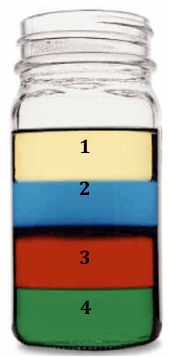
97.
Put the liquids in order from most dense to least dense?
a)
4, 3, 2, 1
b)
1, 2, 3, 4
c)
3, 4, 2, 1, 
d)
4, 3, 1, 2
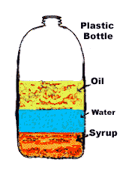
98.
Which liquid is the least dense?
a)
oil
b)
water
c)
syrup 
d)
plastic bottle
99.
What is the volume of Object X?
a)

10.0 ml

b)

15.0 ml

c)

20.0 ml

d)

25.0 ml

100.
What is the volume of the fish?
a)

18.0 ml

b)

6.0 ml

c)

38.0 ml