
Font size
 Worksheets
Science 6 Quiz Review Term1
Total questions: 53
Worksheet time: 28mins
How are the particles arranged in a solid?
Particles are in fixed position but can vibrate.
Particles are closely packed together, but can move around one another.
Particles do not move at all.
Particles are spread out and move around randomly.
Sara mopped the floor. The wet floor dried up in a couple of minutes. What term applies to what happened to the water on the wet floor?
Boiling
Evaporation
Condensation
Melting
Sidra is making coffee. The water reached its boiling point and started to vaporize. What term applies to what happened to the water?
Boiling
Evaporation
Condensation
Melting
Which of these measures changes if the gravitational force upon the object changes?
Mass
Weight
Volume
Density
The liquid that flows slowly has _____________ viscosity.
High
low
Sublimation is ____________.
when solid turns into gas
when gas turns into plasma
when liquid turns into gas
when gas turns into solid
When particles in matter move faster, the __________ increases.
Temperature
light energy
thermal energy
magnetic energy
When a solid reaches the temperatures of its _________, it can become a liquid.
melting point
freezing point
boiling point
density

A (a) is a group of two or more atoms held together by chemical bonds.

Vaporization that takes place only on the surface of the liquid is called (a) .

When a liquid vaporizes after reaching its boiling point, this type of vaporization is called (a) .

A mix of different nuts is a (a) mixture.

Salt solution is a (a) mixture.

(a) is the measure of the average kinetic energy of the particles in an object or a substance.

A (a) is a substance made of two or more elements chemically combined in a set ratio.

(a) is the property of water in which the water molecules at the surface tend to stick together and act like a skin.

(a) is the property of liquids that describes how fast or slowly the liquid will flow.

The Law of Conservation states that (a) is neither created nor destroyed.
Particles in a liquid are closely packed together, but can move around one another.
True
False
The density of water is the highest at 4 degrees Celcius.
True
False
During a physical change the original substance is transformed into another substance.
True
False
The substance with lower density floats on the top.
True
False
The shape and volume of a solid depends on its container.
True
False
The components of a heterogeneous mixture can be separated back easily.
True
False
In the places high above sea-level, the air is less dense. Therefore, water needs less thermal energy to boil.
True
False
Boiling takes place throughout the liquid at a fixed temperature.
True
False
What is the correct formula to calculate density of a substance?

These are solids with atoms aligned in regular, repeating pattern. They melt at a particular temperature.
D
E
F
G
H

In these solids, the particles arrangment is random. They melt over a range of temperature.
D
E
F
G
H

It is the amount of space an object occupies. It is measured in milliliters (mL), cubic meters m3 or cubic centimeters cm3
A
B
C
D
E

It is the amount of matter in an object. It is measured in grams (g) and kilograms (kg).
a
b
c
d
e

It is the measure of the force of gravity on an object.
a
b
c
d
e

It is the measure of the mass of a material in a given volume. It is measured in g/cm3
d
e
f
g

It is the total kinetic and potential energy of all particles in an object or substance.
a
b
c
d

It is the measure of the average kinetic energy of the particles in an object or a substance.
a
b
c
d
e
Calculate the density of the following substances:
Mass: 950 g
Volume: 95 cm3
Calculate the density of the following substances:
Mass: 48 g
Volume: 8 cm3
6 g/cm³
6 kg/m³
Calculate the density of the following substances:
Mass: 63 g
Volume: 7 cm3
Identify the physical changes in matter.
Sharpening pencil
Baking a cake
Souring milk
Rotting fruits
Making Lemonade
Identify the chemical changes in matter.
Sharpening pencil
Baking a cake
Souring milk
Rotting fruits
Making Lemonade
Identify the chemical changes.
Rusting of Iron
Melting Chocolate
Tarnishing of Silver
Identify the physical change.
Rusting of Iron
Melting Chocolate
Tarnishing of Silver
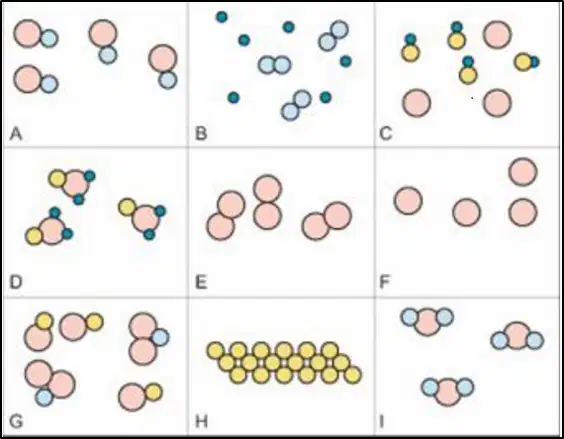
Identify the atoms in these models.
F
B
C
D
E
Identify the ELEMENTS in these models.
A
F
H
D
E
Identify the COMPOUNDS in these models.
A
C
B
D
I
Identify the MIXTURES in these models.
B
C
G
D
I
What happens to the particles in a balloon when it is dunked in hot water?
The particles slow down and the balloon deflates a bit.
The particles move faster and the balloon becomes firm.
some particles escape from the balloon into the air.
Nothing changes.
According to the Boyle’s Law, the volume and pressure of a gas are __________________ proportional at constant temperature.
DIRECTLY
INVERSELY
According to the Charle’s Law, the temperature and volume of a gas are __________________ proportional at constant pressure.
DIRECTLY
INVERSELY
In a directly proportional relationship as one variable increases, the other variable decreases.
TRUE
FALSE
In order for Boyle’s Law to be true, the PRESSURE must be constant.
TRUE
FALSE
Boyle’s Law describes relationship between a gas's volume and pressure when its temperature is constant.
True
False
Charles' Law describes the relationship between a gas's volume and temperature when its pressure is constant.
True
False

