wayground logo

Free Printable Worksheets

NEW

Font size

S
M
L
XL
Worksheets

Gr.9 Modelling Atoms 2

Total questions: 29

Worksheet time: 23mins

Name
Class
Date
1.
Which particle has a positive charge?
a)
electron
b)
orbital
c)
proton
d)
neutron
2.
Choose the particle that has no charge.
a)
nucleus
b)
neutron
c)
proton
d)
electron
3.
This particle determines what element you have - the elements identity.
a)
electron
b)
proton
c)
neutron
d)
valence shell
4.
What is the mass of a proton and a neutron?
a)
1amu
b)
2grams
c)
13amu
d)
10cm
5.
Which particles make up the nucleus of an atom?
a)
protons and neutrons
b)
electrons and protons
c)
electrons, protons, and neutrons
d)
electrons and neutrons
6.
What is the mass number and name of an element with 8 protons and 8 neutrons?
a)
16 - Carbon
b)
16 - Oxygen
c)
24 - Oxygen
d)
8 - Neon
7.
The mass of one proton is equal to the mass of one...
a)
neutron
b)
electron
8.
The mass of one proton is greater than the mass of one...
a)
neutron
b)
electron
9.
All of the mass of an atom comes from what location?
a)
nucleus
b)
electron cloud
10.
What is an atom mostly made up of?
a)
protons
b)
electrons
c)
empty space
d)
neutrons
11.
True or False: An isotope is when the protons and neutrons are the same, but the electrons are different.
a)
True
b)
False
12.

Calculate the average atomic mass of silver.

a)

106.38649amu

b)

111.91896amu

c)

107.8677amu

d)

121

13.
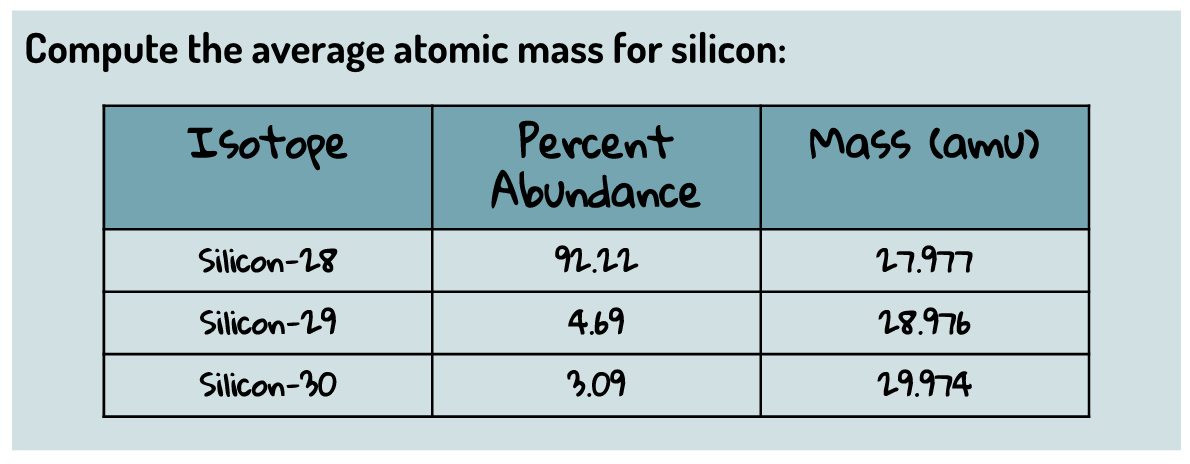
Compute the average atomic mass for silicon:
a)
27.977
b)
28.09
c)
28.976
d)
The average mass cannot be determined from provided information.
14.
the central region of an atom where its neutrons and protons are is its 
a)
nucleus 
b)
electron cloud
c)
core 
d)
center 
15.
an atom with atomic number 6 would have how many protons 
a)
6
b)
12
c)
3
d)
cannot be determined 
16.

What does the 1.00794 stand for?

a)

mass number

b)

atomic number

c)

average atomic mass

d)

number of protons

17.
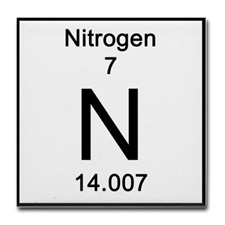
What is the number of protons that the element in this image contain?
a)
14
b)
7
c)
15
d)
18
18.

If an atom has 12 protons, which of the following must it also have to be considered a neutral atom?

a)

12 neutrons

b)

12 electrons

c)

12 protons

d)

24 protons and neutrons

19.
If an atom has 10 protons, 10 neutrons, and 10 electrons, what is the mass of the atom?
a)
10
b)
20
c)
30
20.

What charge does an atom have when it GAINS electrons?

a)

Positive

b)

Negative

c)

Neutral

21.

What two particles determine the mass number?

a)

Protons and electrons

b)

Electrons and neutrons

c)

Protons and neutrons

22.

When an atom loses an electron, it becomes a(n) _____________ ion.

a)

positive

b)

negative

c)

neutral

d)

polyatomic

23.

If the mass number of this chlorine atom is 36, how many neutrons does it have?

a)

17

b)

18

c)

19

d)

can't be determined

24.

What is the atomic number of this atom shown in the Bohr model?

a)

11

b)

12

c)

13

d)

can't be determined

25.

What is the mass number of the atom shown in the Bohr model?

a)

11

b)

12

c)

23

d)

Can't be determined

26.

Is this atom an ion? If so what would it's charge be?

a)

Yes, 1-

b)

No it is neutral

c)

Yes, 1+

d)

Can't be determined

27.

Most of the mass of an atom is found in the ______.

a)

nucleus

b)

proton

c)

electron cloud

d)

isotope

28.
An atom with an unequal number of protons and electrons is said to have (a) ___.
a)
no charge
b)
balance
c)
charge
d)
unbalance
29.
Two atoms of the same element but with different mass numbers are called________
a)
electrons
b)
isotopes
c)
variables
d)
electron cloud