Worksheets
Earth Science Review Exam
Total questions: 75
Worksheet time: 6hrs 15mins
Which of the following is NOT a characteristic of Earth?
The presence of the magnet
Right distance from the sun
The presence of liquid water
The presence of an atmosphere
Which of the following factors is essential for life to exist?
Liquid water
Nutrients
Temperature
All of the above
Why are human and other living organisms capable to live on Earth?
Earth has man-made natural cycles.
Earth has no protective equipment like ozone.
Earth has layer water only for favorable climate.
Earth's temperature is neither the hottest nor the coldest amonf gother plants.
Which of the following statements is TRUE?
All living organisms can survive without sunlight.
Living organisms can harness energy from the sun.
Living organisms cannot harness energy from chemical substances.
All of the above statements are true.
If Earth were much smaller than it is now, it would not support life because it would not have enough mass to
Rotate on its axis
Maintain a gravitational pull on the moon
Collect needed radiant energy from the sun
Have sufficient gravity to hold an atmosphere
Why can humans and other living organisms live on earth?
Earth can provide food for the organism.
Earth can protect the organism from any possible threat.
Earth's temperature is mostly hot compared to other planets.
Earth has the right amount of temperature, water, a good atmosphere, and a favorable climate.
What is the correct order of Earth's atmospheric layers from bottom to top?
Exosphere, Thermosphere, Mesosphere, Stratosphere, Troposphere
Stratosphere, Mesosphere, Troposphere, Thermosphere, Exosphere
Troposphere, Stratosphere, Mesosphere, Thermosphere, Exosphere
Thermosphere, Stratosphere, Mesosphere, Exosphere, Troposphere
Which of the following is an example of an interaction between atmosphere and biosphere?
Dog is drinking water.
Trees are growing in the soil.
Humans are plowing the soil.
Humans are breathing through the air.
Plants use sunlight, water, and carbon dioxide during photosynthesis. Which of the following subsystems are interacting during this process?
Biosphere, atmosphere, and geosphere
Biosphere, atmosphere, and hydrosphere
Geosphere, hydrosphere, and biosphere
Geosphere, atmosphere and hydrosphere
Which of the following events shows an interaction between the geosphere and hydrosphere?
Water evaporating from the soil
Bacteria converting nitrogen to ammonium
Plants undergoing the process of transpiration
Rocks undergoing the process of weathering due to flood
Water availability impacts the growth of animals like cows who depend on plants for food. Which of the following subsystems are involved in this situation?
Atmosphere and biosphere
Atmosphere and hydrosphere
Hydrosphere and biosphere
Hydrosphere and geosphere
Taal Volcano spews gases and ashes into the air. Which two spheres are interacting in this scenario?
Biosphere and geosphere
Biosphere and atmosphere
Geosphere and hydrosphere
Geosphere and atmosphere
Which of the following best describes the relationship between earth’s spheres?
Earth's spheres have their own sets of living organisms.
The cow produces offspring due to the interaction of four spheres.
Together, these spheres support all plant and animal life.
Earth's spheres are independent from one another.
All of Earth's cycles and spheres are interconnected. Why is this so?
Because they are interconnected
Because Earth is where we live in
Because Earth is the only living planet
Because every organism has its function on the Earth
Diamonds are used in jewelry because of their ability to reflect light causing its brilliance or shining effect. What physical property of mineral is exhibited in the aforementioned statement?
Cleavage
Hardness
Luster
Streak
Angela tests a mineral sample by scratching it on a white and black porcelain plate to determine its true color. What property of minerals did she test?
Specific gravity
Hardness
Streak
Color
Friedrich Mohs developed a classification scheme for minerals. Which of the following is the basis of his classification?
Chemical composition of the minerals
Location of mineral occurrence
Hardness of the mineral
Color of mineral
An unknown mineral sample was tested by putting a drop of HCl solution on the surface. After a few minutes, there was a bubble formation on the surface. What physical property of the mineral was tested in the unknown mineral sample?
Odor
Reaction to acid
Specific Gravity
Striations
Anton hammers a piece of unidentified mineral. The mineral breaks into two parts with uneven surfaces. What property of mineral does it show?
Cleavage
Crystal lattice
Diaphaneity
Fracture
During the 1800’s miners can identify real gold from pyrite through biting the surface of the mineral. If a bite mark is exhibited, them the said mineral is considered real gold. What property is tested in this scenario?
Cleavage
Luster
Hardness
Color
What does the mineral property of specific gravity measure or describe?
Describes how easy it is to scratch the surface of a mineral.
Describes how well a mineral reflects light.
Measures the density of the mineral.
The color of the mineral in powdered form.
Why isn't color alone very useful in mineral identification?
Many minerals have the same color.
One mineral can have many different colors.
The presence of one element can cause many colors.
All the above
Tooth extraction leaves an empty gum that affects an individual's speaking and eating ability. To address this problem, dentists use light metallic minerals to implant teeth on the affected gum. What metallic mineral is used by dentists?
Aluminum
Calcium
Titanium
Uranium
Silver is more conductive than copper. Despite this, why do you think silver is not commonly used in electrical wiring?
Silver is harder than copper.
Silver is more expensive than copper.
Silver is more abundant than
Silver is more malleable than copper.
Iron is a corrosive metal, and forms rust once exposed to air. Manufacturers use stainless steel in making safe kitchen wares. Which primary mineral is combined with iron and carbon to form stainless steel?
Chromium
Nickel
Silicon
Titanium
What mineral are used in window and door panel?
Aluminum
Carbon
Granite
Titanium
Which are the mineral component of batteries?
Ni, Cu, Li
Ni, Cu, Zn
Ni, Li, Zn
Ni, Ag, Zn
Which are the components of fertilizers?
Aluminum, iron, and copper
Potassium, nitrogen, and carbon
Calcium, magnesium, and potassium
Potassium, phosphorus, and nitrogen
Which is not true about surface mining?
It is the most dangerous method of mining.
It is used to extract ore minerals near the surface of the earth.
Surface mining can be done through open pits, dredging, and strip mining.
In surface mining, the soil and rock that cover the ores are removed through blasting.
Which arrangement of mineral processing is correct?
Comminution, dewatering, crushing, grinding, and analysis
Sampling, analysis, comminution, filtration, and dewatering
Sampling analysis, comminution, concentration, and dewatering
Dewatering, comminution, analysis, sampling, and surface mining
Which of the following statement/s is/are incorrect?
Surface and underground mining use explosives.
Underground mining is cheaper than surface mining
Open-pit mining is the most common type of surface mining
Which of the following is NOT included in the group?
Dredging
Strip mining
Open-pit mining
Underground mining
Which of the following is mineral ore?
1. a rock with a fossilized insect
2. a sedimentary that has gold traces
3. a rock combined with copper
4. a rock that contains valuable mineral
1,2,3
1,3,4
2,3,4
4,2,1
Engr. Albor took a sample of mineral from the prospective mineral deposits. What mineral processing did he do?
Analysis
Sampling
Comminution
Dewatering
Chromite miners in the Philippines use drills or explosives to bore holes in the ground to extract the mineral deposits. Which mining method did the miners use?
Dredging
Strip Mining
Open-pit Mining
Underground Mining
Which fossil fuel is formed from organic materials which are mostly algae?
Carbon
Natural Gas
Oil
Oil and Coal
Which fossil fuel is the cleanest, odorless and colorless?
Carbon
Natural Gas
Oil
Oil and Coal
What type of fossil fuel is harnessed in Malampaya?
Coal
Coal and Oil
Natural gas
Oil
Why is coal considered as a non-renewable energy source?
Because it is sustainable.
Because it is expensive to mine.
Because it takes millions of years to form
Because it can be regenerated or replaced
Which statements is/are correct?
The Philippines has the largest coal production in the world.
Oil, coal, and natural gas are examples of renewable energy.
Nonrenewable energy is finite; it can't be used for a second time.
Which statement is correct?
Natural gas is not a fossil fuel.
Coal, natural gas, and oil are fossil fuels.
Fossil fuels are man-made energy sources.
Coal is the most expensive energy source in the world.
Which of the following are NOT components of fossil fuels?
remains of bacteria
remains of animals
remains of all vegetation
remains of volcanic ashes
Which is the chronological order of fossil fuel formation?
I. They are then able to turn it into products we can use, such as petrol and diesel.
II. Millions of years ago the remains of prehistoric plants and animals were buried at the bottom of the Earth.
III. The plant and animal remains were altered chemically by this process, and slowly changed into crude oil and natural gas.
IV. The mud sediment was buried by more sediments, and it started to change into rock as the temperature and pressure increased.
I,II,III,IV
I,III,II,IV
II,IV,III,I
II,III,IV,I
A rock sample was recovered from Taal Volcano Island by a local. The resident volcanologists were on site and identified the rock was formed from the material ejected by the volcano during its eruption. He further observed that the rock sample had a glassy appearance. What type of rock did the locals recover?
Extrusive Rock
Intrusive Rock
Metamorphic Rock
Sedimentary Rock
What are the three types of fossil fuels?
Coal,crude oil and natural gas
Nuclear energy,methane and coal
Petroleum,crude oil,propane
Natural gas,coal,biogas
Which type of fossil fuel is formed from dead plants?
Coal
Natural Gas
Crude Oil
What is an advantage of Fossil Fuels
They generate large amounts of electricity
They don't negatively affect the environment
They will never run out
Cooking Gas is?
Natural Gas
Crude Oil
Coal
The liquid form of fossil fuel?
Crude Oil
Natural Gas
Coal
Which type of rock is formed when lava cools and hardens?
Igneous Rock
Sedimentary Rock
Metamorphic Rock
In what type of rock do most fossils appear?
Igneous Rock
Sedimentary Rock
Metamorphic Rock
Limestone is formed from layers of sand, shells and animal remains that have been compacted together. Limestone is a ____.
Igneous Rock
Sedimentary Rock
Metamorphic Rock
A rock that forms when magma hardens beneath Earth's surface is called an:
Intrusive Igneous Rock
Extrusive Igneous Rock
Sedimentary Rock
Metamorphic Rock
Which of the following represents the correct order of the processes responsible for the formation of sedimentary rocks?
Erosion, weathering, compaction, cementation, deposition.
Compaction, cementation, deposition, weathering, erosion, lithification
Deposition, lithification, cementation, compaction, erosion, weathering.
Weathering, erosion, deposition, compaction, cementation, lithification
The movement of sediments from broken rocks is called___________.
erosion
weathering
deposition
cementation
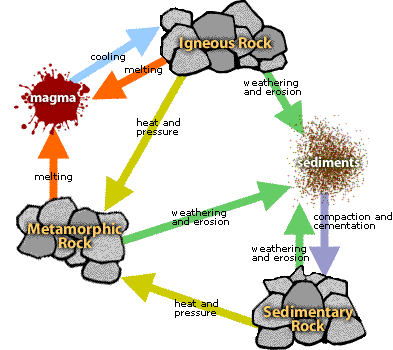
Limestone is a sedimentary rock. During the rock cycle, limestone is changed into marble, a metamorphic rock. The processes that act on limestone and change it into marble are
weather and erosion
heat and pressure
compacting and cementing
melting, cooling, and hardening
Which of the following lists the steps an igneous rock undergoes in order to become a sedimentary rock, in the correct order?
Deposition, erosion, melting, cooling
Erosion, weathering, eruption, cooling
Dissolving, deposition, cooling, fracture
Weathering, erosion, deposition, cementation
This is the continuous process of rock changing from one type to another.
Igneous rocks
Sedimentary rocks
Metamorphic rocks
Rock Cycle
Which energy resources is derived from natural organic materials?
a. fossil fuels
b. geothermal
c. solar
d. wind
Which of the arrangement of mineral processing is correct?
a. comminution, dewatering, crushing, grinding, and analysis
b. sampling, analysis, comminution, filtration, and dewatering
c. sampling analysis, comminution, concentration, and dewatering
d. dewatering, comminution, analysis,
Which is true about surface mining?
a. It is the most dangerous method of mining.
b. Surface mining is expensive type of mining.
c. Surface mining can be done through creating a tunnel.
d. It is used to extract ore minerals near the surface of the earth.
Which of the following is the correct decreasing order of the types of coal based on the quality?
a. anthracite, bituminous, subbituminous and lignite
b. anthracite, lignite, bituminous and subbituminous
c. lignite, anthracite, subbituminous and bituminous
d. lignite, subbituminous, bituminous and anthracite
Fossil fuels formed million years ago from different materials. Which of the following are its component?
1. remains of bacteria
2. remains of animals
3. remains of all vegetation
4. remains of volcanic ashes
a. 1, 2 and 3
b. 1, 2 and 4
c. 1, 3 and 4
d. 2, 3 and 4
Which of the following is the first event in fossil fuel formation?
a. They are then able to turn it into products we can use, such as petrol and diesel.
b. Millions of years ago, the remains of prehistoric plants and animals were buried at the bottom of the Earth.
c. The plants and animals remain were altered chemically by this process and slowly changed into crude oil and natural gas.
d. The mud sediment was buried by more sediments and It started to change into rock as the temperature and pressure increased
Which of the following is NOT a part of a subsystems of the Earth?
Atmosphere
Geosphere
Sphere Shape
Hydrosphere
How do the geosphere and the hydrosphere interact?
The geosphere stores parts of the hydrosphere.
The geosphere erodes (shapes) the hydrosphere.
The hydrosphere stores parts of the geosphere.
TRUE about Minerals:
Inorganic
Naturally occuring
With chemical composition
All of the above
The basic building blocks of rocks:
Crystal
Acids
Magma
Minerals
Characteristics of intrusive igneous rock:
Rapid cooling
glassy texture
coarsed grain
Fine grain
Metamorphic rock were form through:
Weathering
Erosion
Heat and pressure
Mass wasting