wayground logo

Free Printable Worksheets

Font size

S
M
L
XL
Worksheets

Avogadro's Number & Atom Review

Total questions: 46

Worksheet time: 46mins

Name
Class
Date
1.

Avogadro’s number is:

a)

6.02 x 10²²

b)

6

c)

6.02 x 10²³

d)

3.01 x 10²³

2.

1 mole of zinc is how many atoms?

a)

65.4

b)

6.02x10²³

c)

6.54x10²³

d)

0.000,000,000,000,000,000,000,654

3.
Which has more molecules?
a)
1 mole H2O
b)
1 mole Al(OH)3
c)
1 mole NaCl
d)
There are all the same
4.
How many Carbon atoms are in one mole of Carbon?
a)
6.02 x 10²³
b)
1
c)
12
d)
not enough information
5.

How many molecules of sugar (atoms of sugar) (C6H12O6) are in a mole of sugar? (a mole = 1 mole)

a)

24 molecules

b)

180 molecules

c)

180 g

d)

6.02 x 10²³ molecules

6.
The number 6.02 x 10²³ is called...
a)
Obama's number
b)
Bohr's number
c)
Trump's number
d)
Avogadro's number
7.

There are ______ number of molecules (atoms) of NaCl in one mole of NaCl? (hint: one mole is in the question)

a)

6.02 x 10²³

b)

1 mole

c)

2

d)

Mr. Miller

8.
Which has more molecules?
a)
1 mole H2O
b)
1 mole Al(OH)3
c)
1 mole NaCl
d)
There are all the same
9.
How many atoms of iodine are in a mole of iodine?
a)
53
b)
63.55g
c)
126.9
d)
6.02 x 10²³
10.

How many atoms would 2 moles of Sulfur contain?

a)

6.02x10²³

b)

2(6.02x10²³)

c)

(6.02x10²³)/2

d)

(6.02x10²³)^2

11.

How many atoms are equivalent to 0.5 moles Carbon?

a)

6.02x10²³

b)

2(6.02x10²³)

c)

(6.02x10²³)/2

d)

(6.02x10²³)2

12.

Avogadro's number tells us ​ (a)   . This number is ​ (b)   . In order change the number of molecules into the number of moles we use the number of molecules ​ ​ (c)   Avogadro's number. If we want to go the opposite direction and change the number of moles to the number of molecules, we use the number of moles ​ (d)   Avogadro's number.

Choose from the below words
the number of particles in a mole
6.022 x 10^23
divided by
multiplied by
13.
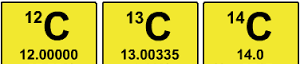
What do these isotopes of carbon all have in common?
a)
neutrons & mass number
b)
atomic number and neutrons
c)
atomic number and electrons
d)
protons, atomic number, and mass number
14.

Isotopes are atoms of the same element with different #’s of __________ & therefore different __________.

a)

neutrons ; atomic numbers

b)

protons ; atomic numbers

c)

electrons ; mass numbers

d)

neutrons ; mass number

15.
How many neutrons does an atom of the isotope Neon-22 have?
a)
12
b)
10
c)
22
d)
20
16.
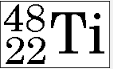
How many protons does this isotope of titanium have?
a)
48
b)
22
c)
26
d)
70
17.
How many neutrons does the isotope of lithium have?
a)
8
b)
3
c)
4
d)
5
18.

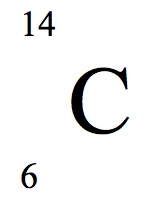
The photo above shows the isotopic notation for which isotope?

a)

Carbon 12

b)

Carbon 13

c)

Carbon 14

d)

Carbon 15

19.
How many neutrons does a Sodium 24 isotope have?
a)
12
b)
13
c)
14
d)
15
20.
How many neutrons does a Calcium 48 isotope have?
a)
16
b)
20
c)
28
d)
12
21.
The positive particles of an atom are 
a)
electrons 
b)
positrons 
c)
neutrons 
d)
protons 
22.
Particles in an atom that are neutral and have no charge are 
a)
negatrons 
b)
electrons 
c)
neutrons 
d)
protons 
23.
The particles that are found in the nucleus of an atom are
a)
neutrons and electrons
b)
electrons only
c)
protons and neutrons
d)
protons and electrons
24.
The central region of an atom where its neutrons and protons are is called the
a)
nucleus 
b)
electron cloud
c)
core 
d)
center 
25.
electrons have this type of charge?
a)
negative
b)
positive
c)
neutral
26.
How does the size of a proton compare to the size of a neutron?
a)
larger
b)
smaller
c)
equal
27.
What is the overall charge of this atom?
a)
+3
b)
-3
c)
0
d)
+1
28.

The mass number is always larger than the atomic number (exept for Hydrogen).

a)

TRUE

b)

FALSE

29.

The mass number of an atom is the mass of ______ + _____

a)

protons + neutrons

b)

protons + electrons

c)

neutrons + nucleus

d)

protons + nucleus

30.

The number of protons in an atom is called the .....

a)

Mass

b)

Atomic Number

c)

Nucleus

d)

Orbital

31.

A neutron has _________ charge or is ________.

a)

negative ... neutral

b)

positive .... neutral

c)

no .... negative

d)

no ... neutral

32.

An electron has a _________ charge

a)

positive

b)

neutral

c)

negative

d)

massive

33.

The subatomic particles that make up an atom.

a)

solid, liquid, gas

b)

electrons, protons, nucleus

c)

energy, protons, nucleus

d)

electrons, protons, neutrons

34.

Atoms are made up of ________________

a)

energy

b)

electrons

c)

subatomic particles

d)

gasses

35.
How many sig figs are there?
100.00
a)
1
b)
3
c)
4
d)
5
36.
How many sig figs are there?
100000000
a)
1
b)
9
c)
10
37.
How many sig figs are there?
4004
a)
1
b)
2
c)
3
d)
4
38.
How many sig figs are there?
0.000008
a)
1
b)
2
c)
6
d)
7
39.
How many sig figs are there?
0.00400
a)
1
b)
3
c)
5
d)
6
40.
How many sig figs are there?
9009.00
a)
2
b)
4
c)
5
d)
6
41.
How many sig figs are there?
4000.
a)
1
b)
3
c)
4
42.

What is 78.5 rounded to one significant figure?

a)

79

b)

78.5

c)

70

d)

80

43.

Round 0.010229 to four significant figures

a)

1022

b)

1023

c)

0.01023

d)

0.01022

44.

What is 0.658 rounded to 1 significant figure?

a)

0

b)

0.66

c)

0.7

d)

0.658

45.

What is 7.555 rounded to two significant figures?

a)

7.6

b)

7.5

c)

70

d)

76

e)

7.60

46.
Round 52689 to 3 significant figures.
a)
526
b)
527
c)
52600
d)
52700