
NEW
Font size
 Worksheets
Cell Biology Quiz
Total questions: 31
Worksheet time: 3hrs 35mins
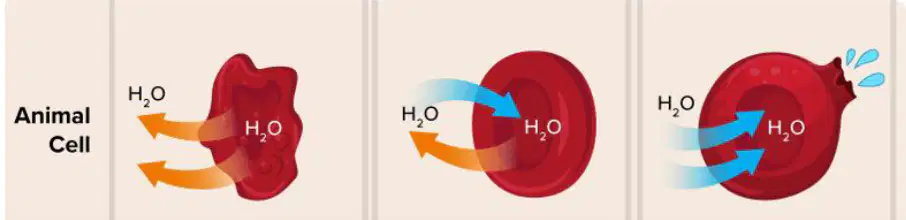
Label the environments of the cells below, from left to right.
Isotonic, Hypertonic, Hypotonic
Hypertonic, Hypotonic, Isotonic
Hypertonic, Isotonic, Hypotonic
What happens to a red blood cell in a super salty sea? It shrinks because of the passive process called
biosis
endocytosis
mitosis
osmosis
Where are proteins assembled in the cell?
Mitochondria
Ribosomes
Chloroplasts
Lysosomes
Which organelle controls most cell activities and contains DNA?
Mitochondria
Ribosomes
Nucleus
Golgi bodies
Plants make glucose through photosynthesis. What type of molecule is glucose?
protein.
carbohydrate.
lipid.
nucleic acid.
Which macromolecules made by the smooth endoplasmic reticulum are used for long-term energy storage?
Lipids
Proteins
Carbohydrates
Nucleic Acids
Which tiny cell factory makes proteins using instructions from the nucleus?
Ribosomes
Mitochondria
Chloroplasts
Golgi apparatus

Which small digestive organelle is filled with enzymes and breaks down old cell parts or bacteria?
Golgi.
Lysosome.
Ribosome.
Vacuole.
Cells store water, salts, proteins, and carbohydrates in sac-like structures called...
Chloroplasts.
Lysosomes.
Mitochondria.
Vacuoles.
What does the cell's selectively permeable membrane do?
It helps the cell to manufacture proteins.
It regulates the amount of ATP the cell produces.
It regulates what materials enter and leave the cell.
It packages and stores most of the material in a cell.
Which feature is found in both prokaryotic and eukaryotic cells?
Ribosomes
Nucleus
Chloroplasts
Which of these is found only in eukaryotic cells?
cell membrane
chromosomes
DNA
Nucleus
Which statement about bacterial cells is true?
The cells are very large.
The cells have no nucleus.
They are eukaryotes.
They have organelles.
What do all living cells have in common?
a cell membrane.
ribosomes.
DNA.
all of the above.
Which two organelles help produce insulin in the pancreas?
nucleus and ribosome
nucleus and mitochondria
ribosome and mitochondria
Golgi apparatus and lysosome
A de-shelled egg (about 2% dissolved solids) is placed in four solutions. Which solution is 10% saltwater? Solution A: The egg swells to twice its size. Solution B: The egg turns bright green but stays the same size. Solution C: The egg shrivels to half its size. Solution D: The egg stays the same.
Solution A
Solution B
Solution C
Solution D
Which cell process requires energy?
osmosis
phagocytosis/endocytosis/exocytosis
passive transport
facilitated diffusion
Which plant cell organelle uses light energy to make sugar?
Chloroplast
Mitochondria
Nucleus
Ribosome
Which organelle is found in abundance in active muscle cells and acts as an energy factory?
centrioles
mitochondria
lysosome
nuclei
Sophia the liver cell needs energy to move vitamins from low to high concentration across her cell membrane. What process does she use?
osmosis.
active transport.
passive transport.
facilitated diffusion.
Arjun and Hannah put a potato slice in salty water, and it became soft and shriveled. When they put it in plain water, it returned to its original shape. Which statement best explains this?
The slice regained its shape because salt moved into the potato.
The potato slice shriveled because water moved from the salt solution into the slice.
The potato slice shriveled because water moved out of the slice into the salt solution.
The slice regained its shape because the concentration of salt inside and outside the slice became equal.
Which organelle acts like a post office, modifying and packaging products for delivery?
Lysosome
Cell membrane
Golgi body
Endoplasmic Reticulum
Which type of organism does not have a cell wall?
animal.
bacteria.
fungus.
plant.
What will happen to a freshwater protozoan if it enters saltwater?
Loss of water through osmosis.
Gain of water through osmosis.
Loss of water through active transport.
Gain of water through active transport.

Which two organelles work together to help proteins leave the cell after being made at the ribosomes?
ribosome and ER
Golgi apparatus and rough ER
Golgi apparatus and lysosome
mitochondria and rough endoplasmic reticulum

Which superpower does Organism 3 have?
It can conduct photosynthesis.
It can move around in its environment.
It can produce male and female gametes.
It can survive for long periods by storing food.
What is the main difference between facilitated diffusion and active transport?
Active transport moves substances against the concentration gradient.
Active transport uses proteins in the process.
Facilitated diffusion moves molecules through the plasma membrane.
Facilitated diffusion requires large amounts of energy.

Which of the three cells are eukaryotic, and why?
Organisms 1 and 2 only, because they both have a nucleus.
Organisms 2 and 3 only, because they both use flagella.
Organisms 1, 2, and 3, because they all have ribosomes.
Organisms 1, 2, and 3, because they are all single-celled.
The cell's selectively permeable membrane acts as a barrier and controls what enters and leaves the cell. This process is important for __________, which keeps the cell's internal environment balanced.
homeostasis
photosynthesis
respiration
digestion

What is the role of the nucleus in Organism 2?
absorbing sunlight
releasing usable energy
storing genetic material
producing food molecules

What is the process called when substances move through membrane proteins, following their concentration gradient, without using cell energy?
osmosis.
endocytosis.
exocytosis.
facilitated diffusion.

