
 Worksheets
DSHS Civics Unit 1 Test
Total questions: 65
Worksheet time: 46mins
What are the three purposes of government?
Establish Law and Order, Provide Protection and Provide Services to the Public
Establish Law and Order, Provide Protection and Represent Citizens
Establish Law and Order, Provide Protection and Opress Citizens
Establish Law and Order, Provide Protection and Uphold Democratic Principles
Which of the following is an example of the government establishing law and order?
Establishing the ADA (Americans with Disabilities Act) to prevent Citizens with disabilities from being discriminated against.
Providing SNAP benefits (food stamps) to families in need of assistance.
Deploying our military to Europe to fight in WW2 after the attack on Pearl Harbor.
Providing free medical insurance (Medicaid) to families who are in need of medical attention, but cannot afford it.
Which of the following is an example of the government providing protection?
Practicing isolationism during WW2 to prevent involvement in a world war.
Providing SNAP benefits (food stamps) to families in need of assistance.
Deploying our military to Europe to fight in WW2 after the attack on Pearl Harbor.
Providing free medical insurance (Medicaid) to families who are in need of medical attention, but cannot afford it.
Which of the following is an example of the government providing services?
Providing women the right to vote (women's suffrage) in the 19th Amendment.
Establishing the Family Educational Rights and Privacy Act, this protects the privacy of student education records by giving parents certain rights to the records
Deploying our military to Europe to fight in WW2 after the attack on Pearl Harbor.
Giving free medical insurance (Medicaid) to families who are in need of medical attention, but cannot afford it.
In a (a) Democracy the citizens vote directly on laws supporting Rousseau's belief of popular sovereignty.
In a (a) Democracy the citizens vote indirectly on laws supporting Locke's belief of Consent of the Governed.
What is the type of government in which there are rule by a few?
(a)
What are the three terms that can be used interchangeably to describe a type of government in which citizens choose delegates (representatives) to make decisions for them in government?
Indirect Democracy, Representative Democracy and Republic
Direct Democracy, Representative Democracy and Republic
Constitutional Monarchy, Representative Democracy and Republic
Indirect Democracy, Representative Democracy and Oligarchy
The Great Compromise created a _________________ legislature.
Unicameral
Bicameral
Tricameral (three branches of gov.)
One House
Which answer choice best describes an oligarchy?
Rule by a few people, usually an upper class group/family.
Rule by one person who inherits their power and is given authority by God to reign.
Rule by one person who usually takes power by force (w/ a military)
Rule by a 50-100 people, usually an upper class group.
Which answer choice best describes an Absolute Monarchy?
Rule by one person who inherits their power and is a figurehead of the nation while parliament and prime minister have authority.
Rule by one person who inherits their power and is given authority by God to reign.
Rule by one person who usually takes power by force (w/ a military)
Rule by a 50-100 people, usually an upper class group.
Which answer choice best describes an Autocracy?
Rule by a few people, usually an upper class group/family.
Rule by one person who inherits their power and is given authority by God to reign.
Rule by one person who usually takes power by force (w/ a military)
Rule by one person who usually takes power through a democratic process.
In a direct democracy, all eligible citizens could vote on laws and (a) ruled.

Using the graphic, which system of government concentrates all power within the central government.
Unitary
Confederal
Federal
Using the graphic, which system of government concentrates the majority of power within the state governments and creates a weak central/federal government.
Unitary
Confederal
Federal
Using the graphic, which system of government divides power between the state governments and central/federal government.
(Federal gov. prevails when there are any disputes)
Unitary
Confederal
Federal
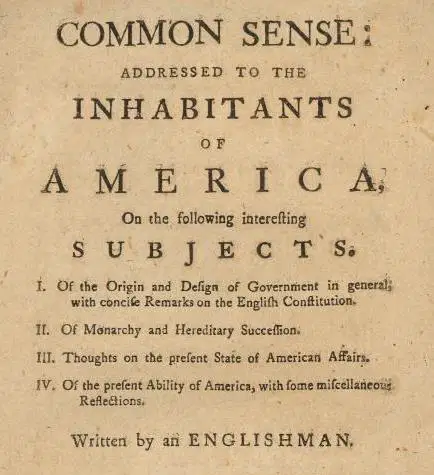
What was a main argument of Common Sense?
The colonists were petty in their complaints about the king.
The colonies should declare immediate independence from the king.
Taxes are a natural part of life.
A council should be created to work with the king.
What was the Mayflower Compact and example of?
Social Contract
A Ship
A Charter
Which of the following Enlightenment Philosophers believed in the idea of limited government, separation of powers and checks and balances?
John Locke
Baron De Montesquieu
Thomas Hobbes
Jean Jacques Rousseau
Which of the following Enlightenment Philosophers believed in the idea of Consent of the Governed and unalienable rights (life, liberty and property)?
John Locke
Baron De Montesquieu
Thomas Hobbes
Jean Jacques Rousseau
Which of the following Enlightenment Philosophers believed in the idea of a STRONG government (Absolute Monarchy) to ensure order in society because people cannot be trusted?
John Locke
Baron De Montesquieu
Thomas Hobbes
Jean Jacques Rousseau
"There would be no freedom if the same man or the same group of men controlled all three powers at the same time. This man or group of men would have complete control over all parts of the law"
- Spirit of Laws
Which Enlightenment Philosopher is being quoted?
John Locke
Baron De Montesquieu
Thomas Hobbes
Jean Jacques Rousseau
"Each person must put himself and all his power under the common control of the general will and must obey whatever the general will decides. Each member has the same power and is thus an equally important part of the whole"
- The Social Contract
Which Enlightenment Philosopher is being quoted?
John Locke
Baron De Montesquieu
Thomas Hobbes
Jean Jacques Rousseau
"In order to live in a more contented [happy]life and escape that miserable condition of war, men must give up their freedom to the State [government]. The power of the State must be absolute in order to keep men obedient, and tie them to fear of punishment."
- The Leviathan
Which Enlightenment Philosopher is being quoted?
John Locke
Baron De Montesquieu
Thomas Hobbes
Jean Jacques Rousseau
" Because men agree to enter into society to preserve their natural rights to life, liberty, and property, whenever the government attempts to take away or destroy the life, liberty, or property of the people, the government put itself in a state of war with the people and the people are released from any further obedience to the government "
- Two Treatise of Government
Which Enlightenment Philosopher is being quoted?
John Locke
Baron De Montesquieu
Thomas Hobbes
Jean Jacques Rousseau
"No freeman shall be seized, imprisoned, dispossessed, outlawed, or exiled, or in any way destroyed; nor will we proceed against or prosecute (punish) him except by lawful judgement of his peers, or by the law of the land"
- Magna Carta
This quote from the Magna Carta shows the influence on...
Law & Due Process
Self Government and Limited Government
Self Government and Independence
Due Process & Self Government
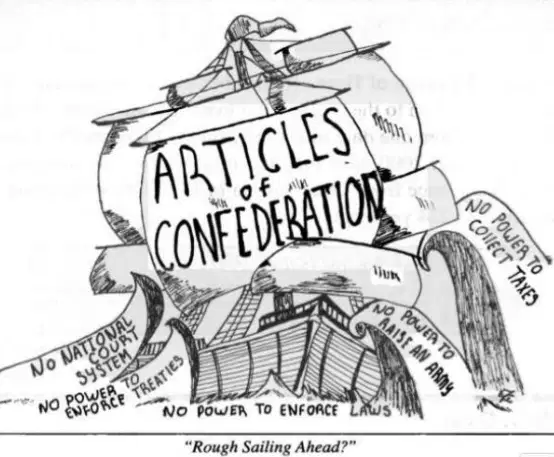
What is the sinking ship in the cartoon representing?
The Central Government
State Governments
The President
Federalism
Which of the following was NOT a weakness of the Articles of Confederation?
No chief executive (No president)
Restricts power of taxation for Congress
Establish a Federalist system of government in which power was split evenly through the federal and state governments
Establish a Confederal system of government in which states had the majority of the power
Under the Articles of Confederation Congress was
Unicameral and weak
Bicameral and weak
Unicameral and strong
Unicameral and strong
"When in the Course of human events, it becomes necessary for one people to dissolve the political bands which have connected them with another..."
-The Declaration of Independence, 1776
What does it mean to "dissolve political bands"?
Get rid of the relationship politically between the Colonies and Great Britain
Getting rid of British rule while still enjoying the benefits of being a colony
Establishing a Constitutional Monarchy in America rather than an Absolute Monarchy
Establishing an Absolute Monarchy in America rather than an Constitutional Monarchy
What are unalienable rights?
Rights that cannot be taken away by anyone under any circumstance
Rights that are given by a ruler that can be taken away by God
Rights that are given to the citizens by the government and can be taken away
Rights that are given to the citizens by the government and cannot be taken away
What Documents ensured that the power of the king is limited, citizens enjoy the right of due process, established rule of law and gives parliament (lawmaking body) more power?
Magna Carta & English Bill of Rights
Magna Carta & Mayflower Compact
Magna Carta & The American Bill of Rights
Mayflower Compact & Common Sense
The Anti Federalist refused to ratify the U.S. Constitution until the Federalist included the _____ ___ __________
(a)
Federalist supported the ratification (approval) of the U.S. Constitution and a (a) central/federal government.
Anti Federalist wanted to revise/modify the Articles and did not support strong (a) government.
The Great Compromise was a compromise between--
The Virginia Plan wanted representation based on--
The New Jersey Plan wanted representation in government based on--
What kind of congress did the Great Compromise establish?
1 House that votes on laws
(unicameral)
2 Houses that vote on laws
(bicameral)

Congress is made up of two houses, which one is based on population?
Congress is made up of two houses, which one has equal representation of 2 representatives per state?
The 3/5 Compromise settled the argument of--
Who was happy with the Virginia plan?
Small States with a small population
Large States with a big population
What kind of states supported the New Jersey Plan?
For the Great Compromise, how is the number of Senators determined?
Who held the most power under the Articles of Confederation?
States
National Government
Congress
the President
How do we vote for the President of the United States?
Indirectly, through the Electoral College Process
Directly, through the Electoral College Process
What type of votes count in the presidential election?
Electoral Votes
(votes from the senate and the house of representatives)
Popular Votes
(people's votes)
What do the separation of powers guarantee?
That government is not all powerful by distributing power
That government is strong enough to overpower the states
State sovereignty
How does the Supremacy Clause resolve conflicts between federal and state laws?
By allowing state laws to override federal laws
By stating that the Constitution and federal laws take precedence over state laws
By requiring conflicts to be resolved by the Supreme Court
By leaving it to individual states to decide
The document that replaced the Articles of Confederation
U.S. Constitution
Who was the author of the influential document, Common Sense ?
Thomas Hobbes
Thomas Paine
Thomas Jefferson
Thomas the Train
An agreement between people and government is a ________ __________ .
(a)
State of Nature can be best described as...
Without government
Without Democracy
Without central leadership
Without Federalism
Which system of government does the United States operate under?
(a)
The Word 'Ratify' means to
to make something official
to act in a rat-like or rodentine manner
to make something new
to stop a process
The Anti Federalist wanted a list of protections from the stronger central government the new U.S. Constitution would make, and refused to ratify the Constitution until they were added.
What was this list of protections called?
_____ __ ______
(a)
The European Union (EU) is a loose alliance of independent nation-states where they hold a common currency, the Euro.
Which geographic distribution of power best represents this system of government?
unitary
confederation
federal
Parliamentary
“. . . that the pretended power of suspending the laws, or the execution of laws, by regal authority, without consent of Parliament is illegal . . . that levying money for or to the use of the Crown . . . without grant of Parliament…is illegal . . . that it is the right of the subjects to petition the king . . . and that prosecutions for such petitioning are illegal . . .”
—English Bill of Rights
Which of the following ideas is embodied in this excerpt?
The king needed the consent of Parliament to appoint advisors and ministers.
The king needed the consent of Parliament in order to tax people.
The king had the power to suspend laws without Parliament’s consent.
The king had the right to prosecute illegal petitions protesting royal laws.

In the image depicted on the book cover of Leviathan, the imagery and title refers to Hobbes’ views regarding
the push for democracy
the “perilous future” of the Age of Revolutions
the social contract, which requires democratic participation
the state of nature, which is “nasty, brutish, and short”
Which philosopher suggested the idea that if a government fails to fulfill its purpose (to protect people's rights) in a social contract, the people have the right to overthrow it?
Jean Jacques Rousseau
John Locke
Thomas Hobbes
Baron de Montesquieu
“We hold these truths to be self-evident, that all men are created equal, that they are endowed by their Creator with certain unalienable rights, that among these are life, liberty, and the pursuit of happiness.”
This quotation from the Declaration of Independence reflects beliefs mainly derived from
Jean Jacques Rousseau’s idea of direct democracy
John Locke’s ideas
Montesquieu’s views
Thomas Hobbes’ theory of the state of nature

Which of the following correctly lists the types of governments from MOST power held by the central government to the LEAST power held by the central government?
Federal, unitary, confederate
Unitary, federal, confederate
Confederate, unitary, federal
All of their central government have the same amount of power
Which of the following best describes popular sovereignty?
People having power
Government having power
Representatives having power
The elite of society (educated) having power
What term describes the legal system that requires all citizens be treated fairly?
Separation of Powers
Bill of Rights
Due Process of Law
Popular Sovereignty

