
 Worksheets
Newtons 2nd Law Practice
Total questions: 65
Worksheet time: 2hrs 7mins
(Using Fnet=ma), What net force is required to accelerate a car at a rate of 2 m/s2 if the car has a mass of 3,000 kg?
6,000 N
1,500 N
3,002 N
2,998 N
(Use Fnet=ma), A 10 kg bowling ball would require what force to accelerate down an alleyway at a rate of 3 m/s2?
30 N
13 N
3.3 N
0.3 N
(Use Fnet=ma). Sally has a car that accelerates at 5 m/s2. If the car has a mass of 1,000 kg, how much force does the car produce?
5,000 N
200 N
0.005 N
1,005 N
(Use Fnet=ma). What is the mass of a falling rock if it produces a force of 147 N? (Acceleration due to gravity = 9.8 m/s2)
15 kg
1,440.6 kg
156.8 kg
137.2 kg
(Use Fnet=ma). What is the mass of a truck if it produces a force of 14,000 N while accelerating at a rate of 5 m/s2?
2,800 kg
0.0004 kg
70,000 kg
13,995 kg
(Use Fnet=ma). What is the acceleration of a softball if it has a mass of 0.5 kg and hits the catcher's mitt with a force of 25 N?
0.5 kg
50 kg
25.5 kg
12.5 kg
(Use Fnet=ma). Your parents' car has a mass of 2,000 kg. If your car produces a force of 5,000 N, at what rate will it accelerate?
2.5 m/s2
0.4 m/s2
10,000,000 m/s2
3,000 m/s2
(Use Fnet=ma). If an object was accelerating at 10 m/s2, and a force of 10 newtons was required to accelerate it, what was the object's mass? (m=F/a)
1 kilogram
10 kilograms
2 kilograms
5 kilograms

(Use Fnet=ma). Use the diagram to determine the net force, assume the object is accelerating at a rate of 2 m/s2 and determine the mass of the object.
2 kg
4 kg
6 kg
8 kg

(Use Fnet=ma). Use the diagram to determine the net force, assume the object is accelerating at a rate of 3 m/s2, and determine the object's mass?
3 kg
5 kg
60 kg
75 kg
What is the equation to solve for FORCE?
F=ma
F=m/a
F=a/m
(Use Fnet=ma). Use the diagram to determine the net force, assume the object is accelerating at a rate of 2 m/s2. What amount of mass does the object have?
2 kg
4 kg
6 kg
8 kg
Since Force = Mass * Acceleration, how would you manipulate the equation to solve for acceleration?
Divide both sides of the equation by Mass
Divide both sides of the equation by force
Divide both sides of the equation by acceleration
Equations cannot be manipulated

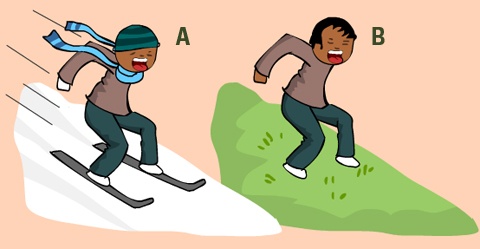

Which box will accelerate MORE given the SAME applied force?
top
bottom
m/s2 is the unit for.....
Mass
Force
Acceleration
weight

How do you find the net force of this image.
Add up all the arrows
Add a green arrow and the orange arrow.
Subtract all the arrows.
Add the green arrows and subtract the orange arrow.
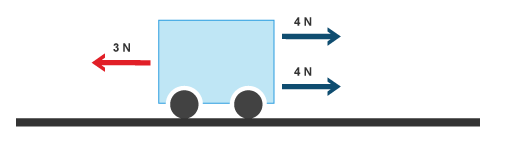
What is the net force on the object pictured?
3 N
5 N
4 N
8 N

What is the net force and to what direction.
210 N to the right
280 N to the right
110 N to the left
180 N to the left

Which SI unit is used to measure mass?
s
m
kg
Pa

25 Newtons
20 Newtons
200 Newtons
10 Newtons

Kelli is trying to move a 1200kg car at a rate of 4 m/sec2. What is the force needed to accelerate of the object?
300N
1,250N
4800 N
5kg

(a)

If you increase the force on an object, its acceleration (a)

Force is equal to
(a) * (b)

Which example best explains Newton's Second Law of Motion?
When a glass slid across a table, it spilled water when it stopped suddenly.
It takes less force to move a small car compared to a large truck.
When you sit on a chair, your body exerts a downward force on the surface of the chair, while the chair exerts an equal and upward force on your body.
Forces that are exerted on an object which are equal in size but opposite in direction
Unbalanced force
Balanced force

True or False. Acceleration of an object is directly proportional to the net force acting on it?
True
False
An evil ewok threw a rock with a force of 24.6N and an acceleration of 6m/s2 at an innocent stormtrooper. What was the rocks mass?
4Kg
41kg
4.1kg
46kg
Your car has a mass of 2500 kg and a force of 5000 N. How fast will it accelerate?
20 m/s2
2 m/s2
0.5 m/s2
120 N

What happens when unbalanced forces act on an object at rest?
the object remains at rest
the object begins moving in an unpredictable direction
the object begins moving in the direction of the net force
the object begins moving opposite to the direction of net force
A 20 kg bike accelerates at 10 m/s2. What was the force?
25 Newtons
20 Newtons
200 Newtons
10 Newtons

What is the net force?
40 N left
400 N right
0 N Balanced
40 N right
What Unit do we Measure Force in?
Newtons
Joules
Kilogram
Work
Jenny applies a 60 N force to a 20 Kg cart, what is the acceleration of the cart if friction can be neglected?
1200 m/s/s
0.33 m/s/s
20 m/s/s
3 m/s/s
What is force?
A push exerted on an object
A push or pull exerted on an object
A pull exerted on an object
Nothing
The mass of a wagon is 40 kg. The wagon accelerates at 8 m/s2 . What is the force?
38.25 Kg
320N
5N
3.825Kg
If an object was accelerating at 10 m/s2, and a force of 10 newtons was required to accelerate it, what was the object's mass?
1kg
10kg
5kg
2kg
What is Newton's 2nd Law?
F=ma
Every action has an equal and opposite reaction
An object at rest stays at rest, an object in motion stays in motion.
Friction

If the man pushes with an equal amount of force, which object will accelerate more?
Car because it has more mass
Lawnmower because it has less mass
Car because it has less mass
Lawnmower because it has more mass
A 25 kg bike accelerates at 10 m/s2. What was the force?
250 N
2.5 N
25 N
15 N


A force of 20 N acts upon a 5 kg block. Calculate the acceleration of the object.
100 m/s2
70 m/s2
15 m/s2
4 m/s2

Which would require more force to place in your shopping car?
Both
Pineapple
Watermelon
What is the unit for mass?
kg
newton
m/s
m/s2
What is the equation needed to solve for acceleration?
A=fm
A=m/f
A=f/m
What is the equation needed to solve for mass?
M=a/f
M=f/a
M=fa

