
 Worksheets
Y7 U2 Materials and their Structure
Total questions: 77
Worksheet time: 54mins


What is it called when water droplets form on the outside of a cool glass?
Condensation
Transpiration
Precipitation
Evaporation
The water cycle is a good example of the cyclic nature of some materials in a natural ecosystem. Cyclic is best defined as
never ending
occurring in cycles
succession
As water evaporates it enters the air as
clouds
rain
water vapor
The water that moves along the surface of the earth is called
ground water
surface water
runoff water
Precipitation that enters the soil is called
ground water
surface water
runoff water
What pulls the groundwater down until it cannot go any deeper?
substrate
succession
gravity
Where is groundwater stored?
in lakes and rivers
in underground lakes
in cracks and pores beneath Earth's surface
in mid-ocean ridges
What is a matter?
Anything that can fill up a space and has mass.
Something that can be measure by weight.
What are the three states of matter? Choose 3 answers.
Solid
Liquid
Gas
Water
Solid has a __________ shape.
Fixed
Not fixed
Take up space
Gas has a shape of the container as they (a) .
Liquid has (a) shape.
Particles in solid have these properties.
Slightly close together, weak force of attraction and can move slightly.
Very far apart, no force of attraction and can move freely.
Closely together, has a strong force of attraction and cannot move.
Particles in liquid have these properties.
Closely together, has a strong force of attraction and cannot move.
Very far apart, no force of attraction and can move freely.
Slightly close together, weak force of attraction and can move slightly.
Particles in gas have these properties.
Very far apart, no force of attraction and can move freely.
Closely together, has a strong force of attraction and cannot move.
Slightly close together, weak force of attraction and can move slightly.

It contains only one type of atom.
(a)

It contains two or more types of atoms that are chemically joined together.
(a)

It contains two or more types of atoms or molecules which can be physically separated.
(a)
The smallest division of particle.
Atom
Element
Compound
Mixture
Which of the following is not an element?
Nitrogen
Oxygen gas
Helium
Carbon
Which of the following is not a compound?
Nitrogen Dioxide
Oxygen gas
Magnesium Carbonate
Carbon Dioxide
Which of the following is not a mixture?
Nitrogen Dioxide
Sandy water
Seawater
Flour and salt
Which method is use to separate a mixture of solids with different sizes?
(a)
Which method is use to separate soluble solids from a solution?
(a)
Which method is use to separate insoluble solids from a mixture?
(a)
Which method is use to separate a mixture of liquids with different boiling point?
(a)

What state of matter does the picture below represent?
solid
liquid
gas
plasma
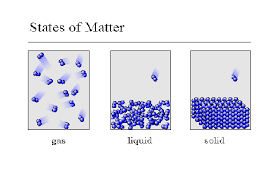

Particles of a liquid
are tightly packed together and stay in a fixed position.
are free to move around one another but still touch.

Has a definite volume but not a definite shape
Solid
Liquid
Gas
Particles vibrate in place and do not change relative positions.
solid
liquid
gas

Freezing
Solid to gas
Liquid to solid
Gas to solid
solid to gas

Boiling
liquid to gas
gas to solid
gas to liquid

What is happening when my ice cream changes from a solid to a liquid?
freezing
melting
burning
What is condensation?
gas to solid
gas to liquid
liquid to solid

The particles in the picture are tightly held together with very tiny movement. They have shape and fixed volume. Therefore, the picture represents _________.
solid
liquid
gas
plasma

What state is represented in the gif?
Solid
Liquid
Gas

a. The glass now has less water in it. What happened to the water?
condensation
gas
evaporation
solid

a. The steam makes Mom’s kitchen window look cloudy. What is happening?
(a)

What is the volume of water in ml from this measuring cylinder?
Give your answer with unit.
(a)
All matter is made up of tiny _______________
energy
particles (atoms and molecules)
bits
antimatter
Particles at a higher temperature, move _____________ than those at a lower temperature.
faster
slower
In which state of matter will there be the LARGEST space between molecules?
Solid
Liquid
Gas
Which of the following is a correct description for solids?
closely arranged and in fixed positions
closely arranged and vibrate in fixed positions
closely arranged and can move around
What is the chemical symbol for Neon?
(a)
What is the chemical symbol for Beryllium?
(a)
What is the chemical symbol for Phosphorus?
(a)
Which element has the chemical symbol of K?
(a)
Which element has the chemical symbol of Al?
(a)
The Periodic Table is organised into rows and columns. The rows (horizontally) are called (a) .
The Periodic Table is organised into rows and columns. The columns (vertically) are called (a) .
Which element is from the last group of the Periodic Table?
Lithium
Magnesium
Silicon
Argon
Which element is from the first group of the Periodic Table?
Lithium
Magnesium
Silicon
Argon
Which element is from the second group of the Periodic Table?
Lithium
Calcium
Silicon
Argon
Tick examples of compounds


Periodic Table is an orderly arranged table of __________?
compounds
mixture
atoms
elements
The chemical term for two atoms joining tightly together is (a) .
Name a compound that consists of the sodium element and chlorine element.
(a)
Name the compound that consists of the magnesium element, sulfur element and oxygen element.
(a)
Which two elements are combined in hydrogen sulfide?
(a)
Which two elements are combined in magnesium oxide?
(a)
Which three elements are combined in calcium carbonate?
(a)
What the the symbol of sodium hydroxide compound?
(a)

The diagrams in the boxes show different arrangements of particles.
Which of the diagram represents: particles of a compound
A
B
C
D
The diagrams in the boxes show different arrangements of particles.
Which of the diagram represents: particles of a molecule.
A
B
C
D
The diagrams in the boxes show different arrangements of particles.
Which of the diagram represents: atoms of a mixture.
A
B
C
D
The diagrams in the boxes show different arrangements of particles.
Which of the diagram represents: atoms of an element.
A
B
C
D

