
Font size
 Worksheets
Refraction of light
Total questions: 64
Worksheet time: 1hrs 11mins

The diagram shows a ray of light going from medium A into medium B. Which one of the following statements cannot be correct?
A is air and B is glass.
A is water and B is vacuum.
A is water and B is air.
A is glass and B is vacuum.

A ray of light is shone on a rectangular glass block as shown. Identify A, B and C.
A = Refracted ray, B = Incident ray, C = Normal
A = Incident ray, B = Refracted ray, C = Normal
A = Normal, B = Refracted ray, C = Incident ray
A = Refracted ray, B = Angle of incidence, C = Angle of refraction

When a drinking straw is placed in a container of water so that it is partly submerged, it appears bent because of
apparent depth
Snell's Law
Refraction
lateral inversion

The diagram shows a ray of light AB striking the interface of medium X and medium Y. BC is the refracted ray. Which one of the following statements is correct?
Medium X is optically less dense than Y and ray BC travels faster than AB.
Medium X is optically denser than Y and ray BC travels slower than AB.
Medium X is optically denser than Y and ray BC travels faster than AB.
Medium X is optically less dense than Y and ray BC travels slower than AB.
When light passes from one medium into another, refraction occurs. This is because of
reflection of light.
a change in color of the light.
a change in velocity of the light.
the absorption of light.
A light ray does not bend at a boundary between two media of different optical densities if its angle of incidence is
180o
45o
0o
90o
The quantity which does not changes during refraction is
direction
speed
frequency
wavelength
The ratio of sin (x °) of the angle of incidence to sin (x °) of the angle of refraction is
Gravitational law
Reflection law
Snell's law
refraction law
The best definition of refraction is ____.
passing through a boundary
changing direction when crossing a boundary
changing speed at a boundary
bouncing off a boundary
When light travels from air into water, the light bends ____________.
towards the normal line
away the normal line
perpendicular to the normal line
in an odd shape
A light ray is incident on a glass block as shown. Identify the correct statement.
The glass block is optically denser than the medium outside and the ray bends towards the normal.
The glass block is optically less dense than the medium outside and the ray bends away from the normal.
The glass block is optically denser than the medium outside and the ray bends away from the normal.
The glass block is optically less dense than the medium outside and the ray bends towards the normal.
When light travels from air into water, the light bends ____________.
away the normal line
perpendicular to the normal line
in an odd shape
towards the normal line
The best definition of refraction is ____.
passing through a boundary
changing speed at a boundary
bouncing off a boundary
changing direction when crossing a boundary
When light passes from a denser material into a less dense material...
light slows down and bends toward the normal
light slows down and bends away from the normal
light speeds up and bends toward the normal
light speeds up and bends away from the normal
Identify the correct definition of the critical angle.
The critical angle is the angle of incidence when the angle of refraction is exactly 90° and light is refracted along the boundary
The critical angle is the angle of refraction when the angle of incidence is exactly 90° and light is refracted along the boundary
The critical angle is the angle of incidence when the angle of refraction is exactly 90° and light is reflected along the boundary
The critical angle is the angle of refraction when the angle of incidence is exactly 90° and light is reflected along the boundary
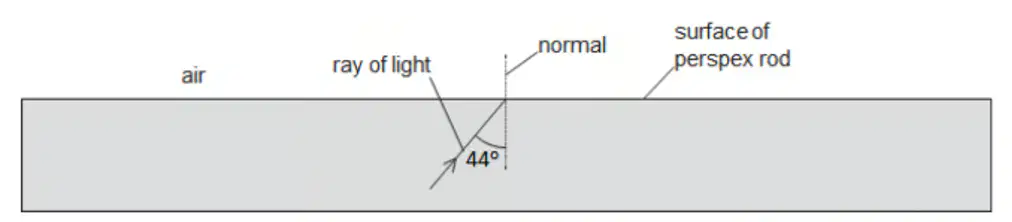
The diagram shows a ray of light inside a perspex rod . Perspex has a critical angle of 42° .
Which one is the correct condition whether there is any light reflected from the surface, and whether there is any light refracted out of the perspex rod?
reflected: yes
refracted: yes
reflected: yes
refracted: no
reflected: no
refracted: yes
reflected: no
refracted: no
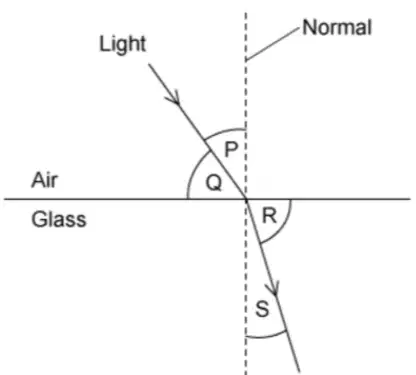
The diagram shows light passing from air into glass. A number of angles have been labelled on the diagram.
Which of equations could be used to correctly calculate the refractive index, n, of the glass?
sin Ssin P
sin Rsin Q
sin Rsin P
sin Ssin Q
Light enters a flat water surface at an angle of 27° .
The refractive index of water is 1.33.
At what angle does the light ray refract?
0.34°
20.0°
20.3°
37.0°
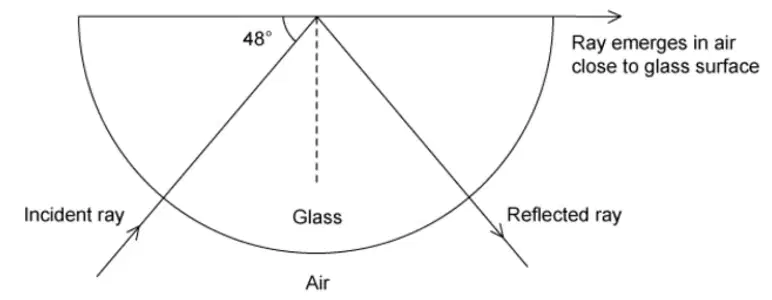
A ray of light is shone into a semi-circular glass block so that it makes an angle of 42° with the rear, flat edge of the block as shown.
Calculate the refractive index of the glass.
0.023
1.49
2.381
1.35
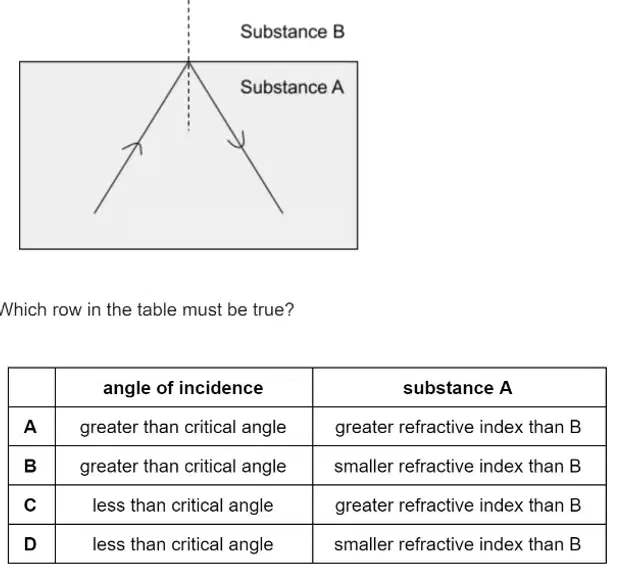
The diagram shows a ray of light being totally internally reflected at boundary between substances A and B.
A
B
C
D

The diagram shows a ray of light incident on the edge of a piece of glass. The angle i is bigger than the critical angle.
Which arrow correctly shows the direction of the ray after it leaves the edge of the glass?
A
B
C
D

Answer the question correctly.
A
B
C
D
Which diagram shows how a ray of light could pass through a glass block in air?


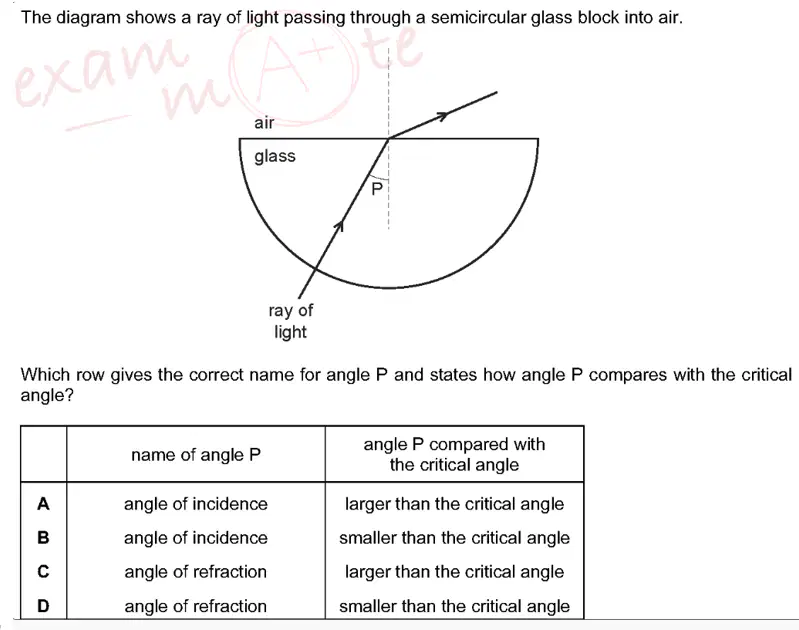
Answer the question correctly.
A
B
C
D
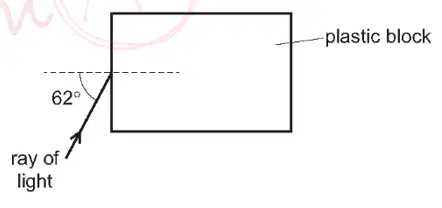
Light travelling in air enters a plastic block at an angle of incidence of 62° .
The plastic has a refractive index of 1.48.
What is the angle of refraction?
18°
28°
37°
42°
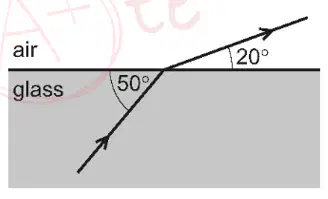
The diagram shows light travelling from glass to air.
What is the angle of refraction for this ray of light?
20°
40°
50°
70°
A student draws four diagrams to represent light passing from air through a glass block and then back into the air.
The critical angle of glass is 42° .
In which diagram is the path of the light through the glass block not correct?


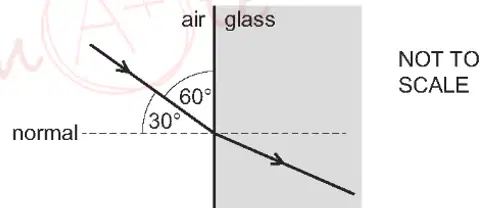
The diagram shows the light passing from air into glass.
The glass has refractive index of 1.5.
What is the angle of refraction in the glass?
19°
22°
35°
49°
flint glass n=1.70
barium glass n=1.60
crown glass n=1.523
water n=1.33
diamond n=2.45
flint glass n=1.70
barium glass n=1.60
crown glass n=1.523
water n=1.33
diamond n=2.45
flint glass n=1.70
barium glass n=1.60
crown glass n=1.523
water n=1.33
diamond n=2.45


diamond n=2.45
flint glass n=1.70
barium glass n=1.60
crown glass n=1.523
The formula for magnification is
height of object/height of image
height of image /height of object
h'/h
h/h'
What is the lens formula used to calculate the position of an image?
(1/f = 1/v + 1/u)
(1/f = 1/v - 1/u)
(1/f = 2/v + 2/u)
(1/f = 1/v^2 + 1/u^2)
A 15.0 m object is placed 10.0 m from a convex lens, which has a focal length of 15.0 m.
Use the thin lens equation to find the distance of the image.
-10
10
-30
30
Calculate the power of a concave lens of focal length 60 cm
−1.67 D
+1.67 D
−16.7 D
+ 16.7 D
An object is placed 60.0 cm from a convex lens, which has a focal length of 15.0 cm. Use the lens formula to find the distance of the image formed.
10 cm
20 cm
30 cm
40 cm
If the power of a lens is – 2 D, what is its focal length?
+50 cm
-100 cm
-50 cm
+100 cm
You are given three media A, B and C of refractive index 1.33, 1.65 and 1.46. The medium in which the light will travel fastest is
A
B
C
Equal in all media
The refractive index of water is 1.33. The speed of light in water will be:
1.33 × 10^8 m/s
3 × 10^8 m/s
2.66 × 10^8 m/s
2.26 × 10^8 m/s
When a light ray is travelling from denser medium to rarer medium, it -----------.
bends towards the normal
bends away from the normal
does not bend
A light ray is incident on a glass block as shown. Identify the correct statement.
The glass block is optically denser than the medium outside and the ray bends towards the normal.
The glass block is optically less dense than the medium outside and the ray bends away from the normal.
The glass block is optically denser than the medium outside and the ray bends away from the normal.
The glass block is optically less dense than the medium outside and the ray bends towards the normal.
When light travels from air into water, the light bends ____________.
towards the normal line
away the normal line
perpendicular to the normal line
in an odd shape
The quantity which does not changes during refraction is
direction
speed
frequency
wavelength
A light ray does not bend at a boundary between two media of different optical densities if its angle of incidence is
180o
45o
0o
90o
When light passes from one medium into another, refraction occurs. This is because of
reflection of light.
a change in color of the light.
a change in velocity of the light.
the absorption of light.
The diagram shows a ray of light going from medium A into medium B. Which one of the following statements cannot be correct?
A is air and B is glass.
A is water and B is vacuum.
A is water and B is air.
A is glass and B is vacuum.
A ray of light is shone on a rectangular glass block as shown. Identify A, B and C.
A = Refracted ray, B = Incident ray, C = Normal
A = Incident ray, B = Refracted ray, C = Normal
A = Normal, B = Refracted ray, C = Incident ray
A = Refracted ray, B = Angle of incidence, C = Angle of refraction
When does the light is refracted?
When light travels in a straight line
When light is bounced
When light travels in two different mediums
When light cannot pass through an opaque object

Diagram shows a phenomenon occurs when the spotlight is directed onto a mirror surface. What is the principle of light shown in the situation?
Light travels in a straight line
Refraction of light
Reflection of light
Light travels in parallel


