wayground logo

Free Printable Worksheets

Font size

S
M
L
XL
Worksheets

Bio 107 Test 1

Total questions: 89

Worksheet time: 1hrs 9mins

Name
Class
Date
1.

There are three tenets of the Cell Theory. Which of the following is NOT a tenet?

a)

Cells are the basic structure and function of life.

b)

All living things are made of one or more cells.

c)

The cell is the basic unit of matter.

d)

All cells come from preexisting cells.

2.

____ is credited with being the first scientist to observe cork cells.

a)

Leewenhoek

b)

Shleidon

c)

Hooke

3.
This scientist concluded that plants are made of cells:
a)
Virchow
b)
Schwann
c)
Schleiden
d)
Leeunwenhoek
4.
This scientist concluded that animals and, in fact, all living things are made of cells:
a)
Hooke
b)
Leeunwenhoek
c)
Schleiden
d)
Schwann
5.
All organisms are made of:
a)
organelles
b)
cytoplasm
c)
DNA
d)
cells
6.
This is the most basic unit of life
a)
atom
b)
cell
c)
nucleus
d)
DNA
7.
Which of the following scientists was the first to observe bacteria?
a)
Anton van Leuwenhoek
b)
Matthais Schleiden
c)
Robert Hooke
d)
Theodor Schwann
8.
Who are the three scientists credited with creating the Cell Theory?
a)
Schlieden, Schwann, Virchow
b)
Schindler, Schmeil, Vanderhoot
c)
Schwimmer, Shanazzek, Van Halen
9.
Rigid, outermost layer of the plant cell
a)
nucleus
b)
cell membrane
c)
cell wall
d)
cytoplasm
10.
Where are proteins made? These are small, grain-like or rod shaped organelles.
a)
Golgi body
b)
Mitoichondrion
c)
Chromosomes
d)
Ribosomes
11.
This cell part is in ALL cells. It is the gel-like substance that provides cell shape.
a)
Chloroplasts
b)
Chromosomes
c)
Cytoplasm
d)
Mitochondria
12.
This organelle is like a recycling center for the cell. It breaks down old materials. It is like a vacuum cleaner that cleans up the waste in cells.
a)
Ribosomes
b)
Lysosomes
c)
Mitochondria
d)
Chloroplasts
13.

Which organelle receives proteins and materials from the ER and packages them and distributes them?

a)

ribosomes

b)

lysosome

c)

nucleolus

d)

Golgi body

14.
Which of these statements best describes the function of the cell membrane?
a)
It allows things to freely enter and exit the cell
b)
it controls which substances enter and exit the cell
c)
it prevents substances from entering the cell
d)
it prevents substances from leaving the cell
15.

Which of the following transports material within the cell?

a)

Golgi apparatus

b)

Endoplasmic reticulum

c)

cell wall

d)

ribosomes

16.

network of proteins found within the cytoplasm

for support and structure in cell

a)

Cytoskeleton

b)

Mitochondria

c)

Cilia

d)

Ribosome

17.

used for storage in the cell

a)

lysosome

b)

vacuole

c)

mitochondria

d)

chloroplast

18.

transports proteins throughout the cell

a)

lysosome

b)

vesicle

c)

cilia

d)

vacuole

19.

"B" is the...

a)

polar head

b)

non-polar tail

c)

hydrophobic head

d)

hydrophillic tail

20.

"C" is the...

a)

polar head

b)

non-polar tail

c)

hydrophobic head

d)

hydrophillic tail

21.
Which structure is common to plant and animal cells?
a)
central vacuole
b)
chloroplast
c)
wall made of cellulose
d)
mitochondrion
22.
Endoplasmic Reticulum:/ER
a)
The smallest organelle with a huge job / Makes proteins, which are the building blocks of the body.
b)
A folded membrane that moves materials around inside cells / Also acts as the site of manufacturing materials needed by the cell.
c)
A small sack that stores water and food until the cell needs it /  Stores waste temporarily until the cell  gets rid of it.
d)
The protective outer layer that controls what enters and leaves the cell.
23.
What 4 structures are common between plant, animal, and bacterial cells?
a)
Golgi Apparatus, Chloroplasts, Ribosomes, Nucleus
b)
Cell Wall, Mitochondria, Cell Membrane, Cytoplasm
c)
Rough ER, Smooth ER, Nucleus, Ribosomes
d)
DNA, Cytoplasm, Ribosomes, Cell membrane
24.
This experiment was conducted by the scientists:
a)
Stanley Miller and Harold Urey
b)
Harold Urey and Albert Einstein
c)
Louis Pasteur and Francesco Redi
d)
James Watson and Francis Crick
25.
Which question were the scientists trying to answer with this experiment?
a)
Where do cells come from?
b)
How did prokaryotes form cell membranes?
c)
How are biomolecules formed?
d)
What gave rise to the Eukaryotic cell?
26.
The apparatus in the experiment was used to mimic what?
a)
Proteins
b)
Present Earth conditions
c)
Early Earth conditions
d)
Nucleic acids (DNA/RNA)
27.
The electrical sparks mimicked?
a)
The Sun's energy
b)
Lightning
c)
Volcanic eruptions
d)
Cosmic radiation
28.
Miller/Urey and other scientists have shown that:
a)
 Life on early Earth required material from space
b)
Cells survived in the primitive atmosphere
c)
Amino acids could be produced from inorganic molecules 
d)
Simple cells can be produced in a laboratory
29.
Which type of cell came first?
a)
Eukaryotic
b)
Prokaryotic
c)
Plant
d)
Both Eukaryotic and Prokaryotic cells evolved around the same time
30.
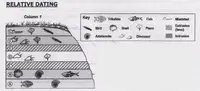
The diagram shows fossils in different rock layers. Which of these statements about the age of these fossils is most likely correct?
a)
Fossil A and C are the same age
b)
Fossil B is older than fossil C
c)
Fossils A is older than fossil B
d)
Fossil D is older than fossil C
31.
Based upon the conditions of the early Earth, which forms of live most likely appeared first?
a)
Prokaryotic and aerobic
b)
Prokaryotic and anaerobic 
c)
Eukaryotic and aerobic
d)
Eukaryotic and anaerobic
32.
The idea that Earth's early oceans had organic molecules that became the first life is called the...
a)
Primordial soup hypothesis
b)
Bubble hypothesis
c)
Miller-Urey Experiment
d)
Radioactive dating theory
33.
The theory of Endosymbiosis explains...
a)
The origin of eukaryotes
b)
How species develop
c)
How bacteria evolved
d)
Why cells rely on one another
34.
The Miller-Urey experiment of 1953 was designed to test the hypothesis that lightning supplied the energy needed to turn atmospheric gases into organic molecules such as amino acids. Which of the following describes why the Miller-Urey theory is widely accepted today? 
a)
Amino acids spontaneously form from molecules in the atmosphere today
b)
 Organic molecules are present today in extremely high concentrations
c)
The process of synthesizing organic molecules from a mixture of gases has been successfully modeled in the laboratory
d)
No other alternative hypotheses have been introduced
35.

How are mitochondria and chloroplasts like bacteria cells?

a)

They divide by meiosis

b)

They can make their own food

c)

They have the same membrane-bound organelles

d)

They contain their own DNA

36.

Which organisms cannot make their own food

a)

heterotrophic

b)

autotrophic

c)

anaerobic

d)

prokaryotes

37.

What two ways do autotrophs create their own food

a)

photosynthesis

b)

oxidation

c)

chemosynthesis

d)

spontaneous generation

38.

Which scientist studied meat and maggots to see where life came from?

a)

Aristotle

b)

Linnaeus

c)

Pasteur

d)

Redi

39.

Which of these means that living things have to come form other living things?

a)

Spontaneous generation

b)

Homeostasis

c)

Peptidoglycan

d)

Biogenesis

40.

Which French scientist confirmed that all life can only evolve from preexisting life and disproved spontaneous generation?

a)

Francisco Redi

b)

John Needham

c)

Louis Pasteur

d)

Alfred Wallace

41.

What experiment did Louis Pasteur conduct to disprove spontaneous generation?

a)

Used two containers of rotten meat, one covered and one uncovered and the appearance of flies

b)

Boiled chicken broth, one left in an open flask and the other left in a sealed flask.

c)

Boiled chicken broth in a goose necked flask that stayed there for a year with no signs of microorganisms until the flask was broken.

42.

What is the idea that life can arise form nonliving material?

a)

biogenesis

b)

evolution

c)

spontaneous combustion

d)

spontaneous generation

43.

What is Spontaneous Generation?

a)

Old belief that living organisms came from non-living things

b)

Old belief that living things come from other living things

c)

Current belief that living organisms come from non-living things

d)

Current belief that living organisms come from other living things

44.

Using the diagram, which scientist disproved Spontaneous Generation?

a)

Pasteur

b)

van Leeuwenhoek

c)

Hooke

d)

Redi

e)

Spallanzani

45.

Using the diagram, which scientist disproved Spontaneous Generation?

a)

Pasteur

b)

van Leeuwenhoek

c)

Hooke

d)

Redi

e)

Spallanzani

46.

__________ is the theory that living things come from other living things.

a)

biogenensis

b)

spontaneous generation

c)

cell theory

d)

evolution

47.

One criticism of Spallanzani's experiment was

a)

he didn't boil the broth long enough

b)

he had a poorly controlled experiment

c)

all of the options listed

d)

air could not get to the broth

48.

Pasteur was able to keep the broth her boiled open to air by

a)

using a special S shaped flask

b)

adding a fan to allow better air flow

c)

none of the options listed

d)

both of the options listed

49.

How long after boiling the broth was Pasteur able to keep it germ free?

a)

1 month

b)

2 months

c)

1 year

d)

3 years

50.

The reason the broth eventually became spoiled for Pasteur was _______.

a)

He broke off the flask so germs could enter

b)

Enough time elapsed so the boiling was no longer effective

c)

Someone broke into his lab and contaminated the broth

d)

Spontaneous generation will actually occur if enough time lapses

51.

What name did Oparin and Haldene give the special ingredients that they hypothesized eventually became life

a)

Adam and Eve stew

b)

biogenesis

c)

primodial soup

d)

abiogenesis

52.

The opossum and kangaroo both incubate their young in a pouch. This provides evidence that they

a)

belong to the same species

b)

are descended from a common ancestor

c)

Have very similar skeletal structures

d)

must range great distances to eat

53.

Which layer has the oldest fossils?

a)

D

b)

B

c)

C

d)

E

e)

A

54.

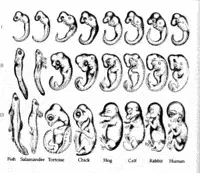
What type of evidence is shown with the diagram above?

a)

Molecular

b)

Embryological

c)

Anatomical

d)

Fossil

55.

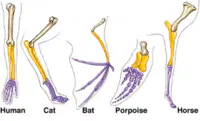
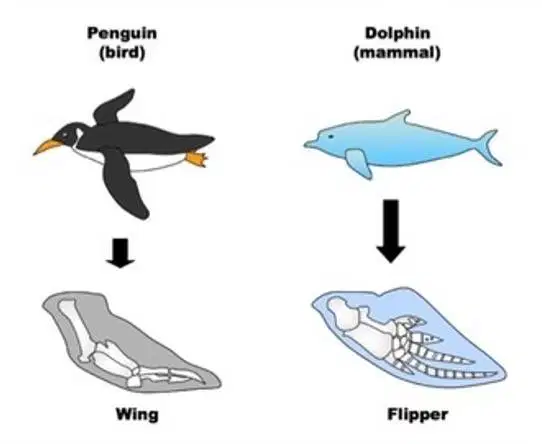
What is this type of structure?

a)

Analogous

b)

Vestigial

c)

Embryological

d)

Homologous

56.

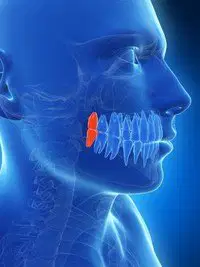
What type of structure is this?

a)

Homologous

b)

Embryological

c)

Analogous

d)

Vestigial

57.

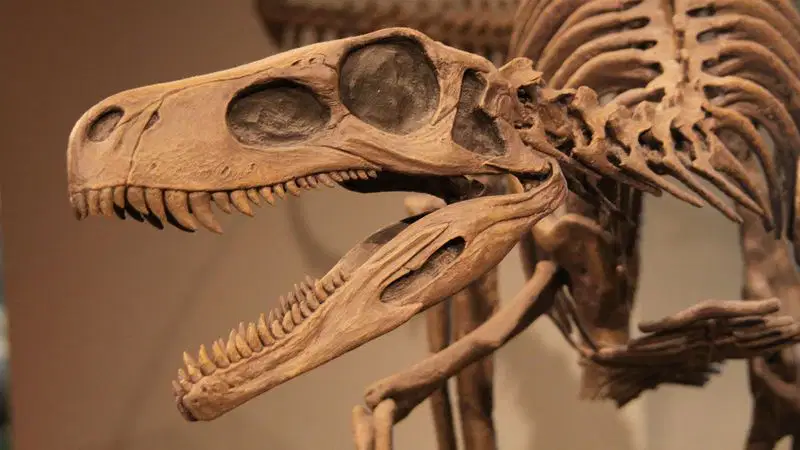
What type of structure is this?

a)

Embryological

b)

Vestigial

c)

Homologous

d)

Analogous

58.

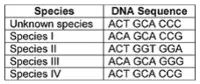
According to this data, the unknown bacterial species is a representation of what type of evidence

a)

Vestigial

b)

Analogous

c)

Embryological

d)

Amino Acid Sequencing

59.

Which type of evidence does this describe?

Scientists find fossilized bones of a huge animal that doesn’t exist today.

a)

Fossil Record

b)

Biogeography

c)

Vestigial Structure

d)

Convergent Evolution

60.

Which type of evidence does this describe?

Both Honey Possums and Butterflies lick nectar from flowers using a tongue. Honey Possums' tongues are made of muscle while Butterfly tongues are made of hard protein.

a)

Fossil Record

b)

Biogeography

c)

Vestigial Structure

d)

Convergent Evolution

61.

Which type of evidence does this describe?

Organisms that live closer to each other tend to be more closely related even if their environments are very different

a)

Fossil Record

b)

Biogeography

c)

Vestigial Structure

d)

Convergent Evolution

62.

What does the term "gene pool" refer to?

a)

The collection of all ecosystems in a given area

b)

The set of all genes or genetic information in any population, usually of a particular species

c)

A storage facility for genetic samples

d)

The total number of genes in a single organism

63.

What does allele frequency describe in a population?

a)

The physical characteristics of the organisms

b)

The number of individuals in the population

c)

How common an allele is within the population

d)

The total number of alleles in the population

64.

What does the "Thumb" represent in the "Five Fingers of Evolution"?

a)

Adaptations

b)

Mutations

c)

Non-Random Mating

d)

Small Population

65.

Which "finger" of evolution is associated with "Gene Flow"?

a)

Pinky Finger

b)

Ring Finger

c)

Middle Finger

d)

Index Finger

66.

What is indicated by the "Ring Finger" in the "Five Fingers of Evolution"?

a)

Small Population

b)

Non-Random Mating

c)

Adaptations

d)

Mutations

67.

Which evolutionary factor is illustrated in the image where the population of beetles changes over generations?

a)

Genetic Drift

b)

Non-Random Mating

c)

Mutations

d)

Natural Selection

68.

Natural selection could not occur without

a)

genetic variation in species

b)

environmental changes

c)

competition for unlimited resources.

d)

gradual warming of the Earth.

69.

The major idea that Darwin presented in his book The Origin of Species was that

a)

species changed over time and never competed with each other.

b)

animals changed, but plants remained the same.

c)

giraffes and peppered moths changed constantly.

d)

species changed over time by natural selection.

70.

Evidence for evolution includes all of the following except

a)

acquired characteristics.

b)

similarities and differences in proteins and DNA sequences between organisms.

c)

the fossil record.

d)

homologous structures.

71.

Which of the following are examples of fossils?

a)

shells or old bones

b)

any traces of dead organisms

c)

footprints of human ancestors, insects trapped in tree sap, and animals buried in tar

d)

All of the above

72.

A biologist analyzes the DNA sequences in three different primates. The biologist finds that primates “A“ and “B” have almost exactly the same DNA sequences. The DNA sequences in primate “C” are significantly different from those of primate “A” and primate “B”. This information allows the biologist to infer that

a)

primates “A” and “B” are more closely related to each other than either is to primate “C.”

b)

all three primates appeared on Earth at about the same time.

c)

either primate “A” or primate “B” must be a direct ancestor of primate “C.”

d)

primate “C” must have been the ancestor of both primate “A” and “B.”

73.

Which of the following is a vestigial structure?

a)

the human tailbone

b)

the bill of a finch

c)

flower color

d)

fossil cast

74.
A flash flood carried a raft of Amazon ants away from their original population. There is enough distance between the two groups, that they will never meet in nature again. What type of reproductive barrier is this?
a)
behavioral isolation
b)
temporal isolation 
c)
gametic isolation
d)
geographic isolation 
75.
Some female peacocks prefer males with large, colorful tales while other female peacocks prefer males with no tail at all. Females are beginning to only mate with the type of males with the tail they prefer. What type of reproductive barrier is this?
a)
behavioral isolation
b)
hybrid sterility 
c)
temporal isolation
d)
mechanical isolation 
76.
The term for the formation of new and distinct species over the course of evolution is...
a)
speciation
b)
biological species concept
c)
reproductive barrier
d)
natural selection
77.
What is a species? 
a)
A group of organisms that can mate with each other and produce fertile offspring. 
b)
A group of organisms that can mate and produce offspring even if those offspring are infertile.
c)
A group of organisms that genetically are very different from each other. 
d)
Indivual organisms that live in the same environment. 
78.

A new river forms and splits two populations, causing ______________ speciation

a)

Sympatric

b)

Allopatric

c)

Extreme

d)

Convergent

79.

When the Grand Canyon in Arizona formed, two populations of one squirrel species were separated by the giant canyon. This is an example of _____________ speciation.

a)

Allopatric

b)

Sympatric

c)

Simple

d)

Divergent

80.
The pollen (sperm) of a flowering plant cannot fertilize the egg cell of a nearby flowering plant of its kind. What type of reproductive barrier is this?
a)
behavioral isolation
b)
temporal isolation 
c)
gametic isolation
d)
geographic isolation 
81.

The entirety of an organism's habitat, including its food, predators, parasites and other species in the same area is know as:

a)

its competition

b)

its ecology

c)

its life cycle

d)

its niche

82.
An organism's ability to survive and reproduce in its environment refers to its
a)
Fitness
b)
Variation
c)
Selection
d)
Mutation
83.
What is the cause for all variation within a population?
a)
Natural Selection
b)
Adaptation
c)
Mutation
d)
Environmental Changes
84.
When has speciation occurred?
a)
When populations no longer look the same
b)
When populations no longer have the same frequency of alleles
c)
When populations are living in different environments
d)
When populations can no longer interbreed
85.
Which of the following is true about antibiotic-resistant bacteria?
a)
Because there are antibiotics in the environment, they become immune
b)
They learn to fight the antibiotic
c)
A mutation results in antibiotic resistance
d)
All of these
86.
A chance occurrence that negatively affects a population because the population is small is 
a)
genetic drift
b)
mutation
c)
speciation
d)
migration
87.
What type of genetic drift occurs when the population size is greatly decreased due to a random event?
a)
Founder's Effect
b)
Bottleneck Effect
c)
Intrasexual Selection
d)
Intersexual Selection
88.
Humans, birds, whales, and lizards all have similar arm bones. What is the reason for this?
a)
The function of these bones is the same in all animals
b)
They live in similar environments
c)
They have a common ancestor
d)
All organisms resemble humans
89.

Which scientist visited the Galapagos Islands and came up with the theory of natural selection?

a)

Theodor Schwann

b)

Gregor Mendel

c)

Charles Darwin

d)

Rudolf Virchow