
 Worksheets
Practice: Atoms and Elements
Total questions: 60
Worksheet time: 30mins
Which of these determines the identity of an element?
A. Number of electrons
B. Number of protons
C. Number of energy levels
D. Number of neutrons
Sodium is an element found in table salt. It contains 11 protons and 12 neutrons. How many electrons are found in a neutral atom of sodium?
A. 23
B. 12
C. 11
D. 1
Elements are described as pure substances because
A. they are all found in nature
B. they cannot be separated into parts by physical means
C. they have no charge
D. they can be produced in a laboratory
The nucleus of an atom contains
A. only neutrons
B. protons and electrons
C. protons and neutrons
D. only electrons

How many protons does nickel have?
A. 31
B. 28
C. 59
D. 3

Based on the description in the table, what is the atomic mass of nickel?
31
28
59
3
Which statement about matter below is true?
Matter makes up things that only we can see
Everything in the universe is made up of matter
The smallest building blocks of matter are protons
Atoms are the building blocks of matter, and they are made up of only protons and electrons
How do you find how many protons an atom has?
Look at the atomic mass
Look at the atomic number
Look at the nucleus
It depends on when it was discovered
What is the best way to identify an element?
By the amount of protons it has
By the amount of neutrons it has
By the size of the nucleus
By its date of discovery
If I have an atomic number of 18 and an atomic mass of 39, how many protons does this element have?
39
21
18
57
The element Calcium has 20 protons, and 20 electrons. Calcium has an atomic mass of 30. How many neutrons does Calcium contain?
20
10
40
30
In a sample of pure copper, all atoms have atomic numbers which are
The same and the atoms have the same number of electrons and protons
The same but the atoms have a different number of electrons and protons
Different but the atoms have the same number of electrons and protons
Different and the atoms have a different number of electrons and protons
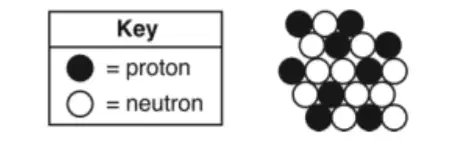
What are the atomic number and mass number of this atom?
The atomic number is 9 and mass number is 19
The atomic number is 9 and the mass number is 20
The atomic number is 11 and the mass number is 19
The atomic number is 11 and the mass number is 20
Experimental evidence indicates that the nucleus of an atom
Contains most of the mass of the atom
Contains a small percentage of the mass of the atom
Has no charge
Has a negative charge
The elements in the Periodic Table are arranged in order of increasing
Atomic number
Atomic radius
Mass number
Neutron number
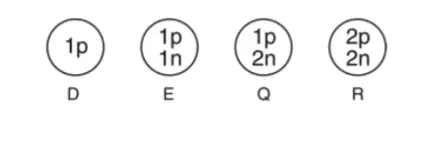
Each diagram below represents the nucleus of a different atom. The “p” signifies Protons, and the “n” signifies Neutrons. Which diagram letters represent nuclei of the same element?
D and E only
D, E, and Q
Q and R only
Q, R, and E
What is the mass number of an atom that has 83 protons, 83 electrons, and 126 neutrons?
83
209
206
289
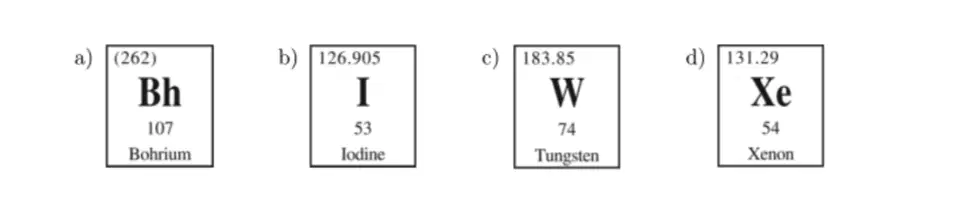
Which of the following elements in the images below has an atom that contains 53 electrons, 74 neutrons, and 53 protons?
Bohrium
Iodine
Tungsten
Xenon
Which statement is true?
Atoms are the smallest unit of matter that cannot be separated
Atoms are the largest unit of matter that are separated through different processes
The atomic number is equivalent to the total number of neutrons in an atom
The atomic mass is equivalent to the total number of protons in an atom
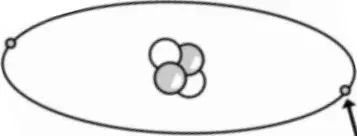
Use the picture of an atom below to answer the question Which statement best describes the part of the atom that is shown by the arrow?
It is an electron, and it has a negative charge
It is an electron, and it has a positive charge
It is a proton, and has a negative charge
It is a proton, and it has a positive charge
If an element has an atomic number of 10 and an atomic mass of 23, how many electrons do I have?
10
23
3
33
Which pair of elements have the most similar properties?
Be and N
O and Cu
B and Rh
Li and Cs
Which pair of elements have the least similar properties?
Cr and W
Sc and Ti
Al and Ga
Cu and Au
Which answer choice contains a metalloid?
Silicon (Si)
Iron (Fe)
Neon (Ne)
Potassium (K)
Which pair of elements have the most similar properties?
Ni and Cu
N and B
Zn and Hg
Al and Zn
Which pair of elements have the least similar properties?
Fe and Ru
Mg and Sr
Li and Be
Ne and Kr
What is the best way to tell if an element will have similar chemical properties to another element?
Look at elements in its period
Look at its atomic number
Look at elements in its group
Find when the element was discovered
Which element has chemical properties that are most similar to the chemical properties of sodium?
Mg
Se
K
Cl
Which element has properties of elements like Calcium (Ca) and Nitrogen (N)?
Zinc (Zn)
Bromine (Br)
Chlorine (Cl)
Antimony (Sb)
Where would the element gold be located on the Periodic Table?
It would be located on the right side of the Periodic Table because it is a metal
It would be located on the left side of the Periodic Table because it is a non-metal
It would be located on the right side of the Periodic Table because it is a metalloid
It would be located towards the left side because it is a metal
Which answer choice contains an element that has a combination of properties of elements like Gold (Au) and Krypton (Kr)?
Arsenic (As)
Iron (Fe)
Fluorine (F)
Xenon (Xe)
The element nitrogen is the most abundant gas in the air we breathe. Where would it be found on the Periodic Table of elements?
It is located on the right side with all the other metals
It is located on the left side with all the non-metals
It is located on the right side with the non-metals
It is located with the metalloids
Which pair of elements has the most similar properties?
K and Ne
As and F
Mn and Bh
C and Cu
Which pair of elements has the least similar properties?
In and Ga
Ir and Co
B and C
Bi and Sb
Which of the following particles can be found inside the nucleus?
Protons and electrons
Electrons and neutrons
Protons and neutrons
Only neutrons
What option below shows where to look to find how many protons there are in an atom?
Atomic mass
Atomic number
Atomic mass + atomic number
Atomic mass – atomic number
Which of the following elements is a gas (nonmetal)?
Cd
Ne
Te
Bi
Which of the following elements is a metalloid?
O
Po
Si
S
Look at the model of the Periodic Table. Which pair of elements will react similarly to other elements?
Al and Ge
Al and Ga
Ga and Ge
Ge and As
What makes up a period in the Periodic Table?
Atoms from the same group
Compounds formed from the same atom
All atoms with metallic properties
A horizontal row
Which pair of elements listed below are the most reactive? (hint: question is not discussing which elements have similar chemical properties, it is asking about the reactivity)
Li and K
Pd and Pt
O and S
Ne and Ar
Which pair of elements listed would not be reactive at all? (hint: question is not discussing which elements have similar chemical properties, it is asking about the reactivity)
V and Nb
F and Cl
Be and Mg
Xe and Rn

Using the table above, which claim is best supported by the evidence?
Element A is an alkaline earth metal.
Element B is the least reactive.
Element C is a transition metal.
Element D is an alkali metal.
Which element below belongs to the noble gas family?
Group 1, period 3
Group 2, period 6
Group 17, period 4
Group 18, period 3
Which pair of elements would be the most reactive?
Li and Na
Be and Sr
Cl and Br
He and Ne
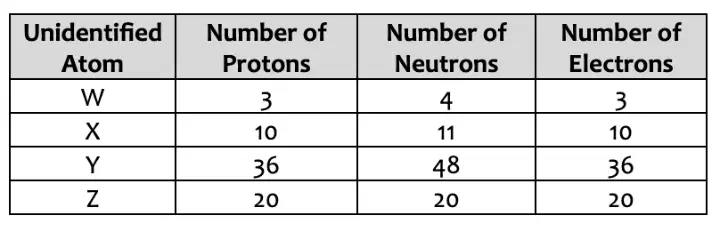
Using the table above, which claim is best supported by the evidence?
Element W is the most reactive.
Element X is the only metal.
Element Y is the only noble gas.
Element Z is a halogen.
Which of the following elements is a noble gas?
He
Br
Ca
K
Which of the following elements is considered very reactive?
Ar
Sn
Ne
F
Which statement about the organization of the periodic table is true?
As you move left to right, elements go from metals to nonmetals, to metalloids, and become more reactive
As you move from left to right, elements go from metals, to metalloids, to nonmetals, and increase in atomic number
As you move from left to right, elements go from nonmetals to metalloids to metals, and increase in reactivity
As you move from left to right, elements go from noble gases to alkaline earth metals
Which atom belongs to group 5, period 6?
Ta
Ca
Rb
Zr
What is true about elements in the same group?
They all belong to the same physical property of gas, liquid, or solid
They all have the same amount of protons
They all have the same amount of neutrons
They have similar chemical properties
Which of the following answer choices reflects groups in the periodic table that are very reactive?
Group 2 and Group 18
Group 1 and Group 17
Group 3 and Group 16
Group 1 and Group 11
Which pair of elements are both not very ductile?
Ti and Pd
Sn and C
Ca and Ra
Cr and Sg
Which of the following can be beaten into thin sheets?
Zinc (Zn)
Phosphorous (P)
Sulfur (S)
Oxygen (O)
What is true about the element found in group 15, period 6?
It cannot be beaten into thin sheets
It has low melting and boiling points
It is very ductile
It is very light and has low density
Which element has a high boiling point?
Helium (He)
Fluorine (F)
Phosphorous (P)
Chromium (Cr)
Which elements from the list below have high melting points, and are good conductors of electricity?
Co and As
Ni and Cu
Which pair of elements would both match the following description? ➔ Low boiling and melting point ➔ Poor conductor of electricity
A. K and Ar
B. Li and Ne
C. F and Xe
D. S and Na
Which statement is true about Na (atomic number 11) and Cl (atomic number 17)?
A. Sodium and Chlorine are good conductors of electricity
B. Sodium is a metal and Chlorine is a metalloid
C. Sodium is a metalloid and Chlorine is a good conductor of electricity
D. Sodium is a good conductor of electricity and Chlorine is not a good conductor of electricity
What is true about Ca and Kr?
A. Ca has a very low melting point and Kr has a very high melting point
B. Ca is a bad conductor of electricity and Kr is a very good conductor of electricity
C. Ca is very malleable and Kr is not very malleable
D. Ca has characteristics of both metals and nonmetals and Kr is only a nonmetal

