Wayground logo

Free Printable Worksheets

Font size

S
M
L
XL
Worksheets

Ch 2 Animal Reproduction, Development Classification

Total questions: 43

Worksheet time: 30mins

Name
Class
Date
1.
Soon after fertilization, the zygote undergoes a series of rapid cell divisions. This is called
a)
Meiosis
b)
Gastrulation
c)
Organogenesis
d)
Cleavage
2.
The solid ball of cells that results from the dividing zygote is called
a)
Blastula
b)
Morula
c)
Gastrula
d)
Blastomere
3.
During cleavage, each cell in the embryo is called a
a)
Blastula
b)
Morula
c)
Gastrula
d)
Blastomere
4.
The stage that results in three germ layers and a primitive gut is the
a)
Blastula
b)
Morula
c)
Gastrula
d)
Blastomere
5.
Radial cleavage is found primarily in which group?
a)
Protostomes
b)
Deuterostomes
c)
Both groups
d)
Neither group
6.
Early in cleavage, a cell breaks off and becomes isolated. It grows into an entire separate individual. This is an example of
a)
Mosaic development found in Deuterostomes
b)
Mosaic development found in Protostomes
c)
Regulative development found in Deuterostomes
d)
Regulative development found in Protostomes
7.
The blastopore will become the mouth in
a)
Protostomes
b)
Deuterostomes
c)
Both groups
d)
Neither group
8.
Most protostomes show this type of coelom formation where a band of mesoderm splits to form the:
a)
Enterocoelous
b)
Schizocoelous
c)
Pseudocoelom
d)
Acoelom
9.
Different kinds of symmetry make it possible for animals to:
a)
Grow very large
b)
Survive when cut into pieces
c)
Move and find food in different ways
d)
Live a long time
10.
If you divided a radially symmetrical animal along any plane through its central axis, you would end up with:
a)
Roughly equal halves
b)
Front and back halves
c)
Top and bottom halves
d)
Three pieces
11.
Which of the following animals is NOT radially symmetrical?
a)
hydra
b)
spider
c)
sea urchin
d)
sea star
12.
Which of the following shows the correct sequence?
a)
Blastula 🡪 zygote 🡪 morula 🡪 gastrula
b)
Gastrula 🡪blastula 🡪 morula🡪 zygote
c)
Morula 🡪 gastrula 🡪 zygote 🡪 blastula
d)
Zygote 🡪morula 🡪 blastula 🡪 gastrula
13.
The embryonic layer that forms the excretory and reproductive systems is the:
a)
Endoderm
b)
Mesoderm
c)
Exoderm
d)
Ectoderm
14.
The embryonic layer that forms the skin and nervous tissue is the:
a)
Endoderm
b)
Mesoderm
c)
Exoderm
d)
Ectoderm
15.
The animal’s digestive tract forms from the:
a)
Endoderm
b)
Mesoderm
c)
Exoderm
d)
Ectoderm
16.
The embryonic layer that forms the circulatory and musculoskeletal systems is the:
a)
Endoderm
b)
Mesoderm
c)
Exoderm
d)
Ectoderm
17.
Animals with bilateral symmetry find food and mates and avoid predators more efficiently because they have:
a)
Body cavities
b)
Good muscular control
c)
Arms, Legs, and Tails
d)
The ability to see in all directions
18.
Social insects, such as wasps, bees, and ants, often use this type of reproduction:
a)
Sexual
b)
Budding
c)
Gemmules
d)
Parthenogenesis
19.
Simultaneous hermaphrodites are animals that:
a)
Begin life as a female, but then become male
b)
Begin life as a male, but then become female
c)
Both donate and receive sperm during mating
d)
Both donate and receive eggs during mating
20.
Hermaphroditism is commonly found among animals that are:
a)
Sessile
b)
Burrowing
c)
Endoparasitic
d)
All of the above
21.
The male gonad which produces sperm is the
a)
Penis
b)
Testes
c)
Prostate gland
d)
Cowper's gland
22.
A sexual union to facilitate the reception of sperm by a female is
a)
Fertilization
b)
Differentiation
c)
Copulation
d)
Cephalization
23.
A sea anemone gastrovascular cavity is an example of a
a)
Blind gut because it has only one opening
b)
Digestive tract because it has two openings
c)
True stomach because it is an advanced digestive organ
d)
Complete gut because it includes both a mouth and anus
24.
A true body cavity completely surrounded by mesoderm is
a)
Acoelom
b)
Coelom
c)
Pseudocoelom
d)
Tricoelom
25.
Which group of animals lacks a body cavity and are considered acoelomates:
a)
Flatworms
b)
Roundworms
c)
Segmented worms
d)
Humans
26.
Having sensory organs concentrated at the anterior end of the body is referred to as
a)
OpNeurolation
b)
Justification
c)
Specialization
d)
Cephalization
27.
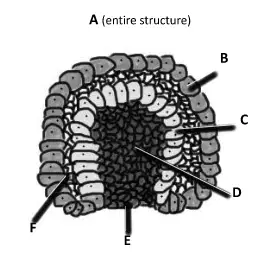
Question Image

Label the following.

a)

Archenteron

1.

D

b)

Blastocoel

2.

F

c)

Blastopore

3.

E

d)

Endoderm

4.

C

e)

Gastrula

5.

A

28.

Animals with three germ layers are ​ ​ (a)  

Choose from the below words
Triploblastic
Diecious
Diploblast
Monoecious
Internal fertilization
External Fertilization
External fertilization
29.

​ ​ ​ (a)   Describes animal species having separate sexes

Choose from the below words
Diecious
Diploblast
Monoecious
Internal fertilization
External Fertilization
External fertilization
30.

​ ​ ​ ​ (a)   Describes animal species that have both male and female reproductive organs in same organism

Choose from the below words
Diploblast
Monoecious
Internal fertilization
External Fertilization
External fertilization
Diecious
31.

​ ​ ​ (a)   ​Release of gametes into surrounding water

Choose from the below words
Diploblast
Internal fertilization
External Fertilization
Diecious
Monoecious
Triploblast
32.

​ ​ ​ ​ ​ (a)   Union of sperm and egg that takes place inside the female’s body

Choose from the below words
Diploblast
Diecious
Monoecious
Triploblast
Internal Fertilization
External Fertilization
33.

​ ​ ​ ​ ​ ​ (a)   Animals with two germ layers

Choose from the below words
Diploblast
Diecious
Monoecious
Triploblast
External Fertilization
Internal Fertilization
34.

Which of the following is a characteristic of deuterostomes?

a)

Spiral cleavage

b)

Radial cleavage

c)

Mosaic development

d)

Acoelomate body plan

35.

Which embryonic layer is responsible for forming the lining of the digestive tract?

a)

Endoderm

b)

Mesoderm

c)

Ectoderm

d)

Exoderm

36.

Which one is not a type of asexual reproduction

a)

Budding

b)

Simultaneous Hermaphrodites

c)

Parthenogenesis

d)

Fragmentation

37.

Match each type of asexual reproduction to the correct description.

a)

Budding

1.

A form of asexual reproduction where a new organism develops from an outgrowth on the parent.

b)

Gemmules

2.

Structures that can survive unfavorable conditions and later develop into new organisms.

c)

Parthenogenesis

3.

A form of asexual reproduction where an organism develops from an unfertilized egg.

38.

Involves the union of gametes

a)

Asexual

b)

Sexual

39.

Produces offspring that are genetically identical

a)

Asexual

b)

Sexual

40.

Occurs in bacteria, unicellular eukaryotes, and in many invertebrate phyla

a)

Asexual

b)

Sexual

41.

Used by many sessile organisms

a)

Asexual

b)

Sexual

42.

May cause animals to have to change their usual pattern of activity

a)

Asexual

b)

Sexual

43.

Can sometimes lead to deadly competition between males

a)

Asexual

b)

Sexual