
 Worksheets
Q1 Exam Review 8th Grade Part 2_2024
Total questions: 62
Worksheet time: 2hrs 4mins
If an astronaut travels from Earth to the Moon, which of the following would change?
weight
mass
volume
density

Samina reports that 50 milliliters (mL) of unpeopled popcorn kernels has a mass of 200 grams (g). What is the density of the popcorn kernels?
2.5 g/mL
4 g/mL
10 g/mL
150 g/mL
The mass of a rock is measured with a balance. The rock is then broken into many smaller pieces and the total mass of all the pieces is measured again. Which of the following sentences about the mass is TRUE?
The mass of the rock will be greater than the total mass of the smaller pieces.
The mass of the rock will be less than the total mass of the smaller pieces.
The mass of the rock will be same as the total mass of the smaller pieces.
The mass of the rock will not be the same as the total mass of the smaller pieces.
Scientific investigations have certain standards, including the ability to be replicated. Why should scientists be able to replicate an investigation?
A scientist might need to conduct multiple trials to ensure that results are accurate.
Other scientists need to verify the results.
Other scientists need to review the method by which results were communicated.
Replicating an investigation proves that the hypothesis was correct.
Sasha keeps her pet snake in an aquarium. Sasha has just completed an investigation to test how the strength of the light bulb she uses in the aquarium affects how much the snake eats. Which of the following procedures would be a repetition of Sasha’s investigation?
Sasha repeats the investigation following the same steps as her initial investigation.
Sasha repeats the investigation using stronger light bulbs.
Sasha repeats the investigation using an additional snake in the cage.
Marcus repeats the investigation following the same steps as Sasha’s initial investigation.

1What is the independent variable in the data table?
The number of trials
The number of chirps
The number of crickets
The temperature

What conclusion can be drawn using the data from the chart?
If crickets are subjected to higher temperatures then the number of chirps per minute will increase.
If crickets are subjected to higher temperatures then the number of chirps per minute will decrease.
If crickets are subjected to the same temperatures then the number of chirps per minute will increase.
If crickets are subjected to lower temperatures then the number of chirps per minute will increase.

3. What evidence supports the claim that the higher the temperature, the greater the number of chirps?
At 25°C the average number of chirps per minute was 83, compared to 127 chirps at 20°C and 168 chirps at 15°C.
At 25°C the average number of chirps per minute was 168, compared to 127 chirps at 20°C and 83 chirps at 15°C.
At 25°C the average number of chirps per minute was 127, compared to 83 chirps at 20°C and 168 chirps at 15°C.
At 25°C the average number of chirps per minute was 91, compared to 135 chirps at 20°C and 180 chirps at 15°C.
Which of the following examples shows an experiment that has been designed and conducted using repeated trials and replication? (8.N.1.2)
Addison is conducting an experiment using water. She has a friend look over the procedures before completing 30 trials.
Amanda is conducting an experiment using aluminum foil. She completes her experiment 1 time and makes adjustments to her procedures. She then completes 20 trials of her experiment.
Rashawn is conducting an experiment using tennis balls. He completes 30 trials and has 2 of his friends complete the experiment by following the his procedures.
Julian is conducting an experiment using rubber bands. He completes 10 trials then begins work on a different experiment.
Which of the following shows repeated trials in an experiment but does NOT show replication? (8.N.1.2)
Samuel writes his own procedures and then has a friend complete 20 trials.
Leslie writes her own procedures for her group to follow.
Joshua conducts an experiment by following the procedures given to him by his teacher.
Katelyn conducts an experiment that requires her to throw an object at a target 20 times.
Jupiter has about 317 times more mass than Earth. What can you infer from this fact?
That Jupiter’s gravitational force is much weaker than on Earth’s gravitational force.
That Jupiter’s gravitational force is much stronger than Earth’s gravitational force.
That Jupiter’s and Earth’s gravitational forces are equal.
Mass has no effect on the gravitational force between two objects.
Which of the following examples demonstrates replication?
Joseph conducts his own experiment 25 times.
Sarah is following another student's written procedures for an experiment that was already performed.
Juanita conducts her experiment 1 time.
Matt writes the procedures of his experiment carefully and carries out his experiment.
Michaela wants to know which brand of rechargeable battery lasts the longest. She buys four batteries made by different companies. She then puts the batteries into four identical flashlights and turns them on. She checks on the flashlights twice a day and records how long it takes for each flashlight to go out. Which of the following procedures would be a repeated trial of Michaela's investigation?
Michaela runs the trial again, using a toy instead of a flashlight.
Michaela runs the whole trial, without changes, two more times.
Michaela's friend runs the whole trial, without changes, two more times.
Michaela runs the trial again, changing her hypothesis so it will be supported.
What type of evidence are you using if you conduct an experiment and draw conclusions that relies on gathering and evaluating evidence?
deductive evidence
subjective evidence
empirical evidence
inductive evidence
Ptolemy, believed that all objects in space, including the sun, revolved around Earth. Nicolaus Copernicus made observations showing that Earth and other planets revolved around the sun, which refuted Ptolemy’s argument. What is this an example of?
Scientific knowledge starts as a scientific theory and becomes a scientific law.
Scientific knowledge is communicated between scientists.
Scientific knowledge always stays the same.
Scientific knowledge changes as a result of new evidence.
Brandon noticed that hummingbirds in his yard visited all the flowers, but especially seemed to like the red trumpet-shaped ones. He read that they use the nectar in the flowers for food. He assumed that since the parents were eating nectar, they must feed their babies nectar as well. To his surprise, he saw hummingbirds bringing small insects and spiders to feed the young hummingbirds. How does this new evidence affect his original assumption?
He should change his original assumption that they only feed their babies nectar.
He should be able to stick to his assumption that the babies eat nectar since he thought that first.
He should believe what he read in the book and disregard what he witnessed.
He should ask other people what they think and agree with the majority.
Which statement does NOT describe a law?
It can be tested.
Describes why something happens.
Describes how nature works.
Describes that something will occur every time in a given set of conditions.
Which of the statements below explain why theories are modified but are rarely discarded?
As long as theories are based on information they will be modified and not discarded.
As long as they are factual, theories will eventually become laws and will be modified and not discarded.
As long as they are well supported or proven, theories will become facts and will be modified and not discarded.
As long as a theory still explains a wide range of observations and evidence, it is modified and not discarded.
Which of the following is an example of a law?
An object in motion tends to stay in motion unless another force acts upon it.
All cells are produced from other cells.
An asteroid struck earth 65 million years ago causing dinosaurs to become extinct.
All substances are made of particles called atoms.
What is weight?
A measure of the force of gravity acting on an object.
A measure of how much matter is in an object.
A measure of how heavy something is.
A measure of how large something is.
Which of the following factors affects weight but does NOT affect mass?
shape
gravity
amount of matter
temperature
A person’s mass on the moon is 70 kg, the same as it is on the earth. What is true about this person’s weight?
The person would weigh zero on the moon because there is no gravity on the moon.
The person would weigh more on the moon because the moon is closer to the sun.
The person would weigh less on the moon because there is less gravity on the moon.
The person would weigh the same on the moon because the moon is closest to earth.
Susie wanted to find the density of a silver bracelet. She found that its mass was 24 grams and its volume was 2 cm3. What was the density of the silver bracelet?
4 g/cm3
6 g/cm3
12 g/cm3
26 g/cm3
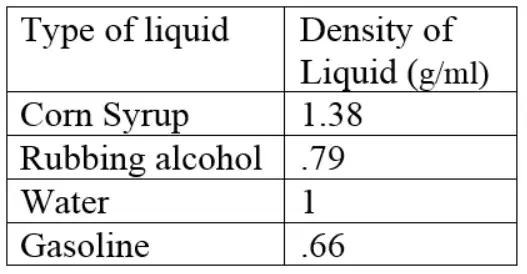
Use the data table to find which liquid would have the greatest mass if there is 100ml of each liquid.
water
gasoline
rubbing alcohol
corn syrup
Jake and Mary rolled a watermelon into the pool. The watermelon floated in the pool. What conclusion can they make?
The density of the watermelon was less than the density of the pool water.
The density of the watermelon was more than the density of the pool water.
The volume of the watermelon was less than the volume of the pool water.
The volume of the watermelon was more than the volume of the pool water.
You find 3 containers of clear liquids in your refrigerator. One contains water, one contains sprite and one contains rubbing alcohol.
Which of the following is NOT a physical property you would use to determine the identity of the liquids?
flammability
density
boiling point
solubility
You are given two balls that are made from the same material. They are also the same size and color. One is hollow and one is solid. Which of the following physical properties could be used to identify the ball that is solid?
pH
density
boiling point
solubility
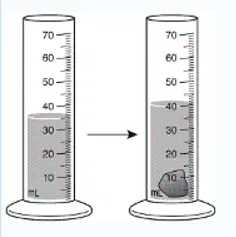
Ron carried out the following procedure to obtain a measurement needed to calculate the density of a solid object. What else must Ron do in order to calculate the density of this object?
its mass
its volume
the melting point
its surface area
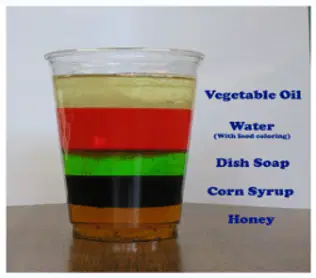
What can you infer about the densities of dish soap, corn syrup and honey?
They all have densities greater than 1g/cm3
They all have densities less than 1g/cm3
They are thicker than the other substances.
They are different colors than the other substances.
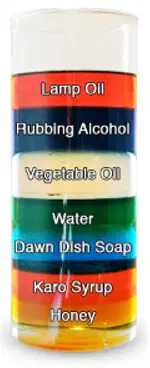
The image shows a density column created when several liquids were carefully combined. Which of the following statements is true for the liquids in the image?
Lamp oil has the greatest density
Dish soap is more dense than water and less dense than Karo syrup
Honey is less dense than Lamp oil
Vegetable oil is more dense than water and less dense than rubbing alcohol.
You are given two cubes that are made from the same material. They are also the same size and color. One is hollow and one is solid. Which of the following physical properties could be used to identify the cube is solid?
pH
density
boiling point
solubility
The density of water is 1.00g/cm3. An object has a density of 0.5g/cm3. What can you conclude about this object?
The object will sink in water.
The object will float in water.
The object has the same mass as water.
The object has the same chemical properties as water.
Jason wanted to explain the difference between mass and weight to his classmates. Which is a correct statement that Jason could include in his explanation?
Weight is a measure of the amount of matter in an object.
Mass is the measure of the gravitational force on an object.
Mass varies depending on the location of the object.
Weight varies depending on where the object is in the Solar System.
Suppose you have two pieces of modeling clay. One piece contains more clay than the other. How do the two pieces of clay differ?
The larger piece of clay has a greater mass and a greater weight.
The larger piece of clay has a greater mass but the same weight.
The larger piece of clay has a smaller mass but the same weight.
The larger piece of clay has a smaller mass and a greater density.
Which of the following actions described below will change an object's weight, but not its mass?
Breaking the object
Compressing the object
Putting the object in a box
Placing the object on a different planet
Which of these statements is true about the weight of objects?
Objects on the same planet all have the same weight.
Weight depends on mass and where the object is.
Only objects on the surface of a planet have weight.
All objects have weight, regardless of where they are in the universe.
Physical properties can be used to compare and classify substances. Which statement is correct about a physical property?
A physical property is based on a substance’s ability to change into a new substance.
A physical property is difficult to observe and even more difficult to measure.
A physical property describes a substance’s ability to be involved in a chemical reaction.
A physical property can be observed or measured without changing the identity of the substance.
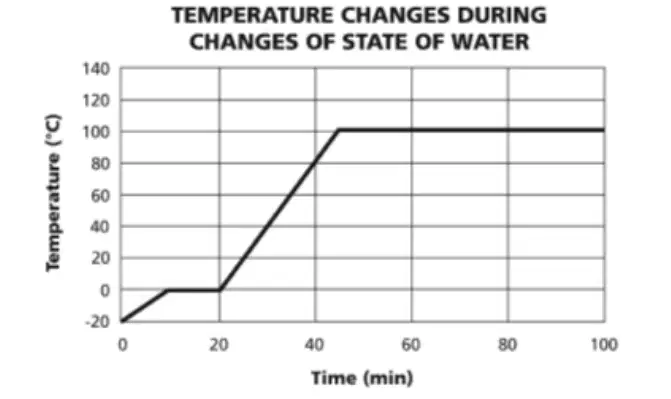
Thomas performed an experiment to measure the temperature of water as he heated it on a hotplate. At the end of his experiment, he plotted the results as shown in the graph . Which of the following physical properties of water did Thomas measure?
volume and thermal conductivity
solubility and electrical conductivity
melting point and boiling point
densities and physical states of matter
This physical property is one that remains the same regardless of the amount of matter that is present. Which of the following physical properties of matter is described above?
mass
density
volume
weight
Mario performed an experiment to investigate how certain substances dissolve in water. He poured the substances in separate beakers of water and stirred each one using a glass rod. He then observed the results. What physical property of the substances did Mario investigate?
density
melting point
solubility
thermal conductivity

Physical properties can be used to classify and compare substances. The illustration below shows a physical property that is being investigated using different materials. What physical property is most likely being investigated in this illustration?
thermal conductivity
melting point
magnetism
electrical conductivity
For a laboratory exercise in class, a student is given a mixture of small pieces of iron, sand, water, and salt. What physical property could be used to best separate the iron from the other ingredients?
magnetism
solubility
melting point
electrical conductivity
Two cubes are placed into a bucket of water. One cube is made of solid foam and it floats. The other cube is made of solid metal and it sinks. Why does this happen when both are placed into water?
The foam cube absorbs more water than the metal cube.
The foam cube is less dense than the metal cube.
The foam cube is more dense than the metal cube.
The foam cube absorbs less water than the metal cube.
The ability to conduct an electric current, dissolve in water and melt are considered which of the following?
Chemical Changes
Chemical Properties
Physical Properties
Physical Changes
You are given two objects that are made from the same material. They are also the same size and color. One is hollow and one is solid. Determine the physical property that could be used to identify which object is solid and which object is hollow.
boiling point
density
electrical conductivity
thermal conductivity
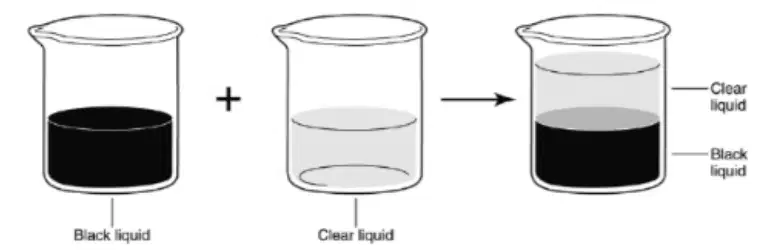
Derek mixed two liquids. One liquid was black, and the other liquid was clear. The illustration shows what happened after Derek mixed the two liquids and allowed them to stand for 10 minutes. Which of the following statements could explain why the two liquids formed distinct layers
The liquids have different densities.
The liquids have different colors.
The liquids have different volumes.
The liquids have different states of matter.
Lucy wanted to determine the density of a colorful stone that she had picked up on the beach. Which two properties must Lucy measure in order to calculate the density of the stone?
size & shape
mass & volume
mass & temperature
composition & texture
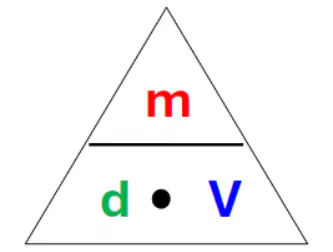
Copper has a density of 9g/cm3. Suppose you had a piece of copper that had a mass of 27g. The formula for density is d = m/v, where m is mass and v is volume. What is the volume of this piece of copper metal?
19.3 cm3
10 cm3
3 cm3
81 cm3
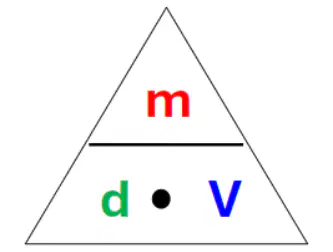
Sam finds a gold-colored rock on a hike. He takes it home and uses his digital balance to find its mass of 25g. Sam uses a graduated cylinder and water displacement to find the volume of the rock to be 5cm3. The formula for density is d = m/v, where m is mass and v is volume. What is the rock’s density?
20 g/cm3
5 g/cm3
30 g/cm3
125 g/cm3
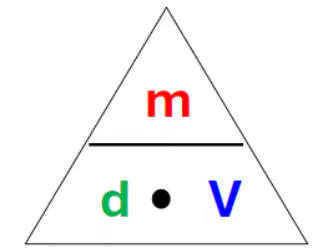
Chocolate cake has an average density of 4.2g/cm3. The volume of a single slice is 113.1cm3. The formula for density is d = m/v, where m is mass and v is volume. What is the mass of this slice of chocolate cake?
26.93 g
475.02 g
0.04 g
117.3 g
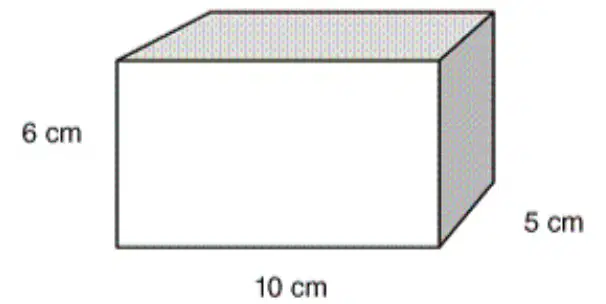
Owen wanted to determine the density of a wooden block. He made the measurements shown. Owen knew he could use these measurements to calculate the amount of space occupied by the block. What else must Owen determine in order to calculate the density of this block?
Its mass
Its volume
Its surface area
Its number of sides
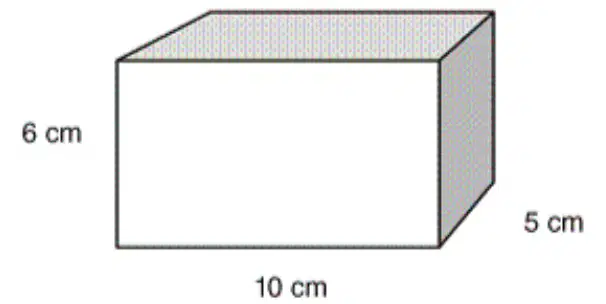
Owen wanted to determine the density of a wooden block. He made the measurements shown below. How much space is occupied by the block?
30 cm3
60 cm3
21 cm3
300 cm3

Ron carried out the following procedure to obtain a measurement needed to calculate the density of a solid object. What else must Ron measure in order to calculate the density of this object?
Its mass
Its volume
Its melting point
Its surface area

Ron carried out the following procedure to obtain a measurement needed to calculate the density of a solid object. What property is Ron measuring? What is the measurement for this object?
volume = 5 mL
mass = 5 g
density = 5 g/mL
weight = 5 N
A golf ball and a ping-pong ball are about the same size. In other words, they have about the same volume. However, a golf ball has more mass than a ping-pong ball. What can you conclude from this information?
A ping-pong ball contains more matter than a golf ball.
A ping-pong ball has the same properties as a golf ball.
A golf ball has a greater density than a ping-pong ball.
A golf ball contains a smaller amount of mass per volume than a ping-pong ball.
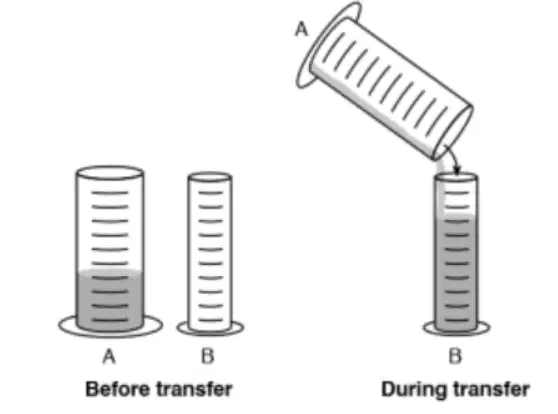
The diagram represents two graduated cylinders. 100mL of a liquid was completely transferred from A to B. Compared to the liquid that was in A, the liquid in B will have ___.
More mass and more volume
More mass and the same volume
The same mass and the same volume
The same mass and more volume
Properties of matter describe features about specific objects or substances. What makes physical properties and chemical properties different from one another?
Physical properties DON'T change the matter, but chemical properties DO change the matter.
Physical properties DO change the matter, but chemical properties DON'T change the matter.
Physical properties ARE measurable, but chemical properties are NOT measurable.
Physical properties are NOT measurable, but chemical properties ARE measurable.
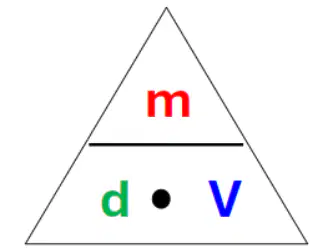
Three liquids--R and S and T--are poured into a graduated cylinder together, however, they separate immediately and form three layers.
Liquid R has a volume of 16mL and a mass of 87g.
Liquid S has a volume of 48mL and a mass of 49g.
Liquid T has a volume of 234mL and a mass of 100g.
Based on this information, describe the order of the liquid layers. The formula for density is d = m/v, where m is mass and v is volume.
Liquid T will be on TOP, liquid R will be in the MIDDLE, liquid S will be on BOTTOM.
Liquid R will be on TOP, liquid S will be in the MIDDLE, liquid T will be on BOTTOM.
Liquid T will be on TOP, liquid S will be in the MIDDLE, liquid R will be on BOTTOM.
Liquid R will be on TOP, liquid T will be in the MIDDLE, liquid S will be on BOTTOM.
Melting point is a property of matter. A large block of ice and a small cube of ice are both allowed to sit in the sunlight and melt. The temperature of each is measured during this process. Which of the following is TRUE?
The large block and the small cube will have the same melting point because they are the same substance.
The large block will have a higher melting point because it is bigger than the small cube.
The small cube will have a higher melting point because it is smaller than the large block.
There is not enough information to know.
Metals have many properties, including the ability to be folded and shaped. What is this property called?
luster
malleability
viscosity
brittleness
When a gas is heated, the molecules move faster causing the volume of the gas to increase while the mass remains the same. How does this affect the density of the gas?
Volume is a physical property and is therefore impossible to change.
Greater volume results in the gas NOT changing density as it heats up.
Greater volume results in the gas becoming MORE dense as it heats up.
Greater volume results in the gas becoming LESS dense as it heats up.

Michelle built a circuit using wires, clips, a battery, and a light bulb. She hooked up various items--like the knife pictured--and recorded which ones caused the light to turn on brightly, dimly, or not at all. What property of matter was Michelle testing?
thermal conductivity
electrical conductivity
malleability
flammability

