
NEW
Font size
 Worksheets
Unit 2 Practice
Total questions: 38
Worksheet time: 57mins
Choose the correct statement that matches each particle with their charge and location.
Proton = negative, nucleus
Electron = positive, nucleus
Neutron = neutral, outside the nucleus
Proton = positive, nucleus
Electron = negative, outside the nucleus
Neutron = neutral, nucleus
Proton = positive, outside the nucleus
Electron = negative, nucleus
Neutron = neutral, nucleus
Proton = neutral, nucleus
Electron = positive, nucleus
Neutron = negative, outside the nucleus
Thompson

Developed the “planetary” model of the atom where the nucleus is at the center and the electrons orbit the nucleus in distinct energy levels.


Which scientist is credited with the discovery of the neutron?
Niels Bohr
James Chadwick
J.J. Thomson
Ernest Rutherford

What is the atomic # of iron?
55
56
26
2

How many protons does krypton have?
84
36
48
8

How many electrons does oxygen have?
8
16
2
15

How many neutrons does lithium have?
3
4
6
7

Which wave has a longer wavelength?
wave C
wave D

Which wave has a greater frequency?
wave B
wave C
As the frequency of an electromagnetic wave increases, the amount of energy in that wave
increases
stays the same
decreases


If an electron moves from n=4 to n=2 it ____
absorbs energy
releases energy
A wave with a large wavelength will have a ______ frequency and _____ energy
high, low
high, high
low, high
low, low

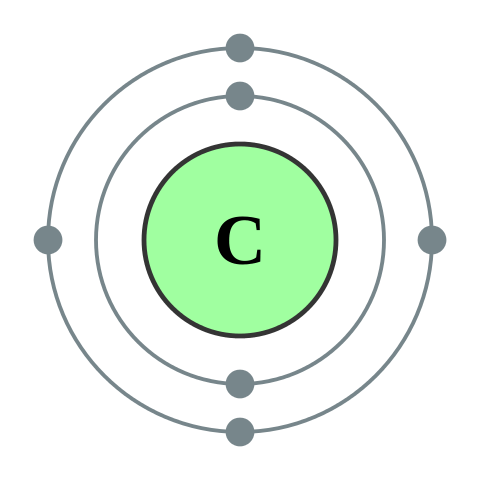
How many valence electrons does carbon have?
4
5
6
7


The sum of protons and neutrons around the nucleus
atomic number
mass number
average atomic mass
mass amount
Calculate the average atomic mass of the element iron (Fe) using the following data:
[Isotope / % abundance]
[Iron 54 / 6% ] [Iron 56 / 92% ] [ Iron 57 / 2% ]
53.7 amu
54.9 amu
5592.0 amu
55.9 amu
Which complete electron configuration belongs to chlorine (Cl)?
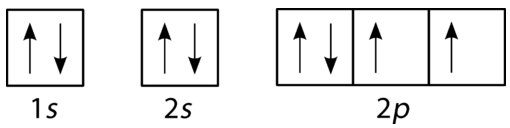
Which element is this: 1s22s22p63s23p64s23d104p6

In an electron configuration, what follows after the 4s is filled?
4p
3d
4s
2f

How many valence electrons for this element?
1s22s22p63s23p64s23d104p65s24d9
6
2
15
8
Which element has the atomic number 12?
Carbon
Magnesium
Oxygen
Neon

The unknown emissions spectra belongs to the element
Hydrogen
Mercury
Neon
Helium


What is the reaction involved if the electron moves from position 1 to 2?
Light will be emitted
Light will be absorbed
The electron will become less excited
The electron will decrease a quantum
Which carries the highest energy?


This is a correct dot diagram for nitrogen (N)
true
false
How would you draw a Lewis dot diagram for Magnesium?



