
 Worksheets
Math 1 Honors Midterm Practice
Total questions: 139
Worksheet time: 7hrs 36mins
3 + 23 - 8
8
1
3
-3
6x - 2 - 7x + 4 - x
-2x + 2
-2x - 2
2x - 6
x + 2
-3(x - 3) + 6(x + 1)
3x + 6
3x + 4
-3x + 16
3x + 15
4a + 8 = -20
-6
-7
3
-3
-5x - 10 < -30
x < 4
x > 4
x < 8
x < -4
8(x - 1) = 4(x + 4) - 2x
2
6
-2
4
What is 16% of 34?
212.5
5.4
2.1
4.5
35 is 29% of what?
10.2
1015
120.7
1.2
It takes you 30 minutes to ride 8 miles on your bike, about how long will it take you to ride 10 miles?
34 minutes
38 minutes
32 minutes
40 minutes

0 < x < 3
0 < x < 3
x > 0 or x > 3
x < 0 or x > 3
What is the slope of a line containing points (2, -1) and (3, 5)
1/6
6
-1/6
-6
Give an equation of a line that is parallel to the line y = -3x
y = 2/3x - 2
y = 3x + 2
y = -3x - 1
y = -2/3x + 3
What correlation is there between time spent driving and gas left in your tank?
No Correlation
Negative Correlation
Positive Correlation
What are the intercepts for 3x - 2y = 6
(0, 3) and (2, 0)
(0, -2) and (-3, 0)
(0, -3) and (2, 0)
(0, 2) and (3, 0)
(4x9)(5x-5)
20x-45
9x4
9x-4
20x4
3b3(4b2 + 5b - 3c)
12b5 + 15b3 - 9b3c
12b6 + 15b4 - 9b3c
12b5 + 15b4 - 9b3c
12b5 + 15b4 + 9b3c
(3x2 - 5x + 7) - (2x2 + 9x - 1)
x2 - 4x + 6
5x2 - 4x + 8
x2 - 14x + 8
x2 + 4x + 6
(5a - 4)(3a - 7)
15a2 - 23a - 28
15a2 - 47a + 28
15a2 + 47a - 28
15a2 - 23a + 28
What is the slope of a vertical line?
Zero
Undefined
1
-1
What is a function?
When the domain (x) has exactly one range (y) assigned to it
When the domain (x) repeats with a different range (y)
When the domain (x) and range (y) are the same
When there is no range (y) for each domain (x)


Can the operation be performed?
Yes
No


Find the product of the two matrices.
1 2
6 -8
-3 -5
-5 -11
-2 8
-6 -12
2 -3
5 -2

17 12
8 -10
-15 -8
-1 -3

Which transformation moves a geometric pre-image right, left, up or down?
Translation
Rotation
Reflection
Dilation
Which transformation enlarges or reduces a pre-image?
Translation
Rotation
Reflection
Dilation
Which transformation flips an image across either the x or y axis?
Translation
Rotation
Reflection
Dilation
Which transformation pivots a pre-image around the origin either clockwise or counter clockwise?
Translation
Rotation
Reflection
Dilation
Which transformation preserves the size of a pre-image? (Chose the best answer)
Rotation
Translation
Reflection and dilation
Reflection, rotation, and translation
Which transformation preserves the orientation of a pre-image? (Chose the best answer)
Translation and dilation
Translation only
Dilation only
Rotation and reflection

If the blue is the pre-image and the red is the image, is this an enlargement or a reduction?
enlargement
reduction

What is the scale factor of the dilation shown?
1/3
1/2
3
2

Describe the rotation shown.
Rotation 180o
Rotation 90o clockwise
Rotation 90o counter clockwise
Rotation 270o clockwise

If blue is the pre-image, describe the transformation
Rotation 180o
Dilation by a factor of 1/2
Translation 6 right and 6 down
Translation six left and six up

Describe the transformation shown.
Rotation 90o clockwise
Dilation by a factor of 3
Translation 2 units down
Reflection across the x axis.

Describe the transformation shown if the image on the left is the pre-image.
Reflection across the y axis
Translation 4 units right
Rotation 90o clockwise
Dilation by a factor of 2

Describe the transformation shown
Reflection across the x axis.
Translation down 6 and left 1
Dilation by a factor of 2/3
Rotation of 180o

If blue is the pre-image and green is the image, the scale of reduction is?
1/2
1/3
3
2

Describe the transformation shown
Rotation of 270o counter clockwise
Translation right one unit and up one unit
Dilation by a scale of 2
Dilation by a scale of 1/2


Given the following table, write the linear equation.
What is the common ratio(multiplier) for the sequence:
3, 15, 75...
12
1/5
5

Which table represents the following equation?


James' 70 in. giant peach doubles in size every week. Write an expression that would represent how big the peach is after 5 weeks.
70(2)35
2(70)5
5(70)2
70(2)5
Given the following table, write the linear equation.
What is the common ratio(multiplier) for the sequence:
3, 15, 75...
12
1/5
5
Which table represents the following equation?
James' 70 in. giant peach doubles in size every week. Write an expression that would represent how big the peach is after 5 weeks.
70(2)35
2(70)5
5(70)2
70(2)5

Is the following function and example of decay or growth?
f(x)=2(0.85)x
Exponential Decay
Exponential Growth
Is the following function an example of decay or growth?
f(x) = 2(1.25)x
Exponential Growth
Exponential Decay
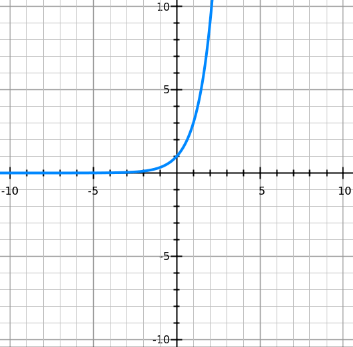
What is the growth factor of the situation represented by f(x)=10(0.3)x?
10
0.3
1
3
Is the population of elephants increasing or decreasing?
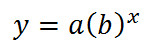
Which variable represents time passed in the function y=abx?
y
a
b
x
What is the common ratio(multiplier) for the sequence:
3, 15, 75...
12
1/5
5
What is the common ratio(multiplier) for the sequence:
28, 14, 7, 3.5...
2
1/2
-14
-7

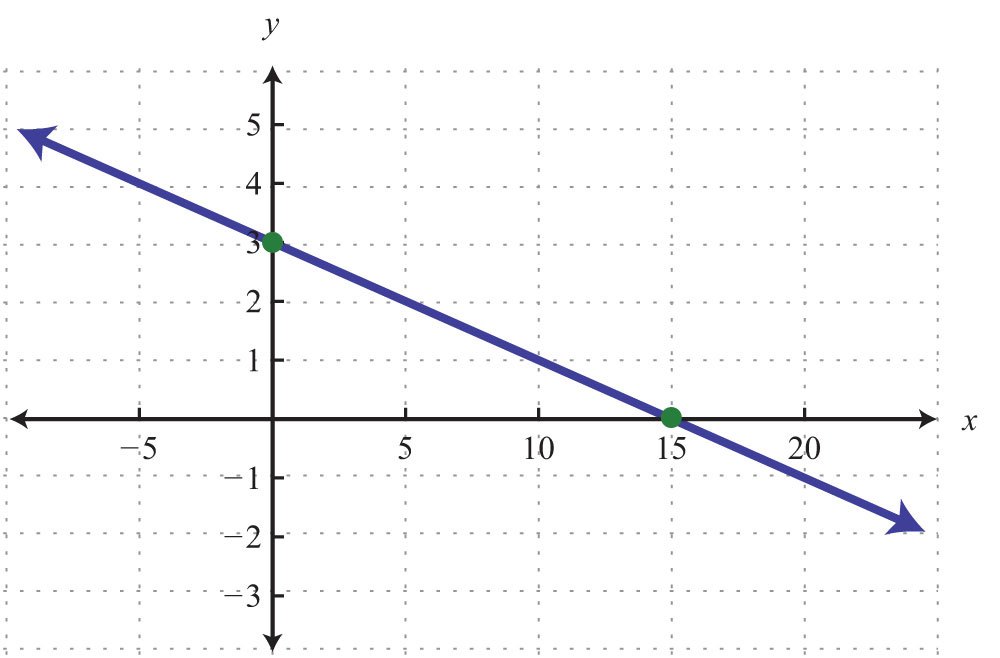

What is the Range?
y ≥ 6
y≤6
-10 ≤ y ≤ 6
-10 ≤ x ≤ 6


Find the DOMAIN
{-5, -2, 1, 4}
{1, -2, 4, -5}
{-1, 0, 2, 3}
{0, -1, 2, 3}
Find the RANGE
{-5, -2, 1, 4}
{1, -2, 4, -5}
{-1, 0, 2, 3}
{0, -1, 2, 3}


Which of the following is an example of exponential decay?
y = 3(5)x
y = .5(5)x
y = 2(.5)x
y = 8(1)x
Which of the following is an example of exponential growth?
y = 5(.5)x
y = .2(.8)x
y = .2(6)x
y = 50(.9)x
Which of the following models represents exponential decay?
y = 5(1 + .05)t
y = 5(1 - .05)t
y = .8(1 + .05)t
y = -2(1 + .05)t
Which of the following models represents exponential growth?
y = 4(1 + .08)t
y = 4(1 - .08)t
y = .5(1 - .08)t
y = 11(1 - .08)t
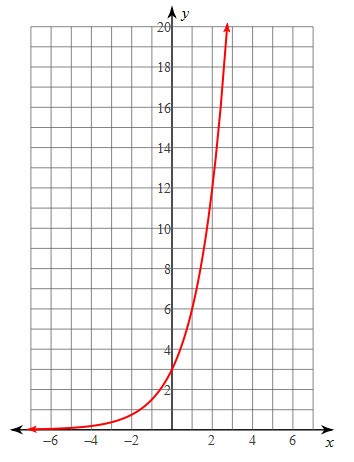
Which graph represents exponential growth?


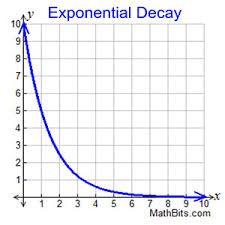
Which graph represents exponential decay?


Which of the following is an example of exponential decay?
y = 8(.5)x
y = .8(5)x
y = 8(5)x
y = 8(2)x
Which of the following is an example of exponential growth?
y = 8(.5)x
y = .8(.95)x
y = 8(5)x
y = .5(.5)x
Which of the following is an example of exponential growth?
y = 8(1.05)t
y = 8(.95)t
y = (.99)t
y = 9(1 - .5)t
Which of the following is an example of exponential decay?
y = 8(1.05)t
y = .8(1.05)t
y = 1.8(1.05)t
y = 8(.95)t

This is an example of:
Linear Growth
Linear Decay
Exponential Growth
Exponential Decay

This is an example of:
Linear Growth
Linear Decay
Exponential Growth
Exponential Decay

This is an example of:
Linear Growth
Linear Decay
Exponential Growth
Exponential Decay

This is an example of:
Linear Growth
Linear Decay
Exponential Growth
Exponential Decay
This is an example of: f(x)= 25 ( 0.20)x
Linear Growth
Linear Decay
Exponential Growth
Exponential Decay
How do you know that this was exponential decay? f(x)= 25 ( 0.20)x
Because the 25 was bigger than one
Because the 0.20 was bigger than one
Because the 25 was less than one
Because the 0.20 was less than one
This is an example of: f(x)= 0.25 ( 1.3)x
Linear Growth
Linear Decay
Exponential Growth
Exponential Decay
How do you know that this was exponential growth? f(x)=0 .25 ( 1.3)x
Because the 0.25 was bigger than one
Because the 1.3 was bigger than one
Because the 0.25 was less than one
Because the 1.3 was less than one
This is an example of: f(x)=90 ( 21)x
Linear Growth
Linear Decay
Exponential Growth
Exponential Decay
How do you know that this was exponential decay? f(x)=90 ( 21)x
Because the 90 was bigger than one
Because the 1/2 was bigger than one
Because the 90 was less than one
Because the 1/2 was less than one
This is an example of: f(x)=3 ( 25)x
Linear Growth
Linear Decay
Exponential Growth
Exponential Decay
How do you know that this was exponential growth? f(x)=3 ( 25)x
Because the 3 was bigger than one
Because the 5/2 was bigger than one
Because the 3 was less than one
Because the 5/2 was less than one
This function represents the number of ants in a colony f(x)=3 ( 2)x How many ants did you begin with?
There was 2 ants
There was 3 ants
The equation doesn't tell us
This function represents the number of ants in a colony f(x)=3 ( 2)x What is the growth rate?
The ants are growing by 3 times
The ants are growing by 2 times
The equation doesn't tell us
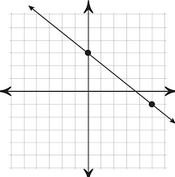
How do we know that is an example of an exponential growth?
Its a line going up
Its a line going down
Its a smooth curve going down
Its a smooth curve going up

How do we know that is an example of an exponential decay?
Its a line going up
Its a line going down
Its a smooth curve going down
Its a smooth curve going up

How do we know that is an example of an linear decay?
Its a line going up
Its a line going down
Its a smooth curve going down
Its a smooth curve going up

How do we know that is an example of an linear growth?
Its a line going up
Its a line going down
Its a smooth curve going down
Its a smooth curve going up


What type of transformation is this?
Rotation
Reflection
Translation
Enlargement

Rotation Rules (clockwise):
90o rotation: (x, y)→(y, -x)
What are the coordinates for A' after a 90⁰ rotation clockwise?
(1, 3)
(3, 1)
(3, -1)
(1, -3)


Pentagor VWXYZ is shown on a coordinate grid. A student reflected pentagon VWXYZ across the x-axis to create pentagon V'W'X'Y'Z'. Which rule describes this transformation?
(x,y) → (x, -y)
(x,y) → (x, y+8)
(x, y) → (-y, x)
(x,y) → (-x, y)



