
 Worksheets
BIOL 1406- Exam 2
Total questions: 115
Worksheet time: 1hrs 5mins
The main structure that is found in all eukaryotic cells, but not in prokaryotic cells, is
the nucleus
DNA
ribosomes
plasma membrane
Select the four things that all cells have in common:
Cytoplasm
Ribosomes
genetic material (DNA)
plasma membrane
Golgi
This is a small organelle which synthesizes proteins from amino acids (via dehydration synthesis)
Ribosome
Mitochondrion
Nucleus
Golgi
This organelle is where cellular respiration occurs
Ribosome
Mitochondrion
Nucleus
Golgi
this large organelle contains the genetic material of the cell (chromosomes) and is surrounded by 2 membranes
Ribosome
Mitochondrion
Nucleus
Golgi
this organelle is a stack of flattened compartments where materials are modified, sorted and sent out to other destinations
Ribosome
Mitochondrion
Nucleus
Golgi
The endoplasmic reticulum, Golgi, and plasma membrane are compartments that are connected indirectly by vesicles that move materials between them. Together, this group of structures is called:
the cytoskeletal system
the respiratory system
the endomembrane system
The first cells on Earth were _________________ and appeared about 3.5 billion years ago
prokaryotes
eukaryotes
The thickest fiber of the cytoskeletal fibers is called a
microtubule
microfilament
intermediate filament
Cell theory is a foundation of (a)
(a) cells are diverse with complex structures and internal compartments
a protein embedded in a cell membrane which contains a passageway for ions or small molecules to move through the passive transport of ions or molecules across a cell
channel protein
facilitated diffusion
bulk transport
endocytosis
membrane with the assistance of a channel or carrier protein
channel protein
facilitated diffusion
bulk transport
endocytosis
the discharge (release) of a vacuole's contents out of a cell which occurs when the vacuole fuses with the plasma membrane.
channel protein
exocytosis
bulk transport
endocytosis
the uptake of materials into a cell via an invagination of the plasma membrane which then forms a vacuole.
channel protein
exocytosis
bulk transport
endocytosis
this term includes two processes (endocytosis and exocytosis) which utilize vesicles to move large materials across the plasma membrane.
channel protein
exocytosis
bulk transport
endocytosis
the uptake of materials into a cell via an invagination of the plasma membrane which then forms a vacuole.
channel protein
exocytosis
bulk transport
endocytosis
Biological membranes separate the inside of a cell from its (a) , and define internal components.
_________ carry out the major functions of biological membranes.
Nucleic acids
Proteins
Carbohydrates
the movement of substances without the expenditure of energy
passive transport
active transport
the movement of substances with a required expenditure of energy
passive transport
active transport
the passive transport of ions or molecules across a cell membrane with the assistance of a channel or carrier protein.
passive transport
active transport
facilitated diffusion
Biological membranes are a mosaic of: (select all that apply)
proteins
lipids
nucleic acids
carbohydrates
The main component of cell membranes, composed of 2 layers of phospholipid molecules.
phospholipid
phospholipid bilayer
amphipathic
A particular type of lipid molecule that has a hydrophilic head containing phosphate and two hydrophobic fatty acid tails.
phospholipid
phospholipid bilayer
amphipathic
This term describes any molecule with both hydrophilic and hydrophobic regions.
phospholipid
phospholipid bilayer
amphipathic
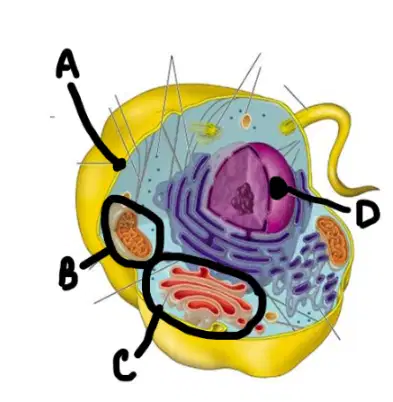
In the following diagram, which structure is marked by the letter A?
golgi
mitochondrion
nucleus
plasma membrane
In the following diagram, which structure is marked by the letter B?
golgi
mitochondrion
nucleus
plasma membrane
In the following diagram, which structure is marked by the letter C?
golgi
mitochondrion
nucleus
plasma membrane
In the following diagram, which structure is marked by the letter D?
golgi
mitochondrion
nucleus
plasma membrane
A lysosome contains
hydrolytic enzymes for intracellular digestion
proteins for protein secretion
oxygen for cellular repiration
chlorophyll for photosynthesis
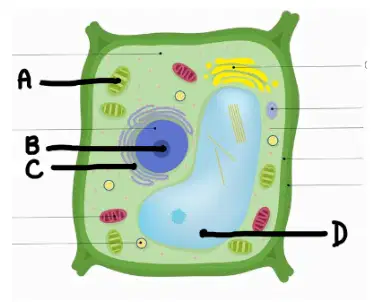
In the following diagram, which structure is marked by the letter A?
central vacuole
rough endoplasmic reticulum
nucleus
chloroplast
In the following diagram, which structure is marked by the letter B?
central vacuole
rough endoplasmic reticulum
nucleus
chloroplast
In the following diagram, which structure is marked by the letter C?
central vacuole
rough endoplasmic reticulum
nucleus
chloroplast
In the following diagram, which structure is marked by the letter D?
central vacuole
rough endoplasmic reticulum
nucleus
chloroplast
Cell theory is comprised of three concepts. Select the three statements from the list below that make up cell theory.
Microscopy is required to view most types of cells.
The cell is the basic unit of living organisms.
New cells come from existing cells by cell division.
All organisms are composed of one or more cells.
There is an upper limit on cell size that is based on an optimum surface area to volume ratio.
The thinnest fiber of the cytoskeletal fibers is called a
Microtubule
Microfilament
intermediate filament
Electron microscopes produce images that are magnified and
black and white.
in color.
The function of the chloroplast is that it contains all of the machinery for
photosynthesis
cellular respiration
peroxide detoxification
intracellular digestion
Individual cells are most often microscopic - that is, they cannot be seen without the use of a microscope.
True
False
In lecture, Professor Buettner emphasized that in college, you should start thinking of the mitochondrion in terms of its function as
the powerhouse of the cell
the site of cellular respiration
Light microscopes produce images that are magnified and
in color
black and white
The ratio of surface area of the plasma membrane to the volume of a cell (SA:V ratio) is larger for cells that have a _________ diameter.
smaller
larger
Endosymbiosis is the well-accepted theory that
modern eukaryotes evolved from ancient prokaryotes that lived inside one another
modern prokaryotes evolved from ancient eukaryotes that lived inside one another
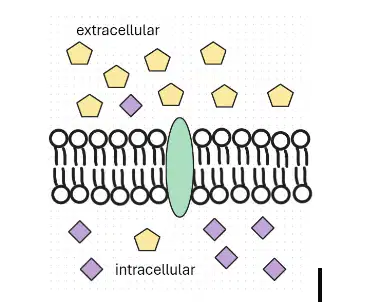
In the following diagram, a small section of a cell's plasma membrane is depicted, including the phospholipid bilayer and one transport protein.
The extracellular and intracellular spaces are marked.
Two solutes are shown as yellow hexagons and purple diamonds. The concentration gradient (at the beginning of this scenario) of each solute is indicated.
If both the yellow hexagons and the purple diamonds diffuse along their own gradients through the same green transport protein, which term correctly describes this transport protein?
it is a uniporter
it is an antiporter
it is a symporter
In the following diagram, a small section of a cell's plasma membrane is depicted, including the phospholipid bilayer and one transport protein.
The extracellular and intracellular spaces are marked.
Two solutes are shown as yellow hexagons and purple diamonds. The concentration gradient (at the beginning of this scenario) of each solute is indicated.
If both the yellow hexagons and the purple diamonds move from the extracellular space to the intracellular space through the green transport protein, which term correctly describes this transport protein?
it is a uniporter
it is an antiporter
it is a symporter
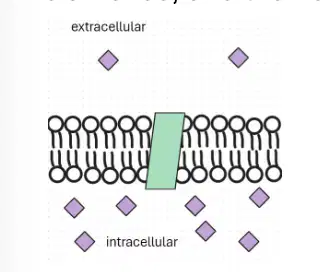
The following diagram depicts a small section of the plasma membrane of a cell, with the phospholipid bilayer visible, as well as one transport protein. The solutes are shown as purple diamonds, and their concentration gradient is indicated.
If the transport protein is allowing diffusion of the solutes through its channel, in which direction will the solutes move?
from the extracellular side (EC) to the intracellular (IC) side
from the intracellular (IC) side to the extracellular (EC) side
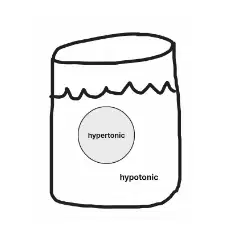
If water is the only molecule that can cross the cell membrane, which way will the water move via osmosis?
From the cell out to the beaker solution.
From the beaker solution into the cell.
When a cell has intentionally produced a protein (or any other product) which is functional, and the cell needs to release that protein out into the extracellular space in order for it to perform its function, that type of exocytosis is specifically called:
excretion
secretion
Ions and small monomers (like amino acids and glucose) can pass through transport proteins to enter cells.
But polysaccharides and polypeptides (proteins) are too large for that. They can be taken into a cell in vesicles by a different process called:
endocytosis
excretion
exocytosis
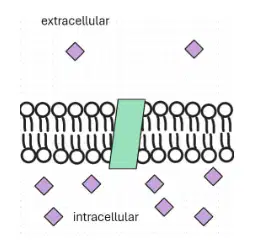
If the transport protein begins moving the solutes from the intracellular side to the extracellular side, would this be "facilitated diffusion" or "active transport?"
active transport
facilitated diffusion
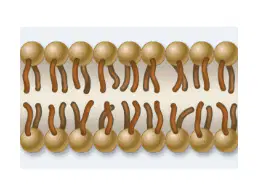
The illustration above is showing:
a phospholipid bilayer
cholesterol
a transmembrane protein
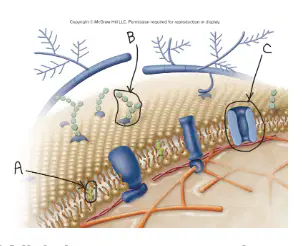
Which component is marked by the letter A?
peripheral protein
transport protein
glycoprotein
cholesterol
glycolipid
Which component is marked by the letter B?
peripheral protein
transport protein
glycoprotein
cholesterol
glycolipid
Which component is marked by the letter B?
serving as a marker for "self" that immune cells can recognize them (and not kill the cell).
transporting ions and small molecules across the membrane.
connecting extracellular proteins like collagen to the intracellular proteins of the cytoskeleton.
creating more fluidity in the membrane by spreading out the hydrophobic tails.
Which component is marked by the letter A?
serving as a marker for "self" that immune cells can recognize them (and not kill the cell).
transporting ions and small molecules across the membrane.
connecting extracellular proteins like collagen to the intracellular proteins of the cytoskeleton.
creating more fluidity in the membrane by spreading out the hydrophobic tails.
Which component is marked by the letter C ?
serving as a marker for "self" that immune cells can recognize them (and not kill the cell).
transporting ions and small molecules across the membrane.
connecting extracellular proteins like collagen to the intracellular proteins of the cytoskeleton.
creating more fluidity in the membrane by spreading out the hydrophobic tails.
Which component is marked by the letter C?
peripheral protein
transport protein
glycoprotein
cholesterol
glycolipid
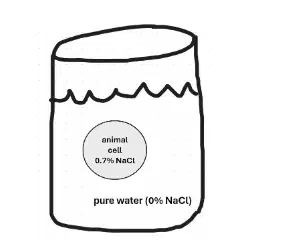
Based on this starting situation, answer the following question:
If only water can cross the cell membrane, which way will water move via osmosis?
Water will move from the inside of the cell into the beaker solution.
Water will move from the beaker solution to the inside of the cell.
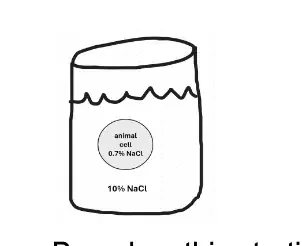
Based on this starting situation, answer the following question:
If water is the only molecule that can cross the cell membrane via osmosis, and that process is given time to occur, do you predict that the cell will shrink, or get bigger (and maybe even burst)?
get bigger (and maybe burst)
shrink
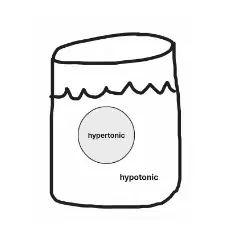
Based on this starting situation, answer the following question:
If only water can cross the cell membrane, which way will water move via osmosis?
Water will move from the inside of the cell into the beaker solution.
Water will move from the beaker solution to the inside of the cell.
Water will move from the inside of the cell into the beaker solution.
Water will move from the beaker solution to the inside of the cell.
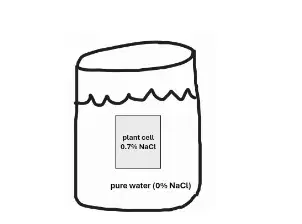
Based on this starting situation, answer the following question:
If water is the only molecule that can cross the cell membrane, and osmosis is allowed to proceed, what will be the outcome from this plant cell?
the cell will become filled with water, but will not burst.
the cell will burst
the cell will shrink, but the cell wall will keep its shape
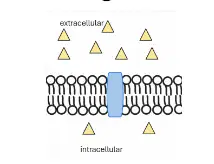
The following diagram depicts a small section of the plasma membrane of a cell, with the phospholipid bilayer visible, as well as one transport protein. The solutes are shown as yellow triangles, and their concentration gradient is indicated.
If the transport protein is allowing diffusion of the solutes through its channel, in which direction will the solutes move?
from the extracellular side (EC) to the intracellular (IC) side
from the intracellular (IC) side to the extracellular (EC) side
The following diagram depicts a small section of the plasma membrane of a cell, with the phospholipid bilayer visible, as well as one transport protein. The solutes are shown as yellow triangles, and their concentration gradient is indicated.
If the transport protein is performing an active transport of these solutes, in which direction will the solutes move?
from the extracellular side (EC) to the intracellular (IC) side
from the intracellular (IC) side to the extracellular (EC) side
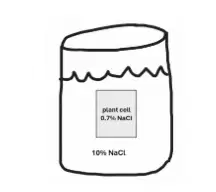
Based on this starting situation, answer the following question:
If only water can cross the cell membrane, which way will water move via osmosis?
Water will move from the inside of the cell into the beaker solution.
Water will move from the beaker solution to the inside of the cell.
Based on this starting situation, answer the following question:
If water is the only molecule that can cross the cell membrane, and osmosis is allowed to proceed, what will be the outcome from this plant cell?
the cell will become filled with water, but will not burst.
the cell will burst
the cell will shrink, but the cell wall will keep its shape
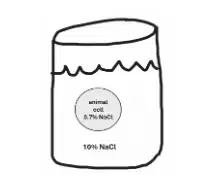
Based on this starting situation, answer the following question:
If only water can cross the cell membrane, which way will water move via osmosis?
Water will move from the inside of the cell into the beaker solution.
Water will move from the beaker solution to the inside of the cell.
Based on this starting situation, answer the following question:
Which solution is correctly called "hypertonic" in this starting scenario?
the cell solution
the beaker solution
When proteins have been modified and sorted at the Golgi, they are then sent out by vesicle to the plasma membrane, where they are released from the cell. This process is an example of
endocytosis
phagocytosis
exocytosis
Very large macromolecules and even entire bacterial cells can be ingested by (taken into) eukaryotic cells. This occurs through the process named:
phagocytosis
exocytosis
diffusion
secretion
According to the lecture, "death" has occurred when
a cell or organism begins to function as an "open system."
a cell or organism has acquired more energy than it can possibly use in a reasonable amount of time.
a cell or organism no longer has any energy flowing through it.
(a) is possible due to energy transformations
Life is possible due to ____ _____
(a)
Biological (a) can take various forms
Cells store and use energy as (a)
(a) are specific biological catalysts
Enzymes are specific biological (a)
The capacity or ability to do work
energy
thermodynamics
ATP
the study of transformations of energy
energy
thermodynamics
ATP
adenosine triphosphate; the energy currency of the cell
energy
thermodynamics
ATP
the study of transformations of energy
energy
thermodynamics
ATP
a biological catalyst, usually a protein, that increases the rate of specific reactions
without being consumed in the reaction.
enzyme
activation energy
anabolism
catabolism
the energy that must be processed by a molecule in order for it to undergo a
specific chemical reaction.
enzyme
activation energy
anabolism
catabolism
the biosynthetic or constructive part of metabolism which requires energy input;
those chemical reactions involved in biosynthesis.
enzyme
activation energy
anabolism
catabolism
in a cell, those metabolic reactions that result in the breakdown of complex
molecules into simpler compounds, often with the release of energy
enzyme
activation energy
anabolism
catabolism
In biology, which type of energy is considered a "wasted" form?
heat
covalent bond energy
light
stored energy
From the following list, select all that are examples of potential energy:
Water behind a dam
A covalent bond in a molecule of glucose
A rock at the top of a mountain that is not moving
A girl sliding down a slide
A tennis ball flying across a tennis court
Radiation, such as heat and light, is considered __________.
Kinetic energy
Potential energy
According to the lecture, if a cell no longer exchanges molecules or energy with its environment, then the cell is:
dead
hibernating
dormant
in a state of "suspended animation"
Select one or more of the statements below that are part of the Second Law of Thermodynamics:
Energy cannot be created or destroyed
No energy transformation is 100% efficient - some is "lost" (released to the universe) as heat.
Entropy (disorder) is continuously increasing in the universe
Energy can be transferred and transformed
The total amount of energy in the universe always remains constant
Select all of the statements below that are part of the First Law of Thermodynamics:
Energy cannot be created or destroyed
No energy transformation is 100% efficient - some is "lost" (released to the universe) as heat.
Entropy (disorder) is continuously increasing in the universe
Energy can be transferred and transformed
The total amount of energy in the universe always remains constant
Select one or more of the statements below that are part of the Second Law of Thermodynamics:
Energy cannot be created or destroyed
No energy transformation is 100% efficient - some is "lost" (released to the universe) as heat.
Entropy (disorder) is continuously increasing in the universe
Energy can be transferred and transformed
The total amount of energy in the universe always remains constant
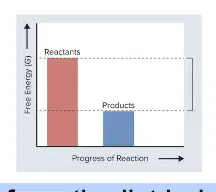
Consider a chemical reaction in which the reactants have more energy than the products.
Select from the list below all statements that must also be true about this reaction.
The ΔG is a negative number.
The reaction releases free energy.
The reaction is "uphill."
The reaction is "downhill."
The ΔG is a positive number.
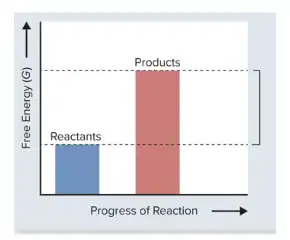
Consider a chemical reaction in which the reactants have more energy than the products.
Select from the list below all statements that must also be true about this reaction.
The ΔG is a negative number.
The reaction requires an input of free energy.
The reaction is "uphill."
The reaction is "downhill."
The ΔG is a positive number.
Consider a chemical reaction in which the reactants have more energy than the products.
Is this reaction "endergonic" or "exergonic"?
Endergonic
Exergonic
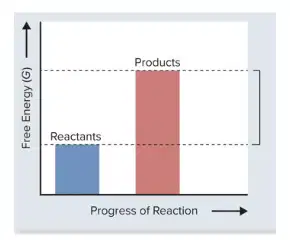
Consider a chemical reaction in which the reactants have more energy than the products.
Is this reaction "endergonic" or "exergonic"?
Endergonic
Exergonic
Can these two reactions be coupled?
Reaction1 : C-P --> C + P (ΔG = -8 units)
Reaction2: A + P --> A-P (ΔG = +9 units)
Yes
No
What is being shown in the following chemical reaction:
ATP + H2O --> ADP + P (ΔG = -12 units)
The synthesis of ATP from ADP and phosphate. This is an endergonic reaction.
The hydrolysis (breakdown) of ATP into ADP and phosphate. This is an exergonic reaction.
Can these two reactions be coupled?
Reaction1 : A + P --> A-P (ΔG = +1 units)
Reaction2: C-P --> C + P (ΔG = -2 units)
Yes
No
What is being shown in the following chemical reaction:
ADP + P --> ATP (ΔG = +12 units)
The synthesis of ATP from ADP and phosphate. This is an endergonic reaction.
The breakdown of ATP into ADP and phosphate. This is an exergonic reaction.
If an enzyme requires a particular cofactor or coenzyme, but that ion or molecule is not present, what will happen?
The enzyme will be inactive.
The enzyme will be permanently denatured (unfolded).
The enzyme will be broken down by hydrolysis reactions into its amino acid monomer components.
Some poisons act as __________________ toward the respiratory enzymes in your body.
Activities
Allergens
Inhibitors
For enzymes that are proteins, which environmental conditions will typically cause them to denature (unfold)? Choose all correct answers.
freezing temperatures
high temperatures (such as boiling temperatures)
extremely high or low pH
Starting with the substrate binding to the active site, put the events of the catalytic cycle of an enzyme into the correct chronological order.
1. The stress on the bonds of the substrate causes bonds to break or form.
2. The substrate enters the active site of the enzyme.
3. After the reaction occurs, the products are released. The enzyme is available for another substrate to bind.
4. The substrate and enzyme form the "enzyme-substrate complex," and there is "induced fit" which means the enzyme squeezes or pulls on the substrate.
1, 2, 3, 4
3, 1, 4, 2
2, 4, 1, 3
3, 4, 2, 1
True or False: According to Professor Buettner's lecture, energy flow through the biosphere is a "dead-end street," rather than a "cycle."
True
False
Covalent bonds that are intact are considered to have:
Kinetic energy
Potential energy
From the following list, select all that are examples of kinetic energy:
a girl sliding down a slide
a tennis ball flying across a tennis court
Sunlight
a covalent bond in a molecule of glucose
a rock at the top of a mountain that is not moving
Catabolism refers to chemical reactions that are __________
breakdown reactions, i.e. they involve breaking covalent bonds.
building reactions, i.e. they involve creating covalent bonds.
Anabolism refers to chemical reactions that are __________
breakdown reactions, i.e. they involve breaking covalent bonds.
building reactions, i.e. they involve creating covalent bonds.
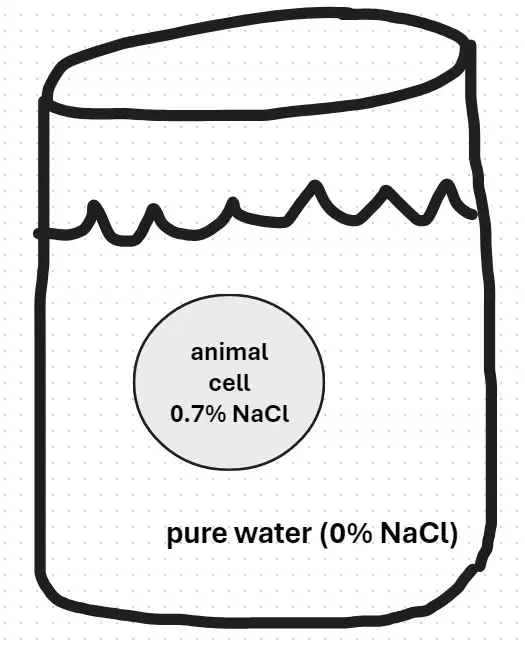
Based on this starting situation, answer the following question:
If water is the only molecule that can cross the cell membrane via osmosis, and that process is given time to occur, do you predict that the cell will shrink, or get bigger (and maybe even burst)?
get bigger (and maybe burst)
shrink
Put the following events of protein secretion into the correct chronological order:
1. Proteins are synthesized by ribosomes and deposited in the endoplasmic reticulum space.
2. The vesicle is moved along microtubule tracks to the Golgi.
3. The vesicle travels to the plasma membrane, fusing with it, and dumping the proteins out of the cell.
4. The vesicle fuses with the Golgi and the proteins are dumped into the Golgi space.
5. A vesicle containing proteins buds off of the endoplasmic reticulum.
6. The proteins are modified and sorted, and a new vesicle buds from the Golgi.
1, 2, 3, 4, 5, 6
1, 5, 2, 4, 6, 3
3, 5, 6, 4, 1, 2
2, 4, 6, 3, 1, 5
The cell is the fundamental unit of life, all cells come from other cells by cell division, and all organisms are composed of one or more cell
These three statements together are called:
cell theory
endosymbiotic theory
evolutionary theory
chromosomal theory
The cytoskeleton serves to provide support and shape for the cell, and also for
movement of structures inside a cell, and movement of the entire cell (locomotion)
cellular respiration and the production of carbon dioxide, which is released
intracellular digestion such that macromolecules are mixed with hydrolytic enzymes and brown down into monomers
Put the following events of intracellular digestion into the correct chronological order:
1. Large macromolecules are brought into the cell in a vesicle called the "food vacuole"
2. The food vacuole fuses with a lysosome, and hydrolytic enzymes mix with the macromolecules.
3. Hydrolysis of the macromolecules occurs, and the monomers produced are allowed to pass out of the lysosome into the cytosol.
4. Any remaining undigested materials are released out of the cell by the fusion of the lysosome with the plasma membrane.
1, 2, 3, 4
4, 3, 1, 2
2, 3, 1, 4
3, 2, 1, 4
The peroxisome is an organelle that
breaks down fatty acids, and detoxifies hydrogen peroxide
performs cellular respiration
builds proteins
performs photosynthesis

